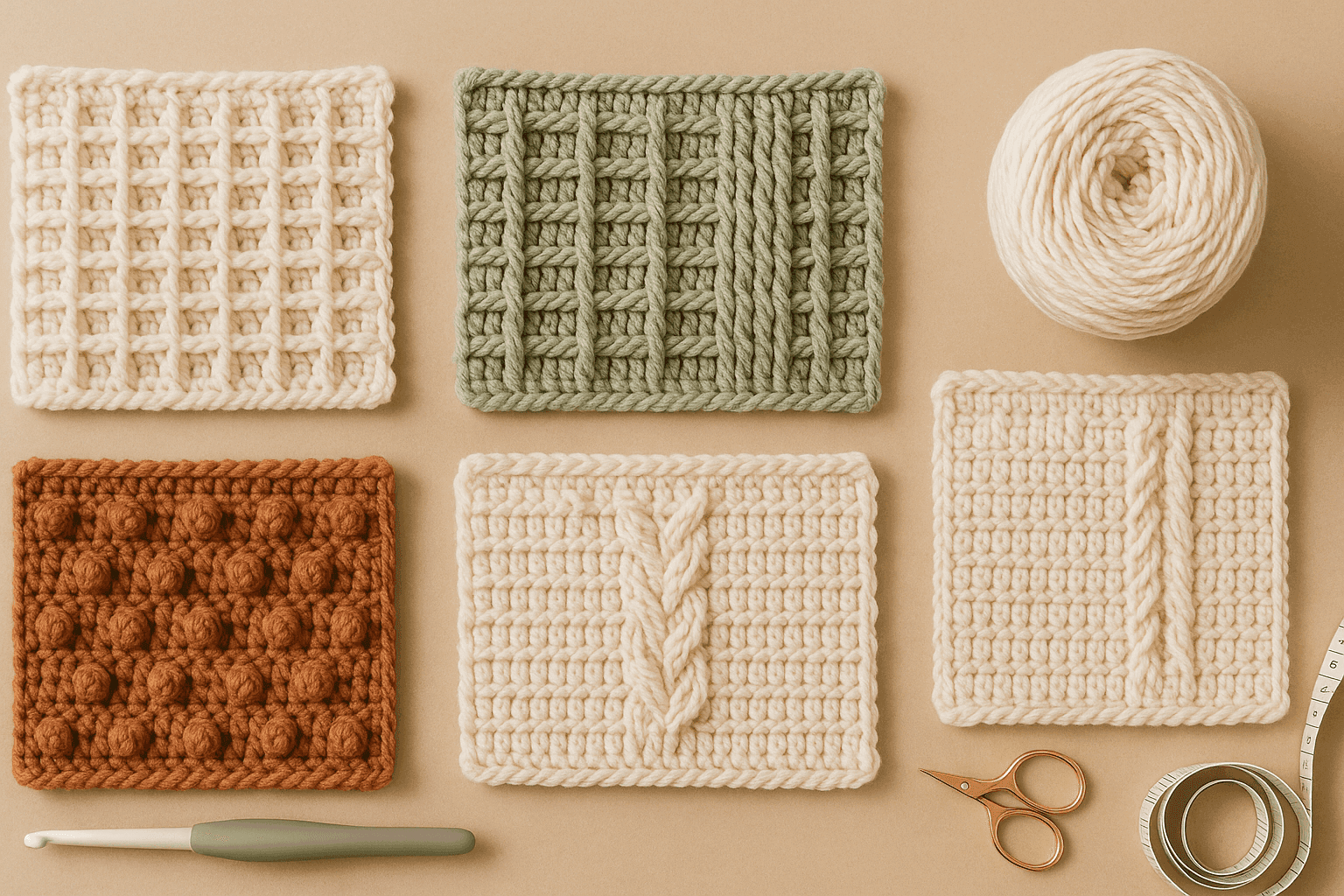
Why Texture Matters in Crochet (and Why It’s More Than “Looking Pretty”)
Texture is one of crochet’s superpowers. Unlike many other textile techniques, crochet naturally creates height, ridges, and shadow because each stitch is a tiny knot of yarn shaped by loops and tension. Texture isn’t just decorative—it changes the fabric’s behavior:
- Drape: Textured stitches often add bulk and stiffness; some make fabric springy or sculptural.
- Warmth: Raised stitches trap air (insulation), which can make textured fabrics noticeably warmer.
- Durability: Dense textures resist abrasion and show less pilling in high-wear areas.
- Stretch and recovery: Stitch architecture (post stitches, slip-stitch ribs, Tunisian, etc.) changes how fabric stretches and snaps back.
- Visual impact: Texture reads strongly in solid colors, while variegated yarn can hide it.
For crochet enthusiasts and fiber artists, learning texture is like learning flavor: once you understand how stitches behave, you can design intentionally rather than hoping a swatch “turns out.” This article dives into the mechanics behind texture, how to choose yarn to highlight it, how to combine textured stitch patterns, and how to troubleshoot common issues.
The Mechanics of Texture: How Stitches Create Height
Crochet texture generally comes from one (or more) of these structural tricks:
- Working around posts rather than into the top loops (e.g., front post/back post stitches). This pushes stitches forward or backward to form ridges.
- Changing where you insert the hook (front loop only, back loop only, third loop, between stitches). This alters the “spine” of the fabric.
- Adding extra yarn per stitch (puffs, bobbles, popcorns, clusters). More yarn creates roundness and raised bumps.
- Compressing the fabric (slip stitch, tight gauge, linked stitches). Dense fabrics create crisp relief and a carved look.
- Layering stitches (overlay mosaic, surface crochet, raised surface chains). Additional layers literally sit on top.
- Directional stitch stacking (e.g., baskets, cables) where alternating relief and valleys produce sculptural effects.
When you’re designing or choosing a pattern, ask: Where is the bulk going? Is it on the right side? Is it evenly distributed? Does it create a bias, pull, or ripple? These questions help you predict results before you commit to 1,500 yards of yarn.
Yarn Choices That Make Texture Sing
Texture depends as much on yarn as on stitch pattern. Here are the yarn properties that most strongly affect textured crochet:
1. Fiber Content
- Wool (especially springy wools like Merino): Excellent stitch definition and bounce. Great for cables, ribbing, and post stitches.
- Cotton: Crisp and stable; shows texture sharply, but can feel heavy in large textured pieces and has less elastic recovery.
- Acrylic: Often smooth and consistent; good for bold textures, but some acrylics can look “plasticky” in high-relief stitches. Great for washable blankets.
- Alpaca: Soft drape, less memory. Textures can relax over time; best for gentle textures rather than tight ribs that need snap.
- Blends: Wool-acrylic blends often balance definition and easy care.
2. Ply and Twist
- High twist / multiple plies: Sharper stitch definition. Ideal for cables, basketweave, and intricate textures.
- Single ply or low twist: Can look hazy and romantic, but may blur fine texture. Great for large-scale, simple relief.
3. Halo and Fuzz
Mohair, brushed alpaca, and fuzzy yarns soften edges and can hide texture. If your goal is sculptural stitchwork, choose a smoother yarn. If your goal is plushness, use fuzz but choose large, bold textures (big ribs, deep post ridges).
4. Color and Variegation
- Solid or heathered solids: Best for showing texture.
- High-contrast variegation: Can camouflage stitch patterns. Use it with simple textures like ribbing or moss stitch.
- Dark colors: Texture shows via shadow, but details can disappear in low light. Consider photographing or wearing in bright light.
5. Yarn Weight
Bulky yarn produces dramatic texture fast, but can become stiff. Fingering weight creates refined texture but requires more time and precision.
Practical tip: Swatch texture using at least a 6" x 6" sample, then hang it vertically for a day. Some textures “drop” and flatten depending on fiber and weight.
Core Texture Families (With Techniques and Pattern Ideas)
Below are major texture families, what they’re good for, and how to work them cleanly.
A) Ribbing and Corrugation (BLO/FLO, Slip Stitch Rib)
Common stitches: single crochet BLO, half double crochet BLO, slip stitch BLO.
Why it’s useful: Elastic edges, cuffs, hat brims, sweater hems, snug blankets.
Technique notes:
- BLO sc rib: sturdy, moderate stretch.
- BLO hdc rib: deeper ribs, softer hand.
- Slip stitch rib: very knit-like, very stretchy, but slower and can tighten gauge.
Mini pattern example (classic rib cuff):
- Ch desired rib depth (e.g., 9–13).
- Row 1: Sc in 2nd ch from hook and across. Ch 1, turn.
- Row 2: Sc BLO across. Ch 1, turn.
- Repeat Row 2 until cuff fits around wrist/ankle/head; seam short ends.
Troubleshooting:
- If your slip stitch rib is curling, go up 0.5–1 mm hook size and keep turning chains loose.
B) Post Stitches and Raised Ridges (FP/BP)
Common stitches: front post double crochet (FPdc), back post double crochet (BPdc), combinations for ribbing and basketweave.
Why it’s useful: Dramatic ridges, cables, architectural fabrics, warm blankets.
Stitch mechanics: A post stitch wraps around the vertical “post” of the stitch below. FP stitches push forward; BP stitches recede.
Pattern idea (post rib):
- Foundation: any multiple depending on stitch height.
- Setup row: Dc across.
- Next row: (FPdc around next st, BPdc around next st) repeat.
Troubleshooting:
- If post rib feels too stiff, use a hook one size larger or switch from dc posts to hdc posts.
- If ridges look uneven, ensure you’re inserting around the post consistently (full wrap, not splitting yarn).
C) Bobbles, Popcorns, and Puffs (3D “Bump” Textures)
These stitches add extra yarn in one spot.
Differences:
- Puff: multiple partial yarn-overs joined at the top; soft and squishy.
- Popcorn: multiple completed stitches in one stitch, then joined; very round and pronounced.
- Bobbles: often partially completed dc stitches gathered; medium height.
Best uses: Accent motifs, playful hats, baby items (with caution), throw pillows.
Practical tips:
- Keep the closing chain consistent to prevent holes.
- Pair with a tighter background stitch (sc or hdc) for contrast.
Troubleshooting:
- If bobbles lean or look messy, you may be turning the work too tightly. Add a setup stitch before/after bobble (e.g., sc, bobble, sc) to stabilize.
- If the fabric warps, bobbles may be consuming width; add stitches or use a smaller bobble count.
D) Cables (True and Faux)
Crochet cables use post stitches crossing over each other.
Key concept: Cables need a base fabric (often rows of dc) and negative space (valleys) created with BP stitches.
Faux cable alternatives:
- Surface crochet chains on top of a dense base.
- Slip stitch overlays.
- “Cable-like” textures using alternating FPdc columns.
Troubleshooting:
- If cables pull the fabric narrower, that’s normal; cable panels often need extra stitches in the base or a wider starting count.
- If crossing is hard, use a cable hook or a removable stitch marker to hold loops briefly.
E) Waffle, Basketweave, and Grids
These patterns use alternating raised and recessed areas.
- Waffle stitch: often FPdc + dc combinations that create little squares.
- Basketweave: blocks of FPdc/BPdc create woven panels.
Best uses: Warm blankets, bags, sturdy home decor.
Troubleshooting:
- If waffle stitch becomes too heavy, choose a lighter fiber or reduce stitch height (try hdc-based textures).
- If edges flare, check for accidental increases and keep turning chains consistent.
F) Moss Stitch, Linen Stitch, and Low-Relief Texture
Not all texture is 3D. Some textures are about surface granularity.
Why it’s useful: Excellent drape, forgiving tension, looks great in variegated yarn, perfect for scarves and garments.
Troubleshooting:
- If gaps feel too open, use a smaller hook or switch to a denser variant (e.g., grit stitch).
G) Tunisian Crochet Texture (Bonus Tool for Fiber Artists)
Tunisian crochet creates a woven-like surface. Great for texture lovers.
- Tunisian simple stitch (TSS): grid-like texture.
- Tunisian knit stitch (TKS): knit-like columns.
- Tunisian purl stitch (TPS): bumps like purl rows.
Tip: Tunisian tends to curl. Add a border, use a larger hook, or choose stitches that counter-curl (ribbing, seed-like mixes).
How to Combine Texture Successfully (Without a Lumpy Mess)
Mixing textures is where design skill shows. Here are practical rules that prevent common problems:
1. Balance Density
Pairing a very dense texture (waffle) next to a very open lace will cause puckering. Keep densities compatible or insert a “buffer” section (rows of sc/hdc).
2. Match Stitch Heights at Transition Points
Switching from sc texture to dc texture can create a visible step.
Technique: Use a transition row (e.g., sc → hdc → dc) or add an increase row to maintain height.
3. Consider Drape Direction
Ribbing stretches horizontally; post cables may stretch vertically. Think about how gravity will pull the finished object.
4. Use Framing Stitches
Texture looks intentional when framed.
Examples:
- 2–4 stitches of sc on both sides of a cable panel.
- A border of ribbing around a bobble motif.
5. Keep a “Resting Zone” for the Eye
If everything is textured, nothing stands out. Use plain sections to spotlight a textured panel.
Practical Texture Projects (Pattern Concepts You Can Customize)
These are not full line-by-line patterns, but structured, adjustable concepts you can apply to your own yarn and size.
1) Textured Sampler Scarf (Skill-Building and Stash-Friendly)
Goal: Learn multiple textures while keeping the project wearable.
Recipe:
- Choose a smooth DK or worsted yarn in a solid color.
- Work a 3–5 stitch sc border on each side for stability.
- Alternate 6–10" blocks of textures:
- Moss stitch block
- Post rib block (FPdc/BPdc)
- Mini basketweave block
- Puff or bobble motif band
- Waffle block (shorter section, as it’s dense)
Tip: Insert 1–2 plain rows (sc or hdc) between blocks to prevent abrupt tension shifts.
2) Cable Panel Headband (High Impact, Low Yardage)
Goal: Practice post stitches and crossing without committing to a sweater.
Recipe:
- Use worsted wool or wool blend for spring.
- Create a central cable panel with BP “valleys.”
- Add side ribbing in BLO hdc for stretch.
Finishing options:
- Seam ends for a classic band.
- Add a twist front (Mobius-style seam).
3) Waffle Throw Pillow (Architecture + Durability)
Goal: Make a structured home item that loves texture.
Recipe:
- Choose cotton or acrylic for easy care.
- Work waffle stitch in panels.
- Add a tight sc border for crisp edges.
- Insert pillow form; seam with slip stitch or mattress stitch.
Tip: Waffle fabric is thick—plan button closure or envelope back to avoid bulky seams.
4) Bobble Motif Baby Blanket (Soft Relief)
Safety note: For infants, avoid overly snaggy textures and ensure everything is securely fastened.
Recipe:
- Use soft, washable yarn.
- Keep bobbles spaced and anchored with sc.
- Consider placing bobbles on one side only and backing with a flatter stitch panel for comfort.
Tension, Gauge, and Hook Choice for Texture
Textured stitches amplify tension differences. A small tension inconsistency that would disappear in plain dc becomes obvious in a cable.
Hook choice guidelines
- For post stitches/cables: consider going up one hook size for better flexibility.
- For puffs/bobbles: a slightly smaller hook can make bumps pop, but don’t choke the yarn.
- For slip stitch rib: go up a hook size and keep loops tall.
Gauge checking (what to measure)
When swatching texture, measure:
- Width and height like normal.
- Thickness (yes, literally). Bulky textures can affect fit, especially in garments.
- Stretch: gently pull and see how it rebounds.
Tip: For wearable items, measure gauge after blocking and after resting overnight. Some fibers (cotton, alpaca) relax.
Blocking and Finishing: Making Texture Look Professional
Blocking can sharpen or soften texture depending on fiber.
Wet blocking (best for wool)
- Enhances stitch definition.
- Relaxes fabric so cables settle into place.
Steam blocking (careful)
- Works for acrylic (steam “kills” acrylic if overdone—this can permanently change drape).
- Use steam to gently set shape without flattening raised stitches.
Pinning strategy for texture
- Pin edges square.
- Avoid compressing bobbles/puffs under heavy pressure.
Seaming textured fabric
- Use mattress stitch for invisible seams on flatter textures.
- For thick textures, consider slip stitch join with a larger hook to avoid a rigid ridge.
Troubleshooting Common Texture Problems
Problem 1: Texture looks uneven or “messy”
Causes: inconsistent tension, split yarn, hook inserted inconsistently.
Fixes:
- Use a yarn with better ply definition.
- Slow down on post stitches and ensure full wrap around the post.
- Try a slightly larger hook to reduce strain and splitting.
Problem 2: Fabric is stiff like cardboard
Causes: dense stitch + tight tension + high-friction fiber (cotton) + small hook.
Fixes:
- Go up a hook size.
- Switch to a taller stitch (hdc instead of sc) in background sections.
- Choose a more elastic fiber (wool blend).
Problem 3: Project is shrinking in width (especially cables)
Causes: post stitches and crossings consume width.
Fixes:
- Add more stitches to the base row.
- Add “valley” stitches between cable columns.
- Block aggressively (within reason) to open the fabric.
Problem 4: Edges are wavy or flaring
Causes: inconsistent turning chains, accidental increases, mismatch between dense and loose rows.
Fixes:
- Use stitch markers in first/last stitch of each row.
- Standardize turning chain height (or use chainless turning stitches).
- Add a border in sc to stabilize.
Problem 5: Holes around bobbles/puffs
Causes: too many yarn-overs, loose closing chain, stitch placement leaving gaps.
Fixes:
- Reduce puff height or number of pulls.
- Tighten the closing loop and keep the securing chain snug.
- Use sc instead of dc as the surrounding fabric.
Problem 6: Texture disappears in the chosen yarn
Causes: high variegation, fuzzy halo, low twist.
Fixes:
- Switch to solid/heather.
- Choose bolder textures (waffle, big ribs).
- Use larger hook/stitch scale to increase shadow and relief.
Designing Your Own Textured Crochet: A Simple Framework
If you want to move from “following patterns” to “creating patterns,” texture is an excellent entry point.
Step 1: Decide the fabric role
- Warmth? Structure? Drape? Stretch?
Step 2: Choose a base stitch
Pick a reliable background: sc, hdc, dc, moss, or Tunisian simple stitch.
Step 3: Choose one hero texture
Cables, bobbles, waffle—choose one main feature.
Step 4: Add support structures
- Borders, framing stitches, transition rows.
Step 5: Swatch and stress test
- Stretch it.
- Hang it.
- Wash it (if it will be washed).
Step 6: Record everything
Hook size, yarn, stitch multiples, row counts, and notes about behavior. Fiber artists who document can reproduce and refine ideas.
Expert-Backed Concepts (Without Getting Too Academic)
While crochet knowledge often comes from community wisdom, it aligns with textile fundamentals:
- Air trapping increases insulation: Raised textures create pockets of still air.
- Elastic recovery depends on fiber memory: Wool “springs back” better than cotton.
- Stitch definition is influenced by twist and ply: Multi-ply, higher twist yarns show stitches clearly.
If you want deeper stitch dictionaries and structured references, look for reputable stitch compendiums and technique texts such as The Harmony Guides (crochet stitch guides) and major craft publisher stitch dictionaries. They’re useful for comparing how a stitch behaves across yarn weights.
A Final Checklist Before You Commit to a Big Textured Project
- Use a yarn that supports your texture goal (smooth + solid for definition).
- Swatch larger than you think you need.
- Check both sides—some textures have a “wrong side” that’s still beautiful.
- Plan transitions between stitch patterns.
- Stabilize edges with borders.
- Consider care: will this be machine washed? Will texture distort?
Texture is where crochet becomes sculpture. With the right yarn, intentional stitch choices, and a willingness to swatch and adjust, you can create fabrics that are not only beautiful but engineered—warm where they should be warm, stretchy where they should be stretchy, and richly tactile everywhere else.