AI-Generated Crochet Patterns: Legality, Accuracy Pitfalls, and a Practical Safety Checklist

ArticlePattern Tips

CrochetWiz

April 27, 202620 min read
AI-Generated Crochet Patterns: Legality, Accuracy Pitfalls, and a Practical Safety Checklist

Can you trust AI crochet patterns? A deep dive into legal realities, common math and gauge failures, and a step-by-step checklist to safely use AI while crediting sources and respecting human designers.

AI-Generated Crochet Patterns: Legality, Accuracy Pitfalls, and a Practical Safety Checklist

AI is now drafting crochet patterns on demand: sweaters in any size, beanies calibrated to a head measurement, amigurumi with intricate shaping, even motif charts. It feels like magic. But is it safe to trust an AI-written pattern with your yarn budget and production schedule? And what happens legally if you publish or sell an AI-influenced design?

Short answer: AI can accelerate ideation and drafting, but raw AI patterns are not reliably accurate or legally simple. If you want to use AI in crochet responsibly, you must audit stitch math, verify terminology, swatch, and handle attribution and licensing with care. This article explains why, how, and where the guardrails are.

Note: Nothing here is legal advice; it’s practical information to help you ask better questions and reduce risk. For specific situations, consult an attorney.

Why listen to this? The assumptions and the audience

  • You already know standard crochet construction and can read patterns, charts, and gauge info.
  • You value correct math, clarity, and repeatability over hype.
  • You want a practical workflow for safely integrating AI with human design, tech editing, and testing.

What AI is genuinely good at (today)

  • Brainstorming variations on construction (e.g., 6-, 8-, or 10-segment crown increases; raglan vs set-in sleeves; motif arrangements).
  • First-pass prose: turning bullet notes into coherent instructions and vice versa.
  • Converting between styles (imperial/metric, US/UK terms) when prompted precisely.
  • Generating structured templates: size tables, materials lists, abbreviations sections, and tester sign-up blurbs.
  • Repetitive drafting: writing out round/row sequences from a clear repeat rule.
  • Summarizing constraints and user preferences from messy notes.

What AI is not yet reliably good at: stitch-accurate construction without human guardrails. That shows up as math and notation errors you must catch before yarn meets hook.

The accuracy pitfalls that bite crocheters (and how to spot them)

AI-generated pattern text is plausible by nature—it looks right. But the following failure modes are common:

  1. Stitch-repeat mismatch

    • Symptom: The pattern says “work in a multiple of 6 + 2,” then the row repeat uses a 5-stitch repeat with a 3-stitch selvage.
    • Fix: Derive the repeat from first principles. Count exactly how many stitches a repeat consumes and produces, and match the foundation multiple to it.
  2. Turning-chain and join confusion

    • Symptom: Ch-2 used as a dc turning chain, then counted as a stitch in some rows but not others. Or rounds alternate between join-and-turn and continuous spiral without warning.
    • Fix: Pick a turning-chain policy (e.g., dc uses ch-3 not counted as a stitch) and enforce it consistently. If working in joined rounds, standardize the join point and note whether turning occurs.
  3. US vs UK term drift

    • Symptom: “dc” used but the gauge and photos imply UK dc (US sc). One inconsistency can destroy your measurements.
    • Fix: Declare terminology explicitly at the top (“US terms” or “UK terms”) and add a sanity-check line in your audit comparing stitch count to expected row height for that stitch.
    • Reference: Craft Yarn Council abbreviations and terms [https://www.craftyarncouncil.com/standards/abbreviations].
  4. Gauge illusions

    • Symptom: AI gives gauge for sc but the body uses hdc/dc. Or gauge is claimed “unblocked” while finished sizes assume aggressive blocking.
    • Fix: Demand a gauge swatch in the dominant stitch pattern and state blocked/unblocked. Put metric and imperial side-by-side.
  5. Yarn weight and hook mapping errors

    • Symptom: “Use a 5.5 mm hook with lace-weight cotton” or “Bulky yarn, 3.5 mm hook.” Not impossible, but suspicious.
    • Fix: Cross-check with CYC yarn weight ranges and typical hook sizes; adjust for fiber and desired fabric density.
    • Reference: Craft Yarn Council Yarn Weight System [https://www.craftyarncouncil.com/standards/yarn-weight-system].
  6. Shaping math off by one (or by π)

    • Symptom: A top-down beanie stalls increases too soon and never reaches target circumference; raglan yoke depth is too shallow for the bust size.
    • Fix: Use geometry, not vibes. For a flat circle in sc/hdc/dc, increases per round should follow a segment count (e.g., +6, +8, +10) and the crown diameter predicts circumference: C ≈ π × D. Match the stitch count to gauge and ease (details below).
  7. Grading fantasy

    • Symptom: Sizes “XS–5X” appear with even step-ups, but the armhole depth, bicep, and shoulder slopes stay constant.
    • Fix: Use real measurement tables and grading rules. Crochet grading is not linear; check bicep, upper arm, bust, hip, yoke depth, and sleeve caps independently.
  8. Yardage optimism

    • Symptom: A long-sleeve adult sweater “uses 600–800 yds” of worsted. That’s usually off by a factor of 2–3.
    • Fix: Estimate by area and density, compare to comparable published patterns, and add 10–15% buffer.
  9. Colorwork chart drift

    • Symptom: The text says “repeat 12-stitch colorwork motif,” but the chart is 14 stitches wide or the floats are unmanageable for crochet.
    • Fix: Rebuild the chart. Crochet color changes are structurally different than knitting; ensure changes happen on the last yarn-over of the previous stitch and floats are secured when needed.
  10. Safety and hardware oversights

    • Symptom: Baby items with buttons smaller than 1.25 inches or unsecured safety eyes on gifts marketed “for under 3.”
    • Fix: Follow small parts and attachment best practices and local laws. When in doubt, embroider features for under-3s and specify compliance notes for sellers.
    • Reference: US CPSC children’s product guidance [https://www.cpsc.gov/Business--Manufacturing/Business-Education/childrens-products].
  11. Accessibility and formatting gaps

    • Symptom: No stitch glossary, no measurements in both units, and inconsistent section headings, making screen-reader navigation painful.
    • Fix: Enforce a style guide. Use consistent headings, lists, tables, and alt text for charts.
  12. Chart–text desynchronization

    • Symptom: Text references RS/WS differently than the chart or the chart key mismatches symbols.
    • Fix: Align RS/WS, row numbering direction, and symbol legend with CYC or your house style.

These errors are fixable—if you assume they’re present and design your process to catch them.

Here’s the short practical view, with references for deeper reading.

  • Patterns contain multiple elements with different protections:

    • Text instructions and original diagrams are protected expressions once fixed in a tangible medium (copyright), but the underlying method (how to make a stitch or technique) is not protected.
    • The finished object, if a useful article (e.g., a hat or sweater), has limited protection under US law unless separable artistic elements qualify. Other jurisdictions vary.
    • References: US Copyright Office Circular 31 (Ideas, Methods, and Systems) [https://www.copyright.gov/circs/circ31.pdf]; Circular 33 (Works Not Protected by Copyright) [https://www.copyright.gov/circs/circ33.pdf].
  • AI-generated material and US copyright

  • Derivative works and “style of” prompts

    • You cannot lawfully copy protected expression from another designer’s pattern or photographs. “In the style of” itself may not infringe if no protected expression is copied, but the risk rises when outputs closely mimic a specific designer’s protected text, unique charts, or layouts.
    • Ethically, avoid using prompts that target living designers’ recognizable signature details unless you have permission. Legally, compare outputs to sources and avoid substantial similarity.
  • Training data and text/data mining (TDM)

  • Platform terms of service

    • Many AI platforms state you own your outputs “to the extent permitted by law,” which in practice means you own your human-authored contributions and any protectable selection/arrangement. Read the ToS, especially sections on commercial use, attribution requirements, and sensitive use restrictions.
  • Licensing and attribution

    • Law vs. norms: The law may not require attribution for public-domain stitches or AI text, but the craft community often expects credit. If your pattern incorporates specific ideas, grading logic, or references from public sources, cite them.
    • Consider licensing your human-authored material clearly (e.g., “Text and original charts © 2026 Your Name. Do not copy or distribute without permission.” or a Creative Commons license if you intend openness). If AI-only sections exist, mark them and clarify their status.

Bottom line: Treat AI as a drafting assistant. Ensure your final pattern has enough human authorship to be protected where you want protection, and enough transparency to be ethical where the law is silent.

The Practical Safety Checklist: How to use AI without getting burned

Use this copy/paste checklist as your baseline. Expand to match your niche.

  1. Project scoping and prompt hygiene
  • Define: garment/accessory, construction (top-down vs bottom-up), stitch family, intended ease, yarn weight, target sizes.
  • Write a prompt that includes: US/UK terms, gauge swatch spec, hook size range, segment count for circular increases (if applicable), and finishing techniques.
  • Example: “Draft a top-down beanie in US terms using hdc, worked in joined rounds without turning, using 8 increase points. Include gauge unblocked in hdc over 4 inches, and a materials list aligned to CYC #4 worsted.”
  1. Terminology and style lock-in
  • Declare “US terms” or “UK terms” at the top of the pattern.
  • Define abbreviations using CYC standard [https://www.craftyarncouncil.com/standards/abbreviations].
  • Choose a turning-chain policy (e.g., ch-1 for sc not counted as a stitch; ch-2 for hdc counts as a stitch; ch-3 for dc counts; be consistent).
  1. Materials sanity check
  • Yarn weight, fiber, and hook size are coherent and match desired fabric density.
  • Yardage estimates compared to at least two published, similar patterns.
  • Notions and safety items listed appropriately for target users (e.g., embroidered eyes for 0–3 years).
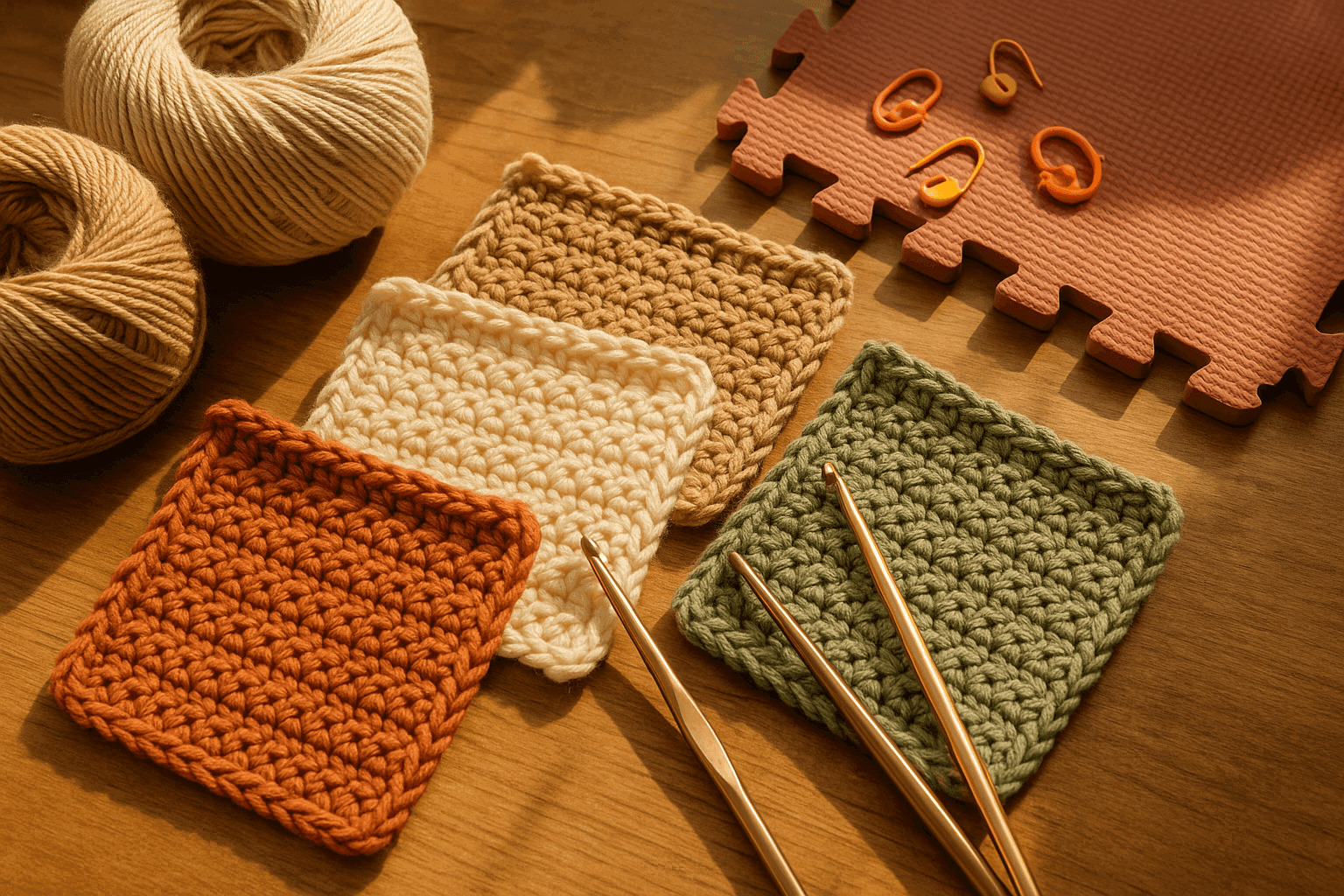
  1. Gauge and micro-swatch protocol
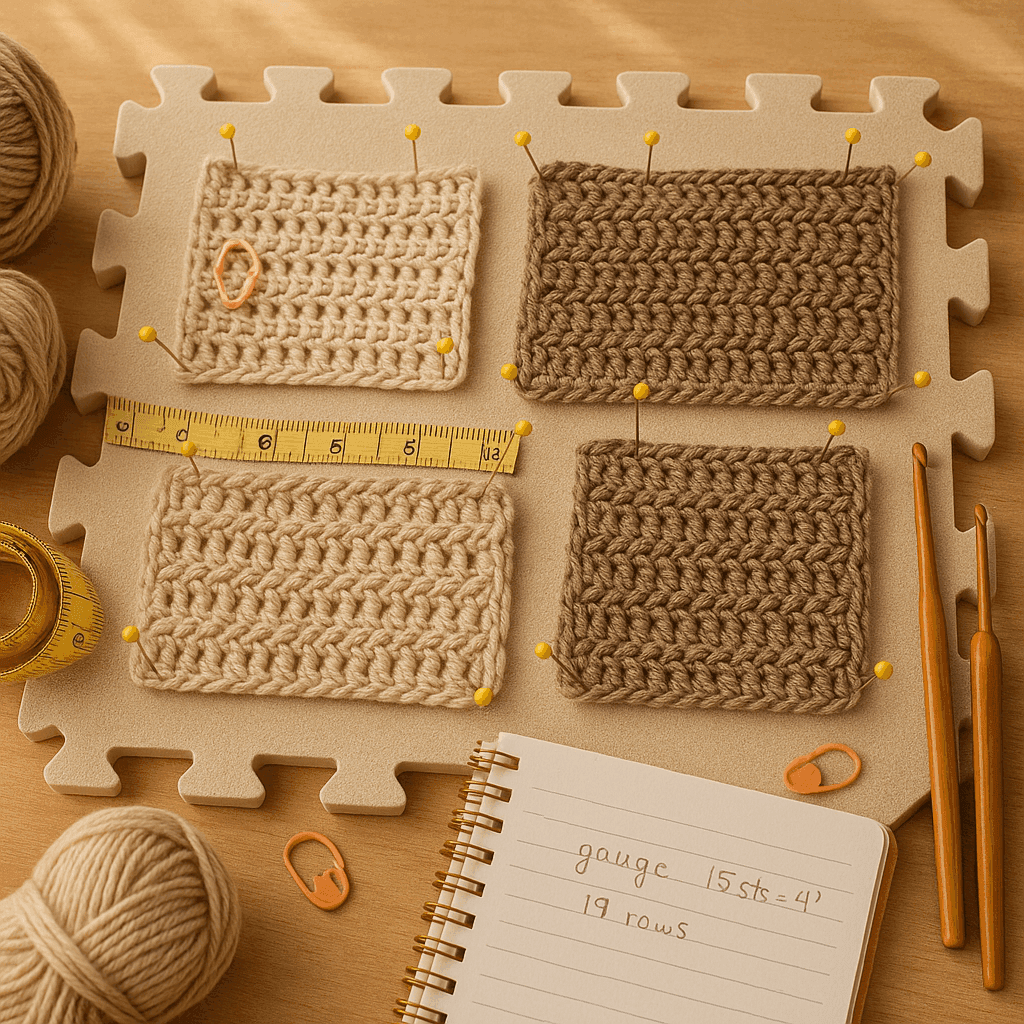
  • Require a 4 x 4 in (10 x 10 cm) swatch in the dominant stitch pattern, unblocked unless you intend blocking. Report stitches and rows per 4 in and per 10 cm.
  • Micro-swatch for stitch math: Make a 12–24 stitch by 12–24 row/round sample of the pattern repeat to confirm repeat arithmetic and drape before full sampling.
  1. Stitch math audit (the heart of the process)
  • Establish variables:
    • g_s = stitches per inch in pattern stitch
    • g_r = rows/rounds per inch in pattern stitch
    • E = intended ease (positive or negative)
    • T = target body/head/finished measurement in inches
    • C = target circumference = T + E
  • Compute target stitch count at key circumferences: N ≈ round(g_s × C) adjusted to fit repeat multiple.
  • For circles (e.g., top-down hats, motifs), use: D ≈ C / π; verify crown diameter and increase plan produce stitch count N at the switch-to-straight point.
  • Verify every repeat: Each row/round must consume and produce exact stitch counts. Simulate the first several rows by hand or with a spreadsheet.
  1. Edge-case tests
  • Check first and last repeats around joins. Ensure the pattern works when the repeat lands exactly at the end of the round and when it splits around the join.
  • For flat pieces, check that the row starts and ends preserve stitch count and maintain symmetry.
  1. US/UK conversion pass (if relevant)
  • If providing both, regenerate the entire pattern in each terminology, don’t mix inline. Cross-check gauge; stitches differ in height.
  1. Accessibility and formatting
  • Headings for Materials, Gauge, Sizes, Abbreviations, Notes, Instructions, Finishing, Blocking, Measurements, and Schematic/Chart.
  • Both imperial and metric units.
  • Alt text for charts and clear legend. Text version of any critical chart sequence.
  1. Legal/ethical checklist
  • Do not copy text from existing patterns. If AI produces text close to a known pattern, discard and regenerate with a broader prompt.
  • Credit sources for techniques, measurement tables, and standards (CYC, DSM/TDM notes, etc.).
  • Include a licensing statement for your human-authored content and a note about AI assistance if you used it.
  1. Testing
  • Run the micro-swatch. If that passes, work a size that’s not your default (e.g., not the sample size) to uncover grading issues.
  • If selling/publishing, use test crocheters and/or a tech editor. Fix the pattern with their feedback.
  1. Publication hygiene
  • Provide finished measurements per size and a schematic.
  • Include a troubleshooting section (common issues and fixes) and contact/support info.
  • State version number and changelog for updates.

Worked example: Auditing an AI beanie pattern

Let’s say AI hands you this (plausible but imperfect) snippet for a top-down hdc beanie in US terms:

  • Yarn: Worsted (#4), 5.0 mm hook
  • Gauge: 14 hdc and 10 rounds = 4 in (unblocked)
  • Sizes: Baby (16"), Child (19"), Adult S (21"), Adult L (23")
  • Construction: Joined rounds, ch-2 counts as 1 hdc
  • Crown: Start with 8 hdc, increase by 8 hdc per round for 9 rounds
  • Body: Work even until hat measures 8.5 in

We’ll audit Adult S (21") with slight negative ease (−1", typical for snug beanies).

  1. Convert gauge to per-inch
  • g_s = 14 / 4 = 3.5 hdc per inch
  • g_r = 10 / 4 = 2.5 rounds per inch
  1. Target circumference
  • Desired finished C = 21 − 1 = 20 inches
  • Target stitch count at brim N ≈ g_s × C = 3.5 × 20 = 70 stitches (adjust to repeat)
  1. Crown math
  • Starting 8 hdc, +8 each round for 9 rounds yields:
    • After R1: 8
    • R2: 16
    • R3: 24
    • R4: 32
    • R5: 40
    • R6: 48
    • R7: 56
    • R8: 64
    • R9: 72
    • R10: 80
  • That overshoots our 70-stitch target. 72 is close, 80 is not.
  • If we stop the increase at 72 stitches, finished circumference ≈ 72 / 3.5 = 20.57". That’s acceptable for a 20" target with a little less negative ease.
  1. Crown diameter sanity check
  • With 8-segment increases, a flat crown in hdc should grow steadily. Target circumference C ≈ π × D ⇒ D ≈ C / π ≈ 20 / 3.1416 ≈ 6.37".
  • At g_r = 2.5 rounds/in, a 6.37" radius needs about 6.37 × 2.5 ≈ 16 rounds for diameter—not correct: careful, we want diameter in inches and rounds per inch tells us rounds to reach that diameter from center. But increases happen radially; more practical is to stop increases when stitch count matches circumference target.
  • Since our stitch count method already matched at 72 stitches, we’ll accept that and check fabric flatness. If the crown ruffles or cups, adjust increase strategy (see below).
  1. Join/turn policy check
  • AI says “joined rounds, ch-2 counts as 1 hdc.” We must maintain this across all rounds. Ensure joins happen at the same point and the first real hdc is placed in the next stitch (not the join).
  1. Corrected crown and body for Adult S
  • Round 1 (RS): Ch 2 (counts as hdc), 7 hdc in magic ring, join to top of ch-2. (8 sts)
  • Round 2: Ch 2, 1 hdc in same st, 2 hdc in each st around, join. (16)
  • Round 3: Ch 2, 1 hdc in same st, [1 hdc in next st, 2 hdc in next] rep around, join. (24)
  • Round 4: Ch 2, 1 hdc in same st, [1 hdc in next 2, 2 hdc in next] rep, join. (32)
  • R5: Ch 2, 1 hdc in same st, [1 hdc in next 3, 2 hdc in next] rep, join. (40)
  • R6: Ch 2, 1 hdc in same st, [1 hdc in next 4, 2 hdc in next] rep, join. (48)
  • R7: Ch 2, 1 hdc in same st, [1 hdc in next 5, 2 hdc in next] rep, join. (56)
  • R8: Ch 2, 1 hdc in same st, [1 hdc in next 6, 2 hdc in next] rep, join. (64)
  • R9: Ch 2, 1 hdc in same st, [1 hdc in next 7, 2 hdc in next] rep, join. (72)
  • Body: Work even in hdc to desired depth. With g_r = 2.5 rounds/in, for a typical adult S beanie depth of about 8.5 in total height, subtract crown depth (~R1–R9 ≈ 9 rounds ≈ 3.6 in). Remaining body height ≈ 8.5 − 3.6 ≈ 4.9 in ⇒ about 12 rounds even (round to taste).
  1. Micro-swatch and fit
  • Make a 20-stitch, 15-row hdc swatch on 5.0 mm. If you get 13–15 sts/4 in, proceed. If drape is too stiff or stitches are off, change hook and update counts.
  • Work the crown to 72 sts and test on the intended head. If you need more negative ease, stop at 64 sts (18.3") and add a brim with post stitches for elasticity; or continue to 80 sts and add ribbing if your yarn lacks stretch and your target wearer prefers looser hats.

This example shows the pattern is salvageable with measured adjustments. AI gave a decent structure (8-segment hdc crown), but the math and target ease needed a human pass.

Stitch-math auditing: repeatable formulas and quick checks

Use these basics across hats, motifs, and garments.

  • Foundation multiples

    • If a row repeat uses k stitches and consumes s edge stitches (e.g., 1 at start, 1 at end), the foundation multiple is k and the foundation count is m × k + s. Run a micro-swatch to confirm visual symmetry at the edges.
  • Circular increases (flat)

    • To keep a flat circle in sc/hdc/dc, increase a consistent number p of stitches per round (commonly 6, 8, 10, or 12 depending on stitch height and desired geometry). The general pattern for round r (starting at 1) is distribute p increases evenly: work about floor((current_sts)/p) between increases.
    • Stop increasing when stitch count matches the target circumference in stitches. Mild cupping or ruffling can be corrected with a round of spacing adjustments or a change in p.
  • Ease targets (typical starting points; adjust per design and wearer)

    • Beanies: −1" to −2" negative ease in circumference.
    • Close-fitting sweaters (bust): 0" to +2".
    • Relaxed cardigans: +4" to +8".
    • Mittens: −0.5" to 0".
  • Yoke depth and armhole checks (top-down raglan/circular)

    • Compare yoke depth against size charts; crochet stitches grow taller/shorter by stitch type, so convert rows to inches then compare. Don’t trust linear grade without measurements.
  • Yardage estimation back-of-envelope

    • For simple hats: Worsted adult beanie typically 150–220 yds; bulky 80–140 yds. If AI suggests 60 yds for a dense adult hat in worsted, it’s wrong.

Micro-swatch protocol (fast and useful)

  • Goal: Validate repeat mechanics, gauge, and drape before committing.
  • Steps:
    1. Chain enough for 2–3 repeats plus selvage (e.g., if repeat is 6, chain 20).
    2. Work 12–20 rows in pattern with the specified hook and yarn.
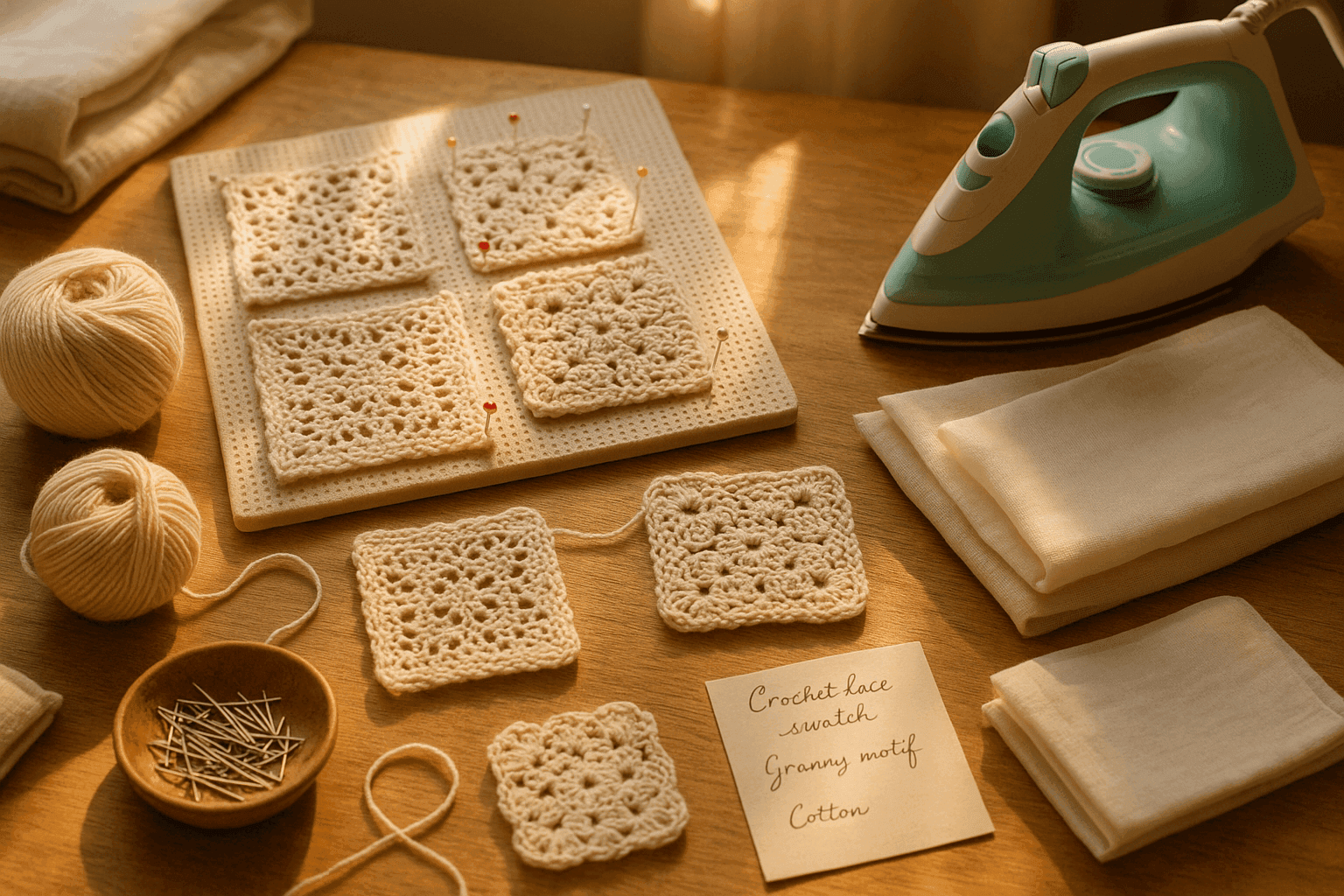
    3. Wash/steam/block as you intend for the final object (even a quick steam can reveal drape changes).
    4. Measure stitches/rows over the central 4 in × 4 in area.
    5. Check if the repeat behaves at edges; if not, adjust the multiple or edge instructions.
  • Bonus: For round-based fabrics, make a 36–48-stitch mini tube in the round to capture join behavior and round gauge.

Integrating AI without sidelining human designers

  • Use AI for:

    • Brainstorming construction variants, names, and collection themes.
    • Generating size tables from a measurement chart you provide.
    • Converting US/UK terms or imperial/metric once you provide authoritative mappings.
    • First-draft grading suggestions to spark review, not as final truth.
    • Drafting consistent boilerplate (materials, abbreviations, blocking notes, tester calls).
  • Keep humans at the center by:

    • Hiring tech editors to verify math, clarity, and grading.
    • Paying test crocheters and crediting them in the pattern.
    • Citing designers or resources that influenced your shaping logic or finishing techniques.
    • Avoiding prompts that exploit a living designer’s distinctive style or copied text.
    • Buying patterns from independent designers and linking alternatives (“If you like this, try X by Y”).
  • Transparency and credit

    • Consider a brief note: “Drafted with assistance from generative tools; all math and final instructions reviewed and authored by [Your Name].”
    • Reference standards you followed (CYC abbreviations, yarn weights) and any stitch dictionaries or public-domain sources that shaped your repeat.

Publication checklist add-ons for shops and platforms

  • Provide both finished and blocked measurements per size.
  • Include a schematic with labeled dimensions.
  • In listing photos, disclose if the sample deviates from the pattern (different yarn weight/hook, added rows, etc.).
  • Maintain a version number and changelog. If you fix math, notify buyers.
  • Make accessibility a feature: screen-reader friendly PDF, colorblind-safe charts, and large-print versions when practical.

Frequently asked practical questions

  • Can I sell an AI-drafted pattern after I edit it?

    • Generally yes, if you contribute sufficient human authorship to the final text/charts and you haven’t copied protected expression from others. Check platform ToS and your jurisdiction.
  • Do I have to credit the AI tool?

    • Legally, usually not required, but check ToS. Ethically, a short transparency note can build trust with buyers and testers.
  • What about stitch names and classic motifs—are they copyrighted?

    • Names of basic stitches and classic, centuries-old motifs are not protected; detailed modern arrangements, text, charts, and photos can be. Use public-domain sources or licensed references and add your own authorship.
  • How do I minimize legal risk?

    • Don’t train your own models on proprietary pattern PDFs without permission. Don’t copy specific text/diagrams. Keep comparison samples to ensure your outputs aren’t substantially similar to any one source.

References and resources

Final take

You can trust AI to speed up crochet pattern drafting—but only after you put it through a rigorous, repeatable audit. Assume the stitch math is wrong until proven otherwise. Micro-swatch early, measure everything, enforce terminology and style, and document your decisions. Credit the humans and sources that help you, and be transparent about how you used AI.

The most resilient workflow is hybrid: AI for structured drafting and options; you for math, taste, and responsibility. That balance protects your time, your yarn, and your reputation.