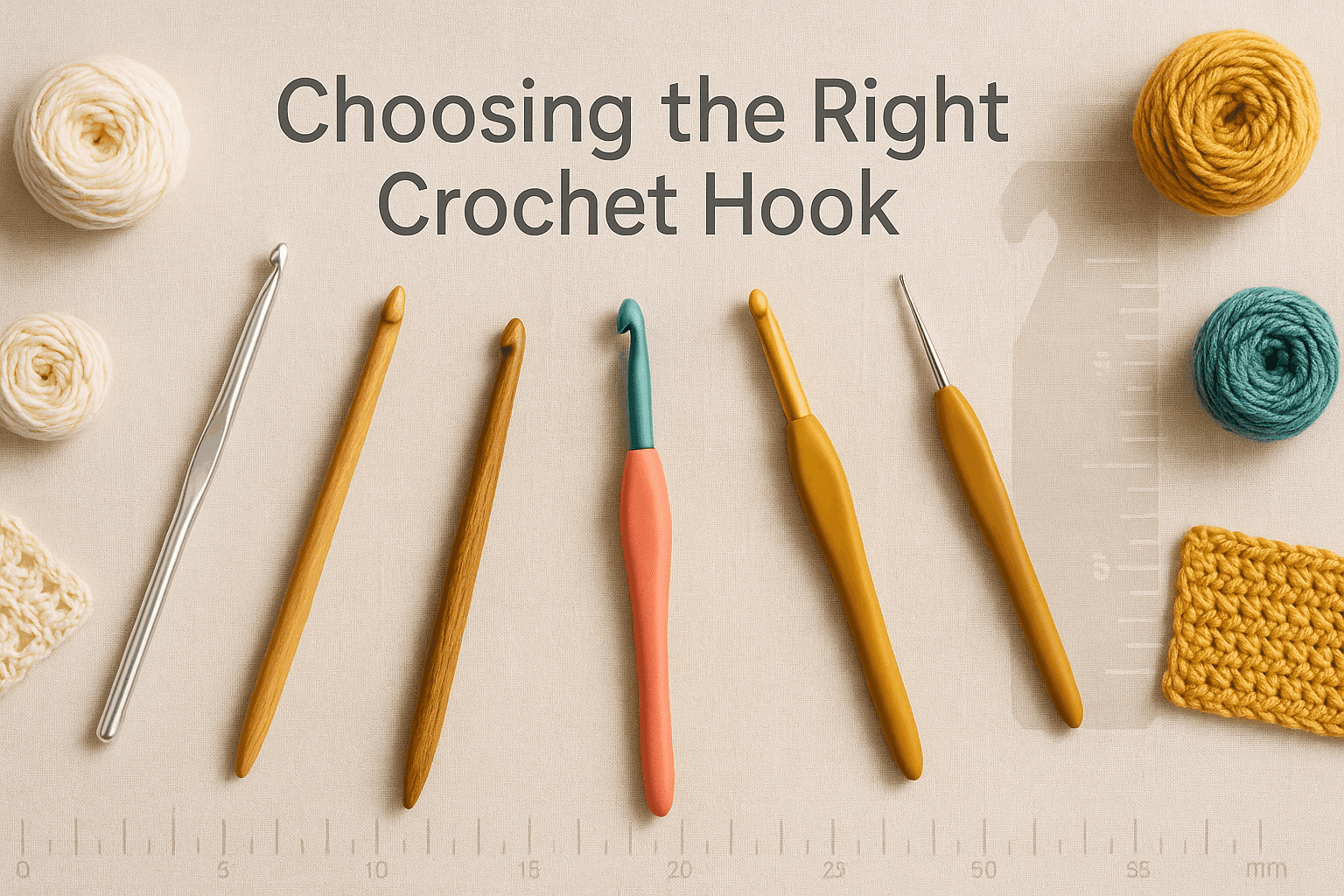
Crochet hooks look deceptively simple: a stick with a notch. Yet that notch—and the shaft behind it—has an outsized impact on your tension, speed, hand comfort, and even the finished fabric’s drape. If you’ve ever wondered why one hook makes your stitches glide like butter while another leaves you wrestling split yarn and sore wrists, the answer is in the interaction between hook geometry, material, and your yarn’s properties.
This guide is a practical, field-tested roadmap for crochet enthusiasts and fiber artists at any skill level. You’ll learn how hook choices affect stitch mechanics, how to match hooks to yarns and project goals, and how to troubleshoot common issues (tight gauge, squeaky hooks, snaggy heads, fatigue). You’ll also find pattern-oriented examples so you can apply these choices immediately.
1) The core idea: a crochet hook is a shaping tool
Every crochet stitch is built from loops that you:
- Catch (the hook grabs yarn),
- Pull through (the hook drags the loop through one or more loops),
- Set (the loop rests on the shaft at a consistent diameter).
A hook’s job is not just to grab yarn—it’s to standardize loop size (via the shaft), minimize friction (via material/finish), and keep the yarn from splitting (via head/throat shape).
If your loops are consistently “too small,” you’ll feel it as stiff fabric, aching hands, or impossible insertions into prior stitches. If they’re too loose, you’ll see gaps, ladders, and poor stitch definition.
Hook selection is essentially engineering your loop formation.
2) Hook anatomy, and how each part affects your stitches
Even within the same labeled size (e.g., 5.0 mm), hooks can feel wildly different because the proportions vary.
2.1 The head (and why it matters)
The head includes the point, the lip (where yarn catches), and the bowl. A good head:
- Catches yarn reliably without shredding it
- Slides through previous stitches without snagging
- Doesn’t split plies (especially important with loosely plied yarn)
Symptoms of a mismatched head:
- Yarn splitting during yarn-over
- Hook “popping out” mid pull-through
- Snagging on fuzzy fibers like mohair
2.2 The throat
The throat is the tapered area beneath the head. It determines how smoothly you can pull loops through and how much “space” you have when working tall stitches or multiple yarn-overs.
A deeper throat can feel forgiving and fast. A shallow throat can feel precise but may require cleaner technique.
2.3 The shaft
The shaft is the true diameter reference for sizing. In consistent stitch formation, your working loop should rest on the shaft—not choked up in the throat.
If your loop stays up near the throat, your stitches will be smaller than expected even if you’re using the “correct” mm hook.
2.4 The handle/ergonomics
Handles aren’t just comfort accessories; they influence how you grip and how much micro-tension you carry in the forearm.
- Inline grips can encourage steadier loop sizing.
- Tapered grips can support speed but sometimes lead to “death grip” tension.
If you crochet for long sessions, handle shape can be the difference between endurance and pain.
3) Inline vs tapered hooks: what’s the real difference?
This is the classic debate, and both have strengths.
Inline hooks
Traits: The head aligns more evenly with the shaft; the throat can be more pronounced; the “step” between shaft and throat is clearer.
Often helpful for:
- Consistent gauge (especially for beginners)
- Heavier yarns (bulky, roving-style) where control prevents splitting
- Stitch patterns requiring repeated, identical loop sizes (e.g., textured stitches)
Potential drawbacks:
- Can feel slower for some
- Some inline designs snag if the head edge is sharp
Tapered hooks
Traits: The head and throat taper smoothly into the shaft; fewer abrupt edges.
Often helpful for:
- Speed crocheting and fluid motion
- Fine yarns where you want smooth pull-through
- Slip stitch-heavy work (e.g., colorwork, some Tunisian-like rhythms)
Potential drawbacks:
- Can tempt you to keep loops in the throat, creating tighter stitches than intended
- Less “stop point” for loop sizing, so gauge can vary more if your tension is inconsistent
Practical takeaway: If you struggle with tightness or uneven gauge, try an inline hook in the same size. If you struggle with snagging or want more glide, try tapered.
4) Hook materials: friction, weight, and fiber behavior
Material choice is not aesthetics—it changes friction, static, temperature feel, and weight distribution.
4.1 Aluminum
Why people love it:
- Smooth and reasonably slippery
- Lightweight, affordable, widely available
Best for:
- Most acrylics and wool blends
- Daily-use “workhorse” crochet
Watch for:
- Squeaking with certain acrylics
- Cold feel in hands (some people dislike it)
Tip: If your hook squeaks, lightly wash hands and hook to remove lotion residue; switch to a different finish or to wood/bamboo for that yarn.
4.2 Steel (for thread crochet)
Steel hooks are typically used for laceweight thread and very fine yarn. They’re durable, stable, and precise.
Best for:
- Doilies, micro crochet, lace motifs
- Clean stitch definition in cotton thread
Watch for:
- Hand fatigue if the handle is thin (consider ergonomic add-ons)
4.3 Bamboo and wood
Why they shine:
- Slight grip (less slippery), which helps control slippery yarn
- Warm in the hand
- Often quieter than metal
Best for:
- Silk, bamboo yarn, rayon blends (slippery fibers)
- Beginners learning tension
- Lace knitting-style crochet where you want less split
Watch for:
- Can snag if the finish wears or if the head isn’t polished well
- Can break in very small diameters or under heavy tension
4.4 Plastic/acrylic hooks
Often used for larger sizes.
Best for:
- Jumbo yarns and big stitches
- Lightweight feel in oversized hooks
Watch for:
- Flexing under tension (can distort stitch formation)
- Mold lines that snag yarn
4.5 Resin and handcrafted hooks
These can be beautiful and ergonomic, but the “finish quality” varies.
Best for:
- People who want a specific handle shape
- Long crochet sessions where comfort matters
Watch for:
- Micro-ridges or seams near the head that catch fuzz
5) Yarn properties and how they interact with hooks
Hook choice becomes much easier when you read yarn like a materials scientist.
5.1 Fiber type (wool, cotton, acrylic, silk, etc.)
- Wool: springy, elastic—forgiving; pairs well with many hook materials.
- Cotton: low elasticity; stitches can look crisp but feel harder on hands; benefits from smooth hooks and ergonomic handles.
- Acrylic: varies; can squeak on metal; sometimes splits if loosely plied.
- Silk/rayon/bamboo: slippery, drapey; often easier with bamboo/wood for added control.
5.2 Ply structure and twist
- High-twist, plied yarns (e.g., many sock yarns) resist splitting and show stitch definition beautifully.
- Low-twist/roving-style yarns split easily; choose a hook with a smoother head and less aggressive point.
5.3 Halo and fuzz (mohair, alpaca, brushed yarns)
These catch on rough surfaces.
Hook advice: polished metal or very smooth resin often performs best. Avoid hooks with sharp edges or worn finishes.
5.4 Tape yarns and ribbon yarns
They can snag or twist.
Hook advice: a hook with a generous throat and smooth head helps prevent the ribbon from folding and catching.
6) Matching hook to project goals: drape, density, and texture
The “right hook” depends on what you want the fabric to do.
6.1 For drape (shawls, garments, lace)
- Consider going up 0.5–2.0 mm from the label suggestion.
- Favor smooth, fast hooks (polished aluminum, resin, or well-finished bamboo).
- Use stitch patterns with open structure: shells, fans, mesh, lace motifs.
Mini pattern example (drapey mesh swatch):
- Chain 27.
- Row 1: dc in 4th ch from hook, ch 1, skip 1 ch, dc in next ch repeat.
- Row 2: ch 3, dc in first dc, ch 1, dc in next dc repeat.
Try the same swatch with two hook sizes. The larger hook will show more openness and fluid drape.
6.2 For density (amigurumi, baskets, rugs)
- Use a smaller hook than label suggestion (often 1.0–2.0 mm smaller for amigurumi).
- Favor hooks that allow controlled tight stitches (inline often helps).
- Choose a yarn that won’t shred under tight tension.
Mini pattern example (amigurumi sphere start):
- MR, 6 sc.
- Round 2: inc around (12).
- Round 3: sc, inc around (18).
If you see stuffing, your hook is too big or your tension is too loose.
6.3 For stitch definition (cables, mosaic, textured stitches)
- Choose a yarn with clear ply and a hook that doesn’t split.
- Aluminum often highlights crisp definition; bamboo can soften it slightly.
6.4 For speed (blankets, charity makes)
- A hook that glides and doesn’t snag is key.
- Ergonomic handle reduces fatigue over thousands of stitches.
7) Gauge isn’t just size: it’s loop geometry
Most crocheters think gauge is simply “stitches per 4 inches.” But your hook affects loop height, loop width, and how stitches stack.
How hook design influences gauge
- A hook with a longer throat may let loops elongate slightly.
- A sharper head may enter stitches more easily, reducing friction and tightening your tension unintentionally.
- A grippy material increases control, sometimes leading to tighter stitches.
Practical gauge method (more reliable than one swatch)
- Swatch in pattern stitch (not just single crochet).
- Work at least a 6 in x 6 in square.
- Wash/block how you’ll treat the final item.
- Measure stitch gauge in multiple spots.
If you are between sizes, changing hook material (metal to bamboo) can sometimes “nudge” gauge without changing hook size.
8) Ergonomics for fiber artists: reduce strain without sacrificing control
Hand pain is common, especially with tight tension work like amigurumi or cotton dishcloths.
Hook handle strategies
- Try a thicker handle if you pinch tightly.
- Try a longer handle if you rest the hook against the palm.
- Consider add-ons (silicone grips, foam tubes) for thin hooks.
Technique tips that interact with hook choice
- Keep your working loop on the shaft, not the throat.
- Relax shoulders; let the hook do the work.
- If you feel resistance on pull-through, don’t force it—evaluate hook/yarn friction.
Red flags you need a change
- Tingling/numbness in fingers
- Pain that persists after rest
- Increasing tension just to maintain control
If these happen, switch hook handle style, reduce session length, and consult a medical professional if symptoms persist.
9) Troubleshooting: what your stitches are telling you
Here are common problems and hook-based fixes.
Problem: Yarn splitting constantly
Likely causes: sharp head, low-twist yarn, rough hook finish.
Fixes:
- Switch to a rounder-headed hook or inline style with smoother entry.
- Move to a slightly larger hook to reduce abrasion.
- Choose a more tightly plied yarn for that pattern.
Problem: Squeaky hook
Likely causes: friction between acrylic yarn and metal, or residue.
Fixes:
- Wipe hook with mild soap and water; dry well.
- Try bamboo/wood or a different metal finish.
- Reduce hand lotion while crocheting.
Problem: Stitches are too tight to insert the hook
Likely causes: loop sitting in throat, hook too small, death grip.
Fixes:
- Consciously pull your working loop up onto the shaft before completing the stitch.
- Size up 0.5 mm.
- Try an ergonomic handle to reduce grip force.
Problem: Uneven tension (rows look wavy)
Likely causes: inconsistent loop sizing, changing grip, yarn snagging.
Fixes:
- Try an inline hook to “standardize” loops.
- Choose a smoother hook material.
- Use stitch markers every 10–20 stitches to stabilize rhythm.
Problem: Hook keeps slipping out of loops
Likely causes: head too shallow or too slippery for your technique.
Fixes:
- Try a hook with a slightly deeper bowl.
- Switch from very slick metal to bamboo/wood for more grip.
10) Pattern-driven hook recommendations (practical pairing ideas)
These are not strict rules, but they’re solid starting points.
10.1 Cotton dishcloths (worsted cotton)
Goal: durability, clean texture.
- Hook: smooth aluminum or ergonomic aluminum.
- Size: often 4.0–5.0 mm depending on desired density.
- Stitch: half double crochet for squish; lemon peel for texture.
10.2 Lace shawl (fingering + mohair)
Goal: drape, openness, gentle halo.
- Hook: polished aluminum/resin to avoid snagging fibers.
- Size: 3.5–5.0 mm depending on pattern openness.
- Stitch: granny-style clusters, fans, or mesh.
10.3 Amigurumi (DK or worsted)
Goal: tight fabric, no stuffing show-through.
- Hook: inline or comfortable ergonomic; less slippery helps control.
- Size: typically 2.5–3.5 mm for worsted, depending on your tension.
- Stitch: single crochet in continuous rounds.
10.4 Wearables (sweaters, tops)
Goal: predictable gauge, comfortable fabric.
- Hook: whichever gives you stable gauge across long sessions; ergonomic handle recommended.
- Swatch and block are non-negotiable.
11) Building a “micro hook wardrobe” (you don’t need everything)
You can cover most crochet with a thoughtful small set.
A minimal, powerful kit
- 3.0 mm, 4.0 mm, 5.0 mm, 6.0 mm aluminum (general use)
- One ergonomic handle in your most-used size
- One bamboo/wood hook around 4.5–5.5 mm (for slippery yarns)
- Steel hook set if you do thread crochet
When to buy duplicates
Buy duplicates of:
- Your most-used size (often 4.0–5.5 mm)
- The hook that gives you perfect gauge for garments
Because “the right hook” becomes part of your personal consistency.
12) Expert-informed principles (what experienced crocheters converge on)
While individual preferences vary, skilled crocheters tend to agree on these fundamentals:
- Hook size is a starting point, not a rule. Yarn labels suggest a general fabric, not your exact tension.
- Smoothness and head shape matter as much as millimeters. Two 5.0 mm hooks can produce different results due to geometry.
- Comfort is a performance feature. Pain changes tension; tension changes fabric.
- Swatching is cheaper than frogging. Especially for garments.
If you want deeper technical reading, look for resources that discuss gauge, fabric behavior, and ergonomics in crochet—many experienced designers emphasize swatching, yarn construction, and blocking as the “physics layer” of crochet.
13) A simple decision tree you can use today
Use this quick guide when a project feels “off.”
- Is the yarn splitting?
- Yes → try rounder head, smoother finish, possibly larger size.
- Is the fabric too stiff?
- Yes → size up; consider slicker hook; loosen grip.
- Are stitches too loose or gappy?
- Yes → size down; consider grippier hook (bamboo).
- Do your hands hurt?
- Yes → ergonomic handle, lighter hook, frequent breaks; revisit tension.
- Is the yarn slippery and hard to control?
- Yes → bamboo/wood; inline for stability.
14) Closing: your best hook is the one that makes the fabric you want, comfortably
Crochet is both craft and choreography: yarn sliding, loops forming, fabric emerging. Hook choice determines how smooth that choreography feels.
When you treat hooks as tools with measurable properties—material friction, head geometry, shaft consistency—you’ll be able to predict outcomes instead of guessing. And once you find a hook that matches your hands and your favorite fibers, you’ll notice something subtle but powerful: you stop fighting your stitches.
If you want, tell me the yarn (fiber + weight), the pattern type (garment/amigurumi/lace), and whether you tend to crochet tight or loose. I can suggest specific hook sizes and materials to test, plus a swatching plan to lock in gauge.