Why yarn choice matters more than you think
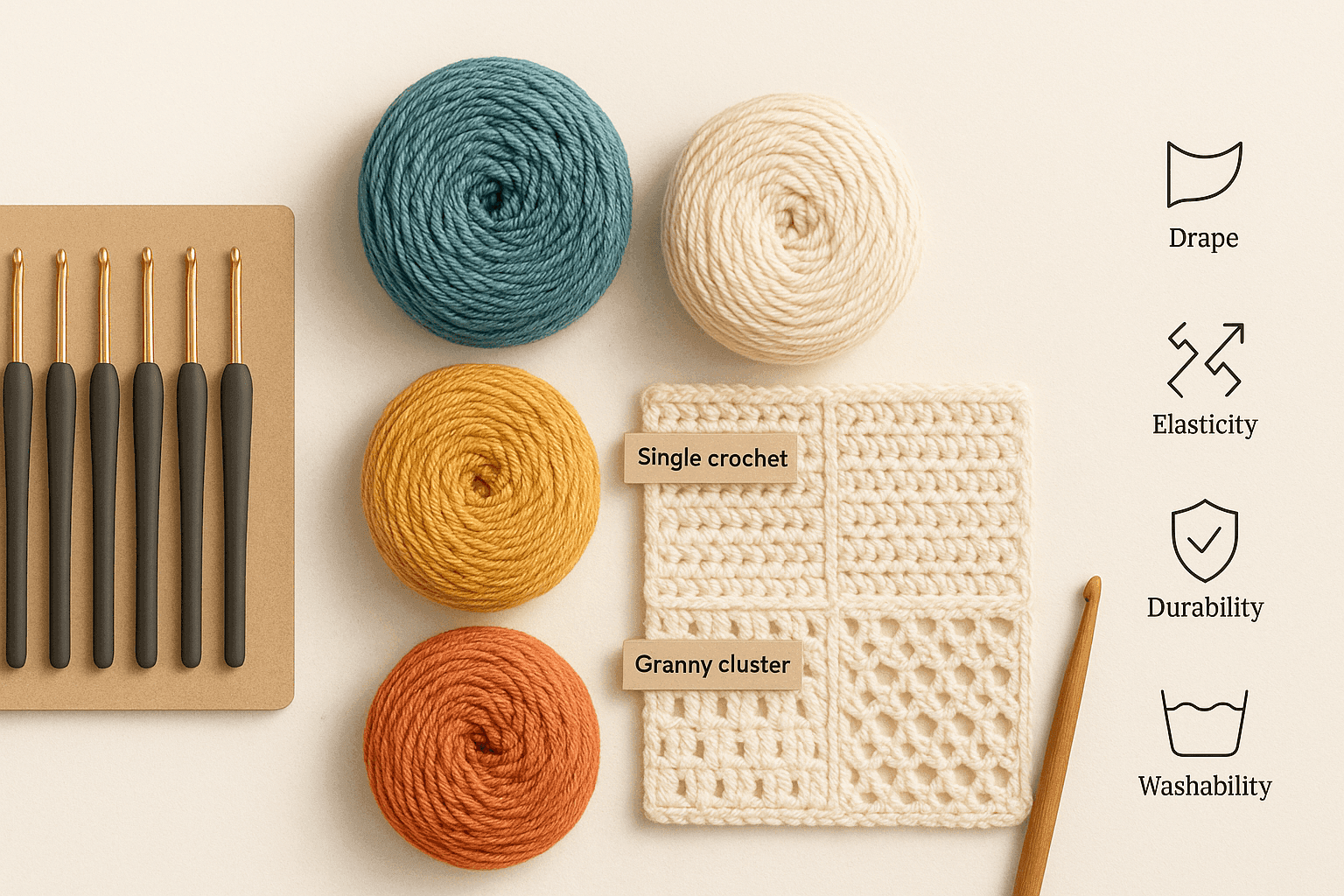
Crochet isn’t just “hook size + pattern = finished object.” Yarn is a construction material. Its fiber content, twist, ply, elasticity, and finishing treatments determine how stitches behave, how fabric drapes, how well it wears, and even whether you’ll enjoy making it.
If you’ve ever made a sweater that grew three sizes, a bag that sagged, a hat that stretched out, or a plushie that looks lumpy—those are often yarn-property issues, not skill issues. This guide breaks down yarn selection in a way that’s useful for beginners and still nuanced enough for experienced fiber artists.
We’ll cover:
- Fiber types and blends (and what they do in crochet fabric)
- Yarn structure: ply, twist, halo, and how they affect stitch definition
- Matching yarn to project goals: warmth, drape, memory, durability
- Gauge and swatching strategies that actually predict outcomes
- Pattern examples and “best yarn bets” for each
- Troubleshooting common yarn-related problems
Throughout, you’ll see references to textile fundamentals (fiber strength, elasticity, abrasion resistance) and stitch mechanics (how crochet’s structure affects drape and growth). Crochet fabric generally has more thickness and less natural drape than knitting at the same yarn size, so yarn selection can make or break the final look.
A quick yarn-selection framework (use this every time)
Before looking at brand names or colors, decide these five things:
- End use: garment, accessory, home decor, toy, bag, lace, rug?
- Desired behavior: drapey vs structured, elastic vs stable, soft vs hard-wearing.
- Care needs: machine washable, dryable, allergy constraints, pet hair issues.
- Climate + comfort: warm, breathable, cool to touch, moisture handling.
- Stitch goals: crisp stitch definition, fuzzy halo, dense fabric, openwork.
Then select yarn based on:
- Fiber (what it’s made of)
- Structure (how it’s spun/constructed)
- Weight (thickness)
- Finish (mercerized, superwash, brushed, chainette, etc.)
Fiber content: how different fibers behave in crochet
Wool (non-superwash)
Best for: hats, mittens, sweaters needing elasticity and warmth, textured stitches.
Why it works: Wool fibers have natural crimp, which creates elasticity and “memory” (ability to bounce back). Wool also has good insulating properties because it traps air.
Crochet impact: Wool helps crochet fabric feel less rigid and more forgiving. It can also help ribbing and brim areas recover after stretching.
Cautions:
- Can felt/shrink with agitation and heat.
- Some people find it itchy; choose finer wools (merino, polwarth) or wool blends.
Tip: If you want a wool garment that holds its shape, choose a wool with a firmer twist and good ply definition.
Superwash wool
Best for: easy-care garments and baby items when you want wool’s warmth without strict washing.
What changes: Superwash is treated (chemically and/or with resin) to reduce felting. This often increases smoothness and drape but can reduce “grab” and memory.
Crochet impact: Many superwash wools are prone to growth (lengthening) in garments, especially when worked in looser stitches or heavy fabric.
Practical strategies:
- Swatch, wash, and hang-dry the swatch with a clip to simulate garment weight.
- Consider going down a hook size to firm up fabric.
- Add structural elements: ribbed cuffs, hems, or seam lines to reduce stretching.
Cotton
Best for: summer garments, dishcloths, market bags (with reinforcement), home decor.
Properties: Cotton has low elasticity and high absorbency. It often feels cool and crisp.
Crochet impact:
- Great stitch definition.
- Can feel heavy in large garments.
- Tends to stretch and stay stretched (low memory), especially under weight.
Mercerized cotton:
- Treated to increase luster and strength.
- Often has firmer stitch definition and slightly less fuzz.
Tip for cotton garments: Choose lighter constructions (lace panels, mesh, openwork) to reduce weight and improve drape.
Linen
Best for: warm-weather tops, towels, structured home items, heirloom-quality pieces.
Properties: Linen is strong, breathable, and becomes softer with washing. It has very low elasticity and can feel stiff initially.
Crochet impact: Excellent for crisp stitch patterns and airy fabric; less ideal for snug-fitting ribbing.
Tip: Expect linen to relax after blocking and repeated washing. Make a larger swatch and treat it the way you’ll treat the final item.
Bamboo / rayon / viscose (plant-based regenerated fibers)
Best for: drapey shawls, soft garments, silky accessories.
Properties: These fibers are smooth and drapey, often with a slight sheen. They can be heavy and have low elastic recovery.
Crochet impact: Gorgeous drape, but can grow in length and sag in bags or long garments.
Tip: Pair with wool or cotton in a blend if you want drape with better recovery.
Acrylic
Best for: affordable blankets, amigurumi, easy-care items, allergy-sensitive households.
Properties: Acrylic is lightweight, usually machine washable, and comes in many colors. Quality varies widely.
Crochet impact:
- Can have “squeaky” feel on hook depending on finish.
- Some acrylics pill more.
- Heat sensitivity: too much heat can “kill” acrylic (relax fibers permanently).
Tip: For blankets and garments, look for acrylics marketed as anti-pilling or premium soft acrylic. For amigurumi, a smoother acrylic can give crisp stitches.
Nylon (often used in blends)
Best for: socks, high-wear items, reinforcement.
Properties: Nylon adds strength and abrasion resistance.
Crochet impact: Great in small percentages with wool for durability in items that rub (socks, mitts).
Alpaca
Best for: warm accessories, drapey garments, luxury feel.
Properties: Very warm, soft, often has low memory and can be heavy.
Crochet impact: Alpaca can drape beautifully but may stretch out in hats and cuffs.
Tip: Use alpaca in blends with wool for elasticity, or reserve it for shawls/cowls where drape is desirable.
Silk
Best for: heirloom shawls, drapey garments, luxe accessories.
Properties: Strong, smooth, shiny, can add drape and strength. Often expensive.
Crochet impact: Enhances stitch definition in lace and adds elegant weight.
Tip: Silk/wool blends are a sweet spot: warmth plus sheen plus better recovery.
Specialty fibers (hemp, nettle, yak, cashmere)
These fibers often appear in blends:
- Hemp: strong, breathable, can be stiff initially.
- Yak: warm, often blended with wool; can be softer and slightly drapier.
- Cashmere: soft, warm, often delicate; best in blends for durability.
For crochet, consider both hand feel while working and fabric behavior after blocking.
Yarn structure: ply, twist, and why it changes your stitches
Fiber content is only half the story. Two cotton yarns can behave completely differently because of construction.
Ply and twist
- High twist, multi-ply yarns: crisp stitch definition, resist pilling, can feel “ropey” (great for cables, textured stitches, amigurumi).
- Low twist, softly spun yarns: lofty and soft, but may pill, split, and blur stitch definition.
Crochet-specific note: Crochet stitches wrap yarn around the hook frequently. If yarn is loosely spun, it can split, especially with inline hooks or sharper hook tips.
Single-ply yarns
Single-ply (or “singles”) can look beautiful and bloom nicely after blocking, but they can pill and abrade faster.
Best for: shawls, low-friction garments, items not subject to rubbing.
Avoid for: bags, cuffs, underarms, heavy blankets that will be washed often.
Chainette (tube) construction
Chainette yarns are made like a knitted tube. They’re lighter for their thickness and can create airy fabric.
Best for: garments where you want less weight and more warmth.
Caution: Some chainette yarns can snag; consider stitch choice if you have pets or rough wear.
Halo and brushed yarns (mohair, suri alpaca, brushed blends)
Halo softens edges and blurs stitch definition.
Best for: simple silhouettes, stockinette-like crochet textures, airy shawls.
Not ideal for: intricate lace charts, detailed cables, motifs requiring crisp edges.
Tip: When using a halo yarn, keep stitch patterns simpler and let the fiber be the star.
Yarn weight and crochet fabric density
Yarn weight (lace, fingering, DK, worsted, bulky, etc.) influences:
- Drape: lighter yarns often drape better (especially with open stitches)
- Warmth: thicker yarns trap more air but can also feel stiff
- Time investment: heavier yarn works up faster
Crochet fabric can become dense quickly. A worsted yarn in tight single crochet makes a stiff fabric; the same yarn in a mesh stitch can become fluid and airy.
Practical rule: If you want drape, pair lighter weight yarn with larger hook and open stitch patterns, then test the resulting fabric for stability.
Matching yarn to project types (with pattern examples)
Below are “best bets” by project category, plus stitch ideas and yarn traits to prioritize.
1) Wearable sweaters and cardigans
Goal: comfort, drape, resilience, low pilling.
Best yarn traits:
- Wool or wool blends with good twist
- Some nylon for durability (optional)
- Avoid overly heavy yarns unless design is very open
Great fiber choices:
- Merino/nylon blend (durable, elastic)
- Wool/silk (drape + strength)
- Wool/cotton (balanced, season-spanning)
Pattern example ideas:
- Top-down raglan cardigan in DK wool blend using half double crochet + occasional ribbing.
- Granny stitch pullover in a wool/acrylic blend for lightweight warmth.
Technique tip: Add structure with ribbed hems/cuffs (front post/back post double crochet) and consider seaming shoulders even in “seamless” designs to reduce stretching.
2) Summer tops and tees
Goal: breathable, not clingy, washable.
Best yarn traits:
- Cotton, linen, bamboo blends
- Good drape but not too heavy
Great fiber choices:
- Cotton/linen for breathable structure
- Cotton/bamboo for softness + drape
Stitch mechanics that help:
- Mesh stitches (chains + double crochet)
- Lace motifs and filet
- Avoid super-dense single crochet over large areas unless you want a structured tank
Pattern example ideas:
- Filet crochet tee: cotton/linen DK with simple geometric blocks.
- Lacy yoke top: cotton/bamboo sport weight with a drapey body.
Trouble prevention: If your top is stretching, it’s usually weight + low memory. Reduce weight (lighter yarn), reduce density (more open stitch), or add structure (edging with slip stitch or single crochet).
3) Hats and beanies
Goal: elasticity, memory, warmth, comfort.
Best yarn traits:
- Wool or wool blends
- Springy structure
Great fiber choices:
- Non-superwash wool for best recovery
- Wool/acrylic for easy care
Stitch choices:
- Ribbing: BLO single crochet rib or post-stitch ribbing
- Textures: front post stitches, waffle, cables (need good stitch definition)
Pattern example ideas:
- BLO ribbed beanie in worsted wool.
- Cable-look hat in a high-twist merino blend for crisp texture.
Avoid: 100% alpaca or bamboo for fitted hats unless the design includes strong negative ease and a stable rib.
4) Scarves, cowls, shawls
Goal: drape, softness, visual texture.
Best yarn traits:
- Drape-friendly fibers (alpaca blends, bamboo blends, silk blends)
- For lace, choose a yarn that blocks well and shows stitch structure
Pattern example ideas:
- Triangle shawl in fingering wool/silk using shells and chain spaces.
- Simple textured scarf in brushed alpaca blend with minimal stitch variety.
Tip: Lace patterns often look best in smooth yarns with moderate twist (not overly fuzzy), so eyelets remain open after blocking.
5) Blankets and afghans
Goal: washable, durable, comfortable, minimal pilling.
Best yarn traits:
- Acrylic (quality matters) or wool blends for warmth
- Cotton for summer throws (but heavy)
Yarn choices:
- Premium acrylic or acrylic blends for easy care
- Wool/acrylic blend for warmth without delicate washing
- Cotton for baby blankets if softness is good and weight is acceptable
Pattern example ideas:
- Granny square blanket in anti-pilling acrylic.
- Moss stitch throw in wool/acrylic for a cozy, flexible fabric.
Tip: Crochet blankets can get heavy. If your wrists suffer, consider lighter yarn weights (DK instead of worsted) or more open stitches.
6) Amigurumi and plush toys
Goal: firm fabric, stitch clarity, durability, washable.
Best yarn traits:
- Smooth yarn, strong plies, low fuzz
- Cotton or acrylic works well
Yarn choices:
- Cotton (excellent stitch definition)
- Acrylic (lighter, soft, many colors)
Stitch mechanics:
- Tight single crochet, invisible decreases, consistent tension
Pattern example idea:
- Classic stuffed animal using worsted cotton with a smaller hook than label recommends for dense fabric.
Troubleshooting: If stuffing shows through, either tighten tension, use smaller hook, or choose a yarn with better “fill” (more plies, less split).
7) Bags and totes
Goal: structure, abrasion resistance, minimal stretch.
Best yarn traits:
- Low stretch fibers (cotton, linen, hemp)
- Firm twist, durable construction
Yarn choices:
- Mercerized cotton (stronger, crisp)
- Cotton/hemp blend
Stitch choices:
- Single crochet, waistcoat stitch, thermal stitch for density
- Consider lining for stability
Tip: Even strong cotton can sag. Add a fabric lining, use shorter handles, reinforce strap areas, or crochet straps with slip stitch/thermal stitch.
8) Home decor: baskets, rugs, pillows
Goal: stiffness, durability, easy cleaning.
Yarn choices:
- T-shirt yarn, macramé cord, sturdy cotton
- For rugs: durable cotton blends or rug yarn
Technique tip: Use smaller hooks and dense stitches for baskets. For rugs, consider slip-stitch fabric or single crochet for thickness.
Swatching like it matters (because it does)
A crochet swatch isn’t only about stitch count; it’s about fabric behavior.
The “real” garment swatch method
- Make a swatch at least 6 x 6 in (15 x 15 cm).
- Work in the actual stitch pattern (not just single crochet unless that’s the project).
- Measure before blocking.
- Wash and dry as you will the finished item.
- Measure again. Then hang it with clothespins for a few hours if the item will hang (sweater, shawl).
Record:
- Stitch and row gauge
- How much it grew or shrank
- How the drape changed
- Whether the yarn pilled or fuzzed
This reflects basic textile behavior: fibers swell with moisture, relax under tension, and sometimes set in new shapes when dried.
Stitch mechanics: how stitch choice interacts with yarn
Crochet stitches create interlocking loops with more “structure” than knitting. That means:
- Single crochet: dense, stiff, excellent for structure (amigurumi, bags).
- Half double crochet: balanced density and drape.
- Double crochet and taller: more drape and airflow.
- Post stitches/cables: require yarn with stitch definition and enough elasticity.
Important interaction: A drapey fiber (bamboo, silk) in a tall open stitch becomes very drapey; the same fiber in dense stitches can become heavy and sag.
Troubleshooting yarn-related problems
Problem: My garment is growing and getting longer
Likely causes: superwash wool, bamboo/rayon, alpaca, heavy cotton; tall stitches; loose gauge.
Fixes:
- Tighten gauge (smaller hook).
- Use a lighter yarn weight.
- Add structural seams or edging.
- Choose a blend with wool for memory.
- Avoid overly long garments with heavy fibers.
Problem: My stitches look messy or uneven
Likely causes: fuzzy yarn; low twist; yarn splitting; hook too sharp/too blunt; inconsistent tension.
Fixes:
- Choose a smoother, higher-twist yarn.
- Try a different hook style (inline vs tapered) to reduce splitting.
- Use stitch markers and count rows to keep structure consistent.
Problem: Yarn keeps splitting
Likely causes: loosely spun plies, low twist, certain bamboo/cotton blends.
Fixes:
- Switch to a more plied yarn.
- Use a blunter hook tip.
- Adjust your hook angle and slow down on yarn-over.
Problem: My blanket is pilling badly
Likely causes: low-twist yarn, short staple fibers, high friction, frequent washing.
Fixes:
- Choose higher-twist yarn or anti-pilling acrylic.
- Avoid singles for high-wear blankets.
- Use gentler wash cycles and avoid high heat.
Problem: My cotton item feels stiff like cardboard
Likely causes: dense stitch pattern; hook too small; stiff cotton.
Fixes:
- Go up a hook size.
- Use a more open stitch.
- Choose a softer cotton (combed, long-staple) or a cotton blend.
- Block and wash—cotton often softens after laundering.
Problem: Color changes look muddy or uneven
Likely causes: variegated yarn + complex stitch pattern; pooling.
Fixes:
- Pair variegated yarn with simple stitches (granny, moss, basic dc).
- Use solid or heathered yarn for highly textured patterns.
- For intentional pooling, choose patterns designed to control it.
Practical yarn “pairings” by stitch pattern
Use these as quick heuristics.
- Cables / raised textures: high-twist, smooth, multi-ply wool or wool blend.
- Lace: smooth yarn with good blocking response (wool/silk, cotton for crisp lace).
- Granny squares: wool/acrylic blends or acrylic for easy care; avoid overly splitty yarn.
- Moss stitch: almost any yarn; looks especially good in heathers and solids.
- Tapestry crochet: firm, non-splitty yarn; mercerized cotton for crisp colorwork.
- Amigurumi: smooth cotton or acrylic, strong stitch definition.
How to substitute yarn in a pattern (without heartbreak)
When you can’t get the recommended yarn, use this substitution checklist:
- Match weight (start there, but don’t stop there).
- Match fiber behavior: if pattern is designed for wool elasticity, substituting cotton may change fit.
- Match structure: a high-definition cable pattern needs a yarn that shows stitches.
- Swatch and block: treat swatch like the final object.
- Adjust hook size for fabric: aim for the fabric feel described (drapey, firm, airy).
If you’re substituting a drapey fiber for a springy one, plan for:
- more ribbing/edging
- potentially smaller hook size
- slightly shorter body length
Expert-level considerations (easy to apply)
Staple length and pilling
Longer staple fibers (often in higher-quality wool and cotton) can reduce pilling because fewer fiber ends work loose. While brands rarely list staple length, you can infer it from:
- smoother surface
- less fuzz in the skein
- better stitch definition
Abrasion zones in garments
Underarms, cuffs, and side seams experience friction. Choose stronger yarns there or design to reduce rubbing:
- add seams
- use tighter stitch patterns
- choose blends with nylon
Blocking behavior differs by fiber
- Wool: blocks beautifully, responds to steam and wet blocking.
- Cotton/linen: can relax with washing; steam helps but water often matters more.
- Acrylic: can be gently steam-blocked; avoid overheating.
These behaviors align with basic fiber science: protein fibers (wool) respond well to moisture/heat reshaping; cellulose fibers (cotton/linen) relax and soften with laundering; synthetics can be heat-set but also heat-damaged.
A yarn-picking cheat sheet
Choose wool (or wool blends) when you want:
- elasticity and memory
- warm, resilient hats and sweaters
- textured stitches that pop
Choose cotton/linen when you want:
- breathable summer wear
- crisp stitch definition
- sturdy household items
Choose bamboo/rayon/silk blends when you want:
- drape and sheen
- elegant shawls and fluid garments
Choose acrylic when you want:
- low-cost, easy-care blankets
- lots of colors
- allergy-friendly options (though sensitivity varies)
Choose blends when you want:
- the best of both worlds (drape + memory, softness + strength)
Closing: make yarn your design partner
The fastest way to level up in crochet isn’t learning a hundred new stitches—it’s learning how yarn behaves. When you match fiber content and yarn construction to the function of your project and the mechanics of your stitches, you get better drape, better fit, better durability, and a more enjoyable making process.
If you take only one habit from this article: swatch, wash, and test for growth—especially for garments. It turns yarn choice from guesswork into a reliable, repeatable design skill.
Suggested references and further learning (non-exhaustive)
- Craft Yarn Council: yarn weight standards and guidance on gauge and categories.
- Clara Parkes, The Knitter’s Book of Yarn (excellent fiber and yarn construction insights applicable to crochet).
- Maggie Righetti, Knitting in Plain English (fiber behavior fundamentals translate well to crochet).
- Interweave and Vogue Knitting fiber/finishing articles (general textile knowledge useful across crafts).