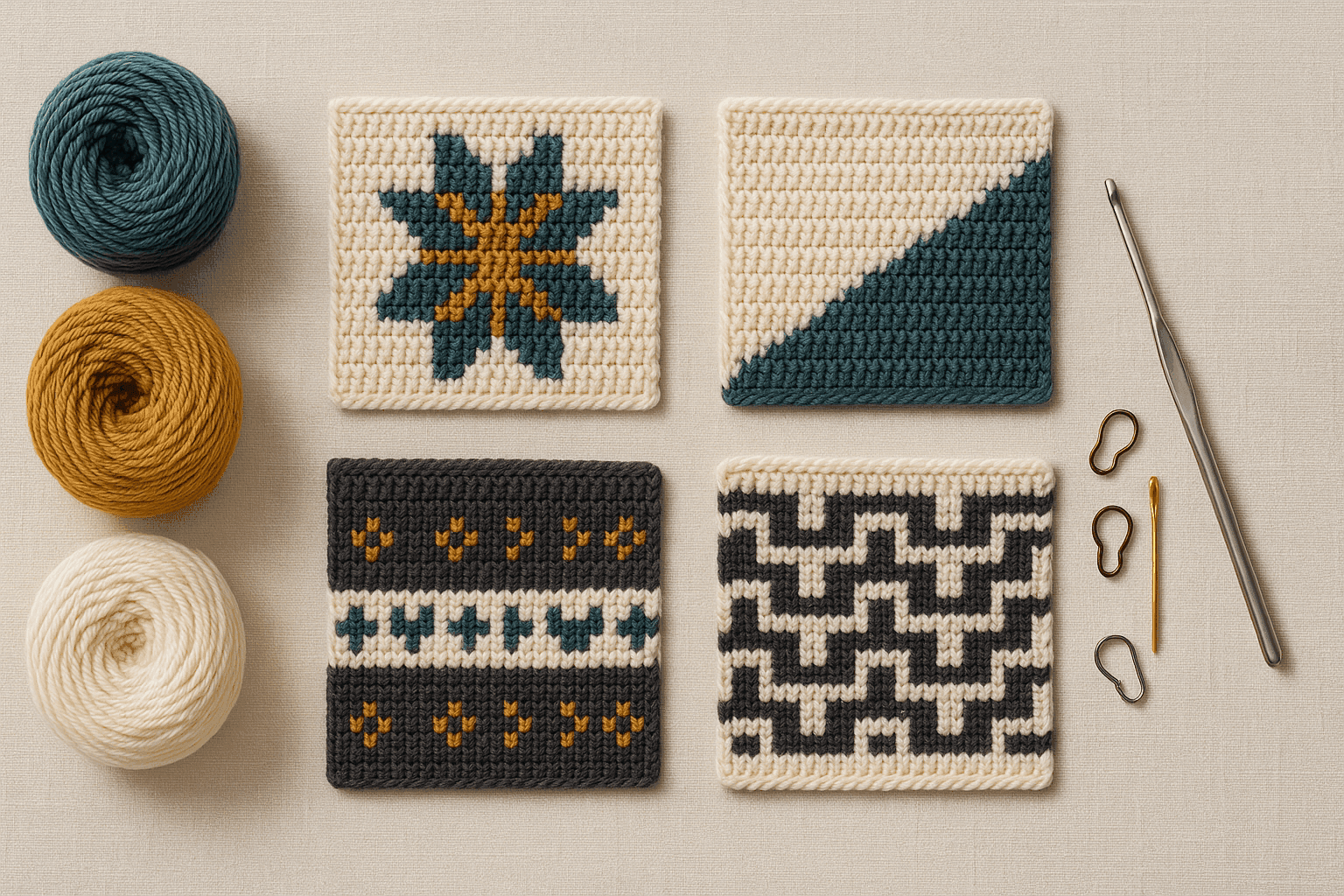
Why Crochet Colorwork Feels Different (and Why That’s Good)
Colorwork is one of the fastest ways to make crochet look “designed.” A simple stitch can become graphic, painterly, or richly patterned with only a second color. But crochet colorwork also has a reputation: it’s bulky, it puckers, my edges look messy, my chart looks different than my knitting chart.
The truth is that crochet has its own colorwork strengths—and its own physics. Crochet stitches are taller and more sculptural than most knit stitches, and each stitch includes structural elements (like the post, top loops, and sometimes a back bar) that influence how color appears. Once you understand stitch mechanics, yarn behavior, and how color changes travel, colorwork becomes predictable and deeply satisfying.
This guide covers the four most common families of crochet colorwork:
- Tapestry crochet (carrying yarn inside stitches)
- Stranded crochet (carrying floats across the back)
- Intarsia crochet (separate bobbins; no carrying across)
- Mosaic crochet (overlay effect using single-color rows)
You’ll also get:
- yarn and hook selection advice
- chart-reading tips tailored to crochet
- practical pattern examples and motif ideas
- troubleshooting for tension, puckering, bleed-through, and jagged diagonals
Yarn, Hook, and Fabric: The Foundation of Clean Colorwork
1) Yarn properties that matter most
Fiber content
- Wool / wool blends: Elastic and forgiving; floats behave well; stitches “bloom” and fill gaps. Great for tapestry and stranded.
- Cotton: Crisp stitch definition, but less elastic—tension issues show more quickly. Great for mosaic and intarsia; can be excellent for tapestry with practice.
- Acrylic: Smooth, consistent, affordable. Can look slightly shiny; some acrylics split less than cotton. Great for learning.
Twist and ply
- A round, plied yarn (4-ply or similar) typically gives sharper color separation than a single or loosely spun yarn.
- Loosely spun yarns can cause color “fuzzing” at boundaries—sometimes charming, sometimes muddy.
Contrast and value
- For graphic motifs, prioritize value contrast (light vs dark) over hue difference. Teal and green may read similar in grayscale; cream and charcoal will pop.
2) Hook size and density
Colorwork improves as fabric density increases because holes between stitches shrink, reducing “peek-through.” Many crocheters size down 0.25–1.0 mm from their usual hook for that yarn.
- Too dense: fabric becomes stiff; stitches become hard to enter; tapestry can feel board-like.
- Too loose: carried yarn shows; edges become wavy; motifs look pixelated.
Tip: Make a small swatch of 20–30 stitches with 2 colors. If you can see the carried yarn from the front, go down a hook size or adjust technique (see “tension and carry” troubleshooting).
3) Stitch choice matters
- Single crochet (sc): The workhorse of tapestry and many charts. Compact and pixel-friendly.
- Half double crochet (hdc): Taller, faster, but color blocks look more “stretched.” Useful for larger motifs.
- Waistcoat stitch (center single crochet): Creates knit-like “V” columns; excellent for tapestry-style looks but requires careful tension and is slower.
- Double crochet (dc): Can be used for intarsia panels and pictorial work; expect more gaps.
How Crochet Color Changes Actually Work
In crochet, a clean color change usually happens when you complete the last step of the previous stitch with the new color.
Single crochet color change (standard):
- Insert hook, yarn over (old color), pull up loop.
- Yarn over with new color, pull through both loops.
This places the new color in the top “cap” of the stitch, which is what you want for crisp blocks.
Tip for neater transitions: When switching colors frequently, keep the inactive yarn tensioned consistently (either carried or dropped cleanly) so stitch height stays uniform.
Technique 1: Tapestry Crochet (Carried Yarn Hidden in Stitches)
What it is
Tapestry crochet carries the unused color inside the stitch as you work, enclosing it in the fabric. This creates a sturdy, often reversible fabric that’s perfect for:
- bags and pouches
- baskets
- hats (with care for stretch)
- pillows
- bold geometric motifs
Best stitches for tapestry
- Single crochet in the round is extremely common (spiral tapestry).
- Single crochet in rows also works, but you’ll manage turning and edge tension.
- Waistcoat stitch is a popular variation for a knit-like look.
How to carry yarn cleanly
- Hold the inactive yarn along the top of the previous row (or within the path of the stitch).
- Insert hook, yarn over with active color, pull up loop over the carried yarn.
- Yarn over and complete the stitch, trapping the carried strand.
Key tension principle: The carried yarn must be relaxed enough not to cinch the fabric, but snug enough not to loop and show.
Common tapestry problems and fixes
Problem: Carried color shows through (“shadowing” or “grinning”)
- Fix: Size down hook, tighten stitch slightly, or choose a stitch variant.
- Try: Yarn under (YU) instead of yarn over (YO) for tighter single crochet. Many tapestry artists use YU because it creates a more compact, square stitch.
Problem: Fabric puckers horizontally
- Cause: Carried yarn is too tight.
- Fix: As you carry, gently tug the work sideways every 5–10 stitches to ensure the carry strand has slack.
Problem: Vertical lines look jagged
- Cause: Crochet stitches stack offset; color changes can “step.”
- Fix: Use tapestry crochet in the round for smoother columns, or use waistcoat stitch for cleaner verticals.
Tapestry pattern example ideas
A. Simple geometric band (beginner-friendly)
- Work in single crochet.
- Alternate blocks of 4 stitches color A, 4 stitches color B across.
- Change colors on the final yarn-over of the last stitch.
B. Icon motif pouch (intermediate)
- Choose a simple 20x20 pixel motif (heart, star, leaf).
- Crochet a flat rectangle in sc using a chart.
- Fold and seam; add a zipper or button.
C. Spiral round basket (intermediate/advanced)
- Crochet in continuous rounds of sc.
- Use 2–3 colors, carrying the inactive colors.
- Incorporate increases evenly to keep the base flat.
Technique 2: Stranded Crochet (Floats Across the Back)
What it is
Stranded crochet is similar in concept to Fair Isle knitting: you work with one color at a time while the other color floats behind the work, carried across the wrong side only where needed.
This method is great when:
- color changes are frequent but not every stitch
- you want a lighter fabric than fully enclosed tapestry
- you’re comfortable managing floats
When stranded crochet shines
- yokes and sweater motifs (with thoughtful float management)
- scarves and cowls (if floats won’t snag)
- decorative panels where the back won’t be exposed
Float length: the practical rule
Avoid floats longer than about 1 inch / 2.5 cm (or roughly 3–5 stitches depending on gauge). Longer floats snag and distort.
How to catch floats: Every few stitches, bring the floating yarn over the working yarn (or vice versa) so it gets lightly trapped on the back without showing on the front.
Stranded crochet tension tips
- Keep the floating yarn spread out along the back—don’t let it bunch.
- After finishing a color section, stretch the fabric horizontally to distribute slack.
Troubleshooting stranded crochet
Problem: Motif looks compressed
- Cause: Floats too tight.
- Fix: Intentionally leave extra slack; use a slightly larger hook for stranded sections.
Problem: Floats show on the front
- Cause: Catching floats too tightly or too frequently; or stitch is loose.
- Fix: Catch less often, catch more loosely, or tighten gauge.
Technique 3: Intarsia Crochet (Separate Color Areas, No Carrying)
What it is
Intarsia uses separate yarn sources (bobbins or small balls) for each color area. You join a new color at a boundary and twist yarns to prevent holes.
Intarsia is ideal for:
- big blocks of color
- pictorial designs (faces, landscapes, lettering)
- blankets with large motifs
- garments where you want minimal bulk
Intarsia in rows vs in the round
- In rows: Most straightforward. You turn your work and manage bobbins.
- In the round: Possible but trickier; many crocheters use a back-and-forth in the round method (turning each round) or seam/join strategies.
Clean joins: the twist
At each color change, twist the two yarns around each other on the wrong side (like linking them) to avoid gaps.
Tip: Always twist in the same direction for consistency.
Managing bobbins without chaos
- Wind small bobbins or wrap yarn around clothespins/bobbins.
- Keep bobbins aligned with their color regions.
- After each row, gently untwist by letting the work dangle.
Intarsia troubleshooting
Problem: Holes at color boundaries
- Fix: Ensure you’re twisting yarns at each join; tighten the first stitch after the join slightly.
Problem: Edges ripple where colors meet
- Cause: Uneven tension between bobbins.
- Fix: Check that each color is worked with the same pull; consider re-winding bobbins so they feed smoothly.
Intarsia pattern example ideas
A. Monogram panel (beginner/intermediate)
- Choose a bold letter chart (block font).
- Crochet in sc or hdc for faster coverage.
- Add a single-color border to stabilize.
B. Colorblock cardigan back panel (intermediate)
- Use 3–5 large shapes.
- Seam pieces; add edging to unify.
Technique 4: Mosaic Crochet (Overlay Colorwork with Single-Color Rows)
What it is
Mosaic crochet creates striking patterns using one color per row/round, typically with:
- Single crochet stitches, and
- double crochet “drop-down” stitches worked into the row below (overlay mosaic)
Because you work one color at a time, mosaic can feel more approachable than tapestry—but it produces bold, architectural designs.
Why mosaic looks so crisp
Instead of changing color stitch-by-stitch, mosaic uses structural layering: a drop-down dc covers a stitch from the prior row, creating a clean color “tile.”
Reading mosaic charts
Mosaic charts often indicate:
- sc in the current row color
- dc worked into a stitch one row below (sometimes two)
Tip: Use stitch markers to track pattern repeats; mosaic patterns are repetitive but can be easy to miscount.
Mosaic edges and borders
Overlay mosaic in rows often creates stepped edges because drop-down stitches extend. Most patterns include:
- a border to square the edges, or
- an envelope border (worked around the whole piece) to hide tails and neaten sides
Mosaic troubleshooting
Problem: Drop-down stitches pull fabric tight
- Fix: Use a hook size up for mosaic, or consciously loosen dc tension.
Problem: Design looks skewed
- Cause: Inconsistent stitch height or missed drop-down placements.
- Fix: Count stitches each row; confirm you’re inserting into the correct stitch below.
Mosaic pattern example ideas
A. Two-color scarf with repeating motif (beginner/intermediate)
- Pick a simple 8–12 stitch repeat.
- Work in rows; add a border.
B. Pillow front (intermediate)
- Overlay mosaic creates a dense fabric perfect for home decor.
- Seam to a solid back panel.
Charts in Crochet: Making Them Work for You
Crochet stitches aren’t perfect squares
Most color charts are based on square pixels. Crochet single crochet is close to square, but it depends on your tension and yarn.
- If stitches are taller than wide, motifs look stretched vertically.
- If stitches are wider than tall, motifs look squat.
Practical fix: Before committing, crochet a small test grid (e.g., 10 stitches by 10 rows) and measure. Adjust hook size or stitch choice to get a more square “pixel.”
Right side vs wrong side on turned rows
When you crochet back and forth, every other row is worked from the wrong side. That means your chart direction matters.
Options:
- Read odd rows right-to-left, even rows left-to-right (mirroring each turned row), or
- Use techniques that keep you always on the right side (less common), or
- Choose mosaic/overlay patterns designed for rows.
Tip: If your design comes out mirrored, you probably read every row in the same direction.
Choosing the Right Colorwork Method for Your Project
Use this as a quick decision guide:
- Bag / basket: Tapestry (dense, durable) or mosaic (thick, bold)
- Sweater yoke: Stranded (with float management) or intarsia for large motifs
- Blanket with big pictures: Intarsia
- High-contrast geometric throw: Mosaic
- Reversible fabric needed: Tapestry (often nearly reversible), some mosaic with borders
- Minimize yarn ends: Tapestry or stranded (but tapestry can use more yarn overall)
Practical Tips for Cleaner, More Professional Results
1) Weave ends strategically
Colorwork produces ends—especially intarsia and mosaic.
- Weave ends along same-color areas when possible.
- Split plies gently and weave in at least 2–3 directions for security.
- In slippery fibers (bamboo, silk blends), consider longer weaves and/or a light fabric backing for bags.
2) Control “dominance” (which color pops)
In stranded work, one color can appear more prominent depending on how it floats behind. In crochet, a similar effect happens with how you hold yarns.
- If you always hold Color A in the same position (e.g., closer to you), it may appear slightly more dominant.
- Consistency matters more than the “right” method.
3) Block with intention
Blocking helps stitches settle and colorwork flatten.
- Wool: wet block or steam gently.
- Cotton: steam block or wet block; may relax significantly.
- Acrylic: careful steam can “kill” acrylic if overheated—test first.
4) Use stitch markers for repeats and motif corners
Especially in tapestry and mosaic, markers prevent drift.
- Mark every repeat (e.g., every 8 or 10 stitches).
- In the round, mark the beginning of round and any key alignment points.
Troubleshooting Clinic: Symptoms, Causes, Fixes
“My tapestry looks like the other color is peeking through.”
- Cause: Loose gauge; high contrast; carried yarn sitting near the front.
- Fixes:
- size down hook
- try yarn-under single crochet
- ensure carried yarn stays centered inside stitches (not riding the front)
- choose a slightly fuzzier yarn (wool) to fill gaps
“My project is narrowing/widening as I go.”
- Cause: Tension changes at color switches; pulling too tight on carried yarn.
- Fixes:
- count stitches every row/round
- practice consistent color-change motion
- periodically spread fabric to redistribute slack
“My diagonal line is stair-stepped.”
- Cause: Pixel geometry of sc; crochet offsets.
- Fixes:
- embrace it as the crochet aesthetic
- use smaller stitches (sc instead of hdc/dc)
- consider surface crochet or embroidery to smooth edges
“My floats snag (or I’m scared they will).”
- Cause: Long floats in stranded work.
- Fixes:
- catch floats every few stitches
- use tapestry instead (fully enclosed)
- line the finished object (bags, mittens)
“Mosaic edges are jagged and messy.”
- Cause: Overlay mosaic creates stepped sides.
- Fixes:
- add a border (common and expected)
- try an envelope border to hide ends
Skill-Building Exercises (Worth 30 Minutes Each)
Exercise 1: Two-color checkerboard in sc (tapestry)
- Chain 21.
- Work 20 sc per row.
- Switch colors every 5 stitches.
- Do 10 rows total.
Focus: clean color changes, even tension, minimal peek-through.
Exercise 2: Stranded band with caught floats
- Crochet a swatch of 30 stitches wide.
- Work 2 rows solid color.
- Next rows: small motifs with 2–3 stitch color pops.
- Practice catching floats every 3 stitches.
Focus: float slack and fabric elasticity.
Exercise 3: Intarsia heart or letter
- Use 2 colors.
- Make a 15x15 chart.
- Use separate bobbins.
Focus: twisting joins and keeping edges tidy.
Exercise 4: Simple mosaic repeat
- Follow a basic overlay mosaic chart.
- Add a small border.
Focus: reading symbols and placing drop-down stitches correctly.
Pattern Planning: Turning an Image into Crochet Colorwork
If you want to design your own:
- Start with a simple silhouette (cat face, strawberry, mountain).
- Convert it to a grid using a spreadsheet, graph paper, or chart software.
- Decide technique:
- many tiny color changes → tapestry
- large blocks → intarsia
- bold graphic with one color per row → mosaic
- Swatch to confirm your “pixel” proportions.
- Adjust the chart (stretch/compress) until the motif looks right.
Practical note: Crochet charts usually look best when simplified. Fewer colors, larger shapes, and strong contrast often outperform detailed shading.
Expert Sources and Further Learning (Non-Exhaustive)
If you want to go deeper, these are widely respected within the fiber community:
- Interweave Crochet and Simply Crochet (tutorials and technique articles)
- Mosaic crochet educators and designers such as Tinna Thorudottir Thorvaldar (well-known for mosaic crochet development and teaching)
- Edie Eckman (noted crochet author; strong fundamentals that support cleaner colorwork)
Also valuable: yarn company resources on fiber behavior, ply structure, and care—because colorwork success often comes down to how yarn responds to tension and blocking.
Bringing It All Together: A Practical Roadmap
If you’re new to crochet colorwork:
- Start with tapestry sc in two high-contrast colors.
- Learn clean color changes and consistent tension.
- Add mosaic as your “one color per row” confidence boost.
If you’re intermediate:
- Try intarsia for a bold motif pillow or blanket panel.
- Explore stranded for small repeated motifs and learn float management.
If you’re advanced:
- Combine techniques (e.g., tapestry body + intarsia panel + surface crochet details).
- Design your own chart and tune stitch proportions intentionally.
Colorwork is not one skill—it’s a toolkit. Once you match the method to the project and respect the physics of yarn and stitches, your crochet becomes a canvas.