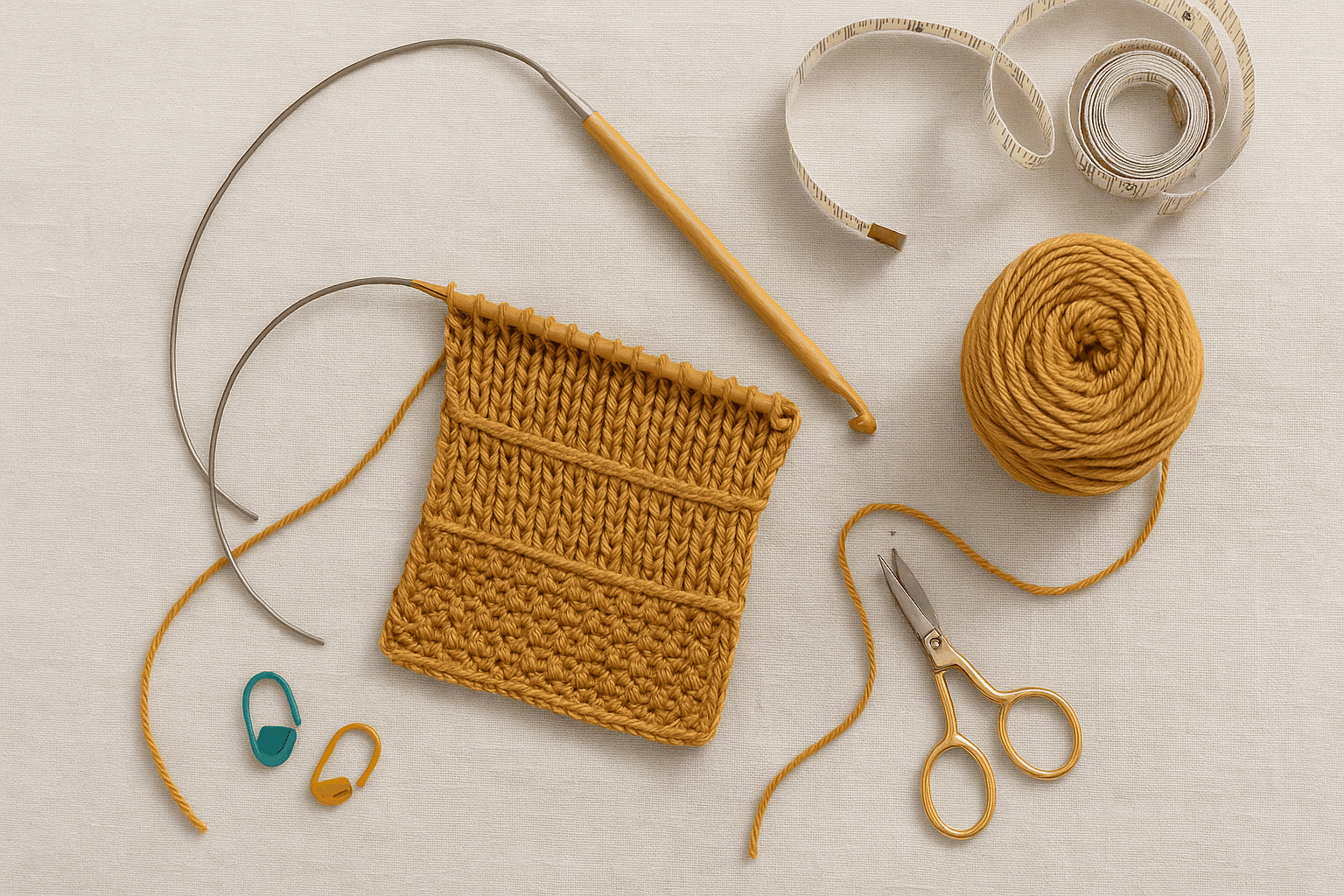
Tunisian crochet: what it is (and why it feels different)
Tunisian crochet—sometimes called Afghan crochet—sits in the sweet spot between knitting and crochet. You use one hook, but you hold multiple loops on the hook at once (like knitting), creating a dense, structured fabric with a distinctly “woven” look. The hallmark is the two-part row:
- Forward pass: you pick up loops across the row and keep them on the hook.
- Return pass: you work those loops off the hook, usually with yarn overs and pull-throughs.
Because you’re building a row of loops before closing it, Tunisian crochet creates a fabric that’s often:
- Thicker and warmer than standard crochet.
- More stable (less drape depending on stitch and yarn).
- Texture-rich with strong stitch definition.
It’s also a technique that rewards patience: small changes in hook size, yarn fiber, and tension can make a big difference in curl, drape, and ease.
Tools: hooks, cables, and why they matter
Tunisian hooks (straight vs. cabled)
You can work Tunisian crochet with:
- Straight Tunisian hooks: long like a knitting needle, often with an end stop. Great for narrow projects (dishcloths, scarves).
- Interchangeable hooks with cables: best for anything wider (blankets, shawls, sweaters). The cable holds loops comfortably without forcing them to crowd the hook.
- Double-ended Tunisian hooks: used for working in the round or for colorwork techniques where you alternate ends.
Practical tip: If you ever feel like your loops are getting tight and hard to move, it’s often the shaft length or cable flexibility as much as your tension. A smoother cable and a hook with a consistent shaft diameter can instantly improve the experience.
Hook material and friction
Different materials affect how easily loops slide:
- Aluminum/metal: fast, smooth, great for sticky fibers (wool, acrylic).
- Bamboo/wood: more grip, helpful if your tension runs loose, but may feel draggy with splitty yarn.
- Resin/acrylic: often in-between; can be lovely for long sessions due to warmth in the hand.
Sizing: go up more than you think
A classic Tunisian rule: use a hook 1–2 sizes larger than the yarn label suggests. Because loops stack on the hook and the fabric compresses, using a larger hook helps prevent stiffness.
- For a worsted yarn calling for a 5 mm crochet hook, try 6–7 mm for many Tunisian stitches.
- If you want a firm fabric (bags, baskets), you can intentionally size down—but do so knowingly, and expect curl to increase.
Understanding stitch mechanics (the key to better fabric)
To improve at Tunisian crochet quickly, it helps to understand what the stitches are structurally.
The “vertical bar” and why it changes everything
In Tunisian crochet, many stitches are worked into a vertical bar on the front of the fabric (rather than under top loops like standard crochet). Those vertical bars are like little posts. How you interact with them determines texture and drape.
- Working under the vertical bar tends to create clean, grid-like fabric.
- Working between bars or under different parts of the stitch changes the fabric’s elasticity.
The return pass: your hidden design partner
Most beginners focus on the forward pass stitch, but the return pass also shapes the final look. The standard return pass (yarn over, pull through one; yarn over, pull through two repeatedly) resembles a chain edge running along the back.
Changing the return pass can:
- add texture (e.g., purl-like ridges),
- alter stretch,
- reduce curl,
- or create colorwork effects.
Think of Tunisian as a “two-layer decision”: forward pass stitch + return pass style.
Getting started: a clean foundation and edge control
Foundation options
Tunisian projects usually begin with one of these:
- Chain foundation: simplest; chain the width, then pick up loops into the back bumps.
- Foundation single crochet (FSC) then pick up loops: gives a slightly stretchier base, great for wearables.
- Tunisian foundation row (built-in): some stitch dictionaries teach a foundation row that creates more stable edges.
Tip for neat edges: When you pick up loops in the foundation chain, insert the hook into the back bump (the third loop). This makes a straighter, less gappy edge.
The often-forgotten “last stitch”
Tunisian edges get messy when the last stitch is skipped or inconsistently worked. Many Tunisian rows end by inserting the hook under two strands at the edge (often the last vertical bar plus an edge strand). Be consistent across the project.
If your edge looks like:
- Loose ladders: you’re likely missing the final edge pickup.
- Bulky knots: you may be grabbing too many strands or yanking the loop too tight.
Essential Tunisian stitches (with what they’re good for)
Below are foundational stitches you’ll see in patterns and stitch dictionaries, plus what to expect from each.
Tunisian Simple Stitch (TSS)
How it looks: classic woven grid.
Pros: easy rhythm, great for colorwork, clean texture.
Cons: notorious for curling; can be stiff.
Best for: blankets (with borders), bags, panels, pillows.
Tunisian Knit Stitch (TKS)
Worked like you’re knitting: insert hook between the front and back vertical bars.
Pros: knit-like “V” columns, excellent stitch definition.
Cons: curl can still happen; can bias if tension varies.
Best for: garments, ribbing combos, textured panels.
Tunisian Purl Stitch (TPS)
Creates a bump like knitting’s purl.
Pros: great for texture, can reduce curl when alternated.
Cons: slightly slower; uses a bit more yarn.
Best for: honeycomb patterns, ribbing-like textures, scarves.
Tunisian Half Double Crochet (THDC)
There are a few variants, but generally adds height and softness.
Pros: more drape, less dense than TSS.
Cons: can look uneven if tension varies.
Best for: shawls, wraps, relaxed garments.
Tunisian Full Stitch (TFS)
Worked between stitches (into the gap).
Pros: airy, drapey, less curl.
Cons: gaps may be too open for warmth unless paired with thicker yarn.
Best for: lightweight wraps, summer tops, lacy blankets.
Combining stitches for stability
Many “signature” Tunisian fabrics come from alternating stitches:
- Honeycomb stitch: typically alternates TSS and TPS across rows, creating a plush, low-curl fabric.
- Basketweave-like textures: mix TKS and TPS blocks.
- Ribbing effects: use Tunisian knit/purl combos or work rows in different directions.
Yarn selection: fiber, ply, twist, and why Tunisian shows everything
Tunisian crochet can be brutally honest about yarn choice. The fabric’s structure highlights stitch definition, color changes, and inconsistencies.
Fiber content and behavior
Wool (and wool blends):
- Pros: resilient, blocks well, warmth, elasticity.
- Great for: garments, hats, cozy wraps.
- Note: Wool’s “memory” helps reduce the look of uneven tension after blocking.
Acrylic:
- Pros: budget-friendly, easy care, consistent.
- Great for: blankets, home decor.
- Note: Acrylic can feel stiff in dense Tunisian stitches; consider larger hook sizes.
Cotton:
- Pros: crisp stitch definition, cool feel.
- Great for: dishcloths, summer tops, bags.
- Note: Cotton has less elasticity, so tension issues and hand fatigue can increase. Curl can feel more “stubborn.”
Linen, hemp, bamboo blends:
- Pros: drape and sheen, breathable.
- Great for: shawls, tops.
- Note: These fibers can be slippery or splitty; try a hook with a slightly grippier surface.
Ply and twist: the stitch-definition factor
- High-twist, multi-ply yarns show crisp vertical bars and clean geometry.
- Single-ply yarns can look fuzzy and may pill faster in high-friction items.
If you want a bold Tunisian texture (honeycomb, knit stitch columns), choose a yarn with good ply definition.
Variegated and self-striping yarn
Tunisian fabric can “pool” color in dramatic ways because the forward and return passes consume yarn differently than standard crochet.
- Busy variegation may obscure texture.
- Long stripes can look stunning in simple stitches.
Tip: Swatch at least 20–25 stitches wide to see how colors behave over both passes.
Gauge and swatching (especially for wearables)
Tunisian gauge can differ significantly from standard crochet gauge, even with the same hook and yarn.
Why gauge surprises happen
- Tunisian stitches often create taller rows and less horizontal stretch.
- Return pass tension affects width.
Swatch smarter, not smaller
For garments, aim for a swatch:
- at least 6 x 6 inches (15 x 15 cm),
- washed/blocked the same way you’ll treat the finished piece,
- measured after resting (some fibers relax over 24 hours).
Measuring tip: Because Tunisian fabric can “spring back,” lay it flat without stretching, and measure in the center away from edges.
Managing curl: prevention and cures
Curl is the #1 Tunisian frustration. It’s not a flaw in your technique—it’s physics. Many Tunisian stitches (especially TSS) pull the fabric inward because the front-facing vertical bars create tension imbalance.
Prevention strategies
-
Use a larger hook
- The easiest fix. More space in the loops = less aggressive curling.
-
Choose a lower-curl stitch pattern
- Honeycomb, full stitch, and stitch mixes tend to curl less than plain TSS.
-
Add edge stitches (selvedges)
- Adding 1–3 stitches of a stabilizing stitch on each side (like Tunisian reverse stitch or even a simple slip-stitch-like edge) can help.
-
Plan a border from the start
- A standard crochet border (single crochet, half double crochet, or reverse single crochet/crab stitch) can flatten edges dramatically.
-
Block appropriately
- Wool: wet block and pin flat.
- Acrylic: “steam blocking” carefully can relax fibers (avoid touching iron directly).
- Cotton: wet block works well, but may need firm pinning.
When curl won’t quit
If you’ve finished a project and it’s still curling:
- Add a wider border than you think (2–3 rounds).
- Try a contrasting border in a slightly smaller hook for a firm frame.
- Consider adding a fabric lining for bags/pouches (stabilizes and prevents rolling).
Pattern examples you can try (with skill-building goals)
Below are practical project “templates” rather than full line-by-line patterns—designed to be adaptable and to teach core Tunisian skills.
1) Beginner dishcloth: TSS with a stabilizing border
Goal: learn forward/return pass rhythm, build neat edges.
Recipe:
- Yarn: worsted cotton.
- Hook: Tunisian hook 6–7 mm.
- Foundation: chain 26.
- Work TSS for ~24 rows.
- Finish with 1–2 rounds of standard crochet single crochet around the square.
Why it works: the border tames curl and gives you a tidy finish fast.
2) Cozy scarf: Honeycomb stitch (low curl, high texture)
Goal: learn alternating stitches, build consistent tension.
Recipe:
- Yarn: wool or acrylic worsted.
- Hook: 6.5–8 mm depending on desired drape.
- Foundation: chain 35–45 for scarf width.
- Forward pass: alternate TSS and TPS across.
- Return pass: standard.
- Length: 60–80 inches.
Finishing options: fringe, twisted fringe, or a simple single crochet edge.
3) Knit-look cowl: Tunisian Knit Stitch in the round
Goal: explore circular Tunisian and reduce seaming.
Recipe (conceptual):
- Use a double-ended hook or a cabled hook suitable for working in the round.
- Work TKS in a tube; add a few rounds of ribbed edging using a knit/purl combo.
Tip: Circular Tunisian often alternates working around the tube so the fabric stays balanced and less prone to curling.
4) Simple blanket block system: modular Tunisian squares
Goal: manage width limitations and practice blocking.
Recipe:
- Make 10–12 inch squares in TSS, honeycomb, or textured mixes.
- Block each square.
- Join with a standard crochet join (slip stitch or single crochet) or whip stitch.
Why it works: modular projects avoid the “too many loops on one cable” issue and make large projects feel more achievable.
Colorwork in Tunisian crochet: clean lines and bold geometry
Tunisian crochet is excellent for colorwork because stitches form a tidy grid.
Simple stripes
Stripes are straightforward: change color at the end of the return pass (or at the start of the forward pass, depending on the effect you want). The key is consistency.
- Changing at the end of the return pass often creates a cleaner transition.
Two-color Tunisian (forward/return color split)
A classic technique uses:
- Color A for the forward pass
- Color B for the return pass
This creates a subtle marled or woven look and can make even simple stitches look intricate.
Tip: Use yarns of similar weight and fiber so the fabric stays balanced.
Intarsia and bobbins
Because Tunisian rows pick up loops across, intarsia is possible but can get tangled. If you try it:
- Use bobbins or butterflies.
- Keep color areas separated.
- Periodically untwist yarns.
Shaping and garment considerations
Tunisian garments are absolutely doable, but shaping requires forethought because the fabric is less elastic sideways than knitting.
Increasing and decreasing basics
- Increases often involve picking up extra loops in a space or working into the same bar in a specific way.
- Decreases can be done by pulling through multiple loops or skipping bars strategically.
Practical advice: When using a pattern, follow its specified increase/decrease method—different designers choose methods that align with their stitch pattern so the shaping doesn’t interrupt the texture.
Drape management
If your garment feels too stiff:
- switch to a drapier stitch (TFS, THDC variants),
- move up another hook size,
- choose a yarn with more drape (wool/silk blends, bamboo blends),
- and block aggressively within the fiber’s limits.
Finishing techniques: bind-offs, borders, and seaming
Bind-off (last row) options
Many Tunisian pieces end with a Tunisian bind-off that resembles slip stitches worked across the loops, producing a tidy edge.
- A tighter bind-off can cause puckering—size up your hook for the bind-off if needed.
Borders: function and style
Borders are not just decorative in Tunisian—they’re structural.
Good border choices:
- Single crochet: firm, simple, great at flattening.
- Half double crochet: slightly softer.
- Crab stitch (reverse single crochet): rope-like, decorative, stabilizing.
- Picot edging: pretty, but can add stiffness.
Seaming: keep the structure
Tunisian fabric can be thick. For seams:
- Use mattress stitch for invisible joins.
- Use slip stitch crochet seams for sturdy, decorative joins.
Tip: Block pieces before seaming for best alignment.
Troubleshooting: common issues and precise fixes
Problem: fabric is extremely stiff
Likely causes: hook too small, dense stitch choice, tight return pass.
Fixes:
- Go up 1–2 hook sizes.
- Try THDC or TFS instead of TSS.
- Loosen return pass tension; don’t choke the yarn.
Problem: edges look uneven or lumpy
Likely causes: inconsistent last-stitch pickup, changing tension at row ends.
Fixes:
- Mark the last stitch and ensure you pick it up every row.
- Keep the final loop on the hook the same height as others.
- Consider adding 1 edge stitch each side in a stabilizing stitch.
Problem: holes or gaps along the edge
Likely causes: skipping the edge strand; inserting hook into only one strand.
Fixes:
- Insert hook under two strands at the edge consistently.
- Avoid pulling the first loop of the forward pass too tight.
Problem: return pass looks messy on the back
Likely causes: yarn overs inconsistent, loops twisted, tension jerky.
Fixes:
- Practice return pass slowly: pull through 1, then pull through 2 repeatedly.
- Keep yarn tension steady; let the hook do the work.
- Use a smoother hook material if yarn is snagging.
Problem: curling won’t block out
Likely causes: stitch choice (TSS), tight gauge, border too narrow.
Fixes:
- Add a wider border.
- Wet block and pin firmly (wool/cotton).
- Steam block carefully (acrylic).
- If starting over is an option: switch to honeycomb or full stitch.
Problem: hand fatigue
Likely causes: cotton yarn + tight tension, hook grip, long sessions.
Fixes:
- Use an ergonomic hook handle.
- Increase hook size.
- Take breaks every 20–30 minutes; stretch hands and forearms.
- Try a yarn with more give (wool blend) for long projects.
Building your Tunisian “skill stack”: a learning path
If you want steady progress without overwhelm, try this sequence:
- TSS washcloth (learn structure, edges, border)
- Honeycomb scarf (learn stitch alternation, reduce curl)
- Tunisian knit stitch cowl (learn knit-look fabric and tension)
- Modular blanket (learn blocking consistency and joining)
- Wearable with shaping (learn gauge discipline and fit adjustments)
This path deliberately revisits fundamentals—edges, tension, blocking—because those are what make Tunisian look polished.
Expert resources and references (for deeper study)
If you want stitch libraries and technique variations, these are widely respected in the crochet community:
- The Tunisian Crochet Handbook by Toni Lipsey (clear visuals and modern patterns).
- Tunisian Crochet Stitch Dictionary by Anna Nikipirowicz (broad stitch reference).
- Interweave and Crochet Guild of America (CGOA) educational materials (technique articles and standards).
- Yarn behavior and fiber fundamentals: resources from organizations like The Woolmark Company (for wool properties) and reputable spinning/weaving references can help you understand elasticity, crimp, and blocking response.
Final thoughts: why Tunisian is worth the learning curve
Tunisian crochet offers a unique combination: the meditative rhythm of building a row, the satisfying structure of a fabric that holds its shape, and the creative freedom to blend crochet and knit aesthetics without switching tools. Once you understand the mechanics—especially edges, return-pass tension, and yarn choice—you’ll find it’s incredibly versatile.
If you’re deciding what to try next, choose a project that solves a real need: a scarf you’ll wear, a dishcloth you’ll use, or a pillow cover that shows off texture. Tunisian rewards repetition, and every swatch teaches you something about fiber, tension, and drape.