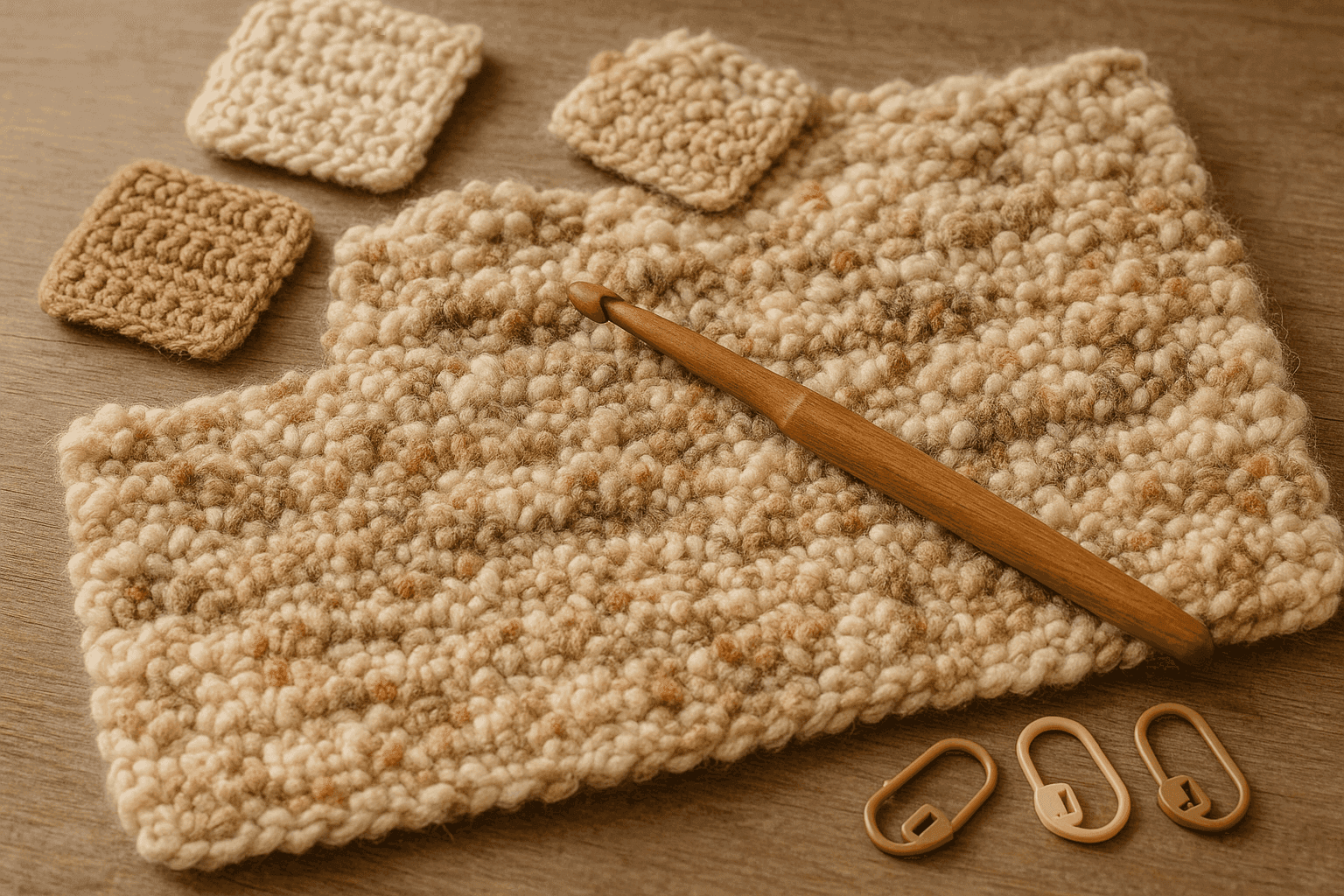
There is a particular kind of optimism that appears when you pull a skein of bouclé, slub, thick-and-thin, or nep yarn from the shelf and think, This texture is going to do all the work for me. Then you crochet three inches, lose sight of every stitch you just made, discover that one row is nearly half an inch taller than the next, and realize novelty yarn is not difficult because it is “bad,” but because it behaves like a material with its own agenda.
That is exactly why these yarns are so exciting in crochet. They are not merely substitutes for smooth, plied yarns with extra personality. They are surface-design tools. Loop pile catches light differently. Slubs create built-in punctuation. Thick-and-thin yarn exaggerates relief, density, and drape shifts across a fabric. Neps produce a flecked, pebbled visual field that can soften stitch definition or enliven a plain silhouette. When you stop expecting these yarns to behave like a classic wool or cotton and start designing for their irregular architecture, your choices about hook size, stitch pattern, shaping, seams, finishing, and even repairs become much clearer.
If you have ever wanted to use textured novelty yarns without fighting them the entire way through a project, the key is to treat their irregularity as a structural property, not just a decorative effect. Crochet responds strongly to yarn diameter, surface friction, elasticity, and visibility. A smooth yarn can forgive small inconsistencies. Bouclé and slub yarns amplify them. But when handled deliberately, they can create fabrics that look sophisticated, dimensional, and intentionally designed rather than chaotic.
Understanding what these yarns actually do in crochet
Before getting into technique, it helps to separate these yarns by structure, because each one creates a different set of opportunities and problems.
Bouclé yarn has loops formed around a core strand. Sometimes there is also a binder ply holding those loops in place. In crochet, those loops obscure stitch anatomy, increase snag potential, and alter the apparent thickness of the yarn without always adding proportional structural strength. Bouclé often creates a soft, haloed, nubby surface that can be cozy and luxurious, but it can also hide where the hook should enter and make ripping back unpleasant.
Slub yarn has deliberately thickened sections spaced along a smoother base. The slubs may be subtle or dramatic. In crochet, these thicker spots create localized bulk, increase visual rhythm, and can distort row height or stitch width if the slubs cluster in one area. Slub yarn often works beautifully in simple stitch patterns where the slubs read like intentional design notes.
Thick-and-thin yarn varies more continuously in diameter. Unlike slub yarn, which tends to have punctuated thick spots, thick-and-thin yarn may swing repeatedly between fine and bulky sections. Crochet fabric made from it can become lively and sculptural, but gauge becomes less stable, and shaping must be approached with more tolerance.
Nep yarn contains small flecks or nublets, often from added fiber bits or structural irregularities. Neps usually interfere less with hook entry than bouclé, but they soften stitch definition and can slightly increase abrasion or pilling depending on fiber content and how firmly they are anchored.
All of these yarns affect crochet in six major ways:
- Hook entry becomes less obvious.
- Stitch visibility is reduced or distorted.
- Gauge, especially row gauge, becomes less predictable.
- Seam behavior changes because the surface is bulkier or less stable.
- Abrasion resistance and snag risk shift depending on the texture and fiber.
- Blocking response can be uneven because the decorative structure blooms, collapses, or resists reshaping differently than the core yarn.
Once you understand those variables, you can design around them instead of trying to force perfect stitch-definition logic onto a deliberately imperfect yarn.
The first design decision: exploit texture or frame it
When makers struggle with novelty yarn, it is often because the yarn and the stitch pattern are competing. If the yarn already creates heavy surface action, an intricate stitch pattern may disappear completely. A deeply textured yarn paired with post stitches, cable motifs, tiny lace repeats, or elaborate shaping can turn into visual static.
The most successful projects with bouclé and slub yarns usually do one of two things:
- Exploit the yarn texture directly by choosing simple stitches and silhouettes that let the yarn become the pattern.
- Frame the textured yarn by pairing it with smooth yarn sections, carry-alongs, edgings, panels, or shaping zones where stitch definition matters.
This is why boxy pullovers, cocoon cardigans, simple hats, scarves, roomy vests, and soft home décor are common winners for novelty yarn. The silhouette gives the texture room to be itself. By contrast, highly tailored garments, crisp lace, and motifs that require exact stitch counting may demand either a very restrained novelty yarn or strategic pairing with a smoother companion.
How irregular yarn architecture changes hook entry
Hook entry is the first practical challenge. With smooth yarn, you can usually identify the top loops of each stitch quickly. With bouclé in particular, loops on the yarn can sit over the actual stitch legs and obscure where the hook belongs. In slub and thick-and-thin yarns, oversized sections can fill the stitch space so fully that insertion feels cramped.
A few principles help immediately:
- Use a hook with a comfortable, tapered or hybrid head if you need more precise entry. Very blunt hooks can struggle in dense novelty fabrics.
- Consider going up 0.5–1.5 mm from the nominal recommendation for the yarn when working bouclé or aggressively slubbed yarn, especially if you are not pairing it with a carry-along. More space around the stitch improves visibility and reduces splitting or snagging loops.
- Work by touch as much as by sight. Learn to feel the top “V” of the stitch or the post beneath the surface texture.
- Use stitch markers frequently. Place them every 10 or 20 stitches across a row, and mark first and last stitches without fail.
Recommended hook starting points
These are starting ranges, not fixed rules:
- Fingering or sport bouclé/slub: 4.0–5.0 mm
- DK novelty yarn: 5.0–6.0 mm
- Worsted novelty yarn: 6.0–7.0 mm
- Bulky bouclé or thick-and-thin: 8.0–10.0 mm
If carrying a smooth yarn alongside, you may be able to come down slightly, because the smooth strand improves structure and stitch readability.
Why stitch visibility matters more in crochet than knit fabrics
Crochet has more distinct, sculptural stitch architecture than many simple knitted fabrics. That can be a strength with smooth yarns, but with looped or irregular yarns, stitch visibility is often reduced to the point that pattern complexity becomes self-defeating.
As a general design rule:
- Bouclé loves simple stitches: single crochet, half double crochet, double crochet, linen stitch, and very simple mesh.
- Slub and nep yarns can tolerate slightly more structure: moss stitch, extended single crochet, herringbone half double crochet, and broad shell repeats can work.
- Thick-and-thin yarn needs open-minded gauge expectations and usually benefits from uncomplicated stitch architecture.
A useful test swatch is to work the same yarn in:
- single crochet,
- half double crochet,
- double crochet,
- moss stitch.
Make each section at least 20 stitches wide and 12 rows tall. In most textured yarns, one of those four will suddenly look “right,” not because the stitch itself is special, but because it gives the yarn enough room to expand and settle.
Gauge instability: why row gauge is usually the bigger problem
Many crocheters focus on stitch gauge first: how many stitches fit in 4 inches/10 cm. With novelty yarn, row gauge often drifts more dramatically than stitch gauge. This happens because thickened sections and loop pile influence how tall each row sits, how much it compresses, and whether the yarn blooms after resting.
A slub that lands across the top of several stitches can push the next row upward. Bouclé loop pile can compact under tension while you crochet, then rebound after the fabric relaxes. Thick-and-thin yarn may alternate between fine, shorter rows and fluffy, taller rows.
How to swatch for realistic gauge
For novelty yarn, a meaningful swatch should be larger than your usual quick square.
Recommended swatch size:
- Chain enough for 30–40 stitches.
- Work 20–24 rows in pattern.
- Measure the center 4 x 4 inches / 10 x 10 cm after the swatch has rested at least several hours.
If making a garment, create two swatches:
- One in the novelty yarn alone.
- One with the novelty yarn plus any smooth carry-along.
Record:
- stitch count over 4 inches,
- row count over 4 inches,
- fabric weight and drape,
- how much the swatch grows when hung briefly,
- how it changes after steam or wet blocking.
Sample gauge comparison
For example, a textured worsted bouclé might produce:
- In hdc with 6.5 mm hook: 12 stitches x 10 rows = 4 inches
- Same yarn + laceweight smooth wool carry-along on 6.0 mm hook: 13 stitches x 11 rows = 4 inches
That small increase in stability can make all the difference in a sweater body or sleeve cap.
When to pair textured yarns with smooth carry-alongs
One of the smartest techniques for crocheting irregular yarn is to pair it with a smoother strand. This is not cheating. It is engineering.
A smooth carry-along can:
- improve stitch visibility,
- stabilize gauge,
- reduce stretching,
- reinforce weak cores in bouclé or loosely spun thick-and-thin yarns,
- reduce snagging because loops are better anchored,
- make seaming and finishing easier.
Good reasons to add a smooth companion
Add a carry-along when:
- the novelty yarn has poor recovery,
- the core appears fragile or loosely spun,
- the project needs shape retention,
- you need cleaner edges for armholes, necklines, or button bands,
- row gauge is fluctuating too much,
- abrasion is a concern, such as cuffs, underarms, or bag straps.
What kind of smooth yarn to choose
A carry-along can be:
- a matching-color wool or wool blend for resilience,
- a fine cotton for crispness and reduced bloom,
- a silk or alpaca blend for drape, though these may reduce recovery,
- a nylon-rich fine strand when durability matters.
A good rule is to choose a smooth carry-along at lace, cobweb, or light fingering weight so it supports rather than dominates. Usually, the combined fabric works best if the smooth strand is visually recessive.
Pairing examples
- Bouclé + laceweight wool: adds elasticity and memory.
- Slub cotton + fine mercerized cotton: improves edge definition and seam clarity.
- Thick-and-thin wool + fine nylon blend: helps durability in high-wear accessories.
- Nep yarn + mohair/silk: only when you want more halo and softness, but beware of excess obscuring.
Fiber content: bloom, recovery, and snag risk
The decorative structure of novelty yarn is only part of the story. Fiber content determines how that structure behaves over time.
Wool and wool blends
Wool often offers the best balance of bloom and recovery. In bouclé, wool loops may soften and fill out attractively after blocking. In slub yarns, wool can help thick spots integrate into the fabric instead of sitting rigidly on top. The downside is that lofty wool bouclé can snag and felt with abrasion.
Best for: sweaters, hats, soft scarves, cushioned home décor.
Alpaca
Alpaca brings softness and drape, but less spring than wool. In a bouclé or thick-and-thin structure, alpaca may lengthen under weight and recover poorly. It can be gorgeous in relaxed silhouettes but risky in fitted garments.
Best for: draped wraps, roomy cardigans, cowls.
Cotton and linen
Plant fibers produce clearer, less elastic fabrics. Slub cotton can be wonderfully architectural, but row gauge inconsistency may become more visible because the fabric does not spring back into shape. Bouclé in cotton can feel heavy and may sag if the loops are not well anchored.
Best for: open summer tops, bags with reinforcement, textured home pieces.
Acrylic and synthetics
Acrylic bouclé can be soft, affordable, and washable, but may pill or snag depending on construction. Recovery varies widely. Some synthetics hold loop texture well; others flatten with wear. Heat sensitivity also affects blocking options.
Best for: easy-care accessories, throws, some garments if carefully swatched.
Silk, viscose, bamboo, and rayon blends
These fibers add sheen and drape but can reduce structural resilience. In thick-and-thin yarns they may emphasize collapse between thick spots. In bouclé they can be slippery to handle and less forgiving in seams.
Best for: elegant scarves, light layering pieces, trim sections rather than fully structured garments.
Snag risk by texture type
Highest snag risk tends to occur in:
- long-loop bouclé,
- loosely anchored slubs,
- brushed novelty yarns with weak cores.
Lower snag risk tends to occur in:
- tightly bound neps,
- short bouclé loops on a firm core,
- slub yarns with moderate rather than dramatic thick spots.
If the project will rub against coat linings, desks, bag straps, or frequent seating surfaces, choose stronger cores and tighter texture.
Stitch patterns that cooperate with irregular yarns
The right stitch pattern does not erase irregularity; it organizes it.
Best stitches for bouclé
1. Half double crochet (hdc)
- Balanced height and density.
- Fast to work.
- Enough openness to avoid an overpacked fabric.
2. Extended single crochet (esc)
- Gives slightly more length than sc.
- Helps bouclé loops settle without producing a stiff board.
3. Linen stitch / moss stitch
- Chain spaces can improve flexibility and reduce visual clutter.
- Best with smaller-loop bouclé.
Best stitches for slub and nep yarns
1. Double crochet (dc)
- Lets slubs sit visibly within a looser fabric.
- Works well in scarves, wraps, and easy garments.
2. Herringbone half double crochet
- Adds subtle directionality without fighting the yarn.
- Good for slub blends with moderate stitch visibility.
3. Simple shell repeats
- Use broad spacing, such as (2 dc, ch 1, 2 dc) into chain spaces.
- Avoid tiny fan repeats that disappear.
Best stitches for thick-and-thin yarn
1. Single crochet in the round
- Useful for hats and baskets where structure matters.
- Accept that the surface will vary strongly.
2. Double crochet mesh
- Excellent for shawls or layering pieces.
- Gives thick sections room to puff without buckling.
3. Tunisian simple stitch with caution
- Not standard crochet fabric, but can harness the yarn in graphic ways if curl and density are managed. Use only if the yarn does not create excessive drag.
Engineering silhouettes that work with the yarn instead of against it
Textured novelty yarn is at its best when the garment or object shape supports visual depth without demanding precision the yarn cannot reliably deliver.
Silhouettes that usually succeed
- Drop-shoulder sweaters
- Boxy vests
- Cocoon cardigans
- Simple beanies with folded brims in smooth contrast yarn
- Straight scarves and wraps
- Pillow covers with stabilized backing
These shapes tolerate slight gauge fluctuation and let the yarn provide the interest.
Silhouettes that require extra planning
- Set-in sleeves n- sharply tailored waist shaping
- fitted bust darts
- highly structured collars
- fine lace yokes
These are not impossible, but you should plan for either a smooth companion yarn, larger seam allowances in seaming terms, or selective use of novelty yarn only in panels.
Smart placement strategies
Use novelty yarn where texture helps the eye:
- upper yoke or sleeve caps for visual softness,
- hem or cuff bands only if paired with sturdier yarn for stretch control,
- front panels framed by smooth side panels,
- collar, pocket, or trim accents.
Avoid placing the most snag-prone yarn in:
- underarms,
- side seams that rub,
- elbow patches unless reinforced,
- bag bottoms and straps.
A practical step-by-step design workflow
Here is a reliable process for planning a crochet project with bouclé, slub, thick-and-thin, or nep yarn.
Step 1: Audit the yarn
Before swatching, examine:
- core strength,
- loop size or slub frequency,
- elasticity,
- fiber content,
- whether the yarn sheds, blooms, or snags easily.
Stretch a length gently and release it. If it does not recover well, note that fitted shapes may grow.
Step 2: Choose two candidate hook sizes
Select one hook at the label recommendation and one 0.5 to 1.5 mm larger. For a worsted bouclé labeled 5.5 mm, for example, test 5.5 mm and 6.5 mm.
Step 3: Work four mini swatches
Using at least 24 stitches each, swatch in:
- sc,
- hdc,
- dc,
- moss stitch.
Work 12–16 rows on each. Do not judge while the swatch is still compressed in your hands.
Step 4: Rest and measure
Let the swatches rest flat for several hours. Measure center sections only. Record approximate counts such as:
- hdc swatch with 6.5 mm: 13 sts x 9 rows = 4 inches
- moss swatch with 6.5 mm: 12 pattern stitches x 11 rows = 4 inches
Step 5: Stress-test the fabric
Rub lightly, tug vertically, and pin one corner briefly to simulate hanging. Decide whether the fabric slumps, blooms, snags, or holds.
Step 6: Decide whether to add a smooth carry-along
If edges look messy, recovery is poor, or rows are wildly uneven, swatch again with a smooth laceweight companion.
Step 7: Simplify the silhouette
For your first design with a difficult novelty yarn, choose rectangles, gentle trapezoids, or top-down rounds with minimal complex shaping.
Step 8: Build transition logic if mixing plain and novelty yarn
Plan exactly where the novelty starts and stops. Put transitions on rows where the stitch count stays constant whenever possible.
Step 9: Add generous markers during construction
For garments, mark:
- side “seams” or faux seam lines,
- armhole depth,
- neckline start points,
- every shaping decrease or increase section.
Step 10: Finish with reinforcement in mind
Ends, seams, and joins often need more thought than in smooth yarn projects.
Managing clean transitions between novelty and plain yarn sections
A textured section next to a smooth section can look polished and intentional, but only if the change is controlled. The biggest issue is that the novelty yarn often occupies more visual volume than its measured gauge suggests.
Transition principles
- Change yarns at a row or round boundary when possible.
- Match fabric behavior, not just stitch counts. A novelty hdc fabric may pair better with smooth sc or esc than with smooth hdc if row heights differ.
- Swatch the transition itself. Do not assume separate gauges will align perfectly.
Example transition test
Suppose your bouclé section in hdc gives 12 sts x 10 rows = 4 inches on a 6.5 mm hook. Your smooth worsted section in hdc on the same hook might give 14 sts x 11 rows = 4 inches and look much thinner.
Possible fixes:
- switch the smooth section to esc or moss stitch,
- use a smaller novelty section hook and larger smooth section hook,
- add a fine carry-along to the novelty only if needed for stability,
- place a deliberate divider row, such as one row of smooth sc worked into the novelty, to visually reset the fabric.
Divider rows that work well
- one round/row of smooth sc,
- reverse single crochet/crab stitch in the smooth yarn,
- a chain-space eyelet row before moving into plain yarn,
- surface slip stitch after completion to define the boundary.
Seams: bulk, creep, and visual blending
Seaming novelty yarn is not just a construction issue; it is a design issue. Bouclé and slub surfaces can either disguise seams beautifully or make them bulky and unstable.
Best seam strategies
1. Seam with a smooth matching yarn This is often the cleanest option. A smooth seaming yarn slides through the fabric more predictably and creates less lumpiness.
2. Use mattress-style or ladder-style joins where possible In crochet, exact mattress stitch logic differs from knitting, but the same principle applies: catch structural bars rather than stuffing the seam through bulky loop pile.
3. Consider slip stitch seams only for sturdy accessories Slip stitch seams can become thick and rigid in novelty yarn. They are better for hats, bags, or pieces where structure helps.
4. Stabilize shoulder seams For garments with weight, run a smooth reinforcement strand through the seam, especially with alpaca-rich bouclé or viscose-heavy thick-and-thin yarn.
Seam allowance in practice
Crochet does not have seam allowances in the sewing sense, but novelty fabrics benefit from planning a “seam zone.” Leave edge stitches slightly firmer and avoid placing the showiest slubs exactly at seam edges. A smooth edge treatment row before assembly can be invaluable.
Finishing woven-in ends so they do not worm out
Novelty yarn ends are notorious for creeping back to the surface, especially if the yarn is slippery, thick-and-thin, or looped in a way that prevents a snug weave.
Reliable end-weaving strategy
- Leave a longer tail than usual: 6–8 inches / 15–20 cm minimum, and longer for slippery fibers.
- Thread the tail onto a blunt tapestry needle if possible. If bouclé is impossible to thread, use a loop threader or attach a temporary smooth strand to guide it.
- Split the route into at least three direction changes.
- Weave through structural cores or dense stitch backs, not just decorative loops.
- For bouclé, if the tail is too bulky, separate out some loop pile from the end and weave the stronger core more discretely.
- In high-stress areas, duplicate the path with a fine matching sewing thread or smooth yarn anchor if the project must be very durable.
What not to do
- Do not rely on a short tail.
- Do not weave only through chain spaces.
- Do not trim flush immediately after blocking if the yarn is known to relax.
Leave a tiny bit of tail until the project has rested after its first wear or wash.
Repairs: how to fix snags, popped loops, and abraded spots
The challenge with repairing novelty yarn is that damage may hide until it becomes structural. A pulled bouclé loop might look cosmetic, but if it disturbs the core, the fabric can weaken.
Snagged bouclé loops
- Use a small crochet hook or blunt needle to gently pull the snagged loop to the fabric wrong side.
- Do not cut it unless you are certain it is purely decorative and disconnected from the core.
- Massage adjacent stitches to redistribute tension.
Abraded slub sections
If a slub wears thin at a friction point, duplicate-stitch style reinforcement is often not visually clean in crochet. Instead:
- anchor a matching smooth yarn on the wrong side,
- pass it through the structural path of neighboring stitches,
- lightly couch or support the weak section from behind.
Broken thick-and-thin yarn
When a thin section snaps:
- Identify whether adjacent stitches remain intact.
- If only one section failed, thread both broken ends to the wrong side.
- Splice visually by needle-weaving each end through several sturdy neighboring stitches.
- Add a reinforcing strand behind the area if it is load-bearing.
Replacing a damaged novelty section
In severe cases, it is often better to unravel to a controlled point or cut out the damaged area and graft in a replacement section using a smooth support yarn on the back. Because stitch visibility is low, invisible repair is sometimes easier than with smooth yarns—as long as the structure is stabilized.
Blocking response: bloom, collapse, and restraint
Blocking novelty yarn is less about forcing dimensions and more about encouraging the fabric to settle into its best version of itself.
Bouclé blocking
Bouclé often responds well to gentle wet blocking or light steam hovering, depending on fiber. The goal is to let loops relax and distribute evenly, not flatten them into submission.
Slub and thick-and-thin blocking
These yarns may show their irregularity more after blocking if the thinner sections relax differently from the thicker ones. Pinning every edge aggressively can create distortions between dense and sparse areas. Usually, softer shaping is better.
Nep yarn blocking
Nep yarn often changes least structurally, but the surrounding base fiber may bloom. Measure after drying, not during pinning.
Safe blocking practice
- Swatch first and block the swatch exactly as you intend to block the project.
- Avoid overhandling wet novelty fabrics; they can stretch unpredictably.
- Support the full weight of garments while drying flat.
- For acrylic or heat-sensitive synthetics, do not oversteam. Crushed texture is hard to restore.
Common mistakes and how to fix them
Mistake 1: Choosing a complicated stitch pattern
Problem: The fabric looks messy and the stitch work disappears.
Fix: Step back to hdc, esc, dc, or moss stitch. Let the yarn be the star.
Mistake 2: Trusting the label gauge
Problem: The project grows or narrows unpredictably.
Fix: Swatch at least 30–40 stitches wide and 20+ rows tall. Measure row gauge carefully.
Mistake 3: Working too tightly
Problem: Hook entry becomes miserable, loops snag, fabric turns board-like.
Fix: Go up one hook size. Reassess after a rested swatch.
Mistake 4: Using novelty yarn in high-friction zones without reinforcement
Problem: Underarms pill, cuffs wear, straps stretch.
Fix: Reinforce with smooth carry-along, substitute smoother yarn in those zones, or add backing/stabilization.
Mistake 5: Weaving ends only through the visible fluff
Problem: Ends worm out after wear.
Fix: Weave through the structural core path with multiple direction changes and longer tails.
Mistake 6: Forcing exact shaping from unstable gauge
Problem: Sleeve caps and necklines do not match.
Fix: Use simpler shapes, top-down fitting checks, or smooth-yarn trims that tame the edge.
Design variations that make textured yarns shine
If you want to incorporate bouclé, slub, thick-and-thin, or nep yarn without committing an entire project to them, these approaches are especially effective.
1. Framed panel design
Use novelty yarn only on front panels, center stripes, pocket facings, or sleeve cuffs, while the rest of the garment is smooth. This gives texture impact with easier shaping elsewhere.
2. Alternating-row strategy
Work one row with novelty yarn and one row with a smooth coordinating yarn. This can stabilize row gauge and create beautifully integrated texture.
For example:
- Row 1: novelty yarn hdc
- Row 2: smooth yarn sc
A 24-stitch swatch may become much more readable and resilient.
3. Carry-along marl effect
Pair a subtle slub or nep yarn with a fine tonal strand. The result looks refined rather than gimmicky and often improves wear.
4. Textured yoke, plain body
A bouclé or nep yoke above a smooth body can be visually rich while keeping the torso lighter and easier to fit.
5. Novelty edging with structural base
Crochet the main piece in smooth yarn, then add a novelty border or collar. This approach is especially good if you love the yarn but do not enjoy working with it for long stretches.
A sample planning scenario
Let’s say you want to design a boxy cropped cardigan using a slub wool-cotton blend.
You swatch and find:
- hdc with 6.0 mm hook: 14 sts x 11 rows = 4 inches
- dc with 6.5 mm hook: 12 sts x 8 rows = 4 inches
- moss stitch with 6.0 mm hook: 13 pattern sts x 10 rows = 4 inches
The dc fabric looks airy but too unstable at the slubs. The hdc fabric is balanced but slightly heavy. Moss stitch gives the best drape and distributes slubs attractively.
You then swatch a smooth fingering wool carry-along with the slub yarn in moss stitch and get:
- 14 pattern sts x 10.5 rows = 4 inches
Now the fabric is slightly firmer, edges are cleaner, and the side seams will be easier to assemble. So you choose:
- body: moss stitch rectangles,
- shoulders: seamed with smooth yarn,
- button band: entirely smooth yarn in sc for crisp function,
- cuffs: smooth yarn ribbing to control stretch.
That is exactly what it means to use novelty yarn deliberately. You are not just accepting its quirks. You are assigning it the role it performs best.
The big takeaway
Bouclé, slub, thick-and-thin, and nep yarns reward a shift in mindset. They are not failed smooth yarns. They are textured materials with distinct structural behaviors. In crochet, that means you must account for obscured hook entry, reduced stitch visibility, unstable row gauge, bulkier seams, variable abrasion resistance, and nuanced blocking response.
But it also means you gain something smooth yarn cannot offer on its own: built-in surface design.
If you remember only a few principles, let them be these:
- Swatch larger than usual and pay close attention to row gauge, not just stitch gauge.
- Choose simple stitch patterns that organize the yarn instead of competing with it.
- Use smooth carry-alongs when you need visibility, recovery, or durability.
- Match the silhouette to the yarn’s structural honesty: relaxed shapes for unstable yarns, more support for fitted areas.
- Reinforce seams, transitions, and ends with intention.
- Block gently and let the yarn settle rather than trying to dominate it.
When approached this way, novelty yarns stop feeling like a battle and start functioning as one of crochet’s most interesting design languages. The loops, slubs, bumps, flecks, and thick-thin shifts become more than decoration. They become the architecture of the fabric itself—and that is where the real pleasure begins for a crocheter who loves both texture and control.