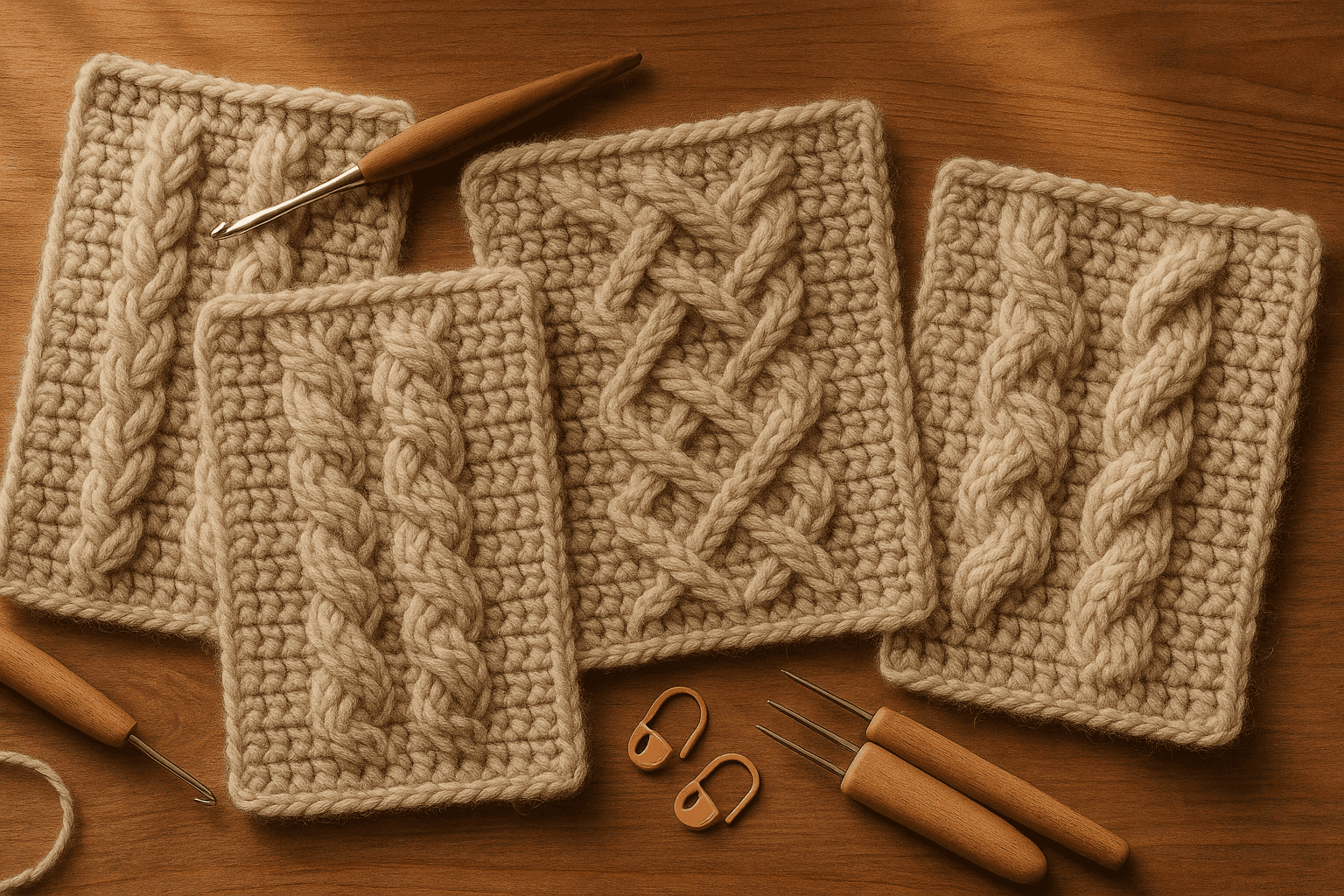
There is a particular kind of crochet optimism that happens when a swatch begins to rise off the fabric. You work a few ordinary rows, then a crossing row, and suddenly the surface develops shadow, lift, and a sculptural line your fingers want to trace again and again. Many of us first meet crochet cables through front-post stitches and simple left or right twists, and they can be beautiful. But at a certain point, you start wanting something more structural: not just a stitch pattern that resembles a cable, but a fabric that behaves like one. You want rope-like cords that sit proud of the ground, braids with convincing overlap, motifs that travel across the fabric without collapsing, and panels that can be shaped into real garments without becoming cardboard or chaos.
That is where crochet cable engineering becomes far more interesting than knit imitation.
The most satisfying advanced crochet cables are not successful because they look knitted. They work because the stitch architecture, background density, row compression, yarn structure, and finishing choices all support relief. In other words, cable clarity is built, not merely crossed. If you have ever made a cable panel that looked dramatic in the swatch but went soft and blurry in a sweater, or a traveling motif that puckered hard enough to distort the whole front, you have already met the real design problem. The cable itself is only one part of the system.
In this article, we will treat crochet cables as engineered structures. We will look at how to create true rope cables, braided cables, and traveling motifs without relying on the idea that crochet should mimic knitting. We will cover yarn and hook choices, the effect of ply and fiber memory, how the background fabric controls lift, how row height affects recoil, and how to plan shaping, charts, and finishing so the relief survives real use. Along the way, I will give practical stitch counts, swatch formulas, common mistakes, and fixes that make the techniques dependable rather than mysterious.
Why advanced crochet cables behave differently from knit cables
Knit cables are formed by changing the order of live stitches on the needle. Crochet, by contrast, usually completes one stitch at a time. That means most crochet cables must be created through one of three structural strategies:
- Post-based displacement: crossing stitch columns by working around posts in altered order.
- Surface or layered construction: building raised elements over or through a base fabric.
- Skipped-space or long-stitch travel: reserving anchor points and later spanning across them to create directional movement.
These methods are not inferior to knitting. They simply have different strengths. Crochet can produce deeper relief, firmer corded forms, and more architectural surfaces than knit cables, especially in accessories and outerwear fabrics. It also allows hybrid construction: a cable can be partly structural, partly surface-applied, and partly embedded in the background.
The key is to stop asking, “How do I fake a knit cable?” and instead ask, “What kind of raised line do I want, and what background will support it?”
That question changes everything.
The four structural variables that determine cable success
Before we get into specific cable types, it helps to understand the four variables that most affect the result.
1. Stitch architecture
Tall stitches such as trebles and double trebles cross more easily because they have length. Shorter stitches such as half double crochet and single crochet create denser ground fabrics and stronger contrast. Many excellent cable fabrics combine the two: tall crossing stitches over a short, compact background.
As a rule:
- Cable strands benefit from taller stitches: dc, tr, dtr, extended dc, linked dc/tr.
- Background fabrics benefit from shorter, denser stitches: sc, waistcoat stitch, hdc, esc, or linked stitches.
If both cable and background are equally soft and tall, the relief blurs.
2. Row compression
Cables require excess path length. A strand that crosses over another has to travel farther than a strand that goes straight up. In crochet, this often creates vertical compression or horizontal draw-in.
You can manage this by:
- adding rest rows between crossing rows
- using taller stitches in the cable than in the background
- loosening hook size slightly for cable rows only
- widening the background between cable strands
If you cross too frequently, the cable will buckle rather than rise.
3. Yarn ply, twist, and fiber memory
This is the variable many crocheters notice intuitively but do not always name.
- High-twist, plied yarns show cable definition best. The edges of the strands stay crisp.
- Smooth wool with elastic memory gives excellent recoil and spring, especially for rope cables and cuffs.
- Wool blends with a bit of nylon can be excellent for structured accessories because they hold shape without becoming too heavy.
- Cotton can show stitch detail beautifully, but with less recoil. Great for bags and home decor, less forgiving for deeply compressed garment cables.
- Single-ply or loosely spun yarns can make broad, soft cables, but fine crossing detail gets fuzzy.
- Alpaca-heavy yarns often drape beautifully yet can blur relief unless paired with a tight ground fabric.
For the clearest advanced cables, choose a 3- or 4-ply worsted or aran wool, wool blend, or high-twist merino, and avoid heavy halo until you know exactly how much definition you are willing to lose.
4. Background fabric density
The background is not empty space. It is the retaining wall that lets the cable stand up.
A cable panel worked over a loose dc fabric often sinks into the cloth. The same cable over hdc, linked dc, or dense sc ribs appears dramatically more raised. This is why a modest cable on a compact background often looks more impressive than a complicated crossing on a loose one.
A useful design principle is this:
The denser the ground, the greater the apparent cable lift.
That does not mean every background should be stiff. It means it should be intentionally chosen.
Recommended swatching setup before you design anything ambitious
For advanced cable work, I strongly recommend a proper engineering swatch, not just a decorative one.
Make a swatch at least 24 sts wide and 24 rows tall, or about 5 x 5 in / 12.5 x 12.5 cm after resting. Include:
- a cable panel
- at least 6 background stitches on each side
- two full crossing repeats
- one variation in crossing frequency
Suggested starting setup for worsted weight yarn:
- Yarn: worsted/aran, 180–220 m per 100 g, smooth plied wool or wool blend
- Hook for background: 5 mm (H-8)
- Optional hook for cable rows: 5.5 mm (I-9)
- Foundation: ch 26
- Row 1: sc in 2nd ch from hook and across, 25 sc
- Row 2: ch 1, turn, 6 sc, 13 hdc blo, 6 sc = 25 sts
- Rows 3–6: establish your cable panel over center 13 sts and maintain 6 sc each side
Why 13? It gives room for a 6-stitch rope cable with separators, or a 9-stitch braid center with margins.
Record three things:
- width before and after a crossing row
- row gauge over straight rows versus crossing rows
- visual clarity after the swatch has rested for several hours
Many cable swatches look over-tight fresh off the hook and settle later. That settling tells you whether the structure has true resilience.
Rope cables: building an actual corded line
A rope cable is the simplest advanced crochet cable to engineer well, and it teaches nearly every principle you need for more complex motifs. The goal is not merely a crossed pair of posts, but a corded line that appears to spiral or twist with a coherent edge.
Best structure for crochet rope cables
The most reliable crochet rope cables usually use:
- 2 over 2 or 3 over 3 strand crossings
- front-post double crochet (FPdc) or front-post treble (FPtr) for the strands
- a compact background such as hdc, esc, or sc
- 2–4 straight rows between crossing rows
A 2 over 2 cable is often crisper than a 3 over 3 cable in crochet because bulk escalates quickly. If you want a thicker rope, consider using taller stitches rather than simply more stitches.
Sample 2 over 2 rope cable panel
Worked flat over 12 stitches.
- Panel width: 12 sts
- Cable core: 4 sts
- Background separators: 2 sts each side of cable core
- Edge support: 2 sts each outer side
Foundation: ch 13
Row 1: dc in 4th ch from hook and across, 11 dc.
Row 2: ch 2, turn, 4 hdc, 4 bpdc, 3 hdc.
From here, think of sts 5–8 as the cable core.
Row 3 crossing row, right twist:
- ch 2, turn
- 4 hdc
- skip next 2 cable sts
- FPdc around each of next 2 sts
- FPdc around skipped 2 sts, crossing in front
- 3 hdc
Stitch count remains 11 sts.
Rows 4–6:
- maintain background as hdc
- work cable core as FPdc around the 4 cable posts in established order, no crossing
Row 7: repeat crossing row.
This produces a clean rope if the background is tighter than the cable stitches. If your hdc rows are too loose, switch them to sc or linked sc for more pushback.
Engineering notes for rope cables
- A 2/2 crossing every 4th row is a strong all-purpose rhythm for worsted yarn.
- For aran yarn, try crossing every 5th or 6th row if the fabric looks compressed.
- If the rope appears flat, move from FPdc to FPtr on the cable core only.
- If the rope splits visually into two columns instead of one cord, reduce separator stitches or increase crossing interval.
Common rope cable mistakes
Mistake: The cable panel pulls inward dramatically. Fix: Add 1 background stitch on each side of the cable, or cross less often.
Mistake: The crossing row looks strained and holes appear. Fix: Use a larger hook for crossing rows only, or switch from dc background to hdc/sc background so the cable strands can sit above a firmer base.
Mistake: The rope loses definition after blocking. Fix: Steam lightly without flattening; do not wet block aggressively unless the yarn needs it. For resilient relief, many cable fabrics only need resting and pinning to dimensions.
Braided cables: managing overlap and layered illusion
Braids are where crochet cable design gets especially architectural. A braid requires the eye to read multiple strands passing over and under each other in sequence. In crochet, this can be done several ways, but the most convincing braided effects usually come from either:
- three structural strands crossed in staged rows, or
- layered long-post or surface-applied strands anchored to a dense base.
The first method is better for garments. The second can be wonderful for cuffs, bags, and statement panels.
Three-strand structural braid
A practical braid can be built over 9 cable stitches, arranged as three groups of 3 sts each.
Layout:
- left strand = sts 1–3
- center strand = sts 4–6
- right strand = sts 7–9
Between major crossings, work plain post rows to let the strands separate visually.
A common sequence is:
- Cross left over center
- work 2–3 plain rows
- Cross right over center
- work 2–3 plain rows
- repeat
That alternating dominance creates a braided rhythm.
Sample braid panel setup
Worked over 19 stitches total:
- 5 hdc background
- 9-st cable field
- 5 hdc background
Foundation: ch 20
Row 1: hdc in 2nd ch from hook and across, 19 hdc.
Row 2: ch 1, turn, 5 sc, 9 bpdc, 5 sc.
Row 3 left-over-center crossing:
- 5 sc
- skip first 3 cable sts
- FPtr around next 3 sts (center strand)
- FPtr around skipped 3 sts, crossing in front (left strand over center)
- BPdc around last 3 cable sts (right strand stays back)
- 5 sc
Rows 4–5:
- 5 sc
- work all 9 cable sts as post stitches without crossing, using front post for visually dominant strands and back post for receding strands as needed
- 5 sc
Row 6 right-over-center crossing:
- 5 sc
- BPdc or plain post around first 3 cable sts
- skip next 3 cable sts
- FPtr around last 3 cable sts
- FPtr around skipped 3 sts, crossing in front (right strand over center)
- 5 sc
Repeat Rows 4–6 with the alternating crossing logic.
Stitch count remains 19 sts.
Why braids often fail in crochet
Braids fail when all strands are given equal visual depth at all times. In a real braid, one strand dominates while another recedes. Crochet can suggest this by changing not just crossing order, but also post position and stitch height:
- use front post trebles for the strand that should sit highest
- use front post doubles for secondary strands
- use back post stitches for receding strands
This is one of the places where crochet has its own language. You are creating depth cues, not merely trading stitch order.
Faux-braid alternative for lower bulk
If a full structural braid becomes too thick for cuffs or fitted garments, use a faux-braid method:
- establish three vertical anchor columns in a dense base fabric
- on designated rows, work long front-surface slip stitches or chained surface strands diagonally between columns
- alternate the direction of these overlays to imply braided overlap
This gives excellent visual braid definition with much less interior bulk. It is especially good on DK or worsted yarn with a 4–5 mm hook for hat bands, cuffs, and bag flaps.
Traveling cables: moving motifs across the fabric without distortion
Traveling cables are among the most exciting advanced crochet textures because they create movement. Leaves, diamonds, harlequin lines, and branching motifs all depend on strands that shift left or right over multiple rows.
The challenge is that every traveling line wants extra path length and anchor stability. Without planning, the whole fabric skews.
The structural rule for traveling motifs
A traveling cable should never rely only on aggressive crossing. It needs:
- a stable anchor rhythm
- enough background stitches to absorb lateral movement
- a stitch height that can reach diagonally without strangling the base
This often means using trebles, extended doubles, or linked trebles for traveling strands, with a dense field beneath.
Simple 2-stitch traveling line
Suppose you want a 2-stitch cable line to drift one stitch to the right every other row.
Panel concept over 14 sts:
- 4 sc background
- 2-st traveling strand
- 4 hdc center ground
- 2-st traveling strand mirrored
- 2 sc background
Rather than crossing tightly every row, use this logic:
- on travel rows, work long front-post or anchored long stitches into the next offset post
- on settling rows, work straight post stitches in the new alignment
This alternation allows the eye to read motion while giving the fabric time to recover.
Chart adaptation for traveling crochet cables
Many crocheters want to adapt knit cable charts directly. You can, but not symbol-for-symbol.
Translate the chart by identifying three things:
- The path of the dominant strand
- The distance it travels before stabilizing
- The visual depth at each crossing
Then convert those into crochet actions:
- a knit crossing becomes either a post crossing or a long-stitch displacement
- a purl background becomes your dense ground fabric
- a cable held in front/behind becomes front-post/back-post or surface-over/embedded-under logic
Do not try to preserve every crossing row from the knit chart. Crochet usually needs fewer, more decisive movement rows with plain rows between them.
A practical adaptation rule:
- if a knit chart crosses every 4 rows, test the crochet version at every 5th or 6th row
- if a knit cable uses 6 stitches, test the crochet version at 4 or 6 stitches, not automatically 6
- if the motif spreads, increase background spacing by 1 stitch between traveling lines
Stitch count planning for diamonds and panels
For a classic diamond cable motif in crochet, a good starting panel is:
- 2 edge background sts
- 2 separator sts
- 4-st left traveling line
- 3–5 center background sts
- 4-st right traveling line
- 2 separator sts
- 2 edge background sts
Total: 19–21 sts
Those center background stitches matter. If you collapse the center too quickly, the diamond center knots into bulk instead of opening elegantly.
Faux-cross methods that are worth using
Not every cable needs to be structurally crossed. In fact, some of the best crochet cable fabrics use faux-cross methods where the eye perceives a crossing because of line direction, shadow, and layering.
These methods are especially useful where you need less thickness, more flexibility, or easier shaping.
1. Long-stitch diagonals over skipped anchors
Work a dense base. Skip anchor points in one row, then on a later row work long stitches back into those anchors on a diagonal. The diagonal line visually crosses neighboring columns.
Best for:
- geometric cable motifs
- lightweight garments
- panel inserts
2. Surface slip-stitch cables
After completing the base fabric, embroider cable paths using crochet surface slip stitch.
Best for:
- precise motif placement
- adding cables after shaping is complete
- correcting a garment that needs more visual structure without remaking the whole panel
Use a hook 0.5–1 mm smaller than the base fabric hook so surface lines stay crisp.
3. Applied cord or Romanian-style overlay
Create a narrow crocheted cord or slip-stitch i-cord-like strip, then stitch it down in overlapping paths.
Best for:
- structured bags
- coat fronts
- cuffs and collars
This is one of the few ways to get a dramatic raised rope effect with minimal distortion in the ground fabric.
Shaping through cable panels in garments
This is where many otherwise beautiful cable projects go wrong. A cable panel is not just decoration if it occupies garment real estate. It affects width, stretch, and drape.
Basic shaping rules
- Avoid placing increases or decreases inside major crossings unless the motif is explicitly designed for that.
- Hide shaping in the background stitches adjacent to the panel whenever possible.
- Allow extra width for cable draw-in before deciding final garment measurements.
A practical rule of thumb:
- a moderate crochet cable panel may draw in 10–20% relative to plain fabric
- a dense braid or frequent crossing can draw in 20–30%
Always swatch the exact panel in the exact yarn.
Example: shaping a sleeve with a center cable
Suppose a cuff begins at 36 sts and needs to increase to 52 sts over the forearm.
You have:
- 8-st rope cable panel at center
- 14 sts background each side initially
Do not enlarge the cable first. Keep the cable at 8 sts and place increases in the side background:
- increase 1 st each side every 4th row, 8 times = +16 sts
- final count = 52 sts
If you want the cable to widen higher on the sleeve, do so after several straight repeats, adding one separator stitch to each side before expanding the core.
Necklines and armholes
For front garment panels with cables:
- complete major cable crossings at least 1–1.5 in / 2.5–4 cm before sharp shaping begins
- convert traveling lines into straighter columns as the shaping zone approaches
- if necessary, continue the cable visually with surface crochet after seaming rather than forcing a distorted structural crossing at the edge
That last strategy is underused and extremely effective.
Cable fabrics for cuffs, hems, and structured accessories
Cuffs and hems need recovery. Bags and structured accessories need stability. The same cable chart will not behave equally well in all contexts.
Best choices for cuffs and hems
Use:
- wool or wool-rich yarn
- hook slightly smaller than label recommendation
- dense background such as hdc, esc, or linked stitches
- modest cable width, usually 4–6 cable sts per motif
Avoid oversized braids with very frequent crossings. They may look beautiful flat and then fail to spring back in wear.
A strong cuff formula in DK yarn:
- Yarn: DK wool
- Hook: 4 mm for background, optional 4.5 mm cable rows
- Panel repeat: 2 sc, 4-st rope cable, 2 sc = 8 sts
- Cross every 4th row
This gives texture without making the cuff too thick to fold or layer.
Best choices for bags and structured accessories
You can go bolder here.
Use:
- cotton, wool, or wool-cotton blend
- tight hook size
- dense base fabric
- layered or applied cables if desired
For a bag front, a braid panel over 9 sts with 3 sc separators and a lined interior can be stunning and durable. If the panel is very raised, line the bag with woven fabric to keep the relief from collapsing under contents.
Finishing strategies that preserve relief without adding bulk
Finishing matters enormously with cables. Over-blocking is the quickest way to flatten the very architecture you worked so hard to build.
Resting before blocking
Let the fabric rest at least several hours, ideally overnight. Many cable panels redistribute tension naturally.
Blocking by fiber type
- Wool: pin lightly to measurements, steam or mist sparingly, and do not crush the cable surface.
- Superwash wool: be cautious; it can relax more than expected. Support dimensions carefully.
- Cotton: shape while damp, but again avoid pressing the relief flat.
- Acrylic: avoid aggressive heat. Light steam from a distance only if needed.
Seaming cable fabrics
Use seams that do not create a hard ridge behind the cable panel.
Good choices:
- mattress seam through edge columns
- slip-stitch seam through back loops only at the far edge of the background stitches
- sewn seam with a blunt tapestry needle for bulky fabrics
If two cable panels meet, try to keep at least 1 background stitch column between the cable and the seam allowance zone.
Ribbing and edgings
When adding ribbing to a cabled edge, pick up into the edge with restraint. Too many stitches create flare; too few create collapse.
A good starting pickup ratio:
- along hdc/sc cable fabric edges, pick up about 3 sts for every 4 rows
- along dc-rich cable edges, start closer to 2 sts for every 3 rows
Always test over a 2-inch segment first.
Troubleshooting guide
Problem: My cable looks bulky but not defined
Likely causes:
- yarn too fuzzy or low-twist
- background too loose
- too many cable stitches relative to panel width
Fixes:
- switch to a smoother plied yarn
- tighten background stitch choice, not necessarily overall hook size
- reduce cable from 6 sts to 4 sts
- use taller stitches only in the cable strands
Problem: The panel twists or slants
Likely causes:
- travel rows all leaning one direction without balancing movement
- turning chains adding asymmetry
- inconsistent post placement
Fixes:
- pair left and right travel sequences over a full repeat
- use chainless starting stitches if needed
- mark cable columns and verify you are posting around the intended row/stitch every time
Problem: Holes at the crossing points
Likely causes:
- crossing distance too large for the stitch height
- tension too tight on the crossover row
Fixes:
- use treble rather than double crochet for the crossing strand
- add a plain row between crossings
- size up hook by 0.5 mm for cable rows
Problem: The garment front narrows more than expected
Likely causes:
- cable draw-in not accounted for
- panel too wide for the garment gauge
Fixes:
- calculate gauge from the cabled swatch, not the plain swatch
- add side background stitches
- reduce crossing frequency
Problem: The cable flattens after wear
Likely causes:
- low-memory fiber
- over-blocking
- cable built into a fabric that is too drapey to support it
Fixes:
- choose wool-rich yarn next time
- reinforce with denser background
- consider layered or applied cable construction in high-wear zones
A practical design workflow for original crochet cables
If you want to design your own advanced cable fabric, use this sequence.
Step 1: Decide the cable type
Choose one:
- rope
- braid
- traveling motif
- faux-cross surface cable
Step 2: Choose the role of the fabric
Ask whether the fabric is for:
- a sweater panel
- a cuff or hem
- a hat band
- a bag or structured accessory
That tells you how much thickness and recoil you need.
Step 3: Pick the background first
This feels backward, but it is correct.
Choose whether your ground will be:
- sc or waistcoat for maximum support
- hdc/esc for balanced support and flexibility
- linked dc for smoother drape with density
Step 4: Build the cable on top of that ground
Select:
- cable stitch height
- crossing interval
- panel width
- separator width
Step 5: Swatch and measure draw-in
Measure:
- plain swatch gauge
- cabled swatch gauge
- post-block gauge
- after-rest gauge
Step 6: Adjust before scaling up
The adjustment usually needed is not dramatic. It is often just one of these:
- one more background stitch each side
- one fewer cable stitch in the strand
- one extra plain row between crossings
- one smoother yarn choice
These small changes can transform a muddy cable into a striking one.
Useful starting formulas by yarn weight
These are not rigid rules, but they are dependable starting points.
DK yarn
- hook: 4–4.5 mm
- best cable width: 4-st rope, 6-st narrow braid, 2-st traveling lines
- crossing interval: every 4–6 rows
- background: sc, hdc, esc
Worsted yarn
- hook: 5–5.5 mm
- best cable width: 4- to 6-st rope, 9-st braid, 4-st traveling motif lines
- crossing interval: every 4–6 rows
- background: hdc, linked dc, dense dc hybrids
Aran or chunky yarn
- hook: 5.5–6.5 mm, often smaller than label if structure is needed
- best cable width: keep motifs simpler, often 4-st rope or broad faux overlays
- crossing interval: every 5–7 rows
- background: hdc, sc, linked stitches
As yarn gets bulkier, complexity should usually decrease if clarity is the goal.
Takeaways for cables that feel engineered, not improvised
When crochet cables really work, they do not succeed because they copy knitting. They succeed because every decision in the fabric supports relief.
Remember these principles:
- Use a dense background to increase cable lift.
- Let cable strands be taller than the ground when they need travel distance.
- Cross less often than you think for clearer structure.
- Choose plied yarn with memory if you want crisp recoil.
- Design shaping around the cable panel, not through its busiest crossings.
- Finish lightly so the relief survives.
If you keep those in mind, you can move well beyond standard front-post twists. You can build rope cables that read as actual cords, braids that suggest layered overlap, and traveling motifs that direct the eye across the fabric without warping it. And perhaps most importantly, you can do it in a way that honors crochet as its own structural language.
That is the real turning point in advanced cable work. Not “How can I make crochet imitate another fabric?” but “What kind of raised architecture can crochet do brilliantly on its own?”
Once you start designing from that question, cable crochet opens up in the most satisfying way: more sculptural, more intentional, and much more useful in real garments and hard-working accessories.