Introduction
Colorwork is one of the fastest ways to make crochet look complex, polished, and uniquely yours. Whether you love bold Scandinavian motifs, subtle speckled fades, or painterly tapestries, crochet colorwork lets you “draw” with yarn. It’s also where many crocheters hit common frustrations: jagged diagonals, puckering fabric, tangled yarn, colors bleeding into each other, or motifs that look crisp on the chart but messy in the swatch.
This article is a deep, practical guide to crochet colorwork for a range of skill levels. You’ll learn how different methods work (and why), how yarn properties and stitch mechanics affect clarity, how to choose the right technique for your project, and how to troubleshoot issues so your results look intentional and professional.
1) Understanding colorwork in crochet: why it behaves differently than knitting
In knitting, most colorwork sits on a grid of knit stitches that are relatively uniform and square-ish. Crochet stitches, however, have more height variation, more texture, and more “lean.” That means:
- Stitch shape affects motif shape. Single crochet (sc) approximates a tighter grid than double crochet (dc). Taller stitches elongate designs vertically.
- Crochet stitches have inherent slant. Many stitches lean slightly, which can make diagonals look stepped.
- Color changes have a visible “seam.” Unless planned for, color transitions can create a faint dotted line.
- Thickness and drape change with method. Carrying floats or working over yarn adds bulk.
The good news: once you understand these mechanics, you can pick the right stitch and technique so charts translate cleanly.
2) The main crochet colorwork techniques (and when to use each)
Below are the most commonly used approaches. Many crocheters combine them within a single project.
A. Tapestry crochet (carrying unused yarn inside the stitch)
Best for: bold geometric motifs, sturdy bags, baskets, phone cases, dense home décor.
How it works: You crochet with one color while carrying the unused color(s) inside the stitches. The carried yarn is hidden within the fabric.
Pros
- Very neat on the “wrong side” (often reversible-looking).
- No long floats to catch.
- Great motif control with charts.
Cons
- Fabric is thicker and less drapey.
- Carried yarn may show through, especially with high contrast.
- Tension management is critical.
Best stitches: single crochet (US sc), sometimes half double crochet (hdc) for faster coverage.
Pro tip: For crisp motifs, use yarn under (YU) single crochet instead of yarn over (YO). Yarn under tends to make tighter, more square stitches and sharper pixel-like edges.
B. Intarsia in crochet (separate yarn sources for each color block)
Best for: large blocks of color, picture-style panels, garments where you want drape without carried bulk.
How it works: Each color area uses its own ball or bobbin. You twist colors at boundaries to avoid holes.
Pros
- No carried yarn showing through.
- Cleaner color separation.
- Can be lighter and more flexible than tapestry.
Cons
- Lots of bobbins can get tangled.
- Requires tidy joins and boundary management.
Best stitches: sc, hdc, dc—intarsia works with many stitches because you’re not trying to hide carried yarn.
Pro tip: Use small yarn bobbins (wrapped on clothespins or cardboard) and keep them in a shallow box or project bag with dividers.
C. Stranded crochet / Fair Isle–inspired crochet (floats on the back)
Best for: yokes, decorative bands, warm accessories, projects where the reverse side won’t snag.
How it works: Like stranded knitting, you carry unused yarn across the back as floats, catching it occasionally.
Pros
- Can be lighter than tapestry if floats are long and not trapped every stitch.
- Produces a classic colorwork look.
Cons
- Floats can snag.
- Tension is tricky (too tight = puckering, too loose = loops).
Best stitches: sc or hdc for clean chart mapping.
Pro tip: Catch floats every 3–5 stitches, or more frequently for slippery fibers.
D. Overlay mosaic crochet (working one color per row; overlay stitches create the design)
Best for: striking geometric patterns, blankets, pillows, wall hangings, modern designs.
How it works: You work in one color per row/round. The pattern appears via front-loop-only (FLO) single crochet plus overlay stitches (often dc or special “mosaic dc”) that drop down to cover stitches in rows below.
Pros
- Only one color in hand at a time.
- Extremely crisp motifs.
- Great for high-contrast, graphic designs.
Cons
- Fabric can be thicker and more structured.
- The back side looks different (often “striped”).
Best stitches: sc (FLO) + dc overlays.
Pro tip: Choose yarn with good stitch definition (smooth plied yarn) to emphasize the clean geometry.
E. Surface crochet and embroidery (adding color on top)
Best for: adding details after the fact—outlines, facial features, lettering, highlights.
How it works: You crochet slip stitches on the surface or embroider with yarn.
Pros
- Adds precision details without disrupting fabric.
- Fixes or sharpens edges.
Cons
- Can add stiffness where applied.
- Requires careful tension to avoid puckering.
Pro tip: For lettering, surface slip stitch often reads cleaner than trying to chart letters into sc.
3) Choosing yarn for colorwork: fiber and construction matter
Colorwork success isn’t just technique—it’s also materials science.
Yarn construction: plies and texture
- Smooth, tightly plied yarn (e.g., many worsted merino, cotton, acrylic) gives crisp stitch definition and clean motif edges.
- Single-ply or roving-style yarn can look fuzzy; edges blur, and abrasion can cause pilling (especially in tapestry bags).
- Highly textured yarn (bouclé, eyelash, thick-and-thin) tends to obscure charts.
Fiber content: behavior and best uses
- Wool/merino: elastic, forgiving with tension; blocks well; great for wearables and stranded styles.
- Cotton: less elastic, can show every tension change; excellent stitch definition; great for mosaic and tapestry but watch stiffness.
- Acrylic: consistent, budget-friendly; can be slightly squeaky and less breathable; colorwork looks bright and graphic.
- Alpaca: drapey and warm but less elastic; motifs can stretch; fuzz can soften edges.
Color characteristics: contrast and value
Motifs read based on value contrast (light vs dark), not just hue. Two different colors with similar value can “vibrate” or disappear.
Practical test: Take a photo of your chosen yarns and convert it to black-and-white. If the colors separate clearly in grayscale, your motif will read well.
Matching weights and dye lots
Colorwork is unforgiving about thickness differences.
- Ensure both colors are the same yarn line and dye lot when possible.
- If substituting, compare wraps-per-inch and feel; a slightly thicker contrast color can dominate edges.
4) Stitch mechanics: how to make charts look cleaner
The “pixel” problem and stitch ratio
Single crochet stitches are not perfectly square; they’re often slightly wider than tall (or vice versa depending on your tension).
Solutions:
- Use waistcoat stitch (center single crochet) for a more knit-like grid (excellent for tapestry).
- Use yarn under single crochet to tighten and square stitches.
- Adjust chart aspect ratio: a chart made for knitting may look stretched in crochet.
Managing the color change
A clean color change usually happens on the last yarn over (or yarn under) of the previous stitch.
Single crochet color change (standard):
- Insert hook, pull up loop in Color A.
- Yarn over with Color B, pull through both loops to complete the stitch.
This makes the “top” of the next stitch Color B, which keeps edges crisp.
Working in the round vs rows
- In continuous rounds, colors can “spiral,” shifting motifs.
- Joining rounds creates a seam, but motifs can align better.
Fixes:
- Use joined rounds with a consistent join technique.
- Or use a stealth spiral join (e.g., slip stitch join + chainless start) to reduce jog.
- For stripes, consider jogless stripe methods (like finishing the last stitch, slip stitch, chainless start).
5) Practical tension management: the #1 key to professional colorwork
For tapestry (carried yarn inside)
Common issue: puckering because carried yarn is too tight.
Tips:
- Keep carried yarn relaxed and slightly arched, not taut.
- Occasionally stretch your work horizontally as you crochet to redistribute slack.
- Use a larger hook than you would for plain sc if your fabric is pulling in.
For stranded (floats)
- Float length should match the width of stitches it spans.
- Catch floats periodically, but don’t over-catch or the fabric can become stiff.
For intarsia (bobbins)
- Twist yarns at color boundaries consistently (always twist in the same direction) to prevent holes.
- Avoid pulling tight at joins; let the boundary sit naturally.
Golden rule
If your work is narrowing, stiff, or curling aggressively, it’s usually a tension issue—either tight carrying, tight floats, or hook too small.
6) Reading charts for crochet colorwork
Many colorwork patterns are charted. Crochet charts for tapestry/mosaic often use square grids where one square = one sc (or one stitch).
Key chart-reading habits
- Mark your right side (RS) and wrong side (WS) rows.
- In rows: RS is read right-to-left; WS is read left-to-right.
- In rounds: charts are typically read in one direction (often right-to-left) each round.
Translating knitting charts
If a chart was designed for knitting:
- Expect distortion if you use taller crochet stitches.
- Try sc or waistcoat stitch.
- Swatch a small area and adjust (add or remove rows/columns) if needed.
7) Three pattern-style examples you can try (concepts, not full paid patterns)
Below are practical “mini patterns” to practice core skills.
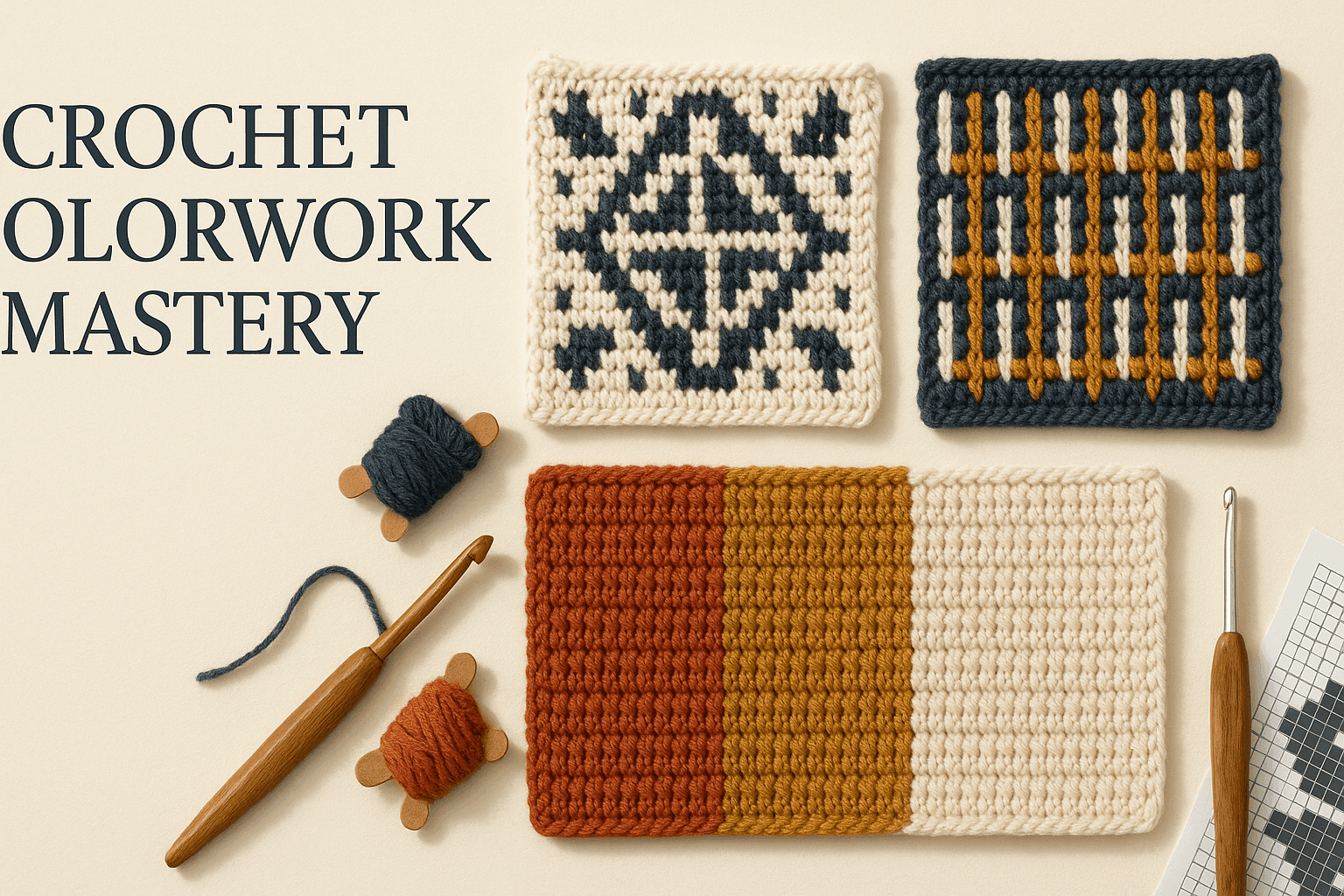
Example 1: A two-color tapestry coaster (geometric)
Goal: Clean color changes, consistent tension, hiding carried yarn.
Materials: Worsted cotton or acrylic in two high-contrast colors; 4.0–4.5 mm hook.
Concept:
- Work a flat square in sc.
- Use a simple chart like a centered diamond or checkerboard.
- Carry the unused color inside every stitch.
Tip: Use yarn under sc for crisper edges, especially in checkerboards.
Example 2: Intarsia wall panel with a large motif
Goal: Managing bobbins and clean joins.
Materials: Smooth worsted wool or acrylic; hook matched to yarn.
Concept:
- Choose a bold silhouette motif (moon, leaf, cat outline).
- Work in rows of sc or hdc.
- Use separate bobbins for motif and background.
Tip: Weave ends as you go on the wrong side to prevent a heavy finishing session.
Example 3: Overlay mosaic pillow front
Goal: One color per row, crisp geometry, controlling thickness.
Materials: Two colors of smooth yarn (cotton/acrylic); hook slightly larger than typical for comfort.
Concept:
- Alternate Color A and B each row.
- Work sc in FLO across.
- Use overlay dc stitches where chart indicates to “drop” and cover stitches below.
Tip: If edges bow, add a border in sc around the panel to stabilize.
8) Finishing and blocking for colorwork
Blocking and finishing can dramatically improve edges and motif clarity.
Blocking by fiber
- Wool: Wet block or steam block; it relaxes and evens tension beautifully.
- Cotton: Wet block; it can grow, so measure carefully.
- Acrylic: Steam block cautiously (do not touch iron directly). Steam can “kill” acrylic, making it drapier but less springy.
Securing carried yarn and ends
- In tapestry, carried yarn is trapped, but ends still need weaving.
- Weave ends through multiple color areas to prevent showing on the front.
- Split plies when weaving for better grip.
Adding a lining (for bags)
Tapestry bags can stretch. A fabric lining:
- Prevents sagging
- Protects floats (if any)
- Adds structure
9) Troubleshooting: common problems and practical fixes
Problem: Colors show through (shadowing)
Causes: high contrast, loose stitches, thin yarn, carried yarn placement.
Fixes:
- Tighten stitch tension slightly or go down a hook size.
- Carry the unused yarn consistently on the same side of the work.
- Use a less contrasting pairing or slightly heathered background.
- Try intarsia if you need perfectly clean separation.
Problem: Fabric puckers or narrows
Causes: carried yarn too tight; floats too tight; hook too small.
Fixes:
- Size up hook.
- Stretch fabric width periodically as you work.
- For tapestry, ensure the carried yarn has slack and is not being pulled at color changes.
Problem: Motif edges look jagged
Causes: stitch slant; color change timing; tall stitches.
Fixes:
- Change color on the last yarn over of the previous stitch.
- Use waistcoat stitch or yarn under sc for a squarer look.
- Outline shapes with surface slip stitch for definition.
Problem: Jog in the round (spiral shift)
Causes: continuous rounds create a spiral.
Fixes:
- Use joined rounds with a consistent join.
- Use jogless stripe technique.
- Design motifs that tolerate a seam (place jog at side/back).
Problem: Bobbins tangle (intarsia)
Causes: many color blocks; turning the work without managing strands.
Fixes:
- Use smaller bobbins and fewer yards per bobbin.
- After each row, dangle the work and let bobbins untwist.
- Keep bobbins in separate compartments.
Problem: Mosaic overlay stitches distort fabric
Causes: too-tight overlay dc; uneven tension.
Fixes:
- Make overlay stitches slightly looser.
- Ensure you’re inserting into correct row below.
- Block aggressively for wool; add border for stabilization.
10) Skill-building drills to improve fast
If you want rapid improvement, practice in small swatches:
- Checkerboard swatch (tapestry): alternate every stitch; focuses on clean color changes.
- Diagonal swatch: forces you to manage stepped edges; try surface outline afterward.
- 3-color band: teaches yarn dominance and carrying order.
- Round motif sample: practice jogless transitions.
Track your hook size, yarn, and notes. Colorwork is as much “engineering” as it is art.
11) Expert-informed best practices (what experienced designers tend to do)
While crochet colorwork has many personal variations, most expert outcomes rely on these principles:
- Swatch specifically for colorwork. Your gauge changes when carrying yarn or working overlay stitches.
- Prioritize value contrast. Many pro-looking motifs are simply high value-contrast with clean edges.
- Use the right method for the project. Don’t force tapestry for a drapey sweater panel if intarsia or mosaic is better.
- Block and finish deliberately. Crisp edges often appear after wet blocking and careful weaving.
If you’d like deeper dives, look for technique discussions from established crochet designers known for colorwork (e.g., overlay mosaic specialists and tapestry-focused bag designers). Many publish chart conventions and tension tips that align with the mechanics described above.
12) How to choose the right colorwork method: a quick decision guide
Ask yourself:
-
Will the back be visible or snag-prone?
- Yes → tapestry or intarsia
- No → stranded may work
-
Do you want drape (garment) or structure (bag)?
- Drape → intarsia or lighter stranded
- Structure → tapestry or mosaic
-
Do you hate managing multiple yarns at once?
- Yes → mosaic (one color per row)
- No → tapestry/stranded/intarsia
-
Is the motif large blocks or many small pixels?
- Large blocks → intarsia
- Pixels/geometric repeats → tapestry or mosaic
Conclusion
Crochet colorwork is a toolkit, not a single technique. When you match method to project goals, pick yarn that supports stitch clarity, and manage tension with intention, your charts become clean, your motifs pop, and the process becomes far more enjoyable.
If you’re uncertain where to start, begin with a small two-color tapestry swatch in smooth yarn, focus on clean color changes, and take notes. Once that feels comfortable, try mosaic for bold graphic impact or intarsia for big, drapey shapes. Each approach teaches you something different—and together they open up an enormous creative palette.