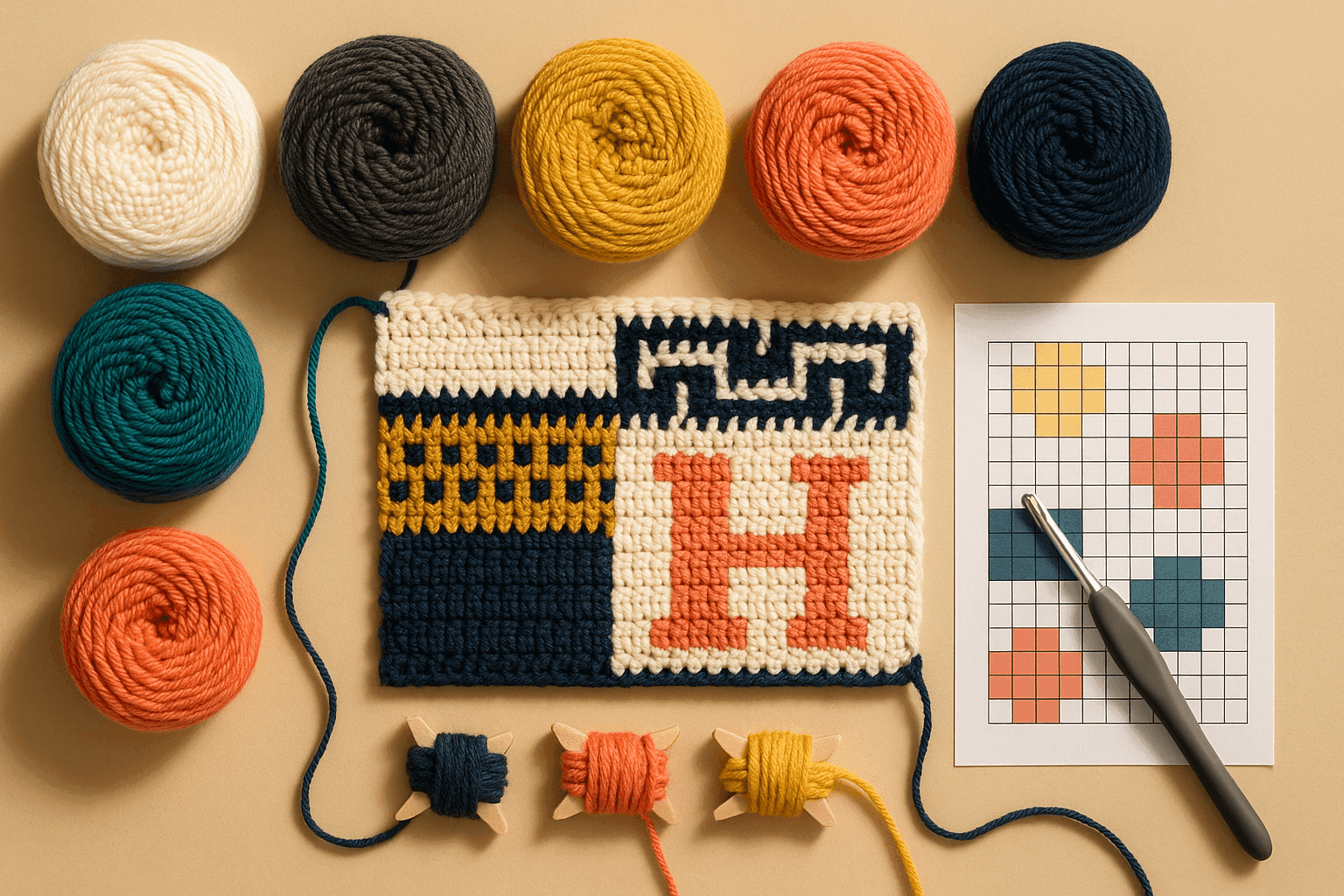
Why crochet colorwork is worth learning
Crochet colorwork—creating patterns and images with multiple yarn colors—opens up an enormous design space. It can turn basic stitches into bold geometry, subtle gradients, intricate motifs, and pictorial scenes. Whether you’re making a Scandinavian-inspired hat, a mosaic blanket, a tapestry wall hanging, or a playful amigurumi sweater, colorwork is the difference between “nice” and “stopping people in the street.”
Colorwork can feel intimidating because it introduces additional variables: managing multiple strands, keeping tension consistent, aligning patterns, and dealing with yarn behavior (twist, split, stretch, dye). The good news is that crochet is uniquely suited to colorwork because stitches are discrete and structurally stable. You can “lock” colors in place with stitches, overlay colors with post stitches, and create crisp shapes without cutting yarn every row.
This guide walks you through the major crochet colorwork methods, how to pick yarns that behave well, how to read and design charts, and how to troubleshoot the most common issues—curling, puckering, uneven edges, and color bleed.
The building blocks: color contrast and stitch mechanics
Before diving into techniques, it helps to understand what makes colorwork readable and clean.
1) Value contrast matters more than hue
Two colors can be different (blue vs green) yet still appear similar at a distance if their value (lightness/darkness) is close. Strong value contrast makes patterns pop.
Practical test: Convert a photo of your yarn choices to black-and-white (most phones can do this). If the colors look distinct in grayscale, your colorwork will be legible.
2) Stitch shape affects pattern sharpness
Crochet stitches have height and texture. This changes how “pixel-like” your colorwork looks.
- Single crochet (sc) makes the most common “grid” for tapestry and intarsia. The stitch is slightly wider than tall, so squares look a bit squat unless adjusted.
- Half double crochet (hdc) can work for larger, softer motifs.
- Tunisian simple stitch (if you do Tunisian crochet) makes an even grid that behaves more like knitting for charting.
3) The golden rule: tension consistency
Colorwork exaggerates tension problems. Any time you carry a strand, switch colors, or change stitch type, tension wants to shift.
Goal: A fabric where the stitch size remains stable across color changes.
Yarn selection: fibers, twist, and dye behavior
Choosing the right yarn can make colorwork dramatically easier.
Fiber type and elasticity
- Wool (especially non-superwash): springy, forgiving, and excellent at evening out tension; grips itself so floats behave. Great for stranded-style crochet and mosaic.
- Superwash wool: smooth and drapier; can show gaps more; may grow after washing.
- Cotton: crisp stitch definition and bold color; less elastic so puckering shows more easily. Great for mosaic, filet, and summer accessories.
- Acrylic: budget-friendly and consistent; can be slippery but often holds color well. Great for big blankets.
Ply and twist
- Tightly twisted plies resist splitting during frequent color changes.
- Smooth, round yarns show colorwork cleanly.
- Single-ply or loosely spun yarns can pill and blur edges, especially in high-friction tapestry crochet.
Dye and colorfastness
For projects with high contrast (white + red, white + navy), test for color bleeding.
Quick test: Soak a small yarn length in warm water with a drop of gentle soap. Blot on a white paper towel. If dye transfers, consider washing separately, using a color-catcher sheet, or selecting a different brand/colorway.
Matching yarn weights across colors
Even within the same label weight, different dyes can slightly change thickness. If one color feels thicker, it can cause ridges or bias.
Tip: Work a mini swatch with all colors to check for thickness and tension consistency.
The major crochet colorwork techniques (and when to use each)
There isn’t one “best” method—each produces a different look and has different tradeoffs.
1) Tapestry crochet (carrying yarn through stitches)
Best for: dense fabric, geometric patterns, bags, baskets, sturdy accessories, some garments.
How it works: You crochet (usually in single crochet) and carry the unused color inside the stitches, switching colors as needed.
Pros:
- No long floats on the back.
- Fabric is sturdy and often reversible-ish (though the wrong side may look different).
- Great for frequent color changes.
Cons:
- Can get thick and less drapey.
- Carrying yarn can “shadow” through light colors.
Key technique tips:
- Carry yarn consistently either always on the wrong side of the work (in rows) or always inside the tube (in rounds).
- Switch colors on the last yarn-over of the previous stitch to avoid specks.
- Consider yarn under (YU) instead of yarn over (YO) for tighter, more square stitches (often used in amigurumi and tapestry).
Pattern example idea: A two-color geometric tote bag using single crochet in the round, with a repeating diamond motif.
2) Stranded crochet (floats on the wrong side)
Best for: hats, yokes, cowls, projects where the wrong side is hidden or lined.
How it works: Similar to stranded knitting—carry unused yarn across the back as “floats,” catching it occasionally.
Pros:
- Cleaner face than tapestry when you don’t want carried yarn inside stitches.
- Can be lighter than tapestry if floats aren’t trapped every stitch.
Cons:
- Floats can snag.
- Tension is trickier; too-tight floats cause puckering.
Tips:
- Catch floats every 3–5 stitches (or as needed) by crocheting over the carried yarn occasionally.
- Keep floats relaxed—spread stitches on the hook before switching colors.
- In garments, consider lining (fleece in hats, fabric in bags).
Pattern example idea: A winter beanie with a simple 8-stitch snowflake repeat around the body, worked in sc or hdc for warmth.
3) Intarsia crochet (separate yarn bobbins for each color block)
Best for: large blocks of color, pictorial designs, minimal color blending, panels (sweaters, blankets).
How it works: Each color area has its own yarn source. You drop and pick up colors at boundaries.
Pros:
- No carried yarn = crisp colors and lighter fabric.
- Great for large shapes (letters, logos, animals).
Cons:
- Many bobbins can become tangled.
- More ends to weave.
Tips:
- Use small bobbins (wrap yarn around clothespins, bobbins, or cardboard).
- Twist yarns at color changes to avoid holes (bring new color under/over consistently).
- Work from a chart and keep bobbins in order.
Pattern example idea: A color-block cushion cover with a bold monogram letter, worked in rows of sc.
4) Mosaic crochet (overlay colorwork)
Best for: bold geometric patterns, blankets, rugs, shawls, home decor.
How it works: You work with one color per row/round, using special stitches (typically front loop only sc and double crochet into a row below) to “paint” the other color into the surface.
Pros:
- Only one color used at a time.
- Crisp, high-contrast patterns.
- Very chart-friendly.
Cons:
- Fabric can be thicker and less stretchy.
- Edges may need finishing (bordering or envelope-style ends).
Tips:
- Choose yarns with strong contrast for maximum impact.
- Keep your dc overlay stitches consistent in height to avoid ripples.
- Plan an edge treatment: envelope border, fringe, or double border.
Pattern example idea: A mosaic throw with a repeating Greek key border and a central diamond medallion.
5) Surface crochet and embroidery overlays
Best for: adding details after the fact—outlines, faces, lettering, highlights.
How it works: Use surface slip stitches, surface single crochet, or yarn embroidery (duplicate stitch-like approaches) on top of finished fabric.
Pros:
- Great control and detail.
- You can “fix” or enhance a design without reworking the fabric.
Cons:
- Adds thickness.
- Can distort fabric if pulled too tight.
Tips:
- Use a blunt tapestry needle for embroidered details.
- Match fiber type to base fabric for similar stretch and wear.
Charts, repeats, and planning your design
Colorwork is easiest when you can see it.
How to read a crochet color chart
Charts are typically grids where each square equals one stitch (commonly sc). But crochet stitches are not perfect squares.
To compensate:
- Expect slight vertical compression.
- For pictorial designs, you may need to stretch the chart vertically (add rows) or use a taller stitch (hdc) depending on the look.
Repeats and stitch counts
For seamless rounds, patterns often need to repeat evenly.
Checklist:
- Total stitch count divisible by the motif width.
- If shaping (increases/decreases), decide whether the motif stays centered or “travels.”
Swatching for colorwork (non-negotiable for big projects)
Swatch with:
- The exact stitch.
- The exact colorwork method.
- The same hook size.
Measure:
- Stitch gauge (stitches per 4 in / 10 cm).
- Row gauge.
- Fabric thickness and drape.
Why it matters: Colorwork often tightens gauge compared to single-color fabric.
Clean color changes: the mechanics that make it look professional
Messy color changes are the most common complaint in crochet colorwork. These techniques help.
Switching colors in single crochet
To switch from Color A to Color B:
- Insert hook, yarn over with A, pull up a loop.
- Yarn over with B, pull through both loops.
This makes the top of the stitch the new color.
Managing the “jog” in rounds
In continuous rounds, color changes can create a visible step.
Options:
- Use a joined round with a slip stitch and chain to start each round (more seam-like but less jog).
- Use a jogless join technique (varies by stitch; often involves a slip stitch or special last stitch manipulation).
- Design so the jog falls in a less visible area (side seam, underarm).
Avoiding “color bleed” specks at boundaries
- Change color on the last yarn-over of the previous stitch.
- Keep both yarns under consistent tension so one doesn’t peek.
- For very crisp lines, consider intarsia instead of tapestry.
Practical pattern mini-recipes (adaptable examples)
These aren’t full row-by-row patterns, but structured recipes you can adapt.
A) Two-color checkerboard coaster (tapestry crochet)
Materials: Worsted cotton, 2 colors, 4.0–4.5 mm hook.
Concept: Work a square in sc, changing color every 3 stitches and every 3 rows.
Setup:
- Chain a multiple of 6 + 1 (e.g., 25 for a small coaster).
- Row 1: sc across.
- Rows 2–4: 3 sc in A, 3 sc in B repeat across.
- Rows 5–7: offset the colors (start with B then A).
Finishing: Single-color border in sc or crab stitch.
Skills practiced: frequent color changes, carrying yarn, tidy edges.
B) Mosaic crochet wall panel (bold geometry)
Materials: two high-contrast colors, aran/worsted, 5 mm hook.
Concept: Alternate colors every row. Use FL sc and dc into row below to create a repeating motif.
Motif idea:
- Background rows: FL sc across.
- Pattern rows: place dc into stitches two rows below where the chart indicates “drop-down” stitches.
Finishing: envelope border or fringe to hide ends.
Skills practiced: chart reading, overlay stitches, edge planning.
C) Intarsia letter patch (monogram square)
Materials: DK yarn, 3.5–4 mm hook.
Concept: A square worked flat in sc with a contrasting letter in the center.
Steps:
- Start with background color.
- When you reach the letter area on a row, drop background, pick up letter bobbin.
- Twist yarns at each boundary.
Use it for: pillow front, bag panel, sweater patch.
Skills practiced: bobbin management, twisting at joins, charting.
Troubleshooting guide: what went wrong and how to fix it
Problem 1: The fabric puckers where colors change
Common causes:
- Floats too tight (stranded method).
- Carry yarn pulled too snug (tapestry).
- Hook too small for your natural tension.
Fixes:
- Go up 0.25–1.0 mm in hook size.
- Relax floats: spread stitches along the hook before switching colors.
- In tapestry crochet, ensure the carried yarn lies flat and isn’t being tugged at each stitch.
Problem 2: Gaps/holes at color boundaries
Common causes:
- Not twisting yarns in intarsia.
- Loose tension at the switch.
Fixes:
- In intarsia, twist the two yarns at every boundary so the new color locks in.
- Use a slightly tighter tension on the first stitch after switching colors.
- Add a border later to stabilize edges.
Problem 3: Carried yarn shows through (shadowing)
Common causes:
- High contrast (dark yarn carried behind light stitches).
- Loose stitches.
Fixes:
- Carry the lighter yarn behind light areas if possible (or switch method).
- Use a smaller hook (careful: can cause stiffness).
- Switch to intarsia for light backgrounds with dark motifs.
- Choose yarns with slightly less contrast or more matte fibers (some cottons show shadowing more).
Problem 4: Edges look messy in rows
Common causes:
- Inconsistent turning chains or edge stitch.
- Color carried up the side without a plan.
Fixes:
- Use a consistent edge: e.g., ch 1, turn, first stitch in the very first stitch.
- Consider adding a border to cover side carry.
- For stripes, carry yarn up the side only if you’ll border or seam that edge.
Problem 5: Colors look dull or the pattern isn’t readable
Common causes:
- Values too similar.
- Highly textured stitch pattern competing with chart.
Fixes:
- Re-pick colors using grayscale test.
- Simplify stitches: sc or Tunisian simple stitch for crisp motifs.
- Use a larger motif scale (bigger blocks) if the yarn is very variegated.
Problem 6: Your chart looks “squished”
Common causes:
- sc stitches aren’t square.
Fixes:
- Stretch the chart vertically (add rows).
- Try yarn-under sc to make stitches tighter and more square.
- Consider using hdc or Tunisian for different aspect ratios.
Finishing techniques that elevate colorwork
Weaving in ends (without bulk)
Colorwork can produce a lot of ends—especially mosaic and intarsia.
Best practices:
- Weave ends through the same color when possible.
- Split plies with a blunt needle rather than knotting.
- Weave in at least 2–3 direction changes to lock.
Blocking and washing
- Wool benefits from wet blocking to even out stitches.
- Cotton can be steam blocked carefully to flatten edges.
- Always test washing for color bleed, especially with red, navy, and deeply saturated shades.
Adding a lining (especially for bags)
For tapestry or stranded bags, a lining:
- prevents stretching,
- hides the wrong side,
- protects floats from snagging.
Skill-building plan: how to get good without overwhelm
- Start with 2 colors and a simple repeat (checkerboard or stripes).
- Try one new method at a time: tapestry → mosaic → intarsia → stranded.
- Swatch small, then scale up.
- Photograph your work from a distance; it reveals value and tension issues.
- Keep notes: hook size, yarn brand, method, and what you’d change.
Expert-informed principles (what experienced designers optimize)
Even without quoting a specific designer, most professional crochet colorwork patterns reflect a few shared principles you can adopt:
- Design for the method. A motif suited to mosaic (high contrast, bold geometry) isn’t automatically suited to tapestry (fine detail may blur).
- Control stitch geometry. Designers choose stitch types, hook size, and sometimes yarn-under to get crisp pixels.
- Anticipate finishing. Borders, seams, and linings aren’t afterthoughts; they’re part of the colorwork plan.
- Choose yarn intentionally. Smooth, consistent yarns show colorwork best; rustic yarns soften shapes.
If you want deeper technical reference, the Craft Yarn Council provides standardized yarn weight terminology and guidance that helps when substituting yarns; many advanced crochet texts and charting resources also emphasize swatching and value contrast as the foundation of successful colorwork.
Closing thoughts: picking your next project
If you want the fastest path to satisfying results:
- Choose mosaic crochet for dramatic, clean patterns with minimal strand management.
- Choose tapestry crochet for sturdy items like bags and baskets.
- Choose intarsia for large pictorial blocks and lettering.
- Choose stranded when you want warmth and don’t mind managing floats (hats are perfect).
Colorwork is a skill stack: yarn handling, tension control, chart reading, and finishing. Each project improves your eye and hands. Start simple, swatch honestly, and let the technique match the project’s purpose—and you’ll build a colorwork practice that’s both artistic and reliable.