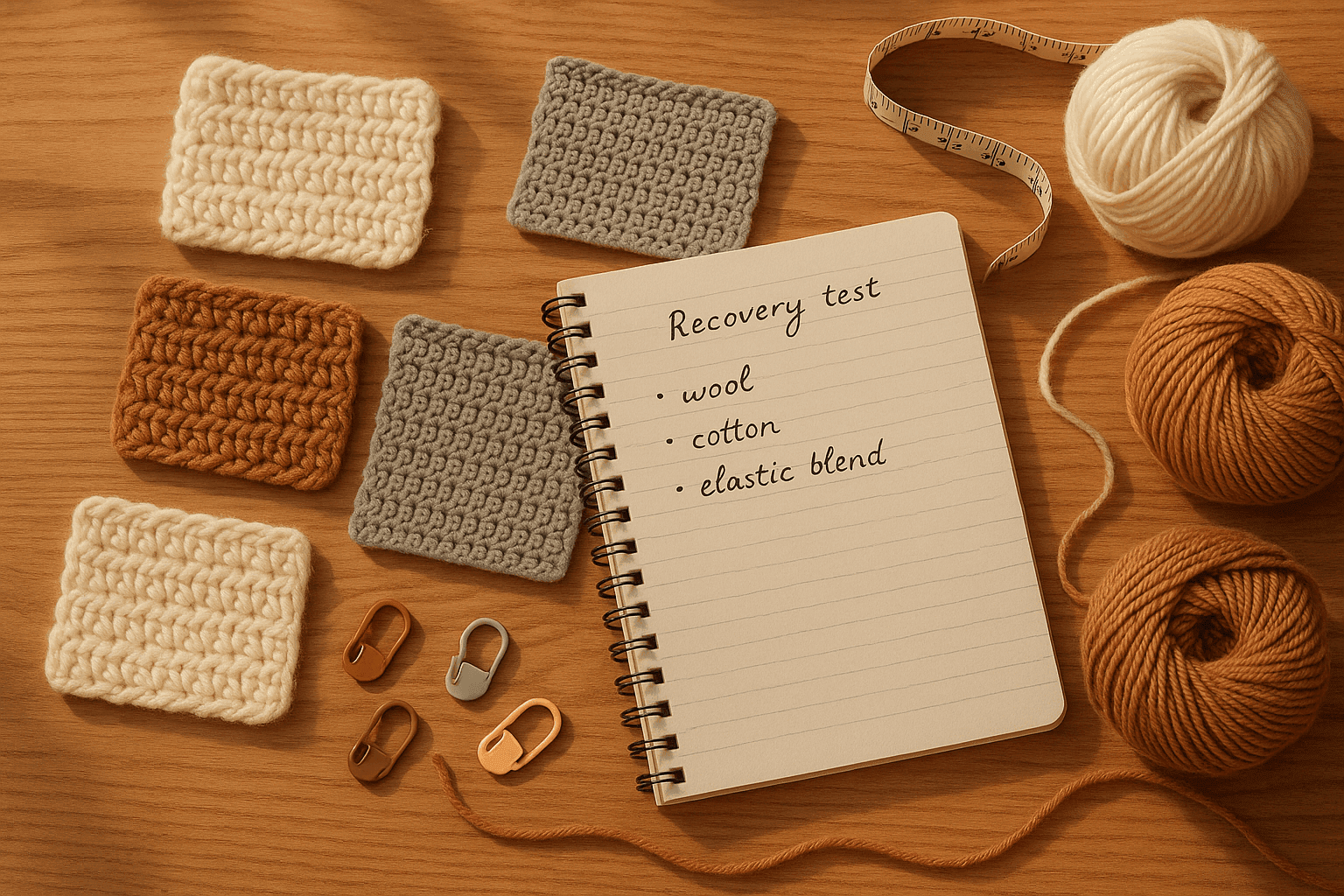
There is a particular kind of disappointment that only garment makers really understand: you finish a cardigan, skirt, sweater, or pair of lounge shorts, wear it twice, and suddenly the elbows pouch, the seat drops, the waistband creeps, or the cuffs look as if they have given up on life. On the other hand, some crochet pieces seem almost magically resilient. You wear them, sit in them, wash them, dry them flat, and they spring back with satisfying discipline. The difference is not luck. It lives in the interaction between fiber morphology, yarn structure, stitch architecture, and the way the fabric is asked to carry load.
If you have ever wondered why one ribbed cuff snaps back and another slouches by lunch, or why a cotton summer top grows two inches after a morning on a hanger, this is the deep-dive. Recovery in crochet is not only about whether a yarn feels stretchy in the skein. It is about crimp, staple memory, filament smoothness, ply angle, twist energy, stitch orientation, fabric density, and where strain accumulates in actual use. Once you begin reading crochet fabric this way, your design decisions become far more intentional.
This article looks closely at what makes crochet bounce back after wear, stretching, and laundering. We will talk about wool crimp and why it matters so much, why cotton often collapses under repeated loading, how elastic blends help and when they do not, what ply architecture changes in a finished fabric, and how stitch direction determines whether your cuff behaves like a spring or a sagging tube. We will also walk through practical swatching and recovery tests, because “it feels nice” is not enough data when you are designing for cuffs, seats, elbows, waistbands, or any area that takes repeated stress.
Why recovery matters more in crochet than many makers expect
Crochet fabric often contains more built-in height, bend, and yarn path complexity than knitting, especially in taller stitches. That can be wonderful for structure, texture, insulation, and graphic design. But it also means crochet can create fabrics that either disperse strain beautifully or concentrate it in very specific places.
Think about a simple double crochet fabric. Each stitch is a tall column with wrapped yarn and a relatively open structure. Under vertical load, those columns can lengthen. Under horizontal load, gaps may widen and the posts may rotate. In contrast, a dense slip stitch or single crochet rib can compress and rebound differently because the path of yarn is shorter, denser, and more resistant to deformation in one direction.
This is why two garments made from the same yarn can perform very differently. A boxy mesh tee in mercerized cotton and a tight single crochet waistband in the same cotton are not asking the yarn to do the same job. Fiber potential and stitch architecture always work together.
When we say a fabric “recovers,” we usually mean one or more of these things:
- Elastic recovery: It returns close to original dimensions after being stretched.
- Compression recovery: It regains loft after being squashed, sat on, or stored.
- Shape recovery after laundering: It returns to intended measurements after washing and drying.
- Bias and distortion recovery: It resists skewing, torque, and permanent leaning under repeated wear.
A garment can excel in one and fail in another. A wool sweater may recover well from gentle stretch yet slowly grow at the shoulders if hung. A cotton-linen top may hold width reasonably but lengthen permanently. A nylon-elastane blend may snap back impressively but reveal every inconsistency in stitch tension.
Fiber morphology: the microscopic story behind bounce-back
At the root of resilience is fiber morphology: the physical shape and behavior of the fiber itself. Crocheters often discuss fiber in broad categories—wool, cotton, acrylic, bamboo—but recovery depends on more specific structural traits.
Wool: crimp, scale, and spring
Wool is the classic recovery fiber because of its natural crimp. Crimp is the waviness along the fiber length. Those tiny waves act like miniature springs. When wool is stretched or compressed, the crimp can open and close before the fiber itself is forced into more permanent deformation.
This gives wool several advantages in crochet:
- Better return after moderate extension
- Better loft recovery after compression
- More forgiveness in cuffs, collars, and ribbed structures
- Improved resilience in textured stitches that need to hold dimension
Not all wool behaves the same way. Fine merino may feel very soft, but its smoothness and processing can make it less robust under abrasion than a more rustic wool. Down-breed fibers may produce airy, elastic fabrics, while longwool breeds may drape more and spring less. Woolen-spun yarns often preserve loft and elasticity because fibers are more randomly arranged and airy. Worsted-spun yarns are smoother, denser, and can feel more structured, sometimes with less bloom-driven rebound.
A useful practical observation: if you need a cuff or waistband to recover repeatedly, a bouncy wool or wool-rich blend usually outperforms pure plant fiber, even at the same gauge.
Cotton: smooth strength, low spring
Cotton is strong, comfortable, breathable, and wonderful for many garments. But cotton fibers are relatively straight and lack natural crimp. They do not act like little springs. Once a cotton crochet fabric elongates under load, especially if the stitches themselves rotate or open, there may be limited internal force encouraging it back to original dimensions.
Cotton’s typical recovery challenges include:
- Length growth in tall stitches
- Persistent bagging at elbows, knees, or seats
- Stretching under its own weight when wet
- Ribbing that spreads rather than snaps back
This does not mean cotton is unsuitable. It means cotton rewards different design choices: denser gauges, shorter stitches, strategic shaping, supportive seams, and negative ease used carefully. Cotton can look crisp and beautiful, but it rarely behaves like wool in high-recovery zones.
Mercerized cotton tends to be smoother and often drapier, with excellent stitch definition but usually even less helpful friction between fibers. That can increase clarity and sheen while reducing the “grab” that sometimes helps a fabric hold itself together under load.
Linen and hemp: crisp, strong, often unforgiving at first
Bast fibers like linen and hemp are famously strong and often improve with wear, but they usually offer limited elastic recovery. They soften over time, and garments can become beautifully fluid. In high-stress zones, though, this often translates into growth rather than rebound.
If you want a summer crochet piece in linen or hemp to maintain shape, lean on architecture rather than expecting fiber memory to save you.
Silk, bamboo, viscose, and other regenerated fibers: drape over rebound
Silk can vary widely depending on construction, but many silk-rich yarns emphasize drape, shine, and fluidity more than spring. Bamboo viscose, rayon, lyocell, and other regenerated cellulose fibers often feel cool and luxurious, but they can become heavy in fabric and may lengthen significantly, especially in open or tall stitches.
These fibers are excellent when you want fluid movement. They are rarely the first choice for cuffs, waistbands, or fitted crochet that depends on snap-back.
Acrylic and synthetic fibers: engineered behavior, mixed results
Acrylic can be resilient in some constructions and disappointingly “dead” in others. Unlike wool, it does not rely on natural crimp in the same way, so its performance depends heavily on how the yarn is engineered. Some acrylic yarns are springy and hold shape well enough for everyday garments. Others stretch under heat, flatten with wear, or pill before they actually recover.
Nylon often contributes toughness and abrasion resistance in blends. On its own, it is rarely what gives a crochet fabric a cozy spring, but it can support durability.
Elastic blends: real stretch, real recovery, and real caveats
Yarns that include elastane, spandex, Lycra, or PBT can offer dramatic improvement in recovery. A small percentage can help cuffs, fitted tops, waistbands, and swim-related items rebound after extension.
But elastic fibers do not solve everything. They can:
- Highlight uneven tension
- Be defeated by a too-open stitch pattern n- Lose performance under high heat
- Behave differently before and after washing
Use them intentionally. If the stitch architecture allows the yarn path to distort excessively, even an elastic blend can produce a fabric that recovers poorly in practice.
Ply architecture: why yarn construction changes garment behavior
Crocheters often focus on fiber content and ignore yarn structure, but ply architecture has an enormous effect on resilience.
Singles versus plied yarns
A single yarn can be lofty, soft, and visually appealing, but it may flatten faster and offer less structural resistance to repeated stitch abrasion and deformation. In crochet, where the hook repeatedly pulls and twists the yarn path, singles can also bias or fuzz more quickly.
A plied yarn usually offers:
- Better roundness
- Better stitch definition
- More resistance to flattening
- More balanced torque, if well made
- Improved wear in high-friction zones
For garments that need recovery, a balanced 3-ply or 4-ply yarn often outperforms a softly spun single, even when both are the same fiber.
Tight twist versus relaxed twist
Higher twist can increase durability and resistance to abrasion, but too much twist may make a yarn wiry or reduce loft. Lower twist can feel soft and plush but may collapse in use.
For recovery, you often want enough twist to help the yarn maintain body without making the fabric hard. In practical terms:
- High-wear cuffs and elbows: moderate to firm twist is often helpful
- Seat and waistband zones: round, balanced yarns hold up better than slack, airy constructions
- Drapey summer garments: lower twist may be lovely, but expect less recovery
Cable plies and chainette constructions
Cable-plied yarns can be exceptionally stable and resistant to abrasion. They often behave beautifully in crochet texture because the yarn remains coherent under repeated manipulation.
Chainette yarns are interesting: because fibers are held in a tubular structure, they can create light fabric with good loft. Recovery depends on the fiber content, but some chainette yarns perform better than their softness suggests.
Woolen-spun versus worsted-spun
This distinction is especially useful when assessing resilience.
- Woolen-spun: airy, lofty, more trapped air, often more elastic-feeling, excellent for springy fabrics
- Worsted-spun: smoother, denser, often more drape and stitch clarity, sometimes less bounce
A woolen-spun yarn in half double crochet rib may create a cuff that compresses and rebounds wonderfully. A smooth worsted-spun cotton blend in the same rib may look tidy but slowly relax outward.
Stitch loading: how force travels through crochet fabric
This is where crochet design gets especially interesting. Recovery is not only about what the yarn is; it is about how the fabric carries force.
When a cuff stretches over a hand, when an elbow bends, or when someone sits in a crocheted skirt, load moves through the stitch network along specific paths. Some stitches lengthen, some rotate, some compress, and some lock against neighbors.
Taller stitches generally permit more growth
Double crochet, treble crochet, and taller stitch patterns offer speed and drape, but they also create more room for extension. Under repeated loading, these fabrics often lengthen or spread unless compensated by fiber spring or very firm gauge.
Shorter stitches generally resist deformation better
Single crochet, extended single crochet, slip stitch, and dense half double crochet fabrics usually distribute stress over shorter yarn paths. That often means less dramatic growth and better structural stability.
Ribbing works because orientation matters
A front-loop-only or back-loop-only rib, or a slip stitch rib worked side to side, behaves differently from the same yarn worked in plain rows.
Why? Because the ridges and columns allow controlled compression and extension across one axis. This is a directional spring. Ribbing that stretches around a wrist can recover well if:
- The yarn has some elasticity or body
- The gauge is not too loose
- The rib direction is aligned with the required stretch
If the rib is oriented incorrectly, or the fabric is too tall and open, the same concept fails.
Post stitches and cables can either reinforce or distort
Front-post and back-post stitches create relief and can imitate knitted rib effects. They also add yarn length to the fabric. In some yarns, this increases body; in others, it creates a heavier panel that slumps.
Post-stitch ribbing in wool may recover reasonably well. In cotton, it often looks handsome initially but can spread under repeated wear if unsupported.
Meshes and lace concentrate load at junctions
Openwork fabrics can absolutely be wearable, but their load paths are concentrated around chains, anchors, and joining points. If those points are made in low-recovery yarn, permanent growth becomes more likely.
Tunisian and hybrid crochet structures
Some Tunisian stitches produce fabrics with less horizontal stretch and stronger dimensional stability than standard crochet. For waistbands, cuffs, and structured garments, this can be very useful. However, certain Tunisian fabrics curl or bias, so swatching is still essential.
Gauge is not just size; it is mechanical behavior
Many crocheters think of gauge only as a route to matching pattern measurements. For recovery, gauge is also your control over fabric mechanics.
A looser gauge generally means:
- More stitch mobility
- More drape
- More extension under load
- Greater risk of bagging
A firmer gauge generally means:
- Less movement per stitch
- Better support in high-wear areas
- Sharper stitch memory in textured fabrics
- Potential stiffness if overdone
For high-recovery zones, going down a hook size is often more effective than changing stitch pattern alone.
Practical hook recommendations by yarn weight
These are starting points, not rigid rules. Recovery testing should decide the final choice.
- Fingering weight (Category 1): 2.25 to 3.5 mm hooks. For fitted cuffs or dense waistbands, try 2.25 to 2.75 mm.
- Sport weight (Category 2): 3.0 to 4.0 mm hooks. For resilient ribbing, try 3.0 to 3.5 mm.
- DK weight (Category 3): 3.5 to 4.5 mm hooks. For garment hems and cuffs, 3.5 to 4.0 mm is often a good testing zone.
- Worsted/Aran (Category 4): 4.5 to 5.5 mm hooks. For stable bands, 4.0 to 5.0 mm can give better rebound than a looser standard gauge.
- Bulky (Category 5): 5.5 to 7.0 mm hooks. Beware false “squish”; bulky yarn can feel springy yet deform permanently if the structure is loose.
A practical swatching protocol for recovery
If you want reliable results, swatch like a garment engineer, not just a stitch tourist.
Make at least three swatches per candidate fabric. A useful size is 20 cm x 20 cm (8 x 8 in) after blocking or laundering, because tiny swatches hide growth behavior.
Swatch set-up
Label each swatch with:
- Fiber content
- Yarn construction if known
- Hook size
- Stitch pattern
- Starting stitch count and row count
- Pre-wash measurements
For most garment swatches, begin with enough stitches to create a measured center area at least 15 cm x 15 cm (6 x 6 in) after edges are excluded.
Examples:
- Single crochet swatch in DK yarn: chain 32 to 38, depending on your gauge
- Half double crochet swatch in worsted: chain 28 to 34
- Ribbed slip stitch cuff swatch: chain 16 to 20 for depth, work until width reaches 20 cm
The exact count matters less than measuring a stable center area. Still, record the numbers because row count changes can reveal growth.
Test 1: Relaxed measurement
Wash or steam the swatch the way the finished garment will be treated. Let it dry fully. Measure width and height across the center.
Record:
- Width
- Height
- Stitch count per 10 cm / 4 in
- Row count per 10 cm / 4 in
Test 2: Stretch and rest recovery
Mark a 10 cm (4 in) span in the center using locking stitch markers. Stretch that span to 12 cm (4.75 in) for moderate extension, hold for 30 seconds, release, and let rest flat for 5 minutes.
Measure again.
A very good recovery result is return to 10.2 cm or less. A fair result may return to 10.3 to 10.7 cm. A poor result remains at 10.8 cm or more.
Repeat three times. Some fabrics perform well once and fail under repetition.
Test 3: Hanging growth test
Especially important for cotton, bamboo, silk blends, and open stitches.
Hang the swatch vertically for 24 hours with a small weight clipped to the lower edge. Use a weight approximately equal to 5 to 10% of swatch weight for light yarns, or a small standardized object such as 20 to 30 g for a medium swatch.
Measure length increase.
If a garment swatch grows more than 5% in length, expect that growth to matter in wear.
Test 4: Compression recovery
Fold the swatch and place a smooth heavy book on top for 8 hours. Remove and let the swatch rest for 30 minutes.
Check:
- Did textured stitches rebound?
- Did ribbing flatten permanently?
- Did the fabric feel lifeless afterward?
Test 5: Laundering cycle repeat
Wash and dry the swatch through three full care cycles. This is tedious and extremely informative. Some yarns improve after the first wash; others steadily lose resilience.
Step-by-step: designing for bounce-back in high-wear zones
Now let’s translate the theory into actual garment decisions.
1. Cuffs
Cuffs need repeated circumference stretch and rapid recovery.
Best choices:
- Wool or wool-rich blends
- Wool/nylon for durability
- Elastic-enhanced blends for close-fit garments
- Dense rib structures, especially slip stitch, single crochet BLO, or hdc BLO worked side to side
Good starting cuff formula:
- Use a hook 0.5 to 1.0 mm smaller than the body fabric
- Aim for 10 to 20% negative ease at wrist circumference depending on fiber
- Work ribbing side to side so rows form the circumference stretch direction
Example in DK wool:
- Wrist measurement: 16 cm (6.25 in)
- Target finished cuff circumference: 14.5 to 15 cm (5.75 to 6 in)
- Hook: 3.5 mm for body, 3.0 mm for cuff
- Rib swatch gauge: 6 rows and 5 stitches per 2.5 cm / 1 in in BLO single crochet
- For a cuff depth of 6 cm (2.5 in), chain 13 (12 sts + 1 turning chain)
- Work rows until slightly stretched circumference reaches your target
Common mistake: using front-post double crochet rib in soft cotton at a loose gauge and expecting knit-like snap. It may look polished on day one and relax by day three.
2. Elbows
Elbows combine repeated flexing, compression, and localized extension.
Strategies:
- Use shorter stitches in fitted sleeves
- Add shaping so the sleeve is not under constant strain at the elbow
- Favor resilient fibers or blends
- Consider textured but compact stitch patterns over open lace
If working top-down sleeves, test the sleeve tube by putting your arm through the swatch and bending repeatedly before committing.
3. Seats and hips
This is the hardest zone for crochet recovery. Sitting applies heat, compression, and outward strain. Fabrics with low elastic recovery may bag noticeably.
Best strategies:
- Use firmer gauge than you think you need
- Avoid very tall stitches in fitted seat areas
- Consider blended fibers with wool, nylon, or elastane
- Add woven elastic or sewn support inside waistbands
- Prefer silhouettes with enough ease that the fabric is not constantly maxed out
For a skirt or dress with a fitted hip line, make a seated test swatch. Literally sit on it.
Protocol:
- Swatch at least 20 x 20 cm
- Place over a cushion edge or your lap
- Sit for 30 minutes
- Stand, smooth flat, and measure width and length after 10 minutes
A fabric that recovers in the hand may still fail under body heat and pressure.
4. Waistbands
Waistbands must resist both downward garment weight and repeated stretch.
The most dependable solutions are hybrid.
Options:
- Crochet dense ribbing with elastic-friendly yarn
- Thread narrow elastic through rib channels
- Sew waistband to a stable inner band or facing
- Use buttonhole elastic or drawcords for load-sharing
For adult garments, a crochet-only waistband in non-elastic cotton is rarely the best structural solution if the garment is heavy.
Example waistband setup in sport-weight wool blend:
- Waist measurement: 76 cm (30 in)
- Negative ease target: 8%, yielding finished waistband of about 70 cm (27.5 in) before wear
- Use 3.0 mm hook if body is worked on 3.5 mm
- Work side-to-side slip stitch rib to a width of 5 cm (2 in)
- Join into ring, then work body from one long edge
- If garment weight is moderate to heavy, insert 1.25 cm (1/2 in) elastic inside folded band
5. Hems and button bands
These areas need shape retention more than active stretch recovery.
A denser edge treatment often solves rippling and flare. Reverse single crochet, slip stitch facings, or narrow rows of compact stitches can stabilize growth-prone body fabric.
Common mistakes and how to fix them
Mistake 1: Choosing fiber for feel instead of function
A buttery bamboo-cotton blend may feel perfect in the skein and completely fail at cuffs.
Fix: Match fiber to stress zone. Use drapey fibers in drapey areas, resilient fibers where recovery matters.
Mistake 2: Swatching flat, wearing curved
A swatch that lies beautifully on a table may distort around a shoulder, bust, elbow, or hip.
Fix: Simulate actual use. Stretch, bend, hang, compress, and wash your swatch.
Mistake 3: Confusing softness with elasticity
Softness often comes from low twist or fluid fibers, which may recover poorly.
Fix: Evaluate spring separately from handfeel.
Mistake 4: Working ribbing too loosely
Loose crochet rib looks appealing and feels comfortable at first, but it often spreads permanently.
Fix: Drop hook size and test negative ease. If in doubt, make the rib denser.
Mistake 5: Using tall stitches in high-load zones
Double crochet waistbands and seat panels are usually asking for growth.
Fix: Substitute single crochet, linked stitches, Tunisian textures, or compact ribs in structural areas.
Mistake 6: Ignoring garment weight
A long cardigan in a decent recovery yarn may still grow because the lower half is pulling on the upper half all day.
Fix: Shorten unsupported spans, add seams, reinforce shoulders, and use lighter stitch architecture.
Mistake 7: Assuming laundering will “fix” growth every time
Some fibers bloom and recover with washing. Others simply relax further.
Fix: Test multiple wash cycles before finalizing a design.
Design variations and smarter fabric strategies
Recovery does not require every garment to be made from springy wool rib. You can combine aesthetics and performance if you place them thoughtfully.
Variation 1: Zoned fabrics
Use one fabric for fit-critical areas and another for visual or drapey sections.
Examples:
- Wool-blend ribbed cuffs on a cotton body
- Dense hdc waistband with lace skirt body
- Slip stitch elbow patches integrated into a softer sleeve fabric
Variation 2: Hybrid finishing
Crochet the visible structure, but let hidden supports handle the load.
Examples:
- Clear elastic in shoulder seams
- Knit elastic inside waistbands
- Twill tape behind button bands
- Lining in seat area of skirts
This is not cheating. It is good engineering.
Variation 3: Stitch substitution by wear zone
Use decorative openwork where little strain occurs and compact stitches where the garment must rebound.
Examples:
- Mesh torso with solid underarm panels
- Textured body with dense cuff and hem facings
- Relaxed sleeves with shaped, compact forearm and cuff sections
Variation 4: Blend balancing
If you love cotton but need better recovery, consider blends such as:
- Cotton/wool
- Cotton/nylon
- Cotton/PBT
- Cotton with a small elastic content
If you love wool but want durability and easier care:
- Wool/nylon
- Superwash wool blends, tested carefully because some superwash yarns can grow more than untreated wool
Variation 5: Structural seams
Seamless garments are popular, but seams can dramatically improve shape retention. A side seam, shoulder seam, or applied band can interrupt stretch pathways and distribute load.
For bag-prone garments, strategic seaming often helps more than changing yarn alone.
Reading likely recovery before you crochet the whole project
Over time, you can train your hands and eyes to predict performance.
Promising signs:
- Yarn springs back when gently stretched between fingers
- The strand feels round rather than limp and ribbon-like
- Ply is balanced and distinct
- The swatch compresses and refluffs easily
- Rows do not lengthen dramatically after washing
Warning signs:
- Yarn feels heavy for its diameter
- The strand untwists easily and flattens
- Swatch grows just from hanging overnight
- Ribbing spreads and does not return after a few extensions
- Wet fabric feels much longer than dry fabric
A sample decision framework for garment planning
Before you start, ask five questions:
-
Where are the highest-load zones? Cuffs, elbows, hips, seat, waistband, shoulders?
-
What kind of recovery matters most? Circumference snap-back, vertical length stability, loft, or anti-bagging?
-
Will the garment be heavy when finished? Long crochet cardigans and dresses create self-load.
-
What care method will it actually receive? Handwash flat is different from machine wash and line dry.
-
Can architecture compensate for the fiber? If you insist on cotton, can you tighten gauge, shorten stitches, add seams, or use elastic support?
If three or more answers point to high stress and low-fiber recovery, redesign before you commit.
A practical mini case study approach
Let’s say you want to design a crocheted lounge skirt with a snug waistband and comfortable seat.
A weak approach:
- 100% mercerized cotton
- 5.0 mm hook
- Double crochet body and front-post waistband
- No swatching under load
Likely result: lovely drape, polished stitch definition, gradual waistband spread, seat bagging, and length growth after wash.
A stronger approach:
- Cotton/wool/nylon blend or cotton with elastic component
- 4.0 mm hook for body, 3.5 mm for waistband
- Compact hdc or linked dc body in seat zone
- Side-to-side slip stitch or BLO sc waistband
- Optional inserted elastic
- Hanging and seated swatch tests before beginning
Likely result: less dramatic drape perhaps, but far better real-life wear.
The most useful takeaways for makers
The biggest shift is to stop treating recovery as a mystery and start treating it as a design property.
Here is the short version:
- Wool crimp is real structural help. It provides natural spring that many fibers simply do not have.
- Cotton is strong but not inherently bouncy. Plan for support, density, and growth control.
- Yarn construction matters almost as much as fiber. Round, balanced plied yarns usually outperform limp, low-twist constructions in high-wear crochet.
- Stitch orientation creates directional behavior. Ribbing, compact stitches, and strategic seams can turn an ordinary yarn into a better-performing fabric.
- Load paths decide where garments fail. Cuffs, elbows, seats, and waistbands deserve specialized treatment.
- Gauge is a mechanical choice. A smaller hook in stress zones is often the simplest effective fix.
- Swatching must include recovery tests. Wash, hang, stretch, compress, sit on it, and then trust the results.
- Hybrid support is smart. Elastic, tape, seams, and facings are part of good garment design.
If you remember nothing else, remember this: crochet resilience is never just in the skein. It emerges from the whole system—fiber morphology, ply architecture, stitch geometry, gauge, and the way the finished piece lives on a body. Once you begin designing with that systems view, you can make garments that do not merely look beautiful on the blocking mat, but continue to behave beautifully after weeks, months, and seasons of actual wear.
That is the kind of bounce-back we are really after: not perfection, but fabrics engineered with enough memory, support, and intention to keep serving the maker and the wearer long after the final end is woven in.