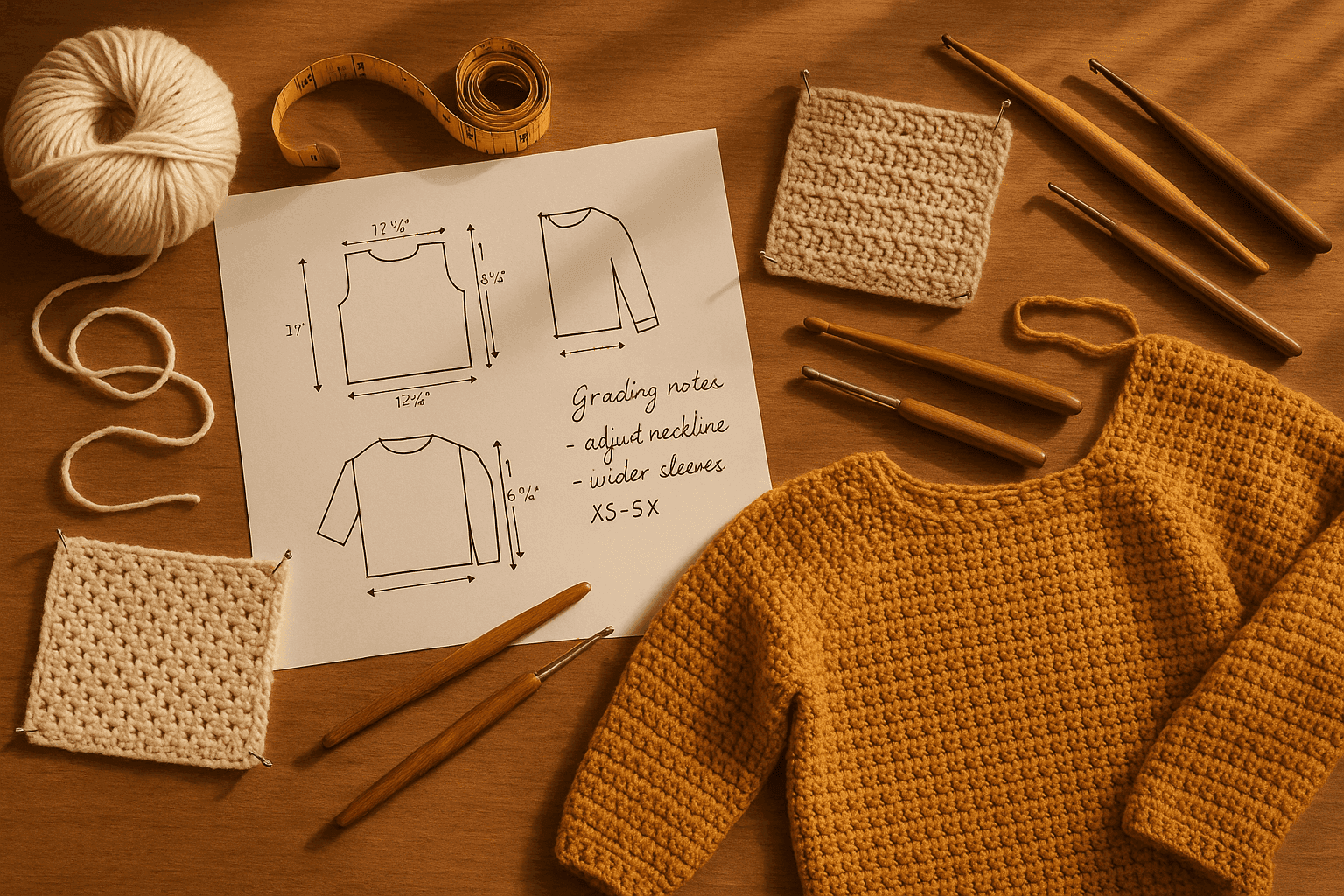
There’s a very specific kind of optimism that happens when a garment sample fits beautifully in one size and we convince ourselves the rest of the sizing is just multiplication. Add a few stitches here, a few rows there, and surely the same cardigan, tee, or fitted pullover will behave the same way from the smallest size to the largest. Then the real-world fittings begin: the armhole cuts in, the sleeve twists forward, the bust pulls horizontal stress lines across the chest, the waist floats instead of shaping, or the fabric that looked springy and refined in the sample suddenly hangs heavy and stubborn in a larger circumference.
If you have ever looked at a graded crochet garment and thought, “The numbers technically scale, but the fabric clearly does not,” you are already asking the right question. Crochet grading is not only about increasing stitch counts to match body measurements. It is about preserving fabric behavior across sizes. Negative ease is not distributed identically on every body. Armhole depth cannot be graded by torso circumference alone. Sleeve caps must respond to row height, shoulder shape, and the way crochet fabric compresses or resists compression. And because crochet stitches create a three-dimensional architecture that is often taller, denser, stretchier, or less elastic than knitting or woven fabric, the grading decisions that look logical on paper can become restrictive or sloppy when worn.
This is where crochet garment design becomes deeply technical and deeply satisfying. Once you start grading from the interaction between body, fabric, stitch architecture, and intended fit—not just a flat size chart—you gain control over the things that make a garment look professional: smooth bust shaping, stable necklines, sleeves that lift with the arm, and silhouettes that remain intentional across an inclusive size range.
Why simple stitch-count scaling fails in crochet
At first glance, grading seems straightforward. If Size S has 180 stitches at the bust and Size M needs 12% more circumference, then Size M gets 202 stitches, adjusted to the stitch pattern repeat. But crochet fabric is not a neutral grid. The stitch itself affects how width, height, drape, and recovery behave under tension.
A few examples:
- Single crochet creates a relatively short, dense, sturdy fabric with limited horizontal stretch unless worked at a loose gauge or in stretch-enhancing loops.
- Half double crochet often has more vertical compression and can “grow” differently after wear, especially in smoother fibers.
- Double crochet can appear flexible but may lengthen under its own weight, changing armhole depth and body length after blocking or wear.
- Textured stitches such as post stitches, cables, waffles, and popcorns consume yarn, thicken the fabric, and often reduce stretch or create directional pull.
- Mesh and lace structures can have dramatic bias, variable recovery, and more ease tolerance at the bust or hip than at the neckline or sleeve cap.
The problem is that when you scale stitch counts without accounting for these traits, the garment’s proportion may remain mathematically larger while the functional fit changes. Two inches of negative ease in a bouncy wool rib-look fabric is not the same as two inches of negative ease in a mercerized cotton stitch pattern with little recovery.
This is why crochet grading must begin with three interacting systems:
- Body measurement and movement requirements
- Stitch architecture and row/stitch gauge ratio
- Fiber behavior under wear, washing, and gravity
Once those are considered together, the grading becomes far more accurate.
Understanding ease in crochet garments
Ease is the difference between body measurement and finished garment measurement.
- Positive ease: garment is larger than the body
- Zero ease: garment matches the body measurement approximately
- Negative ease: garment is smaller than the body and relies on stretch/recovery to fit
For crochet, negative ease must always be assigned according to fabric capacity, not trend alone. A fitted top in a resilient wool blend may tolerate 2–4 in / 5–10 cm negative ease at the bust. The same shape in a cotton-linen blend may become restrictive or ripple unpredictably if you apply the same reduction.
The key principle: negative ease is distributed, not merely subtracted
Many makers think of negative ease as one number: “This sweater has 3 inches negative ease.” In practice, that amount should not always be spread equally across the whole garment.
A fitted crochet garment may need different ease targets at:
- upper bust
- full bust
- waist
- high hip
- full hip
- biceps
- wrist or forearm
- cross-back
- neckline
For instance, a close-fitting crochet tee may have:
- Upper bust: 0 to -1 in / 0 to -2.5 cm
- Full bust: -1 to -3 in / -2.5 to -7.5 cm depending on cup depth and fiber
- Waist: 0 to -2 in / 0 to -5 cm
- High hip: 0 to -1 in / 0 to -2.5 cm
- Full hip: 0 to +2 in / 0 to +5 cm if mobility is needed
- Biceps: 0 to +1 in / 0 to +2.5 cm unless fabric is very elastic
That is not inconsistency. It is intelligent fit.
How stitch architecture changes grading strategy
Before grading, swatch your intended stitch pattern large enough to reveal its behavior. For garments, I strongly recommend a swatch at least 6 x 6 in / 15 x 15 cm, and often 8 x 8 in / 20 x 20 cm for textured fabrics. Measure both before and after washing and drying as intended.
Record:
- stitches per 4 in / 10 cm
- rows per 4 in / 10 cm
- width change after blocking
- height change after blocking
- stretch under gentle tension
- recovery after resting
- drape under its own weight
Stitch gauge ratio matters as much as gauge itself
If your stitch pattern gives you:
- 16 sts and 12 rows = 4 in / 10 cm
then each stitch is about 0.25 in wide and each row is about 0.33 in tall. That means vertical shaping happens in larger increments than horizontal shaping. Armhole depth, sleeve cap height, and waist length must be planned around row height reality.
If instead your gauge is:
- 20 sts and 16 rows = 4 in / 10 cm
you have finer control in both directions.
This matters because in crochet, row height is often the limiting factor in grading curved areas. Sleeve caps and armholes are especially vulnerable. You may be able to add 6 stitches around the bust smoothly, but adding the necessary vertical depth to the armhole may require 2 or 3 whole rows, which can overshoot the intended shape if not redistributed.
Dense vs open fabrics
- Dense fabrics need more generous mobility allowances at armhole, cross-back, and biceps because the fabric will not collapse and stretch as easily around movement.
- Open fabrics may allow more contouring at circumference but can distort at stress points like underarm joins and neckline edges.
Directional stretch
Crochet fabric may stretch more:
- side to side than top to bottom
- top to bottom than side to side
- on the bias in lace or mesh structures
If a garment is worked top-down in rounds, side-to-side stretch may dominate. If a garment is worked side to side, the bust or sleeve width may be controlled by row gauge instead of stitch gauge. That completely changes how you grade.
Fiber behavior and what it means for grading
Fiber choice is not a finishing detail. It changes the grading plan.
Wool
Wool generally offers the best recovery and resilience, especially in non-superwash or elastic wool blends. It can support moderate negative ease because it rebounds after stretch.
Grading strategy for wool:
- You can often use more negative ease at bust and waist.
- Sleeve caps can be slightly more fitted because the fabric recovers after movement.
- Necklines can be graded a bit closer if stabilized.
- Watch for post-block expansion if the fabric blooms.
Typical starting point for a fitted wool garment:
- Bust: -2 to -4 in / -5 to -10 cm
- Waist: -1 to -3 in / -2.5 to -7.5 cm
- Biceps: 0 to -1 in / 0 to -2.5 cm only if stitch pattern stretches well
Cotton
Cotton can be crisp, heavy, and low-recovery. Even when it feels soft, it often lengthens with wear. A cotton crochet garment that is heavily fitted on paper may become both restrictive in width and too long in wear.
Grading strategy for cotton:
- Reduce negative ease substantially.
- Add more vertical control because length growth is common.
- Increase armhole and biceps comfort allowance.
- Avoid overly tight sleeve caps unless fabric is very open.
Typical starting point:
- Bust: 0 to -2 in / 0 to -5 cm
- Waist: 0 to -1.5 in / 0 to -4 cm
- Hip: 0 to +2 in / 0 to +5 cm
- Biceps: 0 to +1.5 in / 0 to +4 cm
Linen and linen blends
Linen often softens beautifully with wear but starts firm and has low elasticity. Linen blends can drape well, yet they rarely recover like wool.
Grading strategy for linen blends:
- Use minimal negative ease except in openwork or boxy silhouettes.
- Build in more wearing ease at joints and movement zones.
- Expect first-wear fit to differ from after-wear fit.
- Keep neckline and shoulder structures stable.
Acrylic
Acrylic varies widely. Some acrylic yarns are springy; others are limp and growth-prone. Test the specific yarn.
Grading strategy for acrylic:
- Swatch aggressively for wash and hang behavior.
- Moderate negative ease may be possible in resilient acrylics.
- Cheap smooth acrylic may stretch out at elbows, hem, and neckline.
- Consider smaller hook sizing for edges.
Elastic blends or yarns with nylon/spandex content
These can support more fitted shaping, but only if the stitch pattern does not negate the elasticity.
Grading strategy:
- Negative ease can be more assertive.
- Sleeve and neckline shaping can be closer to the body.
- Be mindful that heavily textured stitches may still reduce stretch.
Where and how to grade key garment zones
Let’s walk through the major body areas and how to scale them without distorting the original fit concept.
Bust grading: upper bust, full bust, and cup accommodation
Bust grading is where many crochet garments either shine or fail. If you grade only by full bust, larger sizes may end up too broad in the shoulders and neckline before the bust actually has enough room.
Start with upper bust, not only full bust
The upper bust helps determine shoulder width, neckline width, and cross-back. Full bust adds front-body volume. These are not the same thing.
When grading between sizes:
- Grade shoulders, neckline, and cross-back more closely to upper bust/frame size.
- Grade front bust width or shaping to full bust.
For cup-inclusive shaping, you can add front-only length or width using:
- bust darts made with short rows
- extra front rows in side-to-side construction
- increased front stitch count below armhole
- princess-style shaping lines in seamed garments
Example bust math
Suppose your gauge is:
- 18 sts and 12 rows = 4 in / 10 cm
- That is 4.5 sts per inch and 3 rows per inch
You want the finished bust for a fitted wool top to be:
- Body bust 40 in
- Negative ease target 2 in
- Finished bust 38 in
Required total stitches around bust:
- 38 in × 4.5 sts/in = 171 sts
If the stitch pattern repeat is 6, round to 174 sts.
Now divide intentionally, not automatically equally. If the garment is worked in joined rounds with subtle side shaping, you might allocate:
- Front: 88 sts
- Back: 86 sts
If the wearer has a fuller front bust, you may instead use front shaping so the circumference stays balanced while front length increases.
Common bust grading mistake
Mistake: Increasing the entire torso evenly for larger bust sizes.
Result: Neckline becomes too wide, shoulders slip, armholes gape, and the garment still pulls at the fullest point.
Fix: Separate frame grading from bust volume grading.
Waist and hip grading
Waist shaping in crochet benefits from restraint. Because crochet row transitions and increase/decrease points can become visible, abrupt shaping often looks less polished than gradual shaping.
How to distribute waist shaping
Use decrease/increase spacing that preserves fabric flow.
For example, if a body panel must reduce by 16 stitches total from bust to waist:
- Work 8 decrease rounds with 2 decreases each, one on each side seam line.
- Space them every 2nd or 3rd round depending on required waist length.
If gauge is 18 sts and 12 rows = 4 in, and your bust-to-waist depth is 8 in, you have about 24 rows available. Eight decrease rounds spaced every 3rd row uses 24 rows exactly.
Hip grading needs movement awareness
Larger hips do not simply need more circumference; they need enough fabric to sit, stride, and skim without riding up. Crochet fabrics with low recovery especially need more ease here.
As a starting guideline:
- Fitted top ending at high hip: 0 to +1 in ease
- Tunic or sweater ending at full hip: +1 to +4 in ease depending on density and fiber
Common waist/hip mistake
Mistake: Preserving the same percentage of waist reduction across all sizes.
Result: Larger sizes become over-shaped, causing drag lines from bust to waist and from hip to hem.
Fix: Grade waist suppression by silhouette and body proportion, not by fixed percentage. Inclusive sizing often benefits from a softer ratio of waist reduction in upper sizes unless the design specifically includes darting or tailored shaping.
Biceps grading
One of the fastest ways to ruin sleeve comfort is to assume biceps scale in perfect proportion to bust size. They do not.
Crochet sleeves need a realistic biceps target because:
- dense fabrics resist upper-arm motion
- sleeve seams reduce give
- underarm depth interacts with biceps width
A practical sleeve formula
For set-in or shaped sleeves, aim for:
- 0 to 2 in / 0 to 5 cm positive ease at biceps for dense or low-stretch fabrics
- 0 to -1 in / 0 to -2.5 cm only in very elastic fabrics or intentionally body-hugging garments
Example biceps math
If intended finished biceps is 15 in and gauge is 4.5 sts per inch:
- 15 × 4.5 = 67.5 sts
Round to pattern repeat or seam allowance, perhaps 68 or 70 sts.
If your sleeve cap shaping consumes stitches at the top, remember the widest biceps point often occurs below the cap shaping. Do not lose width too early.
Armhole depth: more than just adding rows
Armhole depth is one of the trickiest parts of crochet grading because it depends on:
- body size
- shoulder slope
- bust projection
- sleeve style
- row height
- fabric bulk
- intended layering
A larger bust does not always mean dramatically deeper armholes. In fact, too-deep armholes can reduce mobility and create drag because the garment hangs from the underarm instead of the shoulder.
What armhole depth must do
A good armhole should:
- allow arm rotation without cutting in
- avoid gaping at the front or back
- support the sleeve cap shape
- preserve side bust shaping and side seam balance
How to grade armhole depth intelligently
Instead of adding a fixed amount with each size, compare:
- cross-back and cross-front changes
- biceps requirement
- shoulder width
- actual row gauge increments
For many crochet garments, armhole depth increments may be smaller than expected between adjacent sizes, especially if width increases already provide some additional underarm room.
A common grading range between sizes might be only:
- 0.25 to 0.75 in / 0.6 to 2 cm
With a row gauge of 3 rows per inch, that means one size jump may equal only 1 or 2 rows.
Common armhole mistake
Mistake: Deepening the armhole too much in larger sizes to “make room.”
Result: The sleeve collapses, the side bust droops, and the wearer loses lift range.
Fix: Add some width at the underarm and biceps first; deepen only as needed.
Sleeve caps: preserving movement and shape
Sleeve caps in crochet are difficult because crochet curves are stepped, not smooth. If the row gauge is coarse, every shaping row has visible impact.
What sleeve cap grading must balance
- cap height
- cap width
- armhole perimeter
- shoulder extension
- ease for movement
- stitch pattern continuity
A sleeve cap that is too tall can bind at the upper arm. Too short, and it may create diagonal drag from underarm to shoulder. Too wide, and it puckers into the armhole. Too narrow, and it cannot be set smoothly.
Match perimeter, not only width
For a set-in sleeve, compare the total armhole edge length to the sleeve cap edge length. In crochet, you usually want the sleeve cap perimeter to be close to the armhole perimeter, with only modest ease because bulky seam joins can’t absorb much excess.
As a practical approach:
- sleeve cap edge length should be approximately 0 to 1 in / 0 to 2.5 cm greater than armhole edge length in many crochet fabrics
- in very thick fabrics, aim even closer to equal
Sleeve cap shaping sequence example
Let’s say sleeve top width before cap shaping is 68 sts at 18 sts = 4 in.
A basic shaping sequence for a moderate cap might be:
- Fast underarm removal: bind off or decrease 4 sts each side once
- Then decrease 2 sts total every other row 6 times
- Then decrease 2 sts total every row 6 times
- Finish with a top bind-off
Check the resulting cap height against row gauge. At 3 rows per inch, if the cap uses 14 rows, the cap height is about 4.7 in before top finishing. If your armhole shape requires 5.5 in, you need either more rows, smaller row height, or a revised underarm width distribution.
Common sleeve cap mistake
Mistake: Grading sleeve width larger but keeping nearly the same cap structure.
Result: The sleeve becomes too flat, causing drag lines and restricted lifting.
Fix: Grade width and cap height together, and recalculate perimeter.
Neckline width, depth, and stability
A neckline is not just a style line; it is a structural opening. When grading for larger sizes, many patterns over-widen the neckline when what is really needed is more body circumference and front shaping.
Neckline grading priorities
- Keep shoulder support intact
- Avoid exposing bra straps unintentionally
- Preserve the design style line
- Add front depth before adding too much width in many cases
Good rule of thumb
Grade neckline width more conservatively than bust width. If the shoulder frame does not increase dramatically between sizes, the neckline should not either.
For crochet, especially with open or heavy fabrics, a too-wide neckline can stretch further in wear.
Use:
- smaller hook for edging, often 0.5 to 1.0 mm smaller than body hook
- reinforcement round/row
- slip stitch, crab stitch, or firm rib edge if needed
Cross-back and shoulder width
Cross-back is critical for comfort. Too narrow and the garment strains across the shoulder blades. Too wide and the sleeve sits off the shoulder, distorting the armhole and neckline.
Because crochet fabrics can be bulkier than knit jersey, back width needs enough room for movement, but not so much that the armhole slides outward.
How to grade cross-back
Use body measurement if available, or grade based on upper bust/frame rather than full bust alone. For larger sizes, do not assume cross-back must expand at the same rate as full bust.
If a garment shows drag lines from the back armhole toward the neck, the issue may be:
- insufficient cross-back
- too shallow back armhole curve
- sleeve cap mismatch
- not enough upper-back row depth
Using schematics to grade professionally
A schematic turns fit into an analyzable system. If you want to modify patterns intelligently, draw or study the garment as geometry rather than only row-by-row instructions.
Your schematic should list finished measurements for:
- bust
- waist
- hip or hem
- cross-back
- shoulder width
- neckline width and depth
- armhole depth
- sleeve biceps
- sleeve length
- sleeve cap height
- cuff circumference
- garment length to waist/high hip/full hip
Then add your gauge conversions.
Swatch math workflow
- Measure body or target size chart.
- Decide ease for each area separately.
- Calculate finished dimensions.
- Convert dimensions to stitches and rows.
- Round to stitch pattern repeat.
- Redistribute differences so shaping remains smooth.
- Recheck perimeter relationships for armholes and sleeve caps.
- Prototype or simulate with a partial test piece.
Example conversion
Gauge:
- 18 sts = 4 in = 4.5 sts/in
- 12 rows = 4 in = 3 rows/in
Desired measurements:
- Bust 46 in finished
- Waist 42 in finished
- Hip 48 in finished
- Armhole depth 9 in
- Biceps 16 in
Conversions:
- Bust: 46 × 4.5 = 207 sts, round to repeat: 210 sts
- Waist: 42 × 4.5 = 189 sts, round: 192 sts
- Hip: 48 × 4.5 = 216 sts
- Armhole depth: 9 × 3 = 27 rows
- Biceps: 16 × 4.5 = 72 sts
Bust to waist reduction:
- 210 to 192 = 18 sts reduced total
- If shaping occurs at 4 markers, that is 8 decrease rounds using paired decreases, with 2 extra stitches removed on two rounds or redistributed for symmetry.
This is the kind of math that keeps a pattern coherent.
Step-by-step method for modifying a crochet garment across sizes
Step 1: Build a behavioral swatch
Make a generous swatch in the exact yarn, hook, and stitch pattern.
Recommended hook starting points:
- Fingering yarn: 3.25–4.0 mm
- Sport: 3.5–4.5 mm
- DK: 4.0–5.0 mm
- Worsted: 5.0–6.0 mm
- Aran/Bulky garments: only with careful drape testing; often 6.0–8.0 mm depending on pattern
Wash it. Hang it briefly. Lay it flat. Stretch it gently across width and length. Record everything.
Step 2: Decide fit by zone
Write target ease separately for:
- upper bust
- full bust
- waist
- hip
- biceps
- neckline
Do not use a single global ease number.
Step 3: Convert each dimension to stitch and row counts
Use measured blocked gauge only.
If your counts do not fit pattern repeats, round and then rebalance in the least visible area—often side seams, underarm, or integrated shaping columns.
Step 4: Grade horizontal and vertical dimensions independently
Bust, waist, hip, cross-back, and biceps are mostly width questions.
Armhole depth, waist length, bust-to-waist length, neckline depth, and sleeve cap height are row questions.
Never assume horizontal growth solves vertical fit, or vice versa.
Step 5: Check movement points
Before finalizing, assess these relationships:
- armhole depth vs biceps width
- cross-back vs sleeve cap width
- neckline width vs shoulder width
- hip circumference vs hem drape and stride room
- bust shaping vs front length
Step 6: Add fit checkpoints in the pattern or your modifications
At minimum, check fit when the garment reaches:
- upper bust / underarm split
- waist shaping midpoint
- full bust if shaping is included
- armhole depth before shoulders
- sleeve after biceps shaping but before cap
- neckline before edging
For top-down garments, put the work on waste yarn. For seamed pieces, compare to a paper or fabric template.
Step 7: Evaluate drag lines before finishing
Drag lines tell the truth.
- Horizontal lines across bust: not enough width or front length
- Diagonal lines from bust to armhole: armhole or cross-front issue
- Diagonal lines from underarm to shoulder: sleeve cap mismatch
- Back strain lines across shoulder blades: insufficient cross-back
- Hem kicking up at front: not enough front length or hip room
Troubleshooting common grading problems
Problem: Larger sizes feel tighter even though stitch counts increased
Cause: Fabric density increased, or the same negative ease percentage was applied to a less recoverable circumference.
Fix: Reduce negative ease in upper sizes, test drape with larger swatches, and add mobility ease at biceps and hip.
Problem: Armholes gape in larger sizes
Cause: Armhole depth was over-graded or neckline/shoulder width expanded too much.
Fix: Reduce armhole depth, narrow cross-back slightly, and reshape front armhole curve.
Problem: Sleeves twist or won’t lift comfortably
Cause: Sleeve cap too flat, underarm width misplaced, or armhole perimeter mismatch.
Fix: Recalculate cap height and perimeter; add width lower on sleeve rather than at the cap edge.
Problem: Cotton garment grows after wearing
Cause: Fiber weight and low recovery.
Fix: Shorten body and sleeve slightly before wear, reduce vertical ease, stabilize shoulders and neckline, and avoid aggressive negative ease.
Problem: Neckline stretches out after a few wears
Cause: Opening graded too wide, edge too loose, or fiber too heavy.
Fix: Remove width from neckline grading, use a hook 0.5–1.0 mm smaller for finishing, add a firm edging round, or integrate support tape in sewn finishing.
Problem: Waist shaping looks lumpy
Cause: Decreases too concentrated or too visible in textured pattern.
Fix: Spread shaping over more rows, shift shaping into less visible columns, or use seam-based shaping in pieced garments.
Variations in grading strategy by garment type
Close-fitting tops
- Prioritize upper bust, cross-back, and sleeve mobility.
- Use front shaping for full bust rather than widening everything.
- Keep armholes controlled.
- Use fibers with recovery when negative ease is significant.
Relaxed pullovers
- Use less aggressive waist grading.
- Allow more positive ease at hip and biceps.
- Sleeve cap can be shallower if shoulder is dropped.
- Neckline still needs restraint.
Drop-shoulder garments
- Armhole depth behaves differently because the sleeve insertion point is lower.
- Cross-back width becomes especially important.
- Biceps and sleeve upper width need enough room because the seam sits off the shoulder.
- Negative ease is usually limited to body circumference, not upper arm.
Raglan or yoke garments
- Negative ease distribution interacts with yoke depth and diagonal seam path.
- Larger sizes often need more nuanced front/back shaping in the yoke, not only extra rounds.
- Sleeve separation must preserve both biceps and chest fit.
Side-to-side garments
- Row gauge controls circumference in at least one critical area.
- Bust and hip grading may require row-based shaping, wedges, or short rows rather than stitch additions.
- Sleeve caps become especially dependent on row height.
Inclusive sizing and why proportional grading is not enough
Inclusive grading means more than extending stitch counts. Bodies change proportion as sizes increase, and not every dimension scales linearly.
Common non-linear areas include:
- biceps relative to bust
- upper arm mobility needs
- full bust projection vs shoulder frame
- abdomen and hip prominence
- armhole comfort requirements
- upper back width
If you want professional results, analyze whether each size increment should affect:
- width only
- depth only
- both width and depth
- front only
- back only
- sleeve only
This is especially important from about the mid-size range upward, where using a single sample-size ratio often produces necklines that are too broad, shoulders that are too dropped, and armholes that are too deep while still not accommodating bust projection or biceps comfortably.
Practical checkpoints for smarter pattern modification
When modifying an existing crochet garment pattern, ask these questions before changing anything:
- What is the intended finished ease at bust, waist, hip, and biceps?
- Does the fiber support that ease level?
- Is the stitch pattern dense, open, textured, or vertically unstable?
- Which dimensions are driven by stitch gauge and which by row gauge?
- Does the neckline width really need to grow, or only the front body?
- Is the armhole deep because of fit, or because the sample fabric is thick?
- Does the sleeve cap match the armhole perimeter after grading?
- Where can shaping be hidden elegantly?
- What parts of the garment need stabilization?
- What fit checkpoints can be tested before finishing?
Those questions alone will improve nearly every crochet garment adjustment.
The real goal: preserve behavior, not just measurements
The most useful mindset shift in crochet grading is this: you are not trying to make every size a larger version of the same flat diagram. You are trying to make every size behave like the same garment when worn.
That may mean:
- less negative ease at larger circumferences
- different front and back shaping
- conservative neckline grading
- biceps ease that increases faster than bust ease
- armhole depth that grows slowly
- sleeve caps recalculated from perimeter, not copied from one size
- stronger stabilization in heavy fibers
When you approach grading this way, your garments stop looking merely handmade and start looking designed.
The reward is enormous. Your schematics become more accurate. Your fit sessions become more predictable. Your patterns become easier for others to trust. And perhaps most satisfying of all, the finished garment keeps the same spirit across sizes: the same clean line, the same intended cling or drape, the same comfort in motion.
That is the standard worth aiming for in crochet garment design.
Takeaways
- Crochet garments cannot be graded reliably by stitch-count scaling alone.
- Negative ease should be assigned by body zone and fabric behavior, not as one universal number.
- Stitch architecture, row height, and fiber recovery determine how much shaping the fabric can tolerate.
- Grade upper bust/frame separately from full bust whenever possible.
- Armhole depth should grow cautiously; too much depth often reduces mobility.
- Sleeve caps must be graded by height, width, and perimeter relationship to the armhole.
- Necklines and shoulders should usually be graded more conservatively than bust circumference.
- Wool tolerates negative ease better than cotton, linen blends, or growth-prone acrylics.
- Schematics, blocked swatches, and fit checkpoints are essential for intelligent modification.
- Inclusive sizing requires proportion-aware grading, not simple percentage scaling.
If you treat the fabric as an active participant in grading, your math becomes more meaningful, your fit becomes more consistent, and your crochet garments will look and move the way you intended across the whole size range.