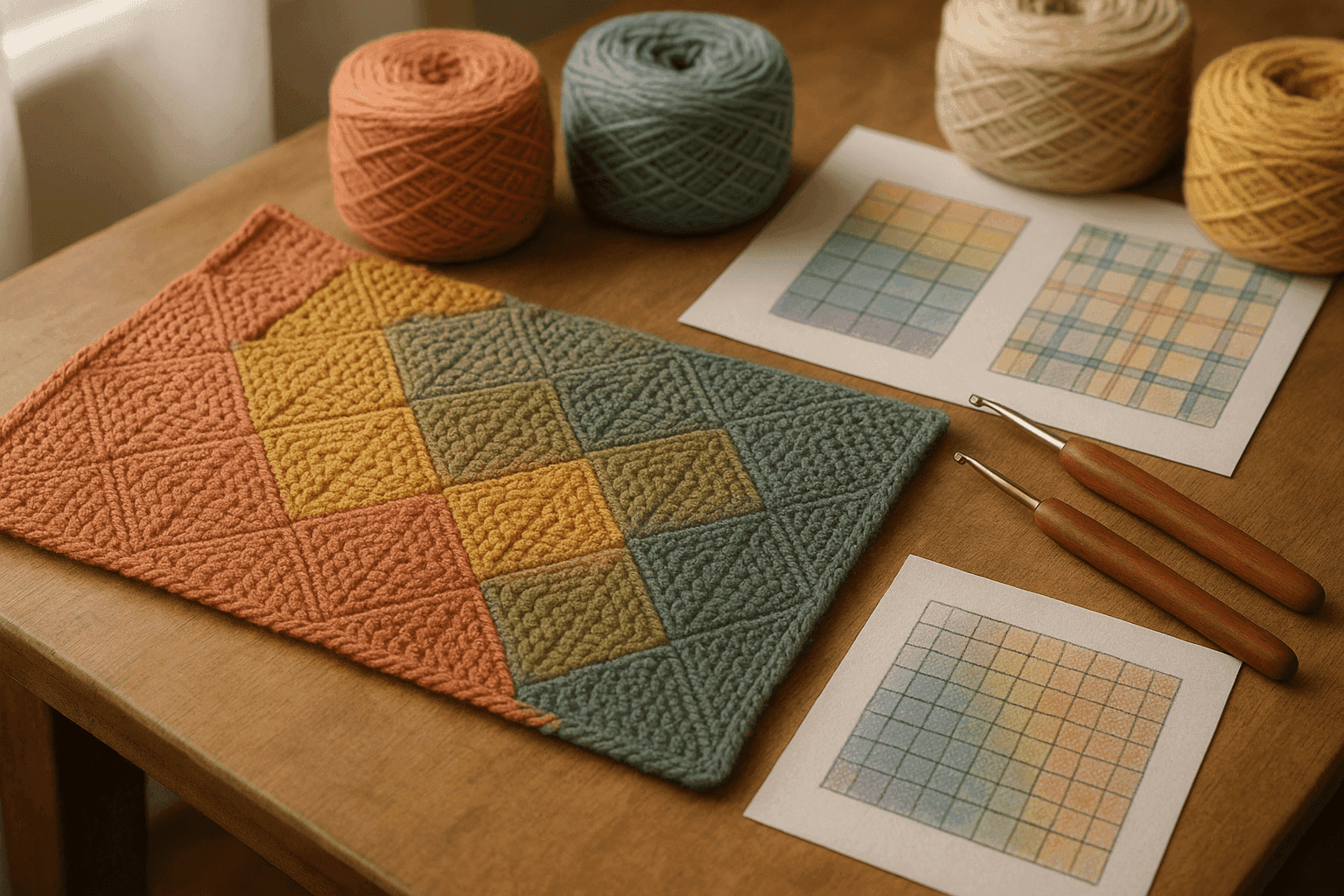
There’s a moment many of us have had with entrelac: you finish that first tidy set of little blocks, step back, and think, well, that’s clever. The texture looks woven, the modules feel architectural, and the fabric seems to organize itself into something more sophisticated than a flat field of stitches. Then you make a larger piece—a scarf, a cushion, a bag panel, maybe the beginning of a cardigan front—and you discover that entrelac is not merely a decorative basketweave effect. It is a construction system. It has grain. It has direction. It has weight distribution, hinge lines, bias tendencies, and a personality that shifts dramatically depending on whether you build it in Tunisian crochet or standard crochet.
That is the point where entrelac gets truly interesting.
If you stop treating crochet entrelac as a novelty texture and start treating it as engineered fabric, you gain control over drape, edge behavior, sizing, shaping, and color in a completely different way. Suddenly those little blocks are not just cute modules—they are structural units. They can be resized, angled, truncated, repeated, mirrored, color mapped, and finished with intent.
This article is for that stage of the maker journey: when you want to understand why entrelac behaves the way it does, not just how to follow a row-by-row instruction set. We’ll look at the geometry of forward and return passes, how bias develops, why some fibers exaggerate hinge lines while others soften them, how Tunisian entrelac differs from standard-crochet entrelac in density and movement, and how to plan color so the fabric reads as gradient, plaid, shadow, or directional light rather than simply “multicolored blocks.” We’ll also get practical about resizing panels, shaping garments and bags with partial blocks, stabilizing edges, and finishing in a way that preserves crisp modular definition without turning the whole piece into cardboard.
Entrelac as a modular fabric system
At its core, entrelac is a tessellated structure made from units—usually squares, rectangles, or diamonds—that are worked one at a time and joined as you go. In crochet, those units are most often built in one of two ways:
- Tunisian entrelac, where each block is worked with a forward pass and a return pass, usually in Tunisian simple stitch (Tss), Tunisian knit stitch (Tks), or occasionally Tunisian full stitch (Tfs).
- Standard-crochet entrelac, where each block is built with rows of regular crochet stitches such as sc, hdc, dc, linked dc, or post-stitch combinations, often attached to neighboring blocks during construction.
Both methods create modular fields. Both can produce the familiar diagonal basketweave appearance. But the mechanics differ enough that they should really be thought of as related systems rather than interchangeable techniques.
The reason this matters is that entrelac behaves less like a single piece of fabric and more like a connected matrix. Every block has:
- a stitch direction,
- a visual grain,
- a pull at its attachment edges,
- and a relationship to neighboring modules.
When those modules alternate direction, they create the diagonal flow we associate with entrelac. But that same alternation also produces controlled distortion—what sewists would think of as a kind of built-in bias architecture.
Understanding the geometry: why entrelac wants to bias
Most crocheters first notice bias as a practical issue: a panel leans, a scarf spirals slightly, or the top edge waves while the side edge seems firm. This is not random. It comes from the geometry of the modules and the way they are joined.
In Tunisian entrelac, each block is formed by collecting loops along one edge or from a base tier, then working repeated forward/return passes across a fixed block width. A common beginner block width is 6 loops, but many wearable fabrics improve at 8 to 10 loops, and larger decorative panels can use 12 loops or more.
For example, a basic Tunisian square block might be:
- Pick up 6 loops along an edge
- Work return pass off all but one loop
- Repeat forward and return passes until 6 rows are completed
That gives a nominally square unit. But because Tunisian stitches have a vertical face and a strong tendency to pull inward horizontally, the square is not neutral in the same way a woven square would be. It often becomes subtly taller or denser depending on:
- hook size,
- return-pass tension,
- fiber elasticity,
- and the stitch used.
Now place a second square onto its side edge. The side edge of the first square becomes the foundation of the second. That means the second square inherits not just stitch count but edge tension from the first. Build a whole fabric this way, and the modules create lines of tension that run diagonally across the piece.
Forward/return-pass geometry and thickness
Tunisian crochet builds fabric in two motions:
- Forward pass: loops accumulate on the hook.
- Return pass: loops are worked off.
This creates a layered structure that is inherently thicker than many standard crochet fabrics worked in similar yarn. In entrelac, because each block starts and stops independently, the edges of those blocks act like seam lines or hinges. The more compact the stitch and the tighter the return pass, the more visible and structural those hinge lines become.
This is why entrelac can feel either beautifully architectural or annoyingly stiff.
A few practical rules:
- Smaller blocks = more hinge lines per inch. More hinge lines usually mean more structure and less fluid drape.
- Larger blocks = fewer interruptions. This generally improves drape but can reduce the crisp woven illusion.
- Tight return passes increase edge definition but can make the fabric cup or bias.
- Loose return passes soften modules but can blur geometry and make joins look sloppy.
If you want engineered clarity without boardiness, begin with a block width of 8 loops in a yarn that suits the project and swatch at least 3 tiers by 3 tiers. A single isolated block tells you very little. Bias and edge behavior only really appear once modules start interacting.
Fiber choice: hinge lines, drape, rebound, and memory
Fiber is where entrelac either comes alive or becomes a fight.
Because the fabric is modular, fiber choice doesn’t simply affect softness or warmth. It changes how sharply each block edge presents, how much neighboring units pivot against one another, and how well the overall fabric recovers after use.
Wool and wool blends
Wool is often the easiest choice for entrelac if you want balanced behavior.
- It has elasticity, so the modules can flex without permanently distorting.
- It has memory, so hinge lines remain crisp but the piece can relax back into shape.
- It blocks beautifully, especially for evening out block dimensions.
A DK or worsted wool blend with a hook one size larger than you might use for flat Tunisian often gives excellent results. For example:
- DK yarn with a suggested 4 mm hook might work well in Tunisian entrelac at 4.5 to 5 mm.
- Worsted yarn with a suggested 5 mm hook may behave better around 5.5 to 6 mm.
The larger hook helps prevent return-pass compression from making the fabric too dense.
Cotton and plant fibers
Cotton, linen, bamboo, and plant-heavy blends can make stunning entrelac because they show geometry and color very clearly. But they reveal every engineering decision.
- Cotton makes very crisp hinge lines and sharp block definition.
- It has less elasticity, so bias and tension inconsistencies are more visible.
- It can become heavy in larger pieces.
- If worked too tightly, it can produce a board-like fabric very quickly.
For bags and structured home décor, this can be an advantage. For garments, it requires more planning. If using cotton for a wearable panel, try:
- a larger hook than usual,
- larger blocks to reduce seam density,
- and a stitch with more give, such as Tfs or a standard-crochet linked stitch pattern.
Acrylic
Acrylic can work well for entrelac, especially for bold colorwork, because it is affordable and available in many shades. Its limitations are mostly about heat sensitivity and memory.
- It often has enough flexibility for scarves and blankets.
- It may not hold a sharply blocked modular edge as well as wool.
- Some smoother acrylics can make modules slide visually into each other, reducing crispness.
If you want plaid or directional color effects, acrylic’s color range is helpful. If you want couture-level shaping and edge memory, wool blend often behaves better.
Silk, alpaca, and drapey luxury fibers
These fibers can make entrelac feel sumptuous, but they soften the structural logic.
- Alpaca increases drape and weight, which can pull blocks out of crisp alignment.
- Silk can emphasize sheen and directional light effects beautifully, but may reduce visible hinge lines.
- High-drape fibers are best with larger modules and simpler color plans.
In short: if the engineering is the star, use a fiber with some memory. If the surface effect is the star, drapier fibers can be glorious.
Tunisian vs standard-crochet entrelac: how the fabric actually changes
This is one of the most useful distinctions to understand before you design or modify a project.
Tunisian entrelac
Characteristics:
- Dense and layered
- Strong directional grain
- More obvious module edges
- Excellent for geometric clarity
- Tends toward warmth and thickness
- More prone to curling or edge tightening if under-hooked
Because Tunisian stitches hold loops on the hook and create vertical bars, the fabric has an internal scaffolding. In entrelac, that makes every block feel intentional and architectural. This is ideal for:
- outerwear accents,
- bags,
- cushions,
- blankets,
- structured shawls,
- and garment sections that benefit from body.
It is less ideal for very fluid summer garments unless you deliberately scale up hook size and block size.
Standard-crochet entrelac
Characteristics:
- More flexible between modules
- Easier to introduce drape
- Less thickness at the same yarn weight
- Broader stitch vocabulary
- More adaptable for curved shaping
If you work entrelac blocks in sc or hdc, the modules can still be crisp, but they hinge more softly. In dc or linked dc, they become even more fluid. Standard-crochet entrelac is especially useful when:
- you want entrelac geometry without Tunisian density,
- you need easier armhole or neckline shaping,
- or you want to integrate lace, mesh, or airy sections.
When to choose which
Choose Tunisian entrelac when you want:
- clean geometric read,
- thicker fabric,
- stronger visual “woven” effect,
- or dimensional color segmentation.
Choose standard-crochet entrelac when you want:
- softer drape,
- easier garment shaping,
- less bulk at seams,
- or a more forgiving fabric for lighter fibers.
An experienced designer will sometimes even combine them: Tunisian entrelac for main panels, standard crochet for side inserts, borders, gussets, or finishing.
Swatching with intent: the numbers that matter
With entrelac, gauge is not just stitches and rows over four inches. You need module gauge.
Here is the most useful way to swatch:
- Choose your stitch and hook.
- Make a swatch at least 3 blocks wide by 3 tiers tall.
- Measure:
- width of one finished block,
- height of one finished block,
- total width across 3 blocks,
- total height across 3 tiers,
- and both diagonals if the fabric is diamond-oriented.
- Steam or wet block lightly and measure again.
For example, suppose your Tunisian entrelac swatch uses 8-loop blocks in DK wool on a 5 mm hook and after blocking each block measures:
- 5 cm wide
- 5 cm tall
Your panel math becomes very straightforward:
- 6 blocks across = 30 cm
- 10 tiers tall = 50 cm
But do not stop there. Check whether the panel pulls narrower at the top than the bottom. Check whether edge triangles distort. Check whether the blocked dimensions hold after the swatch rests for a few hours.
That behavior matters more than perfect square dimensions.
Color planning beyond the basketweave look
The easiest color use in entrelac is changing colors block by block. The most interesting color use treats each block as a pixel or tile in a directional field.
Because entrelac fabric is diagonal and modular, the eye reads color in several competing ways:
- by individual block,
- by diagonal path,
- by row or tier,
- and by overall value movement.
That gives you wonderful design opportunities.
Planning gradients
For a smooth gradient, many crocheters instinctively shift color one row at a time. In entrelac, a more elegant approach is often to shift color along the dominant diagonal.
If your diamonds visually travel lower-left to upper-right, map your color transitions along that same path. This creates a flow that feels embedded in the fabric rather than laid on top.
A simple gradient strategy:
- Assign each block a value from 1 to 5 (light to dark).
- Keep neighboring blocks within 1 step of each other in most directions.
- Let one diagonal carry the main progression from 1 → 5.
- Use the crossing diagonal to echo or delay the change.
This avoids abrupt stair-stepping.
Planning plaid effects
Plaid in entrelac works when you think in terms of bands of value and hue crossing through modules.
Instead of making every block a different color, establish:
- one set of diagonals as “warp bands,”
- another set as “weft bands.”
You can simulate plaid by repeating colors at regular intervals. For example:
- Diagonal set A: navy, navy, cream, navy, navy, cream
- Diagonal set B: burgundy, cream, burgundy, cream
The intersections read as plaid logic even though the fabric is crocheted in separate blocks.
Directional light and shadow
One of the most sophisticated uses of color in entrelac is to treat modules as planes catching light.
Imagine each block as a tiny tilted surface. If you assign slightly different values to alternating block directions, the whole fabric can look illuminated.
Try this approach:
- Use the same hue family.
- Make one orientation of blocks consistently one value lighter than its neighbors.
- Deepen edge triangles or border blocks by one additional value step to frame the field.
In grayscale planning terms, think:
- Orientation A = value 3
- Orientation B = value 4
- Highlight path = value 2
- Shadow path = value 5
This creates a sense of volume without relying on high contrast.
Practical color management tips
- If using many colors, keep fiber and yarn structure consistent. Mixed fiber behavior can distort modules differently.
- For gradient cakes, decide whether color should change within a block or between blocks. Between-block changes usually preserve geometry better.
- For hand-dyed yarns, swatch several blocks. Highly variegated color can either enhance or completely obscure the modular design.
Resizing panels: how to scale intelligently
Resizing entrelac is not difficult once you shift from stitch-based thinking to unit-based thinking.
The basic formula
To resize width:
Desired finished width ÷ finished block width = number of full blocks across
To resize height:
Desired finished height ÷ finished block height = number of tiers
Then round as needed and account for edge triangles or half-blocks.
For example, if each finished block is 2.25 in / 5.7 cm wide and you want a panel approximately 18 in / 45.5 cm wide:
- 18 ÷ 2.25 = 8 blocks across
If each tier is 2.25 in tall and you want 22.5 in length:
- 22.5 ÷ 2.25 = 10 tiers
Stitch count guidance for block sizes
Here are practical starting points:
- 6-stitch or 6-loop blocks: compact, crisp, high texture, more hinge density
- 8-stitch or 8-loop blocks: balanced for many wearables and accessories
- 10-stitch or 10-loop blocks: larger visual modules, softer drape
- 12+ stitch blocks: bold geometry, useful for blankets and statement garments
If your fabric feels too stiff, changing from 6 to 8 or 10 stitches per block often has a bigger effect than changing hook size alone.
Shaping garments and bags with partial blocks
This is where entrelac becomes true engineering.
Full blocks create a grid, but partial blocks let you shape that grid.
Triangles and half-blocks
At edges, you often use triangles to straighten a diagonal fabric line. The same logic can be used intentionally for shaping:
- Necklines: omit successive upper-edge blocks and fill transitions with decreasing triangles.
- Armholes: use stepped partial blocks over 2 to 4 tiers rather than abruptly binding off a whole section.
- Bag gussets: combine full blocks on the body with narrower side modules or half-block columns.
- Waist shaping: reduce one block every few tiers at side seams, then restore later.
A practical garment example
Suppose a cardigan front is 6 blocks wide. You want to shape a V-neck beginning 8 tiers above the hem.
One approach:
- Work straight for 8 tiers.
- On the neck edge, replace the outermost full block with a half-block or triangle over the next tier.
- On every following tier, omit or reduce one neck-edge module as needed.
- Keep the shoulder stable by ensuring the final shoulder width still includes at least 2 to 3 full blocks depending on size.
This gives a stepped-but-controlled neckline that can later be refined with edging.
A practical bag example
For a tote panel worked in Tunisian entrelac:
- Main body: 8-loop blocks, 8 blocks across, 9 tiers tall
- Side gusset: 4-loop partial blocks or narrow standard-crochet strips joined to edge triangles
This lets the body remain crisp while the gusset flexes enough for use.
Edge stability: keeping panels neat without strangling them
Edges are where entrelac projects succeed or fail.
Because modules are built on each other, panel edges often combine:
- block side edges,
- picked-up edges,
- triangle tops,
- and short-row-like transitions.
This creates inconsistent firmness unless you deliberately stabilize it.
Common edge problems
- Top edge flares
- Side edge scallops unintentionally
- Corners collapse or stretch
- Bordering pulls modules out of square
Prevention during construction
- Count every block. If blocks are meant to have 8 loops or 8 stitches, every block must actually have that number.
- Pick up consistently. If you pick up under 1 loop on one block edge and under 2 loops on the next, the edge line will wobble.
- Watch return-pass tension in Tunisian. A tight return pass shortens the top edge.
- Use edge triangles intentionally. Do not skip them just to save time if the design needs a straight boundary.
Border strategies
A good border should stabilize without flattening the modular character.
Best options:
- A single round/row of slip stitch or surface slip stitch for crisp definition
- One or two rounds of sc for moderate stabilization
- Reverse single crochet (crab stitch) for a corded edge on bags or blankets
- Applied i-cord effect in crochet for polished garment edges
- Tunisian simple stitch border worked perpendicular for structured finishing on larger pieces
Avoid heavy multi-round borders unless the project truly needs them. A thick border can overpower module geometry and force the piece into a rectangle unnaturally.
A useful rule: border with a stitch that is equal to or lighter than the density of the entrelac blocks.
Step-by-step framework for building an engineered entrelac panel
Here is a practical workflow you can adapt for nearly any project.
Step 1: Define the project behavior
Ask what the fabric needs to do.
- Scarf: drape, moderate warmth, clean edges
- Bag: structure, abrasion resistance, low stretch
- Garment panel: controlled drape, shape retention, manageable bulk at seams
- Cushion: crisp geometry, less concern about flexibility
This answer determines your stitch system and fiber.
Step 2: Choose method and materials
Suggested starting combinations:
- Structured bag panel: Tunisian entrelac, cotton or wool/cotton, 8-loop blocks, hook 0.5–1 mm larger than usual
- Soft wearable panel: standard-crochet entrelac in linked dc or hdc, wool blend or soft acrylic/wool, 8–10 stitch blocks
- Blanket: Tunisian or standard crochet, washable wool blend or acrylic, 10–12 stitch blocks for better drape over scale
Step 3: Swatch 3 x 3 blocks
Record:
- block width and height,
- total swatch dimensions,
- yarn used,
- hook used,
- whether blocked or unblocked,
- and any observed lean or flare.
Step 4: Map the module grid
Sketch the full project as blocks, not stitches.
For example, a cushion front might be:
- 7 blocks across
- 7 tiers high
- edge triangles on all four sides
A vest back might be:
- lower body: 8 blocks across x 10 tiers
- armhole shaping: remove 1 block each side over 2 tiers
- shoulder shaping: top edge triangles + partial blocks
Step 5: Assign color by value first
Before choosing exact shades, plan light/medium/dark placement. This keeps the design coherent even if yarn substitutions happen.
Step 6: Build with regular counting checks
At the end of each tier, verify:
- number of full blocks,
- block stitch count,
- edge block orientation,
- and top-edge smoothness.
Step 7: Stabilize selectively
Add only the edging or seam support the project needs.
Step 8: Finish for clarity and flexibility
Block enough to align modules, but do not flatten the life out of the fabric.
Troubleshooting: common mistakes and exact fixes
Problem: The fabric leans more and more as it grows
Cause: accumulated tension imbalance, inconsistent pick-up points, or asymmetrical edge treatment.
Fix:
- Confirm every block has identical stitch/loop count.
- Mark the exact loops or edge bars you pick up along every block edge.
- Wet block the swatch and check whether lean relaxes; if not, increase hook size by 0.5 mm.
- If severe, increase block size from 6 to 8 stitches/loops.
Problem: Blocks look rectangular instead of square
Cause: row height and stitch width are out of balance.
Fix:
- For Tunisian, larger hook often solves overly tall/narrow or compressed blocks.
- Add or subtract one row per block while maintaining the same stitch count.
- Example: if 8-loop blocks with 8 rows are too tall, try 8 loops with 7 rows.
- Re-measure after blocking.
Problem: Edge triangles are floppy
Cause: triangles have less internal support than full blocks.
Fix:
- Work triangles slightly tighter than full blocks, but not dramatically.
- Add a single stabilizing border round after completion.
- For bags, consider lining the finished piece or backing edge areas with firm fabric.
Problem: Fabric is too thick and stiff
Cause: block size too small, hook too small, dense stitch choice, or inelastic fiber.
Fix:
- Increase hook by 0.5 to 1 mm.
- Shift from 6-loop to 8- or 10-loop blocks.
- Try standard-crochet entrelac instead of Tunisian.
- Use a wool blend instead of pure cotton for wearables.
Problem: Modules lose crisp definition after blocking
Cause: overblocking or fiber too drapey for the effect.
Fix:
- Steam lightly rather than fully wet blocking.
- Pin only edges and major diagonals, not every block corner.
- Choose a yarn with more memory next time.
Problem: Color plan looks chaotic
Cause: too many equal-contrast choices or no value structure.
Fix:
- Convert your color plan to grayscale mentally or with a phone photo.
- Limit the palette to 3 value levels plus one accent.
- Repeat colors on a deliberate diagonal rhythm.
Variations worth exploring
Once you understand entrelac structurally, you can begin modifying it in meaningful ways.
Rectangular modules
Not every block must be square. Slightly rectangular modules can change the pace of the design and the drape.
Try:
- 8 stitches x 6 rows for a wider, flatter module
- 6 stitches x 8 rows for taller modules with stronger directional read
Use this carefully, because uneven module proportions amplify bias.
Mixed stitch fields
You can alternate block stitches while preserving geometry:
- Tss blocks alternating with Tks blocks for subtle texture shifts
- hdc blocks alternating with linked dc blocks in standard crochet
- matte and sheen yarns in the same color family for light-play effects
Inserted shaping seams
For garments, entrelac does not have to go edge-to-edge. Use entrelac as a feature panel and place:
- plain crochet side panels,
- underarm gussets,
- waist shaping in ribbed sections,
- or shoulder reinforcements in denser stitches.
This often yields better fit than forcing all shaping through modules alone.
Double-faced or lined applications
For bags, pillows, and wall pieces, a backing or lining can support the engineered geometry without changing the surface. This is especially effective for cotton Tunisian entrelac that might otherwise relax unevenly with use.
Finishing methods that preserve crispness without making fabric boardy
Finishing is where restraint matters.
The goal is not to freeze every block in place. Entrelac should still move. What you want is to settle the geometry, align the edges, and support areas under stress.
Wet blocking
Best for wool and wool blends.
- Soak gently.
- Press out water without wringing.
- Lay flat and align overall panel dimensions.
- Smooth diagonals by hand.
- Pin outer edges and only the most distorted key points.
Do not over-pin every module unless the project is a display textile.
Steam blocking
Best for acrylic blends, cotton, and projects where you want to retain more body.
- Hover steam rather than pressing hard.
- Shape with hands while warm.
- Let cool completely.
Press cloth finishing for crisp edges
For structured items, lightly steam through a press cloth at borders only. This sets edges without flattening block texture in the center.
Seaming considerations
If joining entrelac panels:
- Use mattress stitch or slip stitch through matched edge points.
- Avoid thick seam methods on already dense Tunisian fabric.
- For garments, place seams where block orientation helps support the body rather than fights it.
Lining and interfacing for bags
If making a bag, the cleanest result often comes from:
- lightly blocked outer panel,
- woven lining,
- optional interfacing in the lining rather than fusing directly to crochet,
- and reinforced top edge with a compact border.
That preserves module definition while giving the bag practical stability.
Key takeaways
Entrelac becomes much more useful—and much more beautiful—when you stop thinking of it as a faux-woven trick and start thinking of it as a modular fabric architecture.
A few truths make nearly every project better:
- Bias is built into the system. It is not a flaw; it is a behavior to plan for.
- Block size matters as much as hook size. Small blocks create more hinge lines and more structure.
- Fiber determines whether those hinges feel crisp, springy, soft, or stubborn.
- Tunisian and standard-crochet entrelac are not equivalent fabrics. They solve different design problems.
- Color should be mapped by value and direction, not chosen randomly block by block.
- Partial blocks are the key to shaping. They turn entrelac from a rectangle-making technique into a real design system.
- Edges deserve engineering. Consistent pickups, thoughtful triangles, and restrained borders make all the difference.
- Finishing should clarify, not immobilize.
If you are used to seeing entrelac presented as a decorative curiosity, I hope this gives you permission to treat it with more seriousness—and more freedom. It can be sculptural, tailored, graphic, subtle, drapey, dense, softly shaded, or sharply architectural. It can behave like patchwork, like bias fabric, like paneled construction, or like tessellated colorwork. And once you understand the logic of its modules, you can modify it with confidence instead of hoping the fabric will cooperate.
That, to me, is where crochet gets most satisfying: when technique stops being a fixed recipe and becomes a material language. Entrelac absolutely belongs in that category. Use it like an engineer, color it like a painter, and finish it like a textile maker who knows that structure and softness are not opposites—they are design choices.