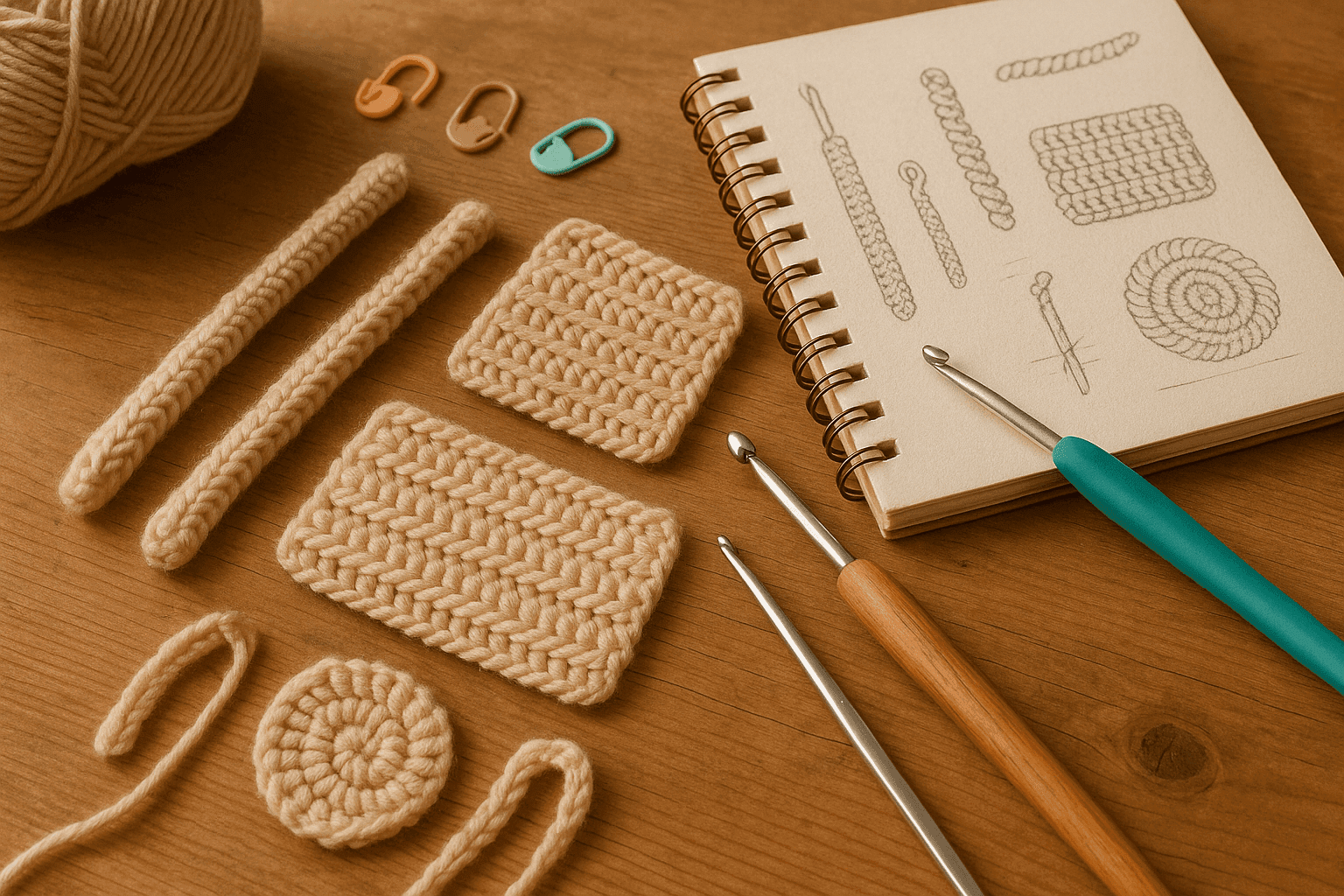
You finish a beautiful cord for a bag, lay it on the table, and it immediately tries to become a phone cord from 1998. A narrow tube meant to sit neatly at the edge of a hood starts corkscrewing. A column of bullions that looked elegant in the swatch pulls the whole fabric sideways. Or maybe a textured panel develops a subtle but persistent bias that no amount of blocking seems to fully erase. Most of us meet crochet torque this way: not as a theory first, but as a project that seems to have developed a strong opinion about which direction it would prefer to turn.
The encouraging news is that twist in crochet is not random. It is structural. Once you understand where rotational torque comes from—yarn ply and spin energy, the path your hook takes, the handedness of your stitches, and the architecture of the fabric—you can predict when it will appear, reduce it when you want stability, and exaggerate it when you want dramatic helical texture. That shift is powerful. Instead of treating twist as a mysterious flaw, you begin using it as another design variable, as real and workable as gauge, drape, or stitch count.
This article is a deep dive into crochet fabric torque with a practical designer’s lens. We will look at why cords, I-cord alternatives, narrow tubes, bullion-heavy surfaces, and directional stitch repeats twist so readily. We will also cover how different yarns amplify or calm that behavior, how to build more balanced straps and trims, and how to intentionally design spiral or helical surface effects that still wear well. Along the way, I’ll give exact stitch frameworks, hook and yarn recommendations, troubleshooting notes, and balancing strategies you can apply whether you are improvising a handle or drafting a full pattern.
What crochet torque actually is
In crochet, torque is the tendency of a fabric or structure to rotate because the stitches store directional energy. That stored energy can come from several places working together:
- Yarn twist: the spin and ply structure already built into the yarn
- Stitch formation: the way loops are drawn through and mounted on the hook
- Fabric geometry: narrow, asymmetrical, or highly directional stitch arrangements
- Tension distribution: when one face, edge, or column is consistently shorter or tighter than another
- Repeat direction: stitches leaning or stacking in one direction over multiple rows or rounds
A flat swatch can hold torque quietly as a slight bias. A narrow element like a cord or tube has very little width to resist that force, so the same energy becomes visibly twisty very quickly. This is why a textured allover fabric may merely slant, while a 4-stitch tube made from similar stitches wants to spiral.
If you like mechanical analogies, think of crochet torque as similar to what happens when multiple tiny directional vectors line up. A single stitch may not force much rotation. Hundreds of stitches worked with the same lean, same yarn energy, and same asymmetry can absolutely do it.
Where the twist starts: yarn ply, spin energy, and stitch handedness
Before we talk about cords and bullion columns, we need to start with yarn itself.
S-twist, Z-twist, and residual energy
Commercial yarns are plied in a direction. Most knitters and crocheters eventually notice that some yarns feel stable and smooth in the hand, while others untwist or tighten as they work. That is because each yarn holds residual spin energy.
Very simply:
- A yarn with lively twist can either open up or tighten as your hook repeatedly enters, wraps, and draws through.
- If your crocheting motion reinforces the yarn’s spin, stitches may become firmer, rounder, and more torque-prone.
- If your motion opposes the yarn’s spin, the yarn may flatten, split more easily, or produce a softer but less springy structure.
Because right-handed and left-handed crocheters form stitches in mirrored ways, the same yarn can behave differently depending on the maker. Even among right-handed crocheters, hook path matters: whether you yarn over from front to back in a broad sweep or a tighter wrist motion can alter how much twist is introduced or released.
Ply count and fiber matter too
A smooth, tightly plied cotton often shows torque clearly because the stitch definition is crisp and the structure is inelastic. A springy wool may hide some bias in the swatch but still store enough energy to twist in a tube. Singles and softly spun yarns may flatten and drift differently from high-twist cable plies.
As a general rule:
- High-twist, firm plied yarns: stronger stitch memory, clearer torque expression
- Cotton, linen, raffia, non-elastic fibers: less forgiving, less self-correction, excellent for revealing structural imbalance
- Elastic wool blends: more recovery, somewhat easier to block, but torque can still remain in cords and narrow trims
- Singles or low-twist yarns: may bias or skew, but often by collapsing rather than corkscrewing
Hook size can amplify or mute torque
Smaller hooks create denser stitches. Dense stitches trap rotational energy more efficiently. Larger hooks add air and flexibility, which can let the fabric relax.
That does not mean “go up a hook size” always solves the problem. In straps and edgings, too much looseness can worsen rolling, edge distortion, and wear. But if a cord is aggressively twisting on a 3.5 mm hook, trying the same structure on a 4 mm or 4.5 mm hook is often worth testing.
Why narrow structures twist more than broad fabrics
A broad fabric distributes stress across width. A narrow structure has almost no lateral resistance. This is why these elements are especially torque-prone:
- Romanian cords and crochet cords
- Slip stitch cords
- Single crochet tubes
- I-cord alternatives built with a tiny stitch count
- Bullion-heavy columns worked in narrow bands
- One-sided edgings and trims
- Straps worked lengthwise rather than side-to-side
If one side of a 4-stitch tube is even slightly shorter than the other, the entire piece rotates because there is no broad fabric plane keeping it flat. The narrower the piece, the stronger the visible twist.
This is not automatically bad. Cords often benefit from some rotational compactness because it makes them rounder and stronger. The problem is uncontrolled twist: when a strap spirals in wear, a neckline trim flips outward, or a sculptural edge loses symmetry.
Cords and I-cord alternatives: why they corkscrew
Many crocheters use crochet cords in place of knit I-cord because they are fast, portable, and sturdy. But crochet structures are generally more directional than knit I-cord, so they can build torque more readily.
Common cord structures and their torque tendencies
1. Chain cord
A simple chain is already twisted by construction. It has front loops, back bumps, and a built-in spiral path. Used alone as a tie or drawstring, it often kinks under its own twist.
Best use: temporary ties, decorative lacing, foundations for other stitches
Typical behavior: high twist, low resistance to kinking
2. Slip stitch cord
Worked back along a foundation chain or as a tiny row-by-row strip, this creates a dense, rope-like element.
Typical behavior: very strong torque, especially with tight tension and cotton yarn
Good for: firm drawstrings, crisp outlines, structured surface lines
Risk: severe corkscrewing if used as a flat-facing trim or unsupported strap
3. Single crochet cord or tube
A narrow strip of 2–4 sc, or a tiny tube worked in rounds, is sturdier than a plain chain but still highly directional.
Typical behavior: moderate to high torque depending on stitch count
- 2 sc width: very likely to twist
- 3 sc width: often twists unless balanced by construction
- 4–6 sc width: more stable, especially in paired or turned structures
4. Thermal or linked strap structures
These use layers, back-loop/front-loop pathways, or slip-joined columns to create denser, more symmetrical straps.
Typical behavior: low to moderate torque, higher wear resistance
Good for: bag handles, belts, camera straps, tote straps
A practical cord comparison swatch
Use worsted weight cotton or wool and a 4 mm hook. Make each sample 20 cm / 8 in long.
- Chain cord: ch 60.
- Slip stitch cord: ch 61, sl st in 2nd ch from hook and across. Stitch count: 60 sl sts.
- 3-sc strip: ch 4, sc in 2nd ch from hook and next 2 ch. Turn. Work 3 sc in each row for 20 cm.
- 4-sc tube: ch 4, join carefully without twisting. Work 1 sc in each ch around. Stitch count: 4 sc per round for 20 cm.
- Thermal strap sample: ch 7, sc in 2nd ch from hook and across. Turn. Work thermal sc across 6 sts for 20 cm.
Lay them flat without stretching. Then hang each sample with a clip and a 50–100 g weight for 24 hours. You will learn more from that little experiment than from a dozen vague warnings about “some twisting may occur.”
How to counteract torque in cords and straps
There are four big strategies: balance the structure, increase width, change stitch path, and pair opposing directional energies.
1. Balance the structure
Symmetry matters. A strap with a clear center and mirrored edges behaves better than a strap where every stitch leans in the same sequence.
Good balancing methods include:
- Working in rows and turning instead of always progressing in one direction
- Using matched edge stitches on both sides
- Building straps from two mirrored layers and joining them
- Seaming or slip-stitching pieces together with opposing stitch orientation
2. Increase width slightly
Going from 3 stitches wide to 5 or 6 stitches wide can dramatically improve behavior. This is one of the most useful fixes for bag straps.
Rule of thumb:
- Decorative tie cord: 2–4 stitches wide is acceptable
- Garment tie or hood cord: 4–6 stitches wide is usually more cooperative
- Bag strap: aim for 6–10 stitches wide minimum unless the structure is layered or reinforced
3. Choose a stitch path with less stored rotation
Some stitches pack rotational energy more tightly than others.
Usually, from most to least torque-prone in narrow forms:
- Tight slip stitch
- Tight single crochet in unturned progression
- Half double crochet with consistent directional slant
- Balanced linked or thermal constructions
- Joined/paired constructions with mirrored orientation
4. Pair opposing energies
This is the designer’s trick that solves many mysteries. If one row or layer leans one way, add another that leans the opposite way.
Examples:
- Make two identical narrow strips and seam them wrong sides together, with one strip flipped so the stitch slant opposes.
- Work a strap in rows and turn every row rather than spiraling around a tube.
- For a tube, work one section in standard rounds and the next section with a compensating stitch pattern or through alternate loop placements.
A stable crochet bag strap formula
Here is a strap structure that wears better than a simple sc strip and resists torque well.
Thermal single crochet strap
Yarn: worsted or aran weight cotton, cotton blend, or wool blend
Hook: 0.5 mm smaller than label recommendation for firmness; for worsted, usually 4 mm or 4.5 mm
Width: 8 foundation chains gives 7 sts across before thermal layering
Finished width: approximately 2.5–3 cm / 1–1.25 in
Step-by-step
- Foundation: ch 8.
- Row 1: sc in 2nd ch from hook and in each ch across. Stitch count: 7 sc. Turn.
- Row 2: ch 1, sc in first st and each st across, working through the loop of the current row and the corresponding unworked loop from the row below to form thermal sc. Stitch count: 7 thermal sc. Turn.
- Repeat Row 2 to desired length.
Why it works
- The strap is thicker and more centered than a plain strip.
- The stitch path creates paired structure rather than a single rolling plane.
- The density improves recovery and slows distortion in wear.
Common mistake
Problem: strap starts curving sideways.
Fix: check that you are consistently catching both required loops in every stitch. Missing one layer on one side shortens that edge and introduces torque.
Bullion columns: beautiful, dramatic, and famously unruly
Bullion stitches are little bundles of wrapped yarn drawn through into a compact coil. They are inherently directional because the wraps stack and compress along a path. One bullion can sit beautifully. A line of them, especially all leaning the same way, can torque a fabric surprisingly fast.
Why bullion-heavy areas twist
A bullion stitch changes the local geometry of the fabric in several ways:
- It adds extra yarn length on the fabric surface
- It creates a raised, cylindrical element with directional wrap
- It often anchors into a smaller base than its visual bulk suggests
- Repeated in columns, it can form a surface rib that contracts one side of the fabric differently from the other
If your bullions all wrap in the same direction and are worked over the same count spacing, they can produce a rope-like tendency across a panel.
Yarn and hook choices for bullions
For clean bullions with manageable torque:
- Choose smooth plied yarn with enough grip to hold wraps but not so much twist that it snarls.
- Often a slightly larger hook than the surrounding fabric helps the wraps settle and reduces over-tight compression.
- In DK or worsted yarn, try using the standard hook for the base fabric and a hook 0.5 mm larger only for bullion rows if needed.
A bullion column swatch
Yarn: DK or worsted wool blend
Hook: 4 mm for base, optional 4.5 mm for bullion row
Base: chain 22
Foundation setup
- Row 1: dc in 4th ch from hook and each ch across. Stitch count: 20 dc. Turn.
- Row 2: ch 2, dc across. Stitch count: 20 dc. Turn.
Bullion row
- Row 3: ch 2, dc in next 2 sts, bullion in next st using 7 wraps, dc in next 3 sts; repeat from * across, ending with dc in last 2 sts. Stitch count: 20 sts total, with 4 bullion stitches.
Then repeat plain dc rows between bullion rows and compare these versions:
- Bullions stacked directly above bullions
- Bullions staggered every other bullion row
- Bullions alternated with mirrored surface placement, such as front-facing and slightly offset anchors
Version 1 will usually show the strongest directional pull.
How to balance bullion fabrics
Stagger columns
Stacked bullions act like vertical ribs. Staggering breaks the continuous spiral invitation.
Alternate wrap count or spacing
If every column has 9 wraps and the surrounding stitches are sparse, the columns dominate. Try 7-wrap bullions with more base stitches between, or alternate 7-wrap and 5-wrap bullions.
Add compensating texture
A matching raised column on the opposite slant can help. Post stitches, paired puff columns, or mirrored surface slip stitches can distribute visual and structural weight.
Use anchoring rows
After a bullion-heavy row, work a stabilizing row in a firm but not tight stitch such as sc or linked hdc. This helps reset the fabric plane.
Check row height honestly
Bullion rows often fool the eye. The fabric may look lofty but actually be vertically compressed. If the rows between bullion rows are too short, the fabric bows and twists.
Fix: add one extra plain row between bullion rows, or switch surrounding stitches from sc to hdc/dc to restore balance.
Helical surface design: when twist is the point
Now for the fun part. Torque is not only something to eliminate. It can create gorgeous spiraling trims, raised vine effects, coiling vessels, organic tendrils, and sculptural edges that look almost engineered.
Intentional helical design works best when you distinguish between:
- Surface helix: a visible spiral texture on an otherwise stable fabric
- Structural helix: the entire fabric or cord physically twisting
The first is often desirable. The second needs control if the piece must wear comfortably.
How to design a visible spiral without disastrous distortion
1. Keep the base fabric balanced
Use a stable ground such as even sc, hdc, or linked dc worked in turned rows or properly managed rounds.
2. Place directional texture on top
Surface slip stitch, post stitches, bullions, or diagonal loop manipulations can create a visual helix while the underlying fabric resists corkscrewing.
3. Repeat with measured shift
A spiral appears when a motif shifts a fixed number of stitches each round or row.
Example: in a tube of 24 sc per round, place a raised stitch cluster every 6 stitches in Round 1, then in Round 2 place each cluster 1 stitch to the right of the previous cluster. Continue that 1-stitch shift each round. The eye reads a helix.
4. Maintain stitch count exactly
Helical patterns go wrong fast if increases or decreases creep in. On a 24-stitch tube, you need 24 stitches every round unless shaping is intentional.
Helical tube sample
Yarn: DK cotton blend
Hook: 3.5 mm to 4 mm
Foundation: ch 24, join without twisting
Base rounds
- Round 1: 1 sc in each ch around. Stitch count: 24 sc.
- Round 2: 1 sc in each st around.
Texture round
- Round 3: surface sl st or front post accent at current point, sc in next 5 sts; repeat 4 times total.
Shifted rounds
- Round 4: move the accent 1 stitch later: sc in 1, accent, sc in next 4; repeat around.
- Round 5: sc in 2, accent, sc in next 3; repeat around.
- Continue shifting by 1 stitch per round until the accent returns to the original position.
This produces a visible spiral track while the base count remains 24.
To keep it stable
- Do not tighten the accent stitches more than the base sc.
- If the tube narrows where the accents occur, go up 0.5 mm in hook size for accent rounds.
- If the spiral line causes puckering, space accents every 8 stitches instead of every 6.
Directional stitch repeats and whole-fabric bias
Not all torque lives in cords. Sometimes a broad fabric develops a diagonal drift because the repeat consistently favors one direction.
Common culprits include:
- Repeated post-stitch lattices leaning one way
- Cluster patterns anchored asymmetrically
- Every-row loop-only work on the same face
- Surface crochet applied repeatedly in one direction
- Long sections worked continuously in the round with no balancing feature
Signs of structural bias
- Side edges slant even though stitch count is correct
- Blocking improves appearance temporarily but bias returns in use
- Vertical motifs drift off-center over length
- A hem or edging flips consistently in one direction
Balancing strategies for directional repeats
- Mirror the repeat on the second half of the piece
- Alternate the directional row every other row
- Insert a neutral reset row every 2–4 pattern rows
- Divide the motif around a centerline and reflect it
- If working in rounds, place opposing directional motifs on opposite sides
For garment fronts, this is especially important. A decorative trim that spirals beautifully on a sample cord may look unsettling if both front bands torque toward the same side rather than mirroring each other.
Edgings, trims, and sculptural applications
Edgings have a special relationship to torque because one side is anchored to the project and the other is free. That unequal freedom makes rotation more visible.
Stable edging principles
- Use a firm attachment edge with evenly spaced joins
- Avoid making the free edge dramatically denser or shorter than the attached edge
- If the trim has a strong directional texture, test both orientations before committing
- On necklines and openings, prefer mirrored motifs at center front/back
Example: balanced sculptural trim
Suppose you want a raised spiral trim on a bag opening.
A good strategy is:
- Work a stable base edging: 1 round sc, 1 round hdc. Keep counts even.
- Add a sculptural round with directional clusters every 4–6 stitches.
- Follow with a settling round worked into the base spaces, not only around the cluster heads.
- If the trim still pulls, add a hidden reinforcement row on the inside edge with slip stitch or a sewn cord.
Example stitch count planning
For a bag opening of 96 stitches:
- Round 1: 96 sc
- Round 2: 96 hdc
- Round 3: (cluster, hdc in next 5) repeat 16 times = 16 clusters + 80 hdc = 96 stitch positions managed around the opening
- Round 4: 96 sc worked evenly
If the cluster round contracts, increase spacing to every 6 or 7 stitches rather than every 5.
Troubleshooting torque in real projects
Here is the part most of us wish patterns included more often.
Problem: my cord twists immediately as I crochet it
Likely causes:
- Structure too narrow
- Tension too tight
- High-twist yarn paired with dense stitch
- Continuous one-direction construction
Fixes:
- Increase width by 1–2 stitches
- Go up 0.5 mm in hook size
- Switch from slip stitch or tight sc to a layered strap method
- Make two narrow cords and join them in opposition
Problem: my bag strap hangs straight at first but spirals after use
Likely causes:
- Fabric compresses unevenly under load
- Strap is stretching on one edge more than the other
- Stitch structure lacks internal balance
Fixes:
- Replace plain sc strip with thermal sc or linked construction
- Add a fabric, ribbon, or twill tape reinforcement on the inside
- Use a yarn with better recovery; cotton alone can be strong but can also distort under load
- Swatch with a hanging test before making the final strap
Problem: my bullion panel slants sideways
Likely causes:
- Bullions too dense or too heavily wrapped
- Rows between bullion rows are too short
- All columns stacked with same directional emphasis
Fixes:
- Reduce wraps from 9 to 7 or 7 to 5
- Add an extra plain row between bullion rows
- Stagger columns
- Use a larger hook for bullion rows only
Problem: my tube spirals even though stitch count is correct
Likely causes:
- Spiral rounds naturally offset the beginning point
- Accent stitches are tightening one track of the tube
- One loop placement is shortening part of the circumference
Fixes:
- Mark the first stitch of every round and verify count every round
- Redistribute accent stitches so they shift intentionally rather than drifting accidentally
- Add occasional neutral rounds in plain sc
- If you need visual straight columns, use joined rounds rather than continuous spiral rounds
Problem: blocking fixes it only temporarily
Likely causes:
- Torque is built into the stitch architecture, not just finishing
Fixes:
- Redesign the structure; blocking cannot permanently erase strong mechanical bias in many yarns
- Add reinforcement or a balancing lining
- Treat the twist as intentional and redesign surrounding components to match it, if appropriate
Designing for wear: recovery, symmetry, and long-term behavior
It is one thing to make a swatch behave on the table and another to make a strap or edging behave after weeks of use.
Recovery
Recovery is how well the structure returns after stretching or twisting. Yarn matters, but so does architecture.
For better recovery:
- Favor layered or centered structures over single-plane narrow strips
- Choose yarns with some elastic memory for functional straps
- Avoid overloading a tiny cord with a heavy bag body
- Consider hidden reinforcement in high-stress areas
Symmetry
Even decorative pieces benefit from symmetry at the macro level.
Examples:
- If a hood cord twists slightly, make both cords in mirrored construction or from the same batch and working method so they match.
- If a front edging spirals, mirror the opposite front edging rather than duplicating in the same directional orientation.
- If a sculptural trim arcs clockwise, use a counterclockwise mate on the opposite side of a center point.
Wear testing
A proper test sample for torque-sensitive crochet should include:
- Flat resting test
- Hanging test with weight
- Light steaming or blocking test
- Friction test by rubbing and flexing the piece repeatedly
- Recovery test after 24 hours of suspension
For bag straps, I strongly recommend making at least a 15–20 cm / 6–8 in sample in the actual yarn and hanging a realistic weight from it. A strap that looks perfect on the hook can reveal its true personality by the next morning.
Variations and intentional design directions
Once you understand torque, you can use it creatively.
1. Intentional rope cords
Use slip stitch or tight sc in a lively plied yarn and a relatively small hook to create a compact decorative cord that wants to twist. Excellent for botanical tendrils, sculptural knots, and statement ties.
Suggested setup: fingering or sport yarn with hook 0.5–1 mm smaller than label recommendation; make cords 2–3 stitches wide or as slip stitch returns over chain.
2. Stable utilitarian straps
Use thermal sc, linked stitches, or two mirrored strips joined together. Ideal for totes, satchels, aprons, and handles.
Suggested setup: worsted/aran cotton blend or wool blend; hook slightly smaller than standard; width 6–10 sts.
3. Bullion vine panels
Alternate bullion columns with plain or lightly textured channels so the fabric reads lush without over-contracting.
Suggested setup: bullions every 4th or 5th stitch, staggered every other motif row, with at least one stabilizing row between motif rows.
4. Helical vessel surfaces
On baskets or sculptural sleeves, intentionally shift textured motifs around a stable round count. Raffia, cotton cord, or sturdy T-shirt yarn can produce dramatic effects.
Suggested setup: fixed stitch count around, accent motif shifted by 1 stitch every round, neutral rounds inserted as needed.
5. Mirrored edgings
Create a right-leaning trim for one side and a left-leaning mirror for the other. This is especially elegant on cardigan fronts, cuffs, and neckline bands.
Common mistakes that create hidden torque
Sometimes the issue is not the pattern concept but tiny execution differences.
Watch for these:
- Inconsistent turning direction when experimenting with narrow strips
- Changing yarn-over style mid-project
- Unnoticed edge tightening at row starts or joins
- Missing one loop path repeatedly in thermal or loop-specific constructions
- Working bullions tighter as your hands tire
- Uneven spacing of attached edgings around a garment or bag opening
A notebook helps here. If you are developing a design, record:
- yarn brand and fiber
- hook size
- whether you worked tightly, average, or loose
- row/round count
- flat width and hanging width
- observed twist direction
- whether blocking changed the result
Patterns become much more reliable when you treat torque as data rather than irritation.
A simple design checklist before you commit
When designing or modifying a torque-sensitive crochet structure, ask:
- Is this element narrow enough that twist will be highly visible?
- Is the stitch path directional or symmetrical?
- Does the yarn have lively twist or little elasticity?
- Am I working continuously in one direction?
- Would one more stitch in width improve stability?
- Should this be turned, mirrored, layered, or reinforced?
- Is the spiral effect intentional surface texture or accidental structural distortion?
- Have I tested the piece under weight and after rest?
If you can answer those questions early, many “mystery problems” never become project problems.
Takeaways
Crochet fabric torque is not a sign that you have done something wrong. It is the visible result of directional forces built into yarn and stitch architecture. Cords, narrow tubes, bullion columns, and one-way repeats simply reveal those forces more dramatically than broad, balanced fabrics.
The key ideas to keep with you are these:
- Narrower structures show torque faster. A 3-stitch cord will expose imbalance much sooner than a 30-stitch panel.
- Yarn twist, fiber, and hook size matter. High-twist plied yarns and tight hooks usually intensify torque.
- Symmetry is your friend. Turn rows, mirror layers, pair opposing slants, and stabilize the base fabric.
- Bullions and directional textures need spacing and support. Stagger them, anchor them, and let the surrounding fabric do some balancing work.
- Helical effects can be designed intentionally. A stable base plus shifted surface texture gives you spirals without uncontrolled distortion.
- Wear testing is essential. Especially for straps, trims, and cords, the hanging test tells the truth.
If you have ever felt betrayed by a strap that would not lie flat or fascinated by a cord that seemed to coil itself into sculpture, you have already met torque as a creative force. The next step is simply to work with it on purpose. Once you start noticing how yarn energy, hook motion, and stitch architecture interact, your crochet becomes more predictable, more durable, and often more inventive. The twist stops being a nuisance you hope to block out and becomes a structural language you can read—and write—much more fluently.