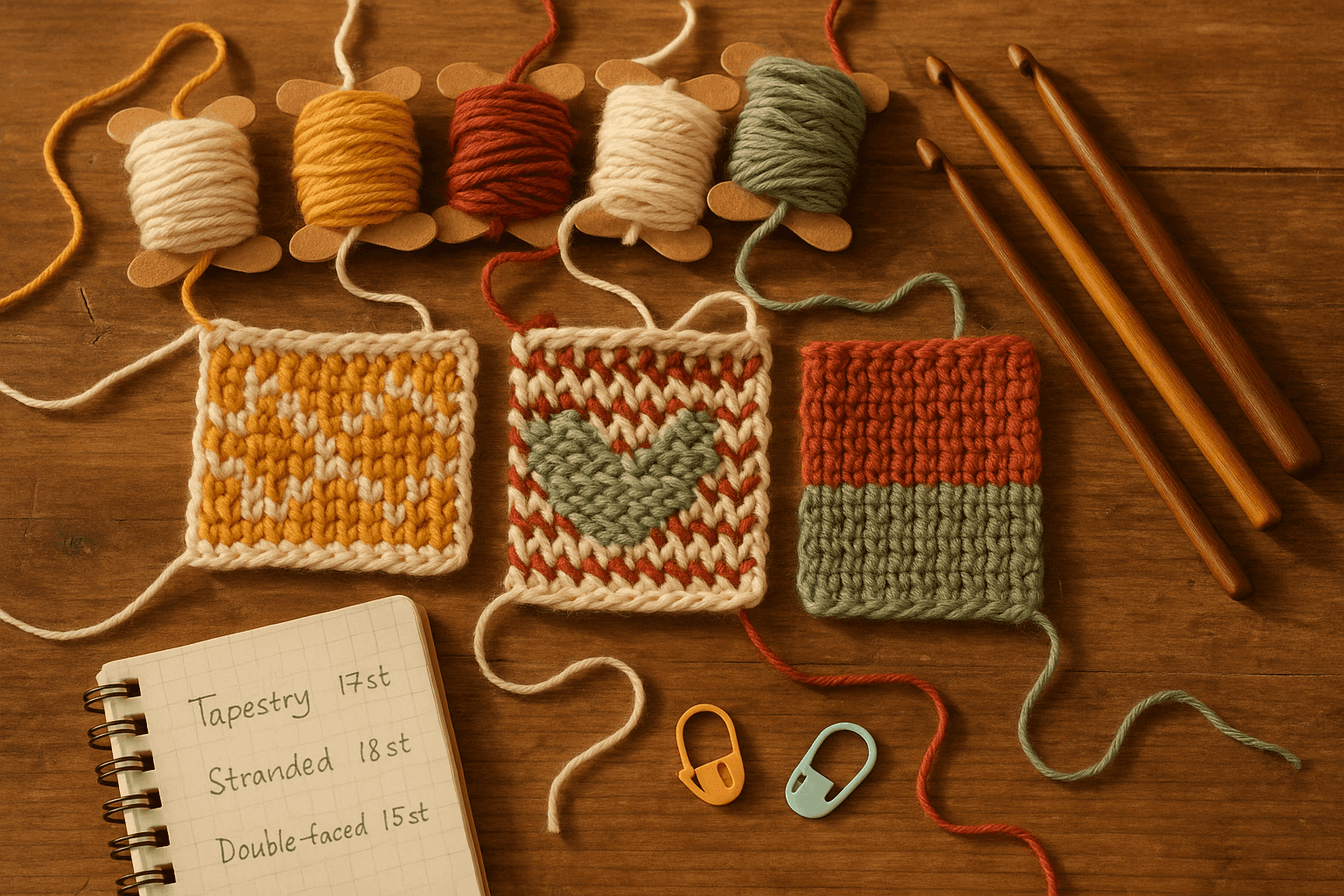
There is a particular moment in crochet colorwork that nearly every maker recognizes: you turn over your work, admire the motif on the front, and then see a long carried strand stretched across the back like a tiny tripwire. It looks neat enough—until you imagine a finger, a button, or the edge of a necklace catching on it. Or maybe the opposite has happened: you were so determined to tame the float that you caught it every stitch or two, and now the fabric draws in, the motif looks pinched, and the whole section has that stubborn, corrugated stiffness that says the yarns are fighting each other.
Managing carried yarns is one of those skills that sounds simple in theory and becomes wonderfully technical in practice. How often should you catch the float? How firmly? Does the answer change if you are working single crochet tapestry, a taller stranded half double crochet motif, or a double-faced fabric where the “carry” becomes part of a second layer? Why does one yarn behave beautifully over five stitches while another starts to grin through after three? And why can the exact same chart feel stable in wool but awkward in cotton?
This is where crochet colorwork gets especially interesting. Float locking and catch frequency are not just habits; they are engineering choices. They interact with stitch height, yarn elasticity, hook path, color dominance, fabric density, motif size, and the intended use of the finished piece. A hat that tolerates slightly shorter catches may behave perfectly. A pullover yoke, mitten cuff, or bag panel may need entirely different handling to stay wearable, durable, and visually crisp.
What follows is a technique-deep guide to long carried yarns in tapestry, stranded, and double-faced crochet. We will look at how and why floats destabilize fabric, how to choose a catch frequency that suits both yarn and stitch structure, how to swatch with purpose, how to redesign motifs when the carry path becomes the problem, and how to finish colorwork so it remains stable after real use. Think of this as the conversation you would have at a table full of serious crocheters—encouraging, practical, but willing to get precise because precision is what gives you freedom later.
Why long carries become a structural problem
A carried yarn is not passive. Even when it sits behind or inside stitches, it still contributes tension, bulk, elasticity, and memory. A long float can misbehave in three main ways:
- It can pull too tight, causing puckering or width loss.
- It can remain too loose, creating snag-prone loops and a sloppy wrong side.
- It can show through, either because the non-working yarn peeks between stitches or because the fabric is not dense enough to hide it.
The challenge is that the threshold for “too long” or “too often caught” changes with method.
In tapestry crochet, non-working colors are usually enclosed within the stitches. The carried yarn travels inside a relatively dense fabric, most often single crochet or waistcoat/split single crochet. The risk is less about loose backside floats and more about bulk, peeking colors, and distortion if too many yarns are trapped over too long a distance.
In stranded crochet, the unused yarn typically floats behind the work in a way more similar to stranded knitting, though crochet stitches are taller, deeper, and often less laterally elastic. This means a float that would be harmless over five knit stitches may become more obvious over five crochet stitches, especially if the stitch is half double, double, or taller. Snagging and grin-through both become major considerations.
In double-faced crochet, each side of the fabric is built intentionally, and the carried yarn often becomes less of a casual float and more of a managed interior path between mirrored or paired stitches. Long unsupported stretches can still skew the layers or telegraph through if the two faces are not balanced.
So before deciding on a catch schedule, it helps to ask: What exactly am I trying to stabilize? Backside snagging? Front-side color clarity? Width? Drape? The answer changes the technique.
The variables that determine catch frequency
A useful rule of thumb is that catch frequency is a function of visible span + stitch height + yarn behavior + fabric density + end use. That sounds abstract, so let’s break it down.
1. Stitch height
Taller stitches create longer travel paths. A float spanning 4 single crochet stitches is not structurally identical to a float spanning 4 double crochet stitches.
Approximate visible width of 4 stitches in medium-weight yarn:
- 4 sc: about 1 to 1.25 in / 2.5 to 3 cm
- 4 hdc: about 1.25 to 1.5 in / 3 to 4 cm
- 4 dc: about 1.5 to 2 in / 4 to 5 cm
Because crochet stitches stack yarn vertically and often leave deeper gaps between posts or loops, a taller stitch usually needs either:
- shorter unmanaged floats, or
- more deliberate float locking, or
- denser hook sizing to compensate.
Practical baseline:
- In sc tapestry: carrying enclosed yarn for 5 to 8 stitches is often manageable if gauge is firm.
- In sc stranded: floats of 3 to 5 stitches are usually a comfortable upper range before catching.
- In hdc or dc stranded: many makers prefer catching every 2 to 4 stitches.
These are not fixed limits, but they are reliable starting points.
2. Yarn elasticity and surface behavior
Elastic yarn forgives. Inelastic yarn exposes every miscalculation.
- Wool and wool blends: springy, cohesive, often easiest for colorwork. Floats can settle into fabric and recover from minor tension irregularities.
- Cotton: excellent stitch definition, but little elasticity. Tight catches cause immediate draw-in; loose floats remain loose.
- Acrylic: varies widely. Some are springy and smooth; some are squeaky and resist even tension. Smooth acrylic may grin through more readily in tapestry.
- Alpaca, silk blends, plant blends: often drapier and less resilient. Long carries can sag or telegraph more than expected.
The less elastic the yarn, the more important it becomes to shorten carry spans or reduce the contrast between active and carried tension.
3. Float length
Float length should be measured in both stitch count and distance. A five-stitch float in sport yarn is not the same as a five-stitch float in bulky yarn.
A useful planning method:
- Swatch and measure the width of 1 stitch in your chosen pattern.
- Multiply by intended float span.
- Compare that number against the project use.
For wearables, many crocheters find that any exposed float over 1 in / 2.5 cm deserves special attention, and anything over 1.5 in / 4 cm generally wants catching, redesign, or a different method.
4. Color dominance and contrast
High-contrast colorwork amplifies every carrying decision. A black yarn carried behind white stitches is more likely to shadow, grin through, or telegraph than two mid-tone heathers close in value.
Dark carried under light = highest risk of show-through.
Fuzzy fibers reduce this risk. Smooth fibers increase it.
When one color consistently appears crisper or more centered, you may be seeing a kind of crochet color dominance caused by where the working yarn travels relative to the hook path. The dominant color is often the one given slightly more surface room and less constricted travel. Consistency matters more than a universal rule: if Color A is held below and Color B above, or one is consistently trapped deeper in tapestry stitches, keep that arrangement stable across the project.
5. Hook path and yarn management
How you pick up the new color changes float behavior.
Common paths include:
- dropping the old color behind and picking up the new color cleanly,
- twisting/catching the carried yarn behind the work at set intervals,
- enclosing the non-working yarn inside the stitch body,
- locking floats by crossing yarns at the wrong side before the next stitch.
A consistent hook path reduces accidental tightening. Inconsistency—sometimes carrying high, sometimes low, sometimes crossing tightly, sometimes loosely—is a major source of rippling and shadowing.
6. Fabric density
Denser fabric hides and controls carried yarns. Looser fabric emphasizes them.
If your goal is stable colorwork, you will often use a smaller hook than the yarn label suggests.
Typical starting points:
- Fingering yarn: 2.75 to 3.5 mm for dense sc colorwork
- Sport yarn: 3.25 to 4 mm
- DK yarn: 3.5 to 4.5 mm
- Worsted yarn: 4 to 5 mm
For tapestry or double-faced fabric, it is common to work 0.5 to 1.5 mm smaller than your usual drapey gauge for that yarn weight.
Method-by-method engineering
Tapestry crochet: enclosed carries, dense structure
Tapestry crochet excels when you want graphic motifs with minimal backside floats. The non-working yarn is carried inside the stitches, which means catch frequency becomes less about snagging and more about how long you can hide a color before it peeks, bulks, or stiffens the fabric.
Best stitch choices
- Single crochet (sc): the standard workhorse
- Split single crochet / waistcoat variants: crisper vertical color columns, denser fabric
- Center single crochet: can improve alignment in the round
Starting recommendations
- Yarn: wool, wool blend, or smooth cotton for bags/home décor; elastic wool blends for wearables
- Hook: 0.5 to 1 mm smaller than standard recommendation
- Carry span inside stitches: often 5 to 8 stitches comfortably, sometimes longer in dark-on-dark or marl effects
Tapestry catch logic
Since the yarn is enclosed continuously, “catch frequency” often means either:
- whether you trap the inactive color under every stitch, or
- whether you occasionally release and reorient the carried yarn to prevent spiraling tension or color peeking.
In most tapestry crochet, the inactive yarn is enclosed under every stitch. But if one color is not used for a long span—say 10 to 20 stitches—you may get a thick ridge or visible shadow. In that case, consider:
- using bobbins instead of carrying all colors across the row,
- redesigning the motif,
- carrying only one inactive color and dropping others,
- working separate color sections joined as you go.
Step-by-step: locking color invisibly in tapestry sc
Example swatch:
- Yarn: DK weight, two colors
- Hook: 4 mm
- Foundation: Ch 31
- Row 1: Sc in 2nd ch from hook and across. 30 sc.
- Work 8 rows plain in main color to establish gauge.
Now introduce a contrast block of 6 stitches centered in the row.
- Work in main color until 1 stitch before the color change.
- Insert hook into next stitch, yarn over with main color, pull up loop.
- Yarn over with contrast color and complete the stitch. This makes the new color appear cleanly at the top of the completed stitch.
- Lay the inactive main color along the top of the previous row, behind the new stitch path.
- For each of the next 6 sc, work over the inactive yarn so it is enclosed inside the stitch body.
- On the final contrast stitch, complete the last yarn over with main color to switch back.
Stitch count remains 30 sc throughout.
Common tapestry mistake
If the carried color peeks through every light stitch, your fabric is too open, your carried yarn is riding too close to the surface, or your contrast is too strong for the gauge. Try a smaller hook, a looser carried strand inside the stitch, or a method change to stranded colorwork with locked floats.
Stranded crochet: exposed floats that must be engineered
Stranded crochet gives you lighter fabric than tapestry and cleaner stitch definition than enclosing multiple yarns. But crochet’s stitch anatomy makes floats more visible and less forgiving than in knitting.
This is where deliberate float locking matters most.
Best stitch choices
- Single crochet for compact motifs
- Half double crochet for slightly faster fabric with moderate height
- Extended single crochet for smoother line transitions in some charts
Double crochet can be used, but long carries in dc require especially careful locking because the backs become snag-prone and the fronts can distort.
Baseline catch frequency by stitch type
Start here, then refine by swatching:
- sc stranded: catch every 3 to 5 stitches
- hdc stranded: catch every 2 to 4 stitches
- dc stranded: catch every 2 to 3 stitches
For high-contrast colors, children’s wear, mittens, sleeves, or bags, work on the conservative end of those ranges.
Step-by-step: locking a float in stranded sc
Example swatch:
- Yarn: fingering or sport weight wool
- Hook: 3.25 mm for fingering, 3.75 mm for sport
- Foundation: Ch 37
- Row 1: Sc in 2nd ch from hook and across. 36 sc.
- Row 2 setup motif: 12 sc MC, 8 sc CC, 16 sc MC.
Suppose you need to carry MC behind an 8-stitch CC segment.
- Work 12 sc in MC.
- Switch to CC in the final yarn over of stitch 12.
- Work 3 sc in CC, letting MC float loosely behind the work.
- Before stitch 4 of the CC section, bring MC under or over CC at the back—choose one path and keep it consistent. This is the catch.
- Work the next CC stitch so the crossed MC is trapped lightly behind, not pulled to the front.
- Continue 3 more CC stitches.
- Catch MC again before the final CC stitch if needed.
- Switch back to MC on the last yarn over of the 8th CC stitch.
The key is that the float lies relaxed across the back, with enough slack to match the width of the stitches it spans. It should not cinch the row.
How much slack is enough?
A practical trick: after the catch, spread the just-made stitches on the hook shaft or with your fingers to full working width before snugging the crossing point. This “sets” the float to fabric width rather than to the compressed width of stitches bunched near the hook.
For circular work, it helps to periodically stretch the fabric around the circumference it will actually occupy—especially hats, sleeves, and yokes.
Locked vs. unlocked catches
There are two broad approaches:
- Unlocked catch: the carried yarn is crossed with the working yarn but not permanently twisted in a tight way. More flexible, less visible, good for soft fabrics.
- Locked catch: the carry is deliberately trapped so it cannot migrate. More secure, useful for slippery yarns or longer spans, but easier to over-tighten.
For wearables, many crocheters prefer the minimum locking needed for stability.
Double-faced crochet: balancing two layers
Double-faced crochet is its own world. Whether you are working linked structures, paired stitches, or intentionally reversible colorwork, the management question is not only “How long can this float be?” but “How do I preserve balance between faces?”
If one layer consumes more yarn path than the other, the fabric may cup, torque, or show one color at the edges.
Best uses
- Scarves
- Cowls
- Pot holders and household pieces
- Structured accessories
- Select garment details where reversibility matters
Starting recommendations
- Yarn: smooth wool or wool blend, DK to worsted for learning
- Hook: firm but not rigid, often 4 to 5 mm for DK/worsted depending on method
- Aim for matched tension between faces
Catch strategy in double-faced fabric
You often avoid classic long exposed floats by distributing yarn paths within or between layers. However, if a color disappears from one face for too long, you can still create imbalance. In practical terms:
- keep motif transitions frequent enough that neither yarn remains structurally absent for excessive distances,
- avoid very long one-sided runs without mirrored compensation,
- use paired catches hidden between layers if needed.
Step-by-step sample concept
Work a reversible checker swatch over 24 stitches with 12 blocks of 2 stitches each. If one face uses Color A for 8 consecutive stitches while the opposite face uses Color B, check after every 2 to 4 stitches that the internal path remains flat and the layers are not drawing together. Open the fabric gently and inspect the interior channel. If one yarn sits taut while the other meanders, rebalance immediately.
Swatching protocols that actually answer the problem
A small decorative swatch is not enough for long-carry engineering. You need a swatch that reproduces the carry conditions of the real project.
Swatch 1: gauge and density
Work at least a 5 x 5 in / 12.5 x 12.5 cm swatch in the intended method.
Record:
- yarn brand/fiber
- hook size
- stitch used
- stitches and rows per 4 in / 10 cm
- whether floats are enclosed, stranded, or double-faced
Example targets:
- dense tapestry sc in DK: 20 to 24 sts and 22 to 28 rows per 4 in
- stranded sc in fingering/sport: 22 to 28 sts and 24 to 32 rows per 4 in
Your exact gauge matters less than consistency and suitability.
Swatch 2: float span ladder
Create a test swatch where one color floats behind spans of increasing length.
Example row plan over 36 sc:
- Row A: 6 MC, 2 CC, 6 MC, 2 CC, repeat
- Row B: 6 MC, 4 CC, 6 MC, 4 CC, repeat
- Row C: 6 MC, 6 CC, 6 MC, 6 CC, repeat
- Row D: 6 MC, 8 CC, 6 MC, 8 CC, repeat
For each row, vary catch frequency systematically:
- section 1: no catch
- section 2: catch every 4 sts
- section 3: catch every 3 sts
- section 4: catch every 2 sts
Block lightly, then evaluate:
- Does the front pucker?
- Does the back snag easily?
- Is there grin-through?
- Which section feels flexible but secure?
This one swatch gives you more useful data than hours of guessing.
Swatch 3: wear simulation
Rub, stretch, and handle the swatch like the finished object.
- Slip fingers under the floats.
- Stretch widthwise 10 to 15%.
- Hang it overnight if the yarn is drapey.
- Launder as you will the finished item.
Many float systems look fine before washing and reveal their real tension relationships afterward.
Motif redesign: when the chart is the problem
Sometimes the best carry strategy is not technical but graphic. If the motif demands repeated 7- to 12-stitch absences of a color, you may be forcing a method mismatch.
Redesign options
-
Add bridge stitches
- Break one long block of color with a tiny internal dot or line.
- This reduces float length and can look intentional.
-
Shift motif scale
- Smaller repeats often reduce extreme carry spans.
- A chart that works in knitting may need compression for crochet.
-
Use a denser stitch
- Converting from hdc to sc can shorten visible span enough to stabilize floats.
-
Change method by section
- Use tapestry for highly geometric high-contrast panels.
- Use stranded for smaller motifs where drape matters.
- Reserve double-faced sections for reversible areas.
-
Split color areas with bobbins
- In flat work, separate small color sections can remove the need for heroic carries.
A good design threshold
If a motif regularly asks one yarn to float more than 5 sc-widths or 3 hdc-widths in a wearable, pause and test whether the motif should be modified rather than forcing more catches.
Troubleshooting specific failures
Problem: Puckering around motifs
Causes:
- catches too frequent
- catches tightened while stitches were compressed
- non-working yarn held tighter than working yarn
- hook too small for stranded method
Fixes:
- reduce catch frequency by one interval, for example from every 2 stitches to every 3 or 4
- spread stitches to full width before setting catches
- consciously relax carried yarn
- go up 0.25 to 0.5 mm in hook size if the whole fabric is rigid
Problem: Grin-through or color shadowing
Causes:
- fabric too open
- carried yarn too close to stitch face
- dark color carried under light stitches
- too many enclosed yarns in tapestry
Fixes:
- reduce hook size
- place carried yarn deeper behind the work or inside the stitch body
- switch color order and test for dominance changes
- use separate bobbins instead of carrying unused colors across long distances
Problem: Snag-prone backside floats
Causes:
- catch frequency too sparse
- stitch height too tall for span length
- slippery yarn not staying in place
Fixes:
- shorten float span with catches every 2 to 4 stitches depending on stitch height
- move from dc to hdc or sc for motif area
- use a locked catch rather than an unlocked one
Problem: Stiff fabric with no drape
Causes:
- tapestry method chosen for too many colors over broad areas
- catches at every stitch in stranded work
- hook too small relative to yarn and method
Fixes:
- change to stranded or intarsia-like bobbin sections
- catch less often
- enlarge motif areas so colors are used longer once active
- size up the hook slightly and reswatch
Problem: Uneven motif edges or jagged color changes
Causes:
- inconsistent color changes
- switching colors after completing the stitch instead of on the last yarn over
- hook path varies from row to row
Fixes:
- switch on the final yarn over of the previous stitch
- use the same catch orientation throughout a motif section
- consider split sc or center sc if tapestry edges need sharpening
Finishing strategies for durable wearable colorwork
Good finishing will not repair fundamentally bad float engineering, but it will stabilize a well-made fabric.
Blocking
- Wool: wet block or steam lightly, then shape without over-stretching. This helps floats settle.
- Cotton: damp block and pin to measurements; avoid forcing width if carries are already taut.
- Acrylic: use caution with heat. A gentle wash-and-dry according to yarn instructions often reveals true final behavior.
Measure before and after blocking. If width grows dramatically but float sections do not, the carries were too short.
Weaving ends
Weave ends along color paths rather than across high-contrast fields when possible. In double-faced work, hide ends between layers. Avoid adding bulk directly behind frequently stretched areas like cuffs or necklines.
Reinforcement
For items that will see abrasion—mittens, bags, children’s sweaters—consider these options:
- line bags or pouches to protect floats and reduce stretch
- reinforce button bands separately rather than asking colorwork fabric to do everything
- in stranded wearable sections, reserve the longest carries for areas unlikely to snag, not cuffs or underarms
Washing and long-term wear
Colorwork relaxes into itself over use, especially in wool. But if floats are at their maximum tolerable length from day one, wear will only expose the weakness. A project intended for heavy use should be swatched more conservatively than a decorative cowl.
Practical catch frequency cheat sheet
Use this as a starting matrix, then swatch.
Tapestry crochet
- sc, wool/DK, medium contrast: enclose every stitch; reconsider carrying beyond 8 stitches if unused color shadows
- sc, cotton/worsted, high contrast: enclose every stitch; avoid carrying unused colors across more than 5 to 6 stitches in pale fields without testing
- split sc, fingering/sport: enclose every stitch; excellent for crisp motifs, but monitor stiffness
Stranded crochet
- sc, wool: catch every 4 to 5 stitches for low snag areas; every 3 to 4 for wearables
- sc, cotton: catch every 3 to 4 stitches and keep floats slightly looser than you think
- hdc, wool blend: catch every 2 to 4 stitches
- dc, any fiber for wearables: catch every 2 to 3 stitches or redesign motif
Double-faced crochet
- inspect internal yarn paths every 2 to 4 stitches in long one-color runs
- balance faces rather than thinking only in float length
- if one color remains absent for more than 6 to 8 stitches structurally, test for cupping or edge bias
A step-by-step protocol for planning a wearable colorwork section
Let’s say you want to design a stranded crochet yoke motif in sport weight wool.
-
Choose stitch and hook
- Start with sc or hdc.
- Hook: 3.5 to 4 mm for sport, aiming for firm definition.
-
Establish base gauge
- Swatch plain fabric over at least 40 stitches and 24 rows.
- Example: 24 sc x 28 rows = 4 in.
-
Map motif spans
- Count the longest number of consecutive stitches each color remains unused.
- Example: darkest contrast may float behind 6 stitches in several areas.
-
Assign provisional catch frequency
- For sc wearable yoke in wool: every 3 or 4 stitches.
-
Swatch the exact motif section
- At least 2 repeats wide and 2 repeats tall.
- Work in the round if the project is circular.
-
Evaluate circumference behavior
- Stretch the swatch over a bowl, pillow, or your hands approximating the intended circumference.
- Check whether floats restrict expansion.
-
Revise motif if needed
- If catches show, change their placement or add internal motif anchors.
- If fabric stiffens, reduce catches or convert some sections to tapestry.
-
Launder and re-measure
- This is not optional for a garment.
-
Document your final system
- Note hook, catch interval, yarn order, and color dominance arrangement.
-
Use that system consistently
- Consistency is what makes the fabric look intentional.
The big takeaway: stable carries come from matching method to motif
There is no single ideal catch frequency because float management is a relationship between materials, stitches, and purpose. If you remember only one principle, let it be this: the longer and taller the travel path, the more support the carried yarn needs—but support can come from shorter floats, denser stitches, better motif design, or a different colorwork method, not only from more frequent catching.
That is a liberating idea, because it means you are not limited to one trick. You can tighten the engineering from several directions:
- choose sc instead of dc,
- use wool instead of inelastic cotton for a wearable,
- shrink the motif repeat,
- switch from stranded to tapestry in a high-contrast panel,
- line a bag instead of overbuilding the float structure,
- or simply move from guessing to swatching with controlled comparisons.
The most durable crochet colorwork usually looks effortless from the outside because the decisions were deliberate on the inside. The floats are not too long, not over-disciplined, and not left to chance. They have room to move with the fabric but not enough room to snag, telegraph, or distort.
And that is really the goal: not perfection for its own sake, but a fabric that behaves well in the real world. A mitten that slides on without fingers catching. A yoke that stretches over the shoulders and settles back into shape. A tapestry panel whose contrasts stay crisp without turning board-stiff. A reversible scarf that remains balanced from edge to edge.
When you approach float locking and catch frequency as engineering rather than folklore, your swatches start telling the truth sooner. And once you can read what they are telling you, long carried yarns stop feeling like a problem to hide and start becoming another design tool you know how to control.