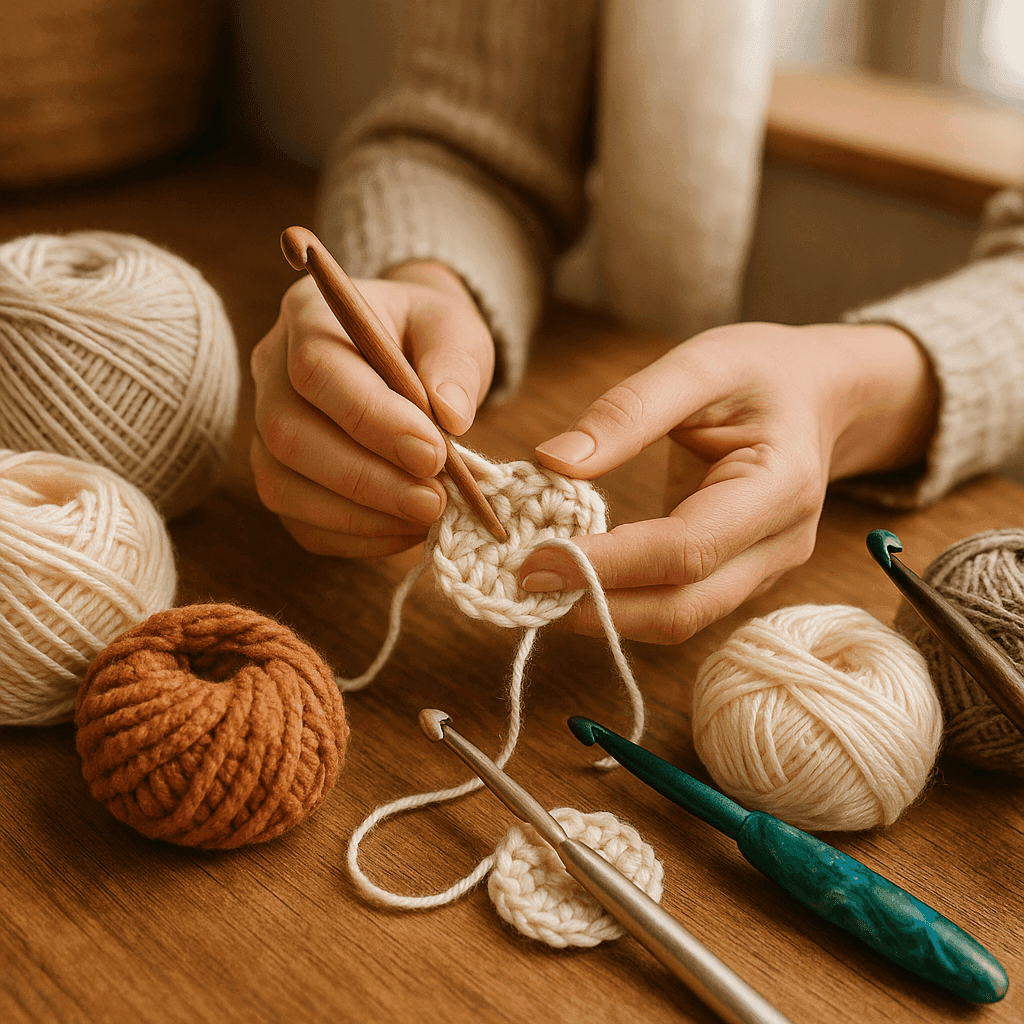
There’s a particular kind of frustration every crocheter knows: one day your stitches flow neatly off the hook, your hands settle into a steady rhythm, and the fabric looks even and calm. The next day, using what seems like the same pattern and yarn, everything feels slightly wrong. The yarn drags. Or it races. The hook squeaks. The loops tighten for no obvious reason. Your colorwork puckers, your lace ladders out, or your rows shift from tidy to uneven before you’ve even reached the end of the repeat.
It’s tempting to blame ourselves and call it “bad tension,” as if tension were a personality trait rather than a changing mechanical system. But crochet is, in a very real way, friction engineering done by hand. Every stitch is shaped by surfaces moving against each other: hook against yarn, yarn against yarn, yarn against skin, and even skin against hook. The finish of the hook, the surface chemistry and structure of the yarn, the cohesion of the plies, and the moisture level of your hands all affect drag, loop control, split risk, speed, and gauge stability.
Once you begin to think of crochet this way, a lot of mysterious problems become easier to diagnose. That sticky cotton project that suddenly improved when you switched from bamboo to metal? Friction change. The slippery silk blend that kept elongating your gauge? Too little drag in the system. The chenille baby blanket that looked inconsistent despite careful counting? Poor pile behavior and unstable loop formation. None of that is “just you.” It’s material interaction.
This article looks at crochet as a controlled friction system. We’ll talk about how hook material and polish change yarn flow, how different fibers behave on different surfaces, what hand moisture does to yarn speed and loop shape, and how to deliberately tune your setup for cleaner, faster, more consistent fabric. I’ll also cover troubleshooting for sticky and runaway tension, plus workflow adjustments for lace, colorwork, plant fibers, chenille, and other yarns that don’t behave the same way.
Why friction matters more than most crocheters realize
Every crochet stitch depends on a sequence of events:
- The hook enters a stitch or space.
- The hook catches the yarn.
- The yarn slides through one or more loops.
- Those loops tighten into a stable stitch shape.
At each stage, friction determines whether the yarn moves willingly, reluctantly, or unpredictably.
Too much friction can cause:
- Tight, undersized gauge
- Hand fatigue
- Squeaking hooks
- Distorted stitch tops
- Difficulty drawing up loops evenly
- Slower pace and abrupt stops
- Increased snagging in textured or splitty yarns
Too little friction can cause:
- Overly loose gauge
- Uneven loop heights
- Overshooting target stitch size
- Yarn splitting because the hook moves faster than the plies stay grouped
- Loss of control in lace or color changes
- Stretchy, unstable fabric
What we want is not the least friction possible. We want matched friction: enough drag for control, not so much that the yarn fights the stitch.
Think of it like using the right presser foot pressure on a sewing machine. A balanced system gives smoother feeding, more repeatable results, and less strain. In crochet, we create that balance by adjusting three main variables:
- Hook surface: material, finish, temperature, and head shape
- Yarn surface: fiber type, spin, ply, halo, pile, and finish
- Hand condition: moisture, oils, warmth, grip pressure, and speed
The hook: material, finish, and what they really change
Crocheters often talk about hook preference in general terms—“I like wood” or “metal is fastest”—but the more useful question is: fast for what yarn, under what conditions, and toward what fabric result?
Polished metal hooks
Common materials include aluminum and steel, often with a smooth, shiny finish.
Typical friction profile: low drag, high glide
Best for:
- Sticky cottons
- Dry, crisp plant fibers like linen blends
- Dense stitch patterns worked tightly
- Amigurumi when your default tension runs tight
- Fast repetitive stitches where speed matters
Potential drawbacks:
- Can feel too slick with silk, bamboo rayon, or smooth superwash wool
- Less forgiving in lace if your loop control is inconsistent
- Split-prone yarn may separate more easily if the head is sharp and the glide is very fast
Metal hooks are often the first fix for a project that feels stubborn. A mercerized cotton with a toothy feel can become dramatically easier on polished aluminum. If your single crochet tends to come out overly compact, switching from a grippy hook to polished metal may bring you closer to target gauge without consciously loosening your hands.
Matte metal hooks
These have slightly more surface resistance than highly polished metal.
Typical friction profile: moderate-low drag
Best for:
- General-purpose use across mixed fibers
- Crocheters who want speed but not slipperiness
- Wool and acrylic blends where polished metal feels too quick
Potential drawbacks:
- Not enough grip for very slippery luxury fibers
- May still drag with dry plant yarns if your hands run warm and tight
Matte metal sits in the middle and is often ideal for swatching because it shows you a balanced version of yarn behavior. If you own many hooks and want one “control condition” for testing, a standard matte aluminum hook is a practical choice.
Wood hooks
Depending on species and finish, wood can range from lightly polished to softly grippy.
Typical friction profile: moderate to moderately high drag
Best for:
- Slippery yarns such as silk, bamboo blends, and some superwash wools
- Lace when you need loop control more than speed
- Crocheters with naturally loose tension
- Cooler working conditions, since wood doesn’t feel as cold or slick in the hand
Potential drawbacks:
- Can drag noticeably with cotton or linen
- More affected by skin oils and humidity over time
- Tips may be less ideal for tightly worked stitches if the head is rounded
A good wood hook can transform a runaway yarn into something manageable. If stitches are lengthening without your permission or yarn-overs are sliding too freely, wood introduces useful resistance. That said, with a dry cotton or raffia-style yarn, the same hook may feel as if every stitch needs negotiation.
Bamboo hooks
Bamboo is usually light and somewhat grippy, though finish varies by brand.
Typical friction profile: moderate-high drag
Best for:
- Beginners learning loop control
- Slippery yarns
- Situations where a lighter hook reduces hand fatigue
Potential drawbacks:
- Often too draggy for dense cotton projects
- Can roughen with wear, increasing friction further
- Not always ideal for splitty, tightly worked stitches
Bamboo excels when control is the problem and speed is secondary. It can be especially helpful in filet or lace if your loops tend to oversize.
Resin, acrylic, and plastic hooks
These vary dramatically. Some are slick, others surprisingly tacky.
Typical friction profile: unpredictable; often moderate
Best for:
- Testing if temperature or hand feel is affecting your grip
- Chunky yarns where a lightweight hook is helpful
Potential drawbacks:
- Static, drag variation, or micro-tackiness on some yarns
- Surface wear may create inconsistent glide
These hooks are very brand-specific. One resin hook may perform beautifully with wool and another may feel sticky with the same skein.
The yarn: surface chemistry, structure, and drag behavior
The yarn itself contributes at least as much to friction as the hook does. Two worsted-weight yarns can call for the same hook size and still behave completely differently because of fiber composition, spin, finishing, and ply architecture.
Cotton
Cotton is one of the easiest fibers to understand through a friction lens because it tends to tell the truth immediately.
Behavior: low elasticity, often high surface drag, strong stitch definition
Common friction issues:
- Feels sticky on wood or bamboo
- Tightens quickly if you over-grip
- Can squeak on some hooks or with dry hands
- Little stretch means any inconsistency shows clearly in the fabric
Good hook pairings:
- Polished metal for most cottons
- Matte metal for mercerized cotton if polished feels too fast
Use caution with:
- Bamboo for dense amigurumi or dishcloth fabric unless you specifically need more control
Cotton rewards smooth mechanics. If your stitch counts are correct but your gauge runs small, don’t assume you need a larger hook immediately. First test a slicker hook in the same size. For example, if a pattern calls for a 4.0 mm/G hook and your cotton swatch is too tight on bamboo, try a 4.0 mm polished aluminum before moving up to 4.5 mm. You may hit gauge simply by reducing drag.
Wool and non-superwash wool blends
Behavior: moderate elasticity, some surface tooth, cohesive plies, forgiving loop formation
Common friction issues:
- Can felt slightly under warm, damp hands and repeated rubbing
- Halo or tooth can increase drag in textured stitches
- Hook choice strongly affects speed but usually not as dramatically as with cotton
Good hook pairings:
- Matte metal as a balanced default
- Wood for slippery wool blends or loose crocheters
- Polished metal for dense garments or if you tend to tighten under stress
Wool is often the easiest yarn for even fabric because it has resilience. That bounce helps disguise small tension variations. If you’re building a swatching method for consistency, wool is a forgiving training ground.
Superwash wool
Behavior: smoother surface, less grab than untreated wool, often more drape and slip
Common friction issues:
- Gauge may grow vertically as stitches relax
- Can feel faster than expected on polished metal
- Less surface tooth means colorwork floats and carried yarn may shift more readily
Good hook pairings:
- Matte metal for balance
- Wood if the yarn feels too slick or your loops are enlarging
For garments, always wet-block a superwash swatch before trusting it. Friction during stitching may feel controlled, but the finished gauge may still expand once the yarn relaxes.
Silk, bamboo rayon, and other very smooth fibers
Behavior: sleek, fluid, low surface drag, often high drape
Common friction issues:
- Loops slide larger than intended
- Yarn overs can elongate in lace
- Stitch architecture can look less crisp if tension is not consistent
- Split risk rises if plies are soft and loosely held
Good hook pairings:
- Wood or bamboo for added control
- Matte metal if wood feels too slow
Use caution with:
- Highly polished metal, especially in openwork, unless your hands naturally crochet tightly and evenly
These fibers often benefit from slowing down. Friction engineering is not only about the tool—it’s also about cadence. If the yarn races, pause after each loop draw-up and normalize loop height before finishing the stitch.
Linen, hemp, raffia, and other plant fibers
Behavior: crisp, low elasticity, sometimes dry or wiry, often softening with use
Common friction issues:
- High drag
- Hand fatigue
- Uneven loop heights from resistance spikes
- Abrasive feel against fingers
Good hook pairings:
- Polished metal almost always
- Slightly larger hook than you would expect for comfort swatching
Plant fibers often improve dramatically after washing and handling, but while you are crocheting them, friction is the main challenge. If a bag pattern recommends a 3.5 mm/E hook and the yarn feels physically resistant, make two swatches: one at 3.5 mm and one at 4.0 mm on polished metal. Compare fabric firmness and hand strain before committing.
Acrylic
Behavior: highly variable; can be squeaky, smooth, fluffy, or dry depending on brand and finish
Common friction issues:
- Squeak on some hooks
- Static in dry environments
- Surface drag shifts across dye lots and textures
Good hook pairings:
- Matte metal as a reliable default
- Polished metal for squeaky or sticky acrylic
- Wood for overly slippery anti-pill acrylics
Acrylic is less predictable than many people assume. Treat each yarn family individually instead of assuming “acrylic behaves like acrylic.”
Chenille and velour yarns
Behavior: pile-covered core, low stitch visibility, high compressibility, weak visual feedback
Common friction issues:
- Hook can catch pile unpredictably
- Loops may size inconsistently because the surface compresses
- Fabric inconsistency can happen even with accurate counts
- Yarn may “worm” or distort if worked too loosely
Good hook pairings:
- Smooth metal with a rounded, non-grabby head
- Sometimes resin if the specific yarn catches too harshly on metal
Use caution with:
- Very grippy hooks, which can strip or snag pile
For chenille, consistent loop height matters more than speed. Count every row or round, use stitch markers aggressively, and make a generous swatch—at least 5 x 5 in (12.5 x 12.5 cm)—because small swatches lie about chenille behavior.
Ply cohesion and split risk
Surface friction is only part of the story. How well the yarn holds itself together matters just as much.
A tightly spun, multi-ply yarn behaves differently from a softly spun single or a loosely twisted chainette. When your hook enters the stitch, catches the yarn, and draws through, the plies are asked to stay grouped under motion. If they don’t, you get splitting.
Higher split risk yarns include:
- Loosely plied cotton
- Soft bamboo blends
- Silk blends with low twist
- Some tape yarns
- Soft singles
How friction affects splitting:
- Very slick hooks can move fast enough to separate weakly cohesive plies
- Very grippy hooks can snag outer fibers instead of sliding under the whole strand
- Sharp hook heads increase the chance of entering between plies
Fixes:
- Choose a hook with a slightly blunter, smoother head
- Slow your yarn-over motion
- Rotate the hook less aggressively during draw-through
- Test one hook material slicker and one grippier; the answer is often in the middle
If your pattern uses repeated yarn overs, such as double crochet mesh, split-prone yarn can make the fabric messy fast. A 10 x 10 cm / 4 x 4 in swatch with at least 2 in (5 cm) of edge margin lets you evaluate not only gauge but also split frequency under real rhythm.
Hand moisture: the variable most people ignore
Your hands are part of the friction system. Dry skin, humid weather, hand lotion, body temperature, and even stress affect how the yarn feeds.
Dry hands
Dry hands tend to increase drag against yarn, especially plant fibers and wool. They can also create a faint catch-release feeling that makes tension spike unpredictably.
You may notice:
- Cotton snagging against your tension finger
- Yarn feeding in jerks instead of a smooth stream
- Tighter stitches late in the session
Helpful adjustments:
- Use a slicker hook
- Reduce one wrap around the tension finger if you wrap the yarn multiple times
- Keep a small bowl of water nearby to lightly dampen fingertips, then dry them to just barely moisturized—not wet
- Apply a non-greasy lotion well before crocheting, not during
Damp or humid hands
Moisture can increase grip on the hook and on some fibers, especially untreated wool and cotton. It may also soften the outer surface of plant fibers enough to create more drag.
You may notice:
- Hook sticking in your grip
- Wool feeling warmer and slightly clingy
- Cotton squeaking or tightening
Helpful adjustments:
- Use a cooler, smoother hook material such as polished metal
- Keep a towel nearby
- Loosen your pinch grip on the hook handle
- Work shorter sessions if heat buildup changes gauge
Lotions and skin oils
These can either improve glide or create tackiness depending on the fiber. Silk and bamboo may move too freely with freshly lotioned hands, while dry cotton might become more manageable.
The key is repeatability. If you routinely crochet after hand cream, swatch that way too.
Matching hook finish to yarn type: practical pairings
Here is a practical starting map. These are not rules, but good first tests.
| Yarn type | Best first hook test | If too sticky | If too slippery |
|---|---|---|---|
| Cotton | Polished metal | Increase polish or go up 0.5 mm | Try matte metal |
| Mercerized cotton | Matte or polished metal | Polished metal | Wood if loops race |
| Non-superwash wool | Matte metal | Polished metal | Wood |
| Superwash wool | Matte metal | Polished metal | Wood or bamboo |
| Silk/bamboo rayon | Wood or matte metal | Polished metal only if you need speed | Wood/bamboo, smaller hook if needed |
| Linen/hemp | Polished metal | Larger hook, smoother finish | Rarely too slippery |
| Acrylic | Matte metal | Polished metal | Wood |
| Chenille | Smooth metal | Rounder head, larger hook if catching | Slightly grippier smooth resin |
Swatching as friction testing, not just gauge checking
Most crocheters swatch for size. If you want consistent fabric, swatch for system behavior.
A repeatable friction swatch method
Use this method when evaluating a new yarn-hook pairing.
1. Make three swatches, not one
Use the same yarn with:
- Hook A: polished metal
- Hook B: matte metal or resin
- Hook C: wood or bamboo
Keep the hook size constant at first. For example, if the pattern suggests a 5.0 mm/H hook, make all three swatches with 5.0 mm hooks in different materials.
2. Swatch large enough to matter
Make at least a 6 x 6 in (15 x 15 cm) swatch for garments and a 5 x 5 in (12.5 x 12.5 cm) swatch for accessories.
Foundation suggestion for a stitch pattern based on double crochet:
- Chain 26
- Row 1: dc in 4th ch from hook and across, 24 dc
- Rows 2–12: ch 3, turn, dc across, 24 dc
This gives enough width and rows to observe rhythm, edge behavior, and loop consistency.
For single crochet fabrics:
- Chain 31
- Row 1: sc in 2nd ch from hook and across, 30 sc
- Rows 2–16: ch 1, turn, sc across, 30 sc
The exact numbers are less important than having enough area to see how the fabric settles.
3. Record four observations
For each swatch, note:
- Speed: Did the hook move smoothly, stop-start, or run away?
- Effort: Did your hands squeeze harder over time?
- Fabric: Did the stitches look even, compact, elongated, or split?
- Gauge: Measure before and after resting, and after blocking if applicable
4. Time a fixed stitch count
Crochet 100 stitches in pattern and time it. For example:
- 100 sc in rows
- or 100 dc in rows
This reveals whether a “faster-feeling” hook is actually faster or just slippier.
5. Count mistakes, not just stitches
Track:
- Number of split stitches
- Number of accidental yarn drops
- Number of times you had to re-form a loop
A setup that is 8% slower but eliminates rework may be your best real-world choice.
Step-by-step: diagnosing sticky tension
If your project feels resistant, use this sequence.
Symptom checklist
- Yarn drags through fingers
- Hook squeaks or grabs
- Gauge is smaller than pattern gauge
- Stitch tops look pinched
- Hands tire early
Fix sequence
Step 1: Keep hook size, change finish
If you are using wood, bamboo, or tacky resin, switch to polished metal in the same size.
Example:
- Current hook: 4.5 mm wood
- Test hook: 4.5 mm polished aluminum
Work 2–3 rows or one full round before judging.
Step 2: Reduce yarn wrap tension
If you wrap yarn twice around the tension finger, try once. If you pinch close to the hook throat, move your pinch slightly farther back to let the loop form before you regulate it.
Step 3: Check hand moisture
If your hands are very dry, lightly moisturize 15–20 minutes before crocheting and wipe away any excess.
Step 4: Normalize loop height deliberately
Before completing each stitch, make sure the active loop on the hook is approximately as tall as the hook shaft diameter. This is especially useful in single crochet and half double crochet.
Step 5: Only then change hook size
If the fabric is still too tight after friction adjustments, go up by 0.5 mm.
For example:
- Pattern gauge target: 16 sc and 20 rows = 4 in (10 cm)
- Your swatch on 4.0 mm bamboo: 18 sc and 22 rows
- Your swatch on 4.0 mm polished metal: 17 sc and 21 rows
- Next test: 4.5 mm polished metal
That sequence tells you more than jumping straight to a larger hook.
Step-by-step: diagnosing runaway tension
This is the opposite problem: the yarn moves too freely, your loops grow, and fabric loses structure.
Symptom checklist
- Stitches come out larger than intended
- Gauge is bigger than pattern gauge
- Yarn overs slip tall in dc/tr work
- Lace openings distort
- Color changes feel loose and messy
Fix sequence
Step 1: Keep hook size, increase surface control
Switch from polished metal to matte metal or wood.
Example:
- Current hook: 5.0 mm polished metal
- Test hook: 5.0 mm birch wood
Step 2: Add one touchpoint of yarn control
Wrap the yarn once more around a finger, or guide it through a tension ring if you use one. The goal is not to clamp, only to smooth feed speed.
Step 3: Slow the draw-through
On tall stitches, pause after the yarn-over and after drawing through the first set of loops. This reduces accidental loop elongation.
Step 4: Shorten loop height consciously
Keep the active loop resting on the shaft, not lifted above it. If the loop rides onto a narrower part of the hook, stitch size becomes inconsistent.
Step 5: If needed, size down by 0.5 mm
Example:
- Pattern gauge target: 14 dc and 8 rows = 4 in (10 cm)
- Your swatch on 5.5 mm polished metal: 13 dc and 7.5 rows
- Your swatch on 5.5 mm wood: 14 dc and 8 rows
In this case, you may not need a smaller hook at all—only more friction.
Adapting workflows for lace
Lace exaggerates friction effects because loop size is the whole structure.
Best practices
- Favor hooks with controlled glide: matte metal or smooth wood
- Use a yarn bowl or low-drag feeding path so the yarn feed is stable
- Stop every repeat to compare loop height visually
- Block your swatch aggressively before final hook choice
Common lace mistakes
- Oversized chain spaces: usually too little drag or excessive active loop height
- Uneven picots: often grip inconsistency or split-prone yarn
- Messy clusters: hook too sharp for soft plies, causing partial catches
For lace swatching, make at least two full repeats in width and three in height, with 1 repeat border if possible. Tiny lace swatches are nearly useless because edge distortion hides the real behavior.
Adapting workflows for colorwork
Colorwork introduces another friction layer: carried yarn or floats rubbing and tightening differently than the working yarn.
If colorwork puckers
Possible causes:
- Hook/yarn combination is too sticky
- Carried yarn is underfed
- Cotton or non-stretch fibers are amplifying every tension difference
Try:
- Polished metal hook
- Spreading stitches along the hook shaft before the next carry
- Going up 0.5 mm for stranded sections only, if pattern structure allows
If colorwork is sloppy or gaps show
Possible causes:
- Hook too slick for the yarn
- Loops enlarging during color changes
- Carried yarn too loose
Try:
- Matte metal or wood
- Completing the final yarn-over of the old color with the new color while maintaining shaft-level loop height
- Frequent tension resets every 8–12 stitches
For tapestry crochet in single crochet, a useful test swatch is:
- Chain 25
- Row 1: sc in 2nd ch from hook and across, 24 sc
- Rows 2–12: work 24 sc with a 2-color motif, carrying unused yarn inside stitches
Measure width after row 12 and compare with a plain single crochet swatch of the same count. Excessive shrinkage usually means your friction system is too grabby somewhere.
Common mistakes and fixes
Mistake: assuming hook size solves everything
Fix: Test hook finish first, then size.
Mistake: swatching with one hook material and crocheting the project with another
Fix: Always swatch with the exact hook you will use for the project, including material and grip style.
Mistake: ignoring environmental conditions
Fix: If you swatched in cool weather and crochet in summer humidity, expect friction changes. Recheck gauge after a few inches.
Mistake: blaming inconsistent rows on counting alone
Fix: Count, yes—but also compare loop height, hand temperature, and yarn feed path.
Mistake: using sharp hooks for splitty yarn without noticing
Fix: Try a rounder head profile, even in the same material.
Mistake: evaluating chenille by feel instead of fabric
Fix: Measure after resting. Chenille can feel fine in motion but produce unstable fabric if worked too loosely.
Building your own friction reference library
One of the most useful habits an experienced crocheter can build is a small notebook or digital chart tracking yarn-hook pairings.
Record:
- Yarn brand and line
- Fiber content
- Ply structure
- Hook brand, size, and material
- Stitch pattern used in swatch
- Gauge before and after blocking
- Notes like “split on sharp hook,” “best with polished metal,” or “needed extra control in lace”
Over time, patterns emerge. You’ll learn that your hands with cotton in winter behave differently than your hands with wool in spring. That kind of knowledge is what makes crochet feel dependable rather than mysterious.
Practical variations: tuning for project type
Garments
Prioritize gauge stability and drape. Favor balanced friction—often matte metal or smooth wood depending on the yarn. Wet-block every swatch.
Amigurumi
Prioritize control and compact fabric, but beware over-gripping. Cotton amigurumi often works best on polished metal with a smaller hook, such as 2.75 mm/C or 3.0 mm, rather than on a grippy hook that encourages hand strain.
Home décor
Plant fibers and sturdy cottons usually benefit from smooth metal and ergonomic handles to reduce fatigue over long sessions.
Shawls and lace wraps
Use hook finishes that support loop consistency over speed. A 4-ply wool-silk blend may shine on a wood hook one size smaller than your instinct says, but always verify blocked drape.
Plush blankets
With chenille, choose visibility aids: bright lighting, stitch markers every 20–25 stitches, and a smooth hook that does not strip pile.
The real takeaway: consistency comes from controlled variables
Crochet tension isn’t just in your hands. It lives in the interaction between your hands, your hook, your yarn, and your environment. When one of those changes, your crochet changes.
That’s good news, because it means better results are not only about “practicing more” or trying to force your grip into submission. Very often, the cleanest path to even stitches is mechanical: a smoother hook for cotton, a grippier hook for silk, a more deliberate swatch, a note about humidity, a pause to correct loop height before a whole project drifts off gauge.
If you want cleaner, faster, more consistent fabric, start treating crochet setup as adjustable engineering rather than fixed preference. Swatch with intention. Change one variable at a time. Measure, time, and compare. Notice how your hands behave on dry days versus humid ones. Match hook finish to yarn surface instead of reaching automatically for your usual favorite.
When you do, tension stops feeling like guesswork. It becomes something you can read, adjust, and repeat—and that is where crochet gets not only easier, but much more satisfying.