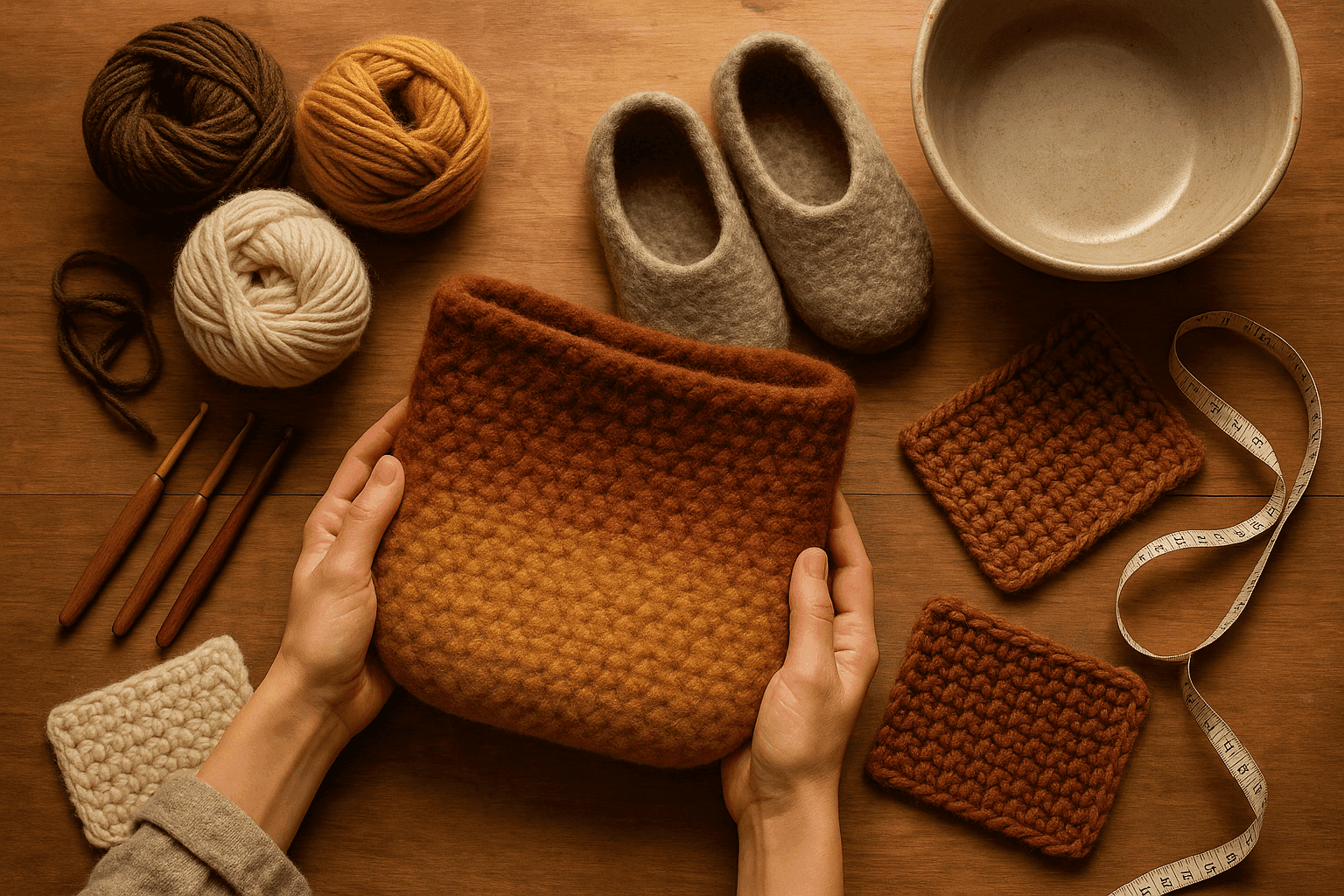
There is a particular kind of delight in pulling a floppy, oversized crochet piece out of a hot bath and discovering that it has transformed into something entirely different: denser, firmer, quieter somehow. The open stitches that looked a little too rustic become a cohesive fabric. The sides of a bag begin to stand on their own. A slipper that seemed absurdly large suddenly fits like it was molded to the foot. If you have ever made a wool project that felt underwhelming straight off the hook and then watched fulling bring it to life, you already know this process is less “finishing step” and more material engineering.
That is the mindset that makes crochet fulling and controlled felting so useful. We are not just shrinking wool and hoping for the best. We are choosing fibers that respond predictably, building stitch architecture that will compress into strength, mapping shrinkage with swatches, and planning reinforcements and shaping before water ever touches the fabric. Done intentionally, fulling turns crochet into a remarkably practical textile for hard-wearing bags, sturdy slippers, baskets, vessel forms, hats, mitts, and sculptural work.
This article is for crocheters who want more control over that transformation. We will talk about what fulling really is, how it differs from felting in everyday craft language, which wools work best, how stitch choice influences the final cloth, and how to design for shrinkage rather than react to it. I will also walk through a practical swatching method, formulas for estimating final dimensions, strategies for differential fulling, reinforcement planning, and troubleshooting the problems that show up most often in projects meant to take wear.
Understanding fulling versus felting in crochet
In craft conversation, “felting” often gets used as a catch-all for anything wool does when it shrinks and mats in heat, moisture, and agitation. Technically, there is a distinction worth understanding because it helps you design more intentionally.
Felting in the strict sense usually refers to creating fabric directly from loose fiber by encouraging the scales on animal fibers to lock together.
Fulling usually refers to taking an existing wool fabric—woven, knitted, or crocheted—and shrinking, matting, and consolidating it into a denser cloth.
For crochet, what we typically do in the washer or by hand is fulling. We start with stitches, and those stitches compress. The gaps close. The strand halo rises. The fabric thickens and often becomes more wind-resistant, abrasion-resistant, and somewhat cut-resistant compared with its pre-fulled state.
I say “somewhat cut-resistant” very deliberately. A fulled crochet fabric is not cut-proof in an industrial sense, but it does resist casual abrasion, snagging, and edge fraying far better than unfulled crochet because the fibers lock together into a cohesive sheet. That matters enormously for bags, slippers, and sculptural forms that need body.
Why crochet benefits from fulling
Crochet starts with more inherent openness than knitting, especially in taller stitches. Even when worked tightly, a crochet fabric often shows distinct columns, ridges, and stitch junctions. Fulling softens that architecture and compresses it into a more unified textile.
That gives you several advantages:
- Greater density for structure and durability
- Reduced stitch definition when you want a smooth sculptural surface
- Improved thermal performance for slippers, mittens, and winter accessories
- Less stretch and sag in bags and vessels
- Better abrasion resistance in high-contact areas
- A better base for embroidery, needle-felting, or surface embellishment
The tradeoff is that fulling reduces drape and obscures detailed stitch patterns. This is not the technique for preserving crisp lace, intricate colorwork with sharp pixel edges, or highly calibrated garment fit unless shrinkage has been tested thoroughly.
Fiber selection: the foundation of successful fulling
If you want predictable controlled felting, fiber choice is everything. You cannot engineer a good result from yarn that refuses to full.
Choose non-superwash wool whenever possible
The number one rule: use non-superwash animal fiber if your goal is fulling.
Superwash wool has been chemically treated or coated so the scales that cause felting are reduced or neutralized. Some superwash yarns will fuzz and relax a little under harsh treatment, but many will not shrink reliably, and some can become limp or stretched rather than dense.
Best choices:
- 100% non-superwash wool
- Wool-rich yarns with at least 85–100% feltable wool
- Some wool blends containing alpaca or mohair, though results vary
Less reliable:
- Superwash wool
- Acrylic blends
- Cotton blends
- Plant fibers like linen, hemp, bamboo, cotton
- Silk-heavy blends
Breed matters more than many crocheters realize
Different sheep breeds produce fibers with different staple length, crimp, luster, softness, and scale structure. Those variables affect how quickly and firmly a yarn fulls.
As a practical guide:
Quick, strong fulling often comes from:
- Corriedale
- Romney
- Highland-type rustic wools
- Lopi-style yarns
- Columbia/Targhee-type wool yarns
- Many generic non-superwash worsted wool yarns marketed for felting
Softer merino can full beautifully, but often with a smoother, more compact surface and sometimes less firm body than a more rustic breed. Fine merino also pills more readily in heavy-abrasion uses if the yarn has a soft spin.
Longwools may full more slowly, depending on processing and yarn structure.
Very lofty, lightly spun yarns often produce dramatic shrinkage and thick fabric, while tightly spun smooth yarns may shrink less but create a harder-wearing surface.
Yarn construction matters too
Breed is not the only variable. Ask these questions:
- Is the yarn woolen spun or worsted spun?
- Is it lofty or dense?
- Is it plied tightly or softly?
- Is there significant halo already?
A lofty woolen-spun yarn tends to trap more air and often shrinks more dramatically, producing thick, cushy fabric—great for slippers, baskets, and soft sculpture.
A firm worsted-spun yarn may produce a more controlled, less dramatic shrink with a smoother exterior—excellent for bags that need abrasion resistance and cleaner edges.
Stitch architecture before shrinkage
This is where crochet design becomes engineering. The fabric you make before fulling determines the cloth you end up with after fulling.
Best stitches for dense fulled cloth
For structural items, favor short stitches and compact construction:
- Single crochet (sc): excellent density, predictable shrinkage, sturdy fabric
- Half double crochet (hdc): slightly loftier, can full into a pleasing dense fabric
- Waistcoat stitch / center single crochet: creates a knit-like grid that fulls densely
- Slip stitch crochet: very dense before fulling, extremely firm after fulling
- Tunisian simple stitch: if you work Tunisian, it fulls beautifully for structured items
Use tall stitches cautiously
Double crochet and taller stitches can be fulled, but their openness means they often distort more during shrinkage and may produce uneven thickness if your tension varies.
If using taller stitches for texture or speed:
- Swatch aggressively
- Expect greater dimensional change
- Consider pairing them with denser sections for support
Hook size recommendations
For fulling projects, work firmer than you would for drape.
General guidance:
- DK/light worsted yarn: 3.5–4.5 mm hook
- Worsted/aran yarn: 4.5–6 mm hook
- Bulky yarn: 6–8 mm hook
But for a structured fulling project, I often go 0.5–1.5 mm smaller than the label suggests.
Examples:
- Worsted non-superwash wool labeled for a 5.5 mm hook may work better at 4.5 or 5 mm for a bag.
- Aran wool labeled for 6 mm may produce a better slipper fabric at 5 or 5.5 mm.
The goal is not board-stiff fabric before fulling; it is a stable stitch field with limited slack.
Swatch-based shrink-rate mapping: the step you should not skip
If you only take one design principle from this article, let it be this: never engineer a fulling project without swatching and measuring.
Even experienced crocheters cannot reliably predict shrinkage by intuition alone because wool breed, yarn spin, stitch type, hook size, and agitation method all interact.
Make a meaningful swatch
For bags, slippers, and sculptural forms, a tiny swatch is not enough. Make at least:
- 15 cm x 15 cm (6 in x 6 in) minimum
- Better: 20 cm x 20 cm (8 in x 8 in) if yarn allows
Work the swatch in the exact stitch pattern, hook size, and yarn you plan to use.
If your project includes shaping or rounds, make a representative swatch of that structure too. Flat swatches tell you one story; rounds and dense corners sometimes tell another.
Record pre-fulling gauge
Mark a square in the center of your swatch with contrasting sewing thread.
Measure:
- Stitches per 10 cm / 4 in
- Rows/rounds per 10 cm / 4 in
- Overall swatch width and height
- Weight if you want especially precise repeatability
Example pre-fulling gauge in single crochet:
- 16 stitches and 18 rows = 10 cm / 4 in
- Swatch overall size: 20 cm x 20 cm
Full the swatch exactly as you intend to full the project
Use the actual process you expect to use:
- Hot water or warm water
- Hand agitation or washing machine
- Soap or no soap
- Number of agitation cycles
- Rinse temperature
- Spin or towel press
Record post-fulling measurements
Measure the marked central square again and overall swatch dimensions.
Example post-fulling:
- 20 stitches and 24 rows = 10 cm / 4 in
- Swatch overall size: 15 cm x 16 cm
Calculate shrink percentage
Use:
Shrink % = (original measurement - fulled measurement) / original measurement x 100
Example width:
- (20 - 15) / 20 x 100 = 25% shrinkage
Example height:
- (20 - 16) / 20 x 100 = 20% shrinkage
Now you know something critically important: your fabric does not shrink equally in both directions.
That is normal. Crochet often fulls anisotropically, meaning width and height shrink differently based on stitch structure and how the yarn traveled through the fabric.
Map multiple swatches when precision matters
For fitted slippers or sculptural vessels, make at least 3 swatches:
- Standard fabric swatch
- Swatch with shaping increases/decreases
- Swatch with seam or reinforcement treatment if applicable
That will tell you whether dense areas, corners, or sewn joins behave differently.
Designing oversized forms intentionally
Because fulling shrinks fabric, you must crochet larger than the desired final dimensions.
Use the shrink map to reverse-calculate size
If your swatch shrinks 25% in width and 20% in height, divide desired final measurements by the remaining percentage.
Formula:
Starting measurement = desired final measurement / (1 - shrink rate)
Example bag width:
- Desired final width = 30 cm
- Width shrink rate = 25%
- Starting width = 30 / 0.75 = 40 cm
Example bag height:
- Desired final height = 28 cm
- Height shrink rate = 20%
- Starting height = 28 / 0.80 = 35 cm
You would crochet the bag body roughly 40 cm wide and 35 cm tall before fulling.
Stitch count planning example for a bag panel
Suppose your pre-fulling gauge is:
- 16 sc per 10 cm
- 18 rows per 10 cm
That means:
- 1.6 stitches per cm
- 1.8 rows per cm
For a pre-fulling width of 40 cm:
- 40 x 1.6 = 64 stitches
For a pre-fulling height of 35 cm:
- 35 x 1.8 = 63 rows
So each panel might be worked to 64 stitches x 63 rows before fulling.
For slippers, plan even more ease in the oversized stage
Slippers are compressed from three dimensions, not just two flat dimensions. Soles, insteps, and toe shaping all interact while the wool thickens.
As a starting point, many crocheted slippers need to be:
- 15–30% longer than target foot length before fulling
- 10–25% wider than target foot circumference sections
But do not trust generic percentages. Your swatch and your shaping style matter more.
For sculptural forms, think in volume
A vessel or sculpture changes not only in height and width but also in wall thickness, rim firmness, and curvature.
Useful rule of thumb:
- Loftier yarn + looser gauge = more dramatic volume collapse and thicker walls
- Firmer yarn + tighter gauge = more predictable edge definition
For bowls and baskets, exaggerate flare and diameter before fulling. The final piece usually pulls inward and upward as fibers lock.
Step-by-step method for controlled fulling
There are many ways to full wool, but the most predictable approach is to think of it as a series of controlled stages rather than one violent event.
1. Crochet and prepare the piece
Weave in ends securely. Do not leave short tails expecting them to disappear.
Before fulling:
- Check stitch counts on major sections
- Measure key dimensions
- Photograph the shape if needed
- Mark centerlines or target dimensions with contrast thread for symmetry checks
If the project has straps or thin appendages, consider placing them in a mesh laundry bag or tying them loosely to prevent excessive twisting.
2. Pre-soak if hand fulling
Soak in warm water for 10–15 minutes. A little mild soap can help wet the fibers thoroughly.
This removes trapped air and helps the fabric respond more evenly when agitation begins.
3. Begin with moderate agitation
You can use:
- A top-loading or front-loading machine on a short hot/warm cycle
- Hand agitation in a sink, tub, or basin
- Alternating hot and cool rinses if you want to encourage faster fulling
My preferred controlled method for a test-first project is:
- Warm soak
- 3–5 minutes agitation
- Check fabric
- Repeat in short intervals
This reduces the risk of over-fulling.
4. Check frequently
After each agitation interval, assess:
- Are stitch gaps closing?
- Is the fabric thickening evenly?
- Are dimensions approaching target size?
- Are handles, corners, or seams distorting?
You can stop before the fabric becomes completely smooth. Sometimes the best bag fabric still shows a hint of stitch structure while being dense and stable.
5. Shape while damp
This step is where many projects are won or lost.
While the piece is damp and pliable:
- Stretch gently to square corners
- Flatten seams with fingers
- Insert forms, towels, shoe lasts, bowls, or stuffing as appropriate
- Align handles symmetrically
- Smooth rims and openings
For slippers:
- Put them on a form, your sock-covered foot, or a measured template
- Match left and right carefully
- Check sole length and instep depth
For bags:
- Stuff with towels to establish base depth
- Push out bottom corners if a boxed base is desired
- Align side seams vertically
6. Dry thoroughly under support
Air-dry fully. Dense fulled wool holds moisture longer than it appears to.
Support the intended shape while drying:
- Towels inside bags
- Shoe inserts or paper stuffing in slippers
- Bowls, balloons, or custom armatures for sculptural pieces
Do not judge final firmness until fully dry.
Differential fulling for structure
One of the most powerful advanced techniques is planning areas to full differently within the same project.
How to create differential fulling
You can vary response by changing:
- Stitch density
- Hook size
- Yarn held single vs double
- Fiber blend in selected zones
- Added reinforcement layers
Practical uses
Bags
- Dense single crochet base with slightly looser body
- Double-stranded lower corners for abrasion resistance
- Tighter hook around upper edge to create a firmer opening
Slippers
- Sole worked with smaller hook for denser wear surface
- Instep slightly looser for comfort
- Heel collar tighter to reduce stretching
Sculptural forms
- Base and rim tighter for structure
- Sidewalls slightly looser to encourage elegant shaping during fulling
Example differential bag plan
Yarn: worsted non-superwash wool Hook sizes:
- Base: 4.5 mm
- Body: 5 mm
- Upper band/handle anchors: 4 mm
Stitch pattern:
- Base: 8 rounds sc worked tightly
- Body: hdc in continuous rounds
- Upper band: 6 rounds sc
Expected result:
- Base fulls into a dense platform
- Body remains thick but not overly rigid
- Opening resists collapse
Reinforcement planning before fulling
Fulling gives strength, but it does not eliminate stress points. In fact, shrinkage can concentrate stress at joins, handle attachments, and high-flex seams.
Where reinforcement matters most
- Bag handles and handle bases
- Boxed-bag corners
- Slipper heel seams
- Toe joins
- Vessel rims
- Attachment points for straps, closures, and hardware
Reinforcement strategies
Work structural rounds into the crochet
For a bag opening, add 3–6 rounds of tight sc before fulling. This often creates a naturally firmer lip.
For slipper soles, add an extra sole layer or work the sole in tighter rounds.
Use internal support after fulling
For bags expected to carry weight, consider:
- Fabric lining
- Sewn-in interfacing
- Leather or canvas base insert
- Corded handle core
Do not rely on wool alone if the bag will routinely carry books, bottles, or electronics.
Seam with strength in mind
Crochet seams should be sturdy before fulling, not merely decorative.
Good options:
- Mattress-style sewn seam in matching wool
- Slip stitch seam worked tightly
- Single crochet join for structural edges
Leave generous tails for sewn finishing. I like at least 20–30 cm (8–12 in) tails for stress points.
Seam stress warning
A common mistake is assuming fulling will hide a weak seam. Often it does the opposite: the body shrinks and thickens, and the seam becomes the first failure point if it was underbuilt.
If in doubt, reinforce after fulling with matching wool sewing thread or a hidden fabric support strip.
Surface finishing after fulling
Once your fabric is dry, finishing determines whether it looks merely shrunk or truly refined.
De-pilling and halo control
Some halo is beautiful; too much fuzz can obscure form and attract wear.
Use:
- Small sweater comb very gently
- Fabric shaver with caution
- Fine scissors for isolated pills
Be conservative. Over-shaving can thin the outer felted layer.
Trimming and edge refinement
After fulling, edges may look slightly uneven.
You can:
- Steam lightly without flattening too much
- Blanket-stitch openings with wool thread
- Add crab stitch or tight slip stitch edging if more definition is needed
Embellishment options
A fulled surface is ideal for:
- Needle-felted motifs
- Surface embroidery
- Applied patches
- Leather handles or tabs
- Decorative blanket stitching
For sculptural work, this is also the stage for inserted armatures, weighted bases, or mixed-media additions.
Step-by-step project planning examples
To make the principles concrete, here are three sample planning frameworks.
Example 1: Structured everyday bag
Target final size:
- Width: 32 cm
- Height: 26 cm
- Depth: 10 cm
Yarn:
- 100% non-superwash wool worsted weight
Hook:
- 5 mm for body
- 4.5 mm for base and upper edge
Pre-fulling swatch:
- 15 sc = 10 cm
- 17 rows = 10 cm
- Shrinkage: 22% width, 18% height
Reverse calculation:
- Starting width: 32 / 0.78 = 41 cm
- Starting height: 26 / 0.82 = 31.7 cm, round to 32 cm
Stitch counts:
- Width: 41 x 1.5 = about 62 stitches
- Height: 32 x 1.7 = about 54 rows
Construction suggestion:
- Oval base worked in sc to approximately 41 cm x 13 cm pre-fulling
- Body worked up in sc or hdc to 54 rows/desired round count
- Upper edge: 4–6 rounds tight sc
- Handles added after fulling, or worked extra robust if integrated
Example 2: House slippers
Target final foot length:
- 24 cm
Yarn:
- Aran-weight rustic non-superwash wool
Hook:
- 5 mm for upper
- 4.5 mm for sole
Pre-fulling swatch in sc:
- 14 stitches and 16 rows = 10 cm
- Shrinkage: 18% width, 24% lengthwise in worked direction
Starting slipper length:
- 24 / 0.76 = 31.6 cm total pathway if the principal shrink is lengthwise in that section
Construction suggestion:
- Sole worked to 31.5–32 cm pre-fulling equivalent shape
- Sole rounds in tight sc
- Upper with controlled ease at instep
- Heel seam reinforced with duplicate sewing in wool
Fit note:
- Stop fulling just shy of final fit, then shape on foot form while damp
Example 3: Sculptural basket
Target final rim diameter:
- 20 cm nTarget final height:
- 18 cm
Yarn:
- Bulky lightly spun non-superwash wool
Hook:
- 6 mm
Swatch result:
- 30% width shrink, 25% height shrink
Starting dimensions:
- Rim diameter: 20 / 0.70 = 28.5 cm
- Height: 18 / 0.75 = 24 cm
Construction note:
- Work base tightly in sc
- Side walls in hdc for a bit more loft
- Final rim in slip stitch or sc to create a crisp edge after fulling
Troubleshooting common problems
Even well-planned projects can misbehave. Here is how to diagnose the usual issues.
Problem: The project barely fulled at all
Possible causes:
- Superwash yarn
- Too much synthetic or plant fiber in the blend
- Water not hot enough
- Not enough agitation
- Tension too tight with very smooth yarn, limiting movement
Fixes:
- Confirm fiber content first
- Increase agitation gradually
- Alternate hot wash and cool rinse
- Use a mesh bag with towels or jeans in the washer to increase friction
- If the yarn is truly superwash, accept that dramatic fulling may not be possible
Problem: It fulled unevenly
Possible causes:
- Uneven crochet tension
- Inconsistent stitch pattern density
- Crowded washer load causing folds
- Seams or handles tangling during agitation
Fixes:
- Resoak and continue fulling in shorter intervals
- Shape aggressively while damp
- For future projects, use larger swatches and check gauge in multiple areas
- Place delicate appendages in a mesh bag to prevent torque distortion
Problem: The bag twisted or skewed
Possible causes:
- Spiral rounds without careful stitch placement
- Directional stitch bias
- Asymmetrical shaping before fulling
Fixes:
- Block and reshape while damp with internal stuffing
- Steam lightly after drying and restuff
- Next time, consider joined rounds or periodic realignment markers
- Use matched increase placement in round bases
Problem: Slippers became too small
Possible causes:
- Underestimated shrinkage
- Over-agitation
- Yarn fulled faster than swatch indicated because project mass created more friction
Fixes:
- While very wet, stretch over a firm form repeatedly as drying begins
- Some recovery is possible, but severe over-fulling is hard to reverse
- For next pair, stop earlier and shape to final fit
- Add a larger swatch or full a half-slipper prototype before production
Problem: Surface is fuzzy and pills quickly
Possible causes:
- Fine, soft merino with low-twist spin
- Abrasion-heavy use
- Fabric not fulled enough to lock the outer fibers
Fixes:
- Full a little more if structure allows
- Gently de-pill after drying
- Reserve very soft yarns for lighter-duty items or line/reinforce them
- For hard wear, choose more robust breed yarns next time
Problem: Seams are straining or splitting
Possible causes:
- Weak seaming yarn or shallow seam bites
- Shrinkage pulling against rigid handle attachments
- High load on unsupported sections
Fixes:
- Reinforce seams by hand sewing with matching wool or strong thread
- Add lining to distribute weight
- Reattach handles through reinforced patches, not only through felted fabric
Problem: The fabric is dense but still sags in use
Possible causes:
- Yarn too soft and elastic
- Stitch pattern too open before fulling
- Bag too large for unsupported wool body
Fixes:
- Add lining and base insert
- Add internal channels with boning or firm interfacing if appropriate
- Use tighter stitch architecture and denser wool next time
Common mistakes to avoid
- Skipping the swatch and guessing shrinkage
- Using superwash wool and expecting true felting
- Choosing a hook too large for a structural item
- Designing handles too narrow without reinforcement
- Assuming all directions shrink equally
- Over-fulling before checking dimensions
- Ignoring shaping during drying
- Treating seams as an afterthought
Practical recommendations by project type
For bags
Best yarns:
- Worsted or aran non-superwash wool
- Firmly spun rustic wool
Best stitches:
- sc, waistcoat stitch, slip stitch accents
Suggested hook range:
- 4.5–5.5 mm for worsted/aran, depending on yarn
Reinforcement must-haves:
- Upper edge stability
- Handle anchor reinforcement
- Optional lining for heavy loads
For slippers
Best yarns:
- Lofty aran or bulky non-superwash wool
- Rustic, high-friction wool for soles
Best stitches:
- Tight sc for sole
- sc or hdc for upper
Suggested hook range:
- 4.5–6 mm depending on yarn weight
Reinforcement must-haves:
- Heel seam strength
- Optional suede/leather sole patches for longevity and slip resistance
For sculptural forms
Best yarns:
- Lofty wool for thick walls
- Rustic wool for shape memory
Best stitches:
- sc base, hdc walls, slip stitch/sc rims
Suggested hook range:
- 5–8 mm depending on yarn and desired wall thickness
Reinforcement must-haves:
- Internal forms during drying
- Hidden armature if the shape must remain highly specific
Takeaways for engineering dense fulled crochet fabric
If you want crochet that behaves more like a textile material and less like a collection of visible stitches, fulling is one of the most useful techniques you can learn. But the best results come from treating it as a design system, not a surprise ending.
Choose your wool for its willingness to full, not just its softness on the skein. Favor non-superwash fibers and learn how breed and yarn construction affect firmness, halo, and wear. Build compact stitch architecture, usually with single crochet or similarly dense stitches, and use hook sizes that support structure rather than drape.
Most importantly, swatch with seriousness. Measure before. Full under controlled conditions. Measure after. Map width and height shrinkage separately. Those numbers become the blueprint for your oversized starting shape.
Then think beyond shrinkage alone. Plan where you need firmness, where you need flexibility, and where seams or handles will experience stress. Use differential fulling, tighter zones, extra rounds, or post-fulling reinforcements to support real use.
When the piece comes out of the wash looking halfway between too small and not quite right, do not panic. Much of the final success happens in shaping while damp: stretching a slipper over the right form, stuffing a bag square, coaxing a basket rim into a smooth circle. Fulling is transformation, but shaping is editing.
A well-fulled crochet piece has a satisfying authority to it. It feels substantial in the hand. It resists wear. It softens visually while gaining structural clarity. And once you understand how to control that process, you can design for it as confidently as you choose stitch counts or hook sizes. That is when fulling stops being a novelty and becomes one of the most powerful technical tools in crochet.