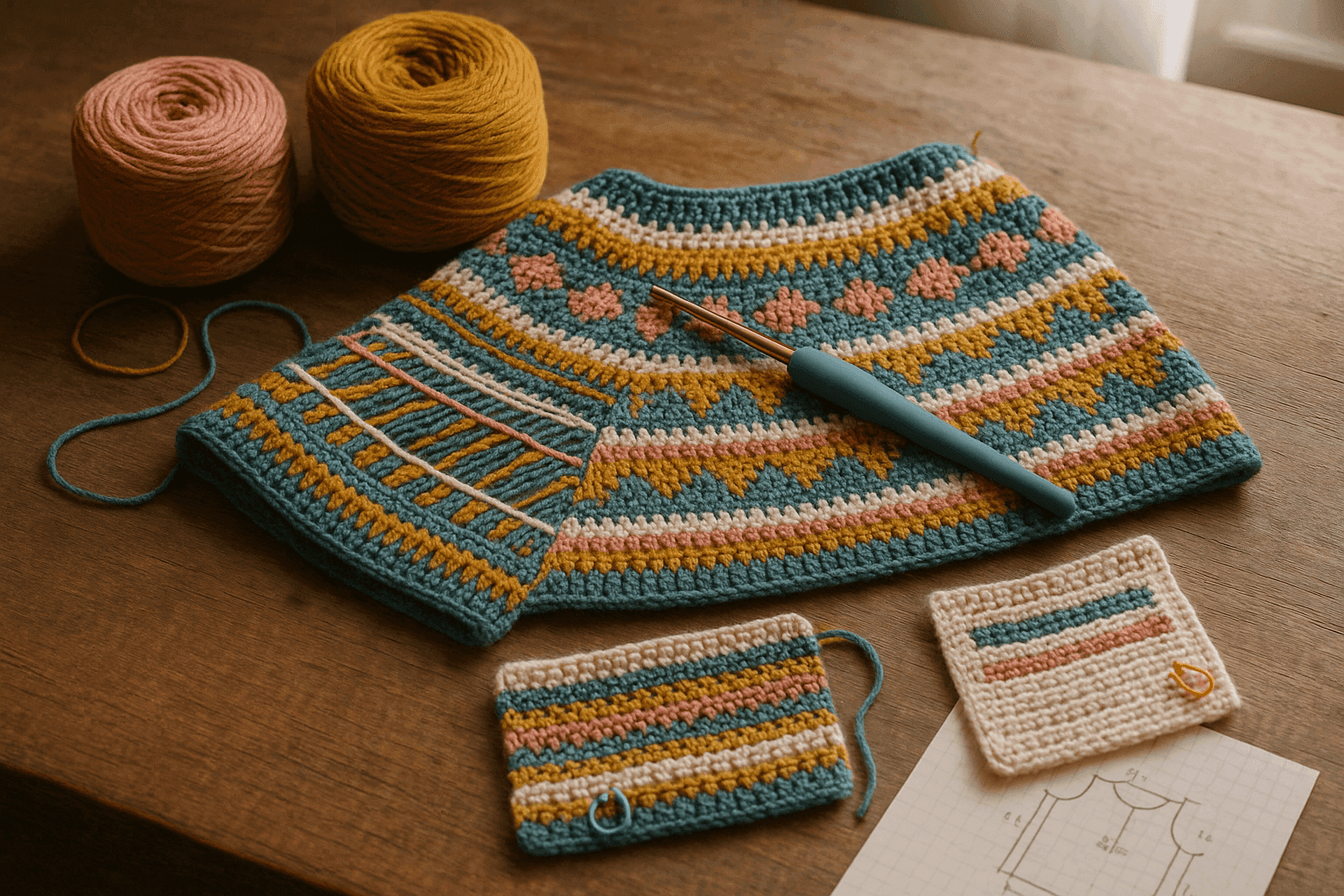
There is a particular kind of disappointment that only shows up after hours of joyful colorwork. On the right side, the motif looks crisp, clever, and full of promise. Then you turn the fabric over and find a forest of long floats waiting to snag on rings, buttons, and fingertips. Or maybe the wrong side looks tidy enough, but the fabric has become stiff, ropey, and reluctant to drape around a body. Many crocheters have had that moment with multicolor work: the design is beautiful, yet the fabric is not behaving like a garment fabric.
That tension between image and fabric is exactly where the idea of ladderback jacquard becomes useful. In knitting, ladderback jacquard is a float-management method that anchors long carried strands to hidden columns on the wrong side, reducing snagging and helping the fabric stretch more evenly. Crochet does not build stitches the same way knitting does, so we cannot simply copy the method stitch for stitch. But we can absolutely borrow the engineering logic behind it: long spans need structure, carries need intentional anchoring, and colorwork for garments must be designed around the architecture of the fabric rather than forced onto it.
In crochet, that means thinking beyond standard tapestry crochet, where unused colors are trapped inside the stitches, and beyond simple stranded methods, where yarns are carried loosely across the back. Ladderback-inspired crochet sits in the middle. It asks: when should a float stay free, when should it be caught intermittently, and when does it deserve its own anchored column or feeder path on the wrong side? Once you begin to answer those questions deliberately, your colorwork gains flexibility, durability, and a much more professional finish.
Why ladderback principles matter in crochet
Knitted ladderback jacquard relies on the fact that knit stitches are comparatively elastic and that a hidden “ladder” structure can be built behind long floats. Crochet stitches are taller, more locked in place, and less willing to redistribute tension across a span. A float that is tolerable in knitting can be very obvious or restrictive in crochet. The problem is not that crochet is bad at colorwork. The problem is that crochet announces structural decisions more clearly.
A crochet stitch has a front-facing presentation and a back-side architecture created by loops, posts, and the path of the working yarn. Depending on whether you are using single crochet, waistcoat stitch, half double crochet, linked stitches, Tunisian simple stitch, or another dense fabric-forming stitch, the wrong side may expose more or less of the carry. It may also compress the carry in different ways. This changes float behavior dramatically.
Here are the big differences to keep in mind:
- Crochet stitches are bulkier per stitch than knitted stockinette, so trapped yarn adds thickness faster.
- Crochet row height is more pronounced, which can make vertical motif edges stair-step unless planned carefully.
- Long floats resist stretch more strongly because the fabric has fewer opportunities to redistribute strain.
- Color carry placement is more visible on the wrong side, especially in flatter stitches like single crochet.
- Gauge changes from color handling are magnified in wearable pieces, where shaping and drape matter.
For garments, this means a simple rule: if a colorwork method produces a swatch that feels like upholstery, it will not become a happy sweater just because the motif is charming.
Context: where standard methods fall short
Before we build a ladderback-inspired approach, it helps to identify what the common methods do well and where they become limiting.
Tapestry crochet
In tapestry crochet, unused colors are carried inside the stitches. This works beautifully for bags, home décor, and dense graphic work. It creates very controlled motifs and protects carried yarns. But for garments, especially larger motifs or multiple color changes, tapestry can create:
- excessive bulk
- visible color shadowing or grin-through
- reduced stretch
- heavy fabric with poor drape
- uneven stitch definition when one color is consistently enclosed in another
Standard stranded crochet
In stranded crochet, you carry the unused yarn behind the work and pick it up when needed. This improves drape compared with tapestry, but long floats can:
- snag easily
- pull if tension is too tight
- bag if tension is too loose
- peek through open stitch architecture
- create irregular wrong-side bulk when catches are inconsistent
Intarsia-style bobbins
Intarsia avoids long carries by using separate yarn sources for distinct color sections. It is excellent for large blocks of color but becomes cumbersome in repeating motifs, allover patterns, and motifs with frequent color changes.
A ladderback-inspired crochet system fills the gap for repeating wearable motifs where you want cleaner wrong sides than standard stranded work, less bulk than tapestry, and fewer active bobbins than full intarsia.
The crochet version of ladderback jacquard
Instead of imagining a direct translation from knitting, think of crochet ladderback as a family of wrong-side support strategies:
- Intermittent catches for moderate float spans.
- Anchored float columns for repeated long spans in the same vertical area.
- Feeder strands that travel in planned pathways so color is available without being trapped in every stitch.
- Motif mapping that places long carries where the fabric can tolerate them structurally.
The exact implementation depends on stitch choice and motif scale.
What counts as a long float in crochet?
This varies with stitch, yarn, and intended use, but these guidelines are practical for garment fabrics:
- 1–3 stitches between uses of a color: usually safe to strand freely.
- 4–5 stitches: often still manageable, but consider an intermittent catch.
- 6–8 stitches: usually worth anchoring somehow in crochet garments.
- 9+ stitches: plan a support strategy in advance; do not simply hope tension will behave.
If you are using single crochet at a gauge of 24 sts x 28 rows over 4 in/10 cm with fingering or sport yarn, a 6-stitch float is physically shorter than it would be in bulky yarn at 14 sts over 4 in/10 cm. So stitch count alone is not enough. Measure the actual span. On many sweaters, a back float longer than about 1 to 1.5 in (2.5 to 4 cm) deserves management.
Stitch architecture and float behavior
Not all crochet stitches are equally suitable for ladderback-inspired colorwork.
Single crochet
Single crochet is the most common base for graphic crochet because it creates compact pixels. It also creates the firmest fabric. Floats behind single crochet can lock the fabric if they are tight, and trapped colors can show through readily.
Best use:
- small motifs
- high-contrast geometric patterns
- yoke or accessory areas where more structure is acceptable
Watch for:
- stiffness
- color grin-through
- horizontal drag from tight floats
Waistcoat stitch
Waistcoat stitch offers a knit-like appearance and can display motifs cleanly, but it is already dense. Adding trapped yarn or frequent catches can produce heavy fabric quickly.
Best use:
- polished graphic motifs in fine yarns
- areas where a refined surface is more important than fluid drape
Watch for:
- compacted gauge
- hand fatigue
- reduced elasticity
Half double crochet and extended single crochet
These can be useful if you want a little more flexibility and row height. They can soften the fabric, but motifs may appear slightly less square unless charted accordingly.
Best use:
- garments needing more drape
- larger-scale motifs where slight pixel softness is acceptable
Watch for:
- vertical distortion of charts written for single crochet
- visible carries in looser gauge
Linked crochet stitches
Linked stitches can reduce gaps and create smooth fabric, but they also create a more engineered structure. Use with caution for allover colorwork unless the yarn is fine and the motif spacing is controlled.
Tunisian crochet note
Tunisian crochet, especially simple stitch or knit stitch, can borrow ladderback ideas very effectively because the wrong-side return path already offers a structural framework. But that is its own article. Here we are focusing on standard crochet fabric.
Fiber, ply, and how yarn changes the success of the method
Yarn choice determines whether a sophisticated colorwork plan behaves elegantly or turns clumsy.
Fiber content
Wool and wool-rich blends are the friendliest choice for wearable multicolor crochet. They have memory, mild bloom, and the ability to settle after blocking. Wool also grips lightly, which helps anchored catches stay where you put them.
Superwash wool has smoother behavior and excellent stitch clarity, but floats may slide more, catches may appear a bit more distinct, and the final fabric can feel less cohesive unless blocked carefully.
Alpaca and other drapey fibers can produce gorgeous fabric, but floats may lengthen over time because the yarn relaxes. Use shorter spans and more frequent support.
Cotton has little elasticity and can magnify every tension inconsistency. It also makes trapped yarn bulk more obvious. If using cotton, keep motifs simpler, use finer yarn, and swatch aggressively.
Acrylic varies. Some acrylics are springy enough for successful garment colorwork, while others are squeaky, splitty, or too slick for neat catches.
Ply structure
- High-twist plied yarns give crisp stitches and resist abrasion. Excellent for detailed motifs.
- Lofty woolen-spun yarns bloom and can hide slight irregularities, reducing grin-through.
- Smooth chainette or blown yarns may create soft fabric but can make carries sit oddly and catch placement less precise.
- Singles can fuzz attractively, but long-term abrasion at wrong-side catches may be less stable.
Grin-through and bulk
“Grin-through” is when the carried color peeks through the dominant color on the right side. In crochet, this is strongly affected by:
- contrast level between colors
- stitch density
- how tightly the carry is trapped or laid behind the stitch
- fiber bloom
- the relative thickness of the carried yarn
To reduce grin-through:
- choose yarns of equal diameter
- prefer slightly woolly fibers over very slick ones
- keep gauge firm but not rigid
- avoid enclosing dark colors tightly behind pale shades in every stitch
- consider feeder-style carrying instead of full tapestry trapping when contrast is extreme
Color dominance and contrast management in crochet
Color dominance is widely discussed in knitting, but it matters in crochet too. The color held or carried in the more prominent path relative to the stitch can appear slightly more forward. In practical terms, one color may read cleaner or larger depending on how you tension and pick up yarns during changes.
For crochet colorwork:
- Keep the motif color consistently picked up in the same manner each time.
- Keep the background color traveling on a consistent path on the wrong side.
- If one color should visually pop, avoid trapping it tightly behind the other color.
- When carrying two yarns in the same row, maintain a fixed yarn order in your hands or over your fingers.
Contrast planning
Successful wearable colorwork needs value contrast, not just hue contrast. Squint at your palette. If the colors blur together in grayscale, the motif may disappear.
For garments, aim for:
- one clearly lighter color
- one clearly darker color
- optional accent colors used sparingly
Highly contrasted colors also increase the risk of grin-through, so your technique must become cleaner as your palette becomes bolder.
Building anchored float columns
Now to the heart of the method. Anchored float columns are the crochet equivalent of creating hidden support ladders in areas where one color disappears for many stitches across multiple rows.
Imagine a repeating motif where Color B appears in a vertical motif element every 8 stitches, every 3 or 4 rows. Instead of letting Color B float loosely across those long absences on every row, you can create a planned anchor column on the wrong side at a consistent location. This gives the carried strand a place to attach and reduces the length of each exposed span.
How to create a crochet anchor column
There are several workable approaches. The best one depends on whether you are working in rows or rounds.
Method 1: Intermittent catch at a fixed column
This is the simplest and most versatile method.
- Identify a stitch column where the float can be caught discreetly without disrupting the motif.
- On rows where the unused color must travel across a long span, bring the carried yarn into contact with the working yarn at that same stitch position each time.
- Catch it once by laying it over or under the working yarn before completing the stitch, then release it again.
- On the wrong side, these catches form a subtle vertical path or “ladder.”
This does not create a separate crochet structure, but functionally it behaves like a ladderback support.
Method 2: Anchored slip-stitch feeder on the wrong side
For particularly long recurring spans, you can create a dedicated feeder path.
- At the end of a row or round segment, bring the carried color into position on the wrong side.
- Work a small wrong-side slip stitch or chain-anchor at the same horizontal point every few rows, attaching the carried color to the back-side structure.
- Resume stranding from that point when the color is needed again.
This requires planning and is easiest in pieces worked flat before seaming, because you can inspect the wrong side as you go.
Method 3: Surface-fed vertical support after the fact
If the fabric is complete and floats are too long, you can add a support path afterward.
- With the carried color or a matching reinforcement yarn, weave a vertical support pathway behind repeated long floats.
- Catch each long float at the same approximate column.
- Secure lightly without drawing in the fabric.
This is not “true” ladderback construction, but it is a highly useful rescue and finishing strategy.
Placement rules for anchor columns
Anchor columns work best when:
- they fall in low-visibility background areas
- they repeat in the same approximate vertical line
- they do not coincide with sharp shaping points unless tested
- they avoid the fullest stretch zones of the garment, such as bust or upper arm, unless catches are very loose
For example, in a sweater yoke motif with 12-stitch background gaps between stars, placing an anchor every 4 to 6 stitches in the gap region will often preserve stretch better than carrying a full 12-stitch float.
Intermittent catches: the practical everyday version
Most wearable crochet colorwork benefits from intermittent catches even when full anchor columns are unnecessary.
How often to catch
A good starting rule:
- Catch every 4 to 6 stitches for high-contrast colorwork in single crochet.
- Catch every 5 to 7 stitches for finer yarn or more elastic fibers.
- Catch every 3 to 4 stitches in cotton or low-stretch fibers.
But never catch at the exact same offset in every row unless you want a visible structural rhythm. Staggering catches can reduce bulk concentration. Use fixed columns only when deliberately building ladderback-like support.
Catching without showing on the right side
To minimize visibility:
- catch in the center of a background run rather than immediately beside a motif edge
- keep the carried yarn relaxed when caught
- avoid wrapping it tightly around the working yarn
- test whether “carry over” or “carry under” is less visible with your stitch style
Different crocheters form stitches differently, so this is swatch territory, not dogma.
Step-by-step swatch exercise: building a ladderback-inspired colorwork sample
Let’s make a practical test swatch you can use to compare free floats, intermittent catches, and anchored columns.
Materials
- Sport or DK weight wool yarn in two high-contrast colors
- Hook: 3.5 mm to 4.5 mm, chosen to create a firm but flexible fabric
- Stitch markers
- Row counter
- Tapestry needle
Target gauge
Using single crochet or waistcoat stitch, aim for approximately:
- 20 to 24 sts over 4 in/10 cm
- 22 to 28 rows over 4 in/10 cm
Exact gauge matters less than consistency for this experiment, but write it down.
Swatch setup
Chain 31.
Foundation Row: Work 30 single crochet.
You now have 30 sts.
Work 4 rows in Color A plain, maintaining 30 sts per row.
Now begin a repeat that creates long gaps for Color B.
Motif repeat
For Rows 5–16, work as follows:
- Row 5: 6 A, 2 B, 10 A, 2 B, 10 A = 30 sts
- Row 6: 5 A, 4 B, 8 A, 4 B, 9 A = 30 sts
- Row 7: 4 A, 6 B, 6 A, 6 B, 8 A = 30 sts
- Row 8: 5 A, 4 B, 8 A, 4 B, 9 A = 30 sts
- Row 9: 6 A, 2 B, 10 A, 2 B, 10 A = 30 sts
- Rows 10–12: all A = 30 sts
- Repeat Rows 5–9 for Rows 13–17 if desired.
This structure creates some moderate and some long spans where Color B is absent.
Section 1: free float management
For Rows 5–9, carry Color B loosely across the back whenever not in use, with no catches unless the span exceeds your comfort limit.
Observe:
- Does the fabric pucker?
- Are the floats snag-prone?
- Does the right side stay clean?
Section 2: intermittent catches
For Rows 10–14 or your next motif set, catch Color B every 4 or 5 background stitches during long A runs.
Observe:
- Has the fabric become more stable?
- Are catches visible on the right side?
- Does the fabric still stretch across the row?
Section 3: anchored column
For the next repeat, choose a fixed stitch position in the middle of each long A run, for example stitch 15 of the row, and catch Color B there every row it must travel.
Observe:
- Does the wrong side show an organized vertical support line?
- Is snagging reduced compared with free floats?
- Is stretch better than in heavily trapped tapestry work?
Block the swatch and compare all three areas after drying. This is where the lesson becomes obvious.
Mapping motifs so the fabric keeps drape
This is where colorwork graduates from technique to engineering. A motif chart is not just a picture. It is also a plan for yarn traffic.
Questions to ask when charting
- Where are the longest color absences?
- Do those absences stack vertically from row to row?
- Will repeated catches create hard bands?
- Is there enough plain fabric between motifs to preserve mobility?
- Are motif edges producing too many one-stitch color changes, which increase bulk?
Drape-friendly motif design rules
- Break up giant background spans. If a motif leaves 12 to 16 stitches of background between color uses, consider redesigning the chart or using an anchor column.
- Avoid checkerboard overkill in dense stitches. Constant alternation creates a thick, corrugated fabric.
- Use fine yarn for complex motifs. Crochet gains bulk faster than knitting.
- Distribute motif density strategically. A yoke can handle more structure than an underarm panel.
- Let plain sections breathe. Every garment needs visual and physical rest.
A useful garment guideline
If more than about one-third of the row is carrying inactive colors across long spans in a dense stitch, reassess the motif or the method. That row is at risk of becoming a structural band rather than a flexible textile.
Gauge effects and how to compensate
Colorwork almost always changes gauge in crochet.
You may see:
- fewer stitches per 4 in because floats restrict width
- more rows per 4 in because the fabric compacts vertically
- the opposite effect if carries are too loose and distort the back
How to swatch accurately
Make a colorwork swatch at least 6 x 6 in (15 x 15 cm) and measure the center 4 x 4 in (10 x 10 cm) after blocking.
Record:
- plain fabric gauge
- colorwork gauge with free floats
- colorwork gauge with your chosen catch strategy
If your plain single crochet gauge is 22 sts x 24 rows over 4 in, but your colorwork gauge becomes 20 sts x 26 rows, that difference is significant in a sweater. You may need:
- a larger hook for colorwork sections
- more stitches in the motif section
- a different base stitch
- more relaxed catch spacing
Steeking compatibility
Can you steek crochet colorwork? Yes, in some contexts, but with caveats.
Crochet does not behave like non-superwash stranded wool knitting, where steeked columns can be remarkably stable after reinforcement. Crochet is already more structurally secure stitch by stitch, but cut edges still require planning.
Best candidates for steeked crochet colorwork
- firm wool or wool-blend yarn
- dense stitches such as single crochet or waistcoat stitch
- garments worked in the round where seam-like structure is desired
- motifs with controlled carry behavior near the steek area
Steek planning tips
- Add at least 4 to 6 steek stitches to create a secure cut channel.
- Avoid long loose floats crossing the future steek line.
- Catch carries before they reach the steek area, or use separate feeder management there.
- Reinforce with machine stitching, hand backstitch, or crochet slip-stitch reinforcement before cutting.
If the wrong side near the steek is a web of unmanaged floats, cutting becomes far riskier and finishing much messier.
Troubleshooting common problems
Problem: The fabric is stiff and board-like
Likely causes:
- too many trapped yarns inside stitches
- hook too small
- motif too dense
- catches too frequent and too tight
Fixes:
- size up hook by 0.5 mm
- switch from tapestry handling to stranded with intermittent catches
- reduce motif complexity
- use wool instead of cotton
Problem: Floats snag constantly
Likely causes:
- spans too long
- no support planning
- slippery yarn
Fixes:
- add anchor columns in repeated long-span areas
- catch every 4 to 6 stitches
- weave post-fabric support behind vulnerable zones
Problem: The right side shows little dots of the carried color
Likely causes:
- grin-through from high contrast and dense trapping
- inconsistent yarn order
- stitch tension too tight around carry
Fixes:
- keep yarn order consistent
- loosen the carry slightly
- shift from trapped to feeder-style carrying
- use a woollier yarn pair
Problem: Motif columns lean or distort
Likely causes:
- natural crochet slant
- chart not adjusted for stitch shape
- uneven tension at color changes
Fixes:
- use a stitch better suited to graphic work
- re-chart motifs with awareness of row height and stitch width
- place color changes in the final yarn-over of the previous stitch consistently
Problem: Colorwork section is narrower than plain sections
Likely causes:
- tight floats
- over-controlled catches
- stress from carrying inactive yarn
Fixes:
- spread stitches on the hook-side portion of the row before continuing after a float
- increase hook size for colorwork area
- relax catches and test a wider catch interval
Finishing strategies for professional results
Finishing is where careful technique starts to look intentional and polished.
Block with purpose
Wet block or steam block according to fiber. During blocking:
- open the fabric sideways gently to let floats settle
- align motif columns n- smooth wrong-side feeder paths flat without stretching them taut
Do not over-stretch colorwork. You are settling the engineering, not forcing it.
Weave in ends on the bias or within color paths
In multicolor crochet, random end weaving can create extra bumps. Instead:
- weave within same-color wrong-side paths
- split plies only if the fiber tolerates it
- avoid crossing highly contrasting areas where the tail might shadow through
Consider a wrong-side facing in high-wear zones
For children’s garments, cuffs, or bags-with-garment styling, a light woven facing or ribbon behind a particularly snag-prone colorwork panel can be a smart finishing choice.
Light duplicate reinforcement
If a motif edge looks underdefined, a tiny amount of duplicate-stitch-like embroidery in the motif color can sharpen the visual line without restructuring the whole fabric.
Variations on the method
Once you understand the principles, you can adapt them in several directions.
Ladderback-inspired yoke crochet
Use anchored columns behind repeated contrast motifs in a circular yoke, especially where background spans widen between motif repeats. Keep catches aligned with the spaces between motif units.
Hybrid tapestry-stranded crochet
Trap colors only in short, high-activity sections of the chart, and switch to free stranding with anchor columns across broad background zones.
Featherweight fine-gauge crochet colorwork
Use fingering yarn and a 2.75 mm to 3.5 mm hook for a softer garment fabric. Fine gauge allows longer visual motifs with less structural heaviness.
Post-work reinforcement for luxury fibers
With alpaca, yak blends, or silk-rich yarns, work with fewer catches during crocheting, then reinforce select float zones afterward to preserve drape.
A practical workflow for garment planning
If you want your next multicolor crochet garment to feel intentional instead of experimental, use this sequence.
- Choose the base stitch and yarn based on desired drape.
- Swatch plain fabric and colorwork fabric separately.
- Mark every chart span longer than 5 stitches.
- Decide whether each span will be:
- freely floated
- intermittently caught
- supported by an anchor column
- converted to separate yarn management
- Evaluate palette contrast for grin-through risk.
- Test blocking.
- Recalculate gauge before committing to garment sizing.
- Plan finishing, especially if steeking or heavy wear is involved.
This sounds methodical because it is. Professional-looking colorwork is rarely the product of luck.
Takeaways
Crochet may not reproduce knitted ladderback jacquard literally, but it can absolutely benefit from its logic. The real lesson is not the ladder itself. The lesson is that long carries need a system.
When you approach wearable colorwork as fabric engineering, several things become clear:
- Crochet stitch architecture changes how floats behave, so float management must be stitch-specific.
- Ladderback-inspired support in crochet usually takes the form of intermittent catches, anchored columns, or feeder paths.
- Yarn fiber and ply directly affect bulk, stretch, and grin-through.
- Motif design is structural planning, not just decoration.
- Gauge changes in colorwork are real and must be measured.
- Steeking is possible with planning, but unmanaged floats near cut lines are asking for trouble.
- Finishing matters as much as the crocheting.
If you have mostly worked with tapestry crochet or simple stranded carrying, this approach can feel like a shift in mindset. But it is an exciting one. Instead of asking how to force a picture into crochet fabric, you start asking how to build a fabric that can carry a picture beautifully. That is where multicolor crochet moves from competent to truly refined.
The next time you chart a motif, do not just count the stitches in the flower or star. Count the silences between colors. Those quiet stretches are where the fabric either succeeds or struggles. Give them structure, give them breathing room, and your colorwork will not only look better on the right side. It will feel better everywhere a real garment needs to move.