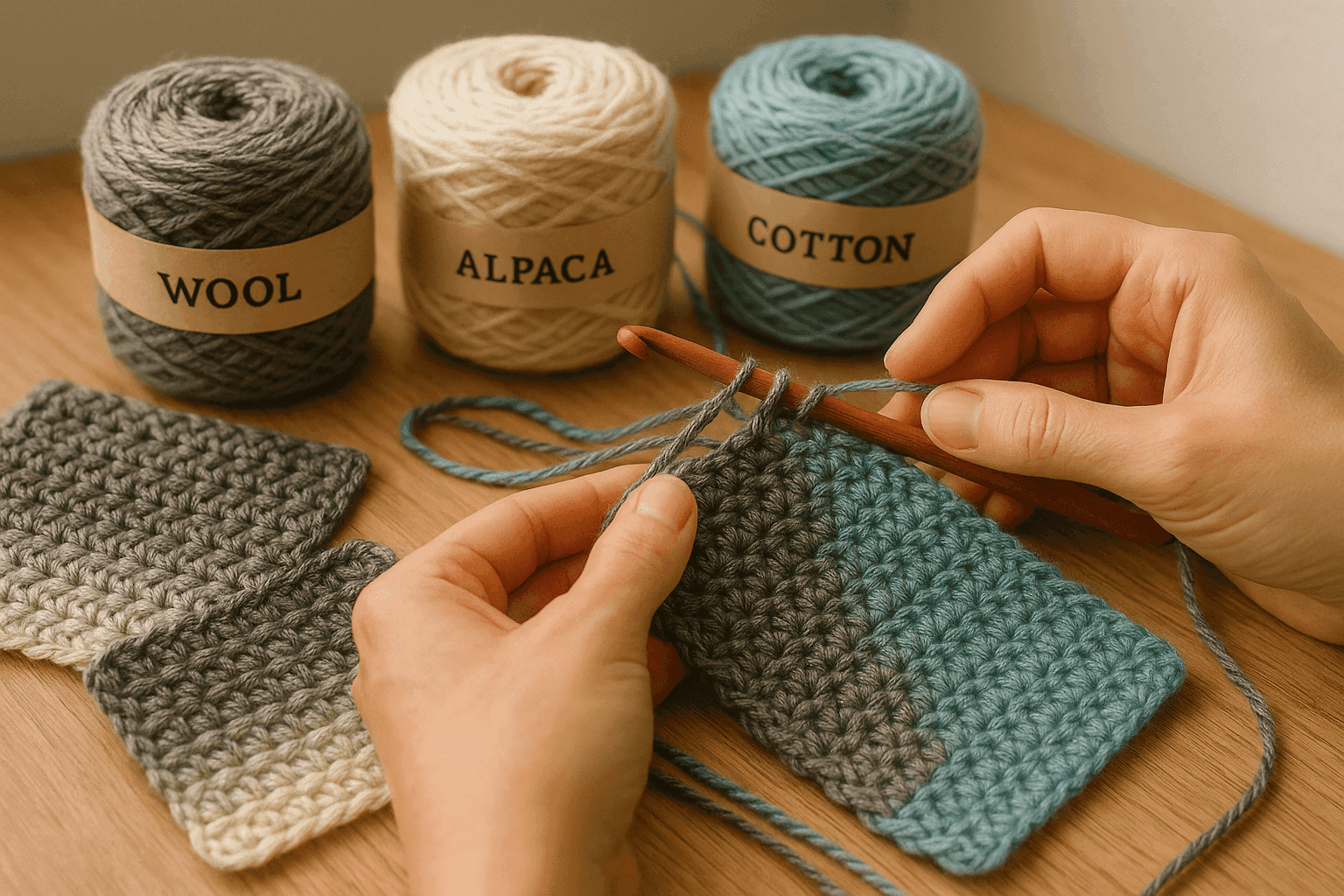
There’s a particular kind of confidence that comes from picking up two strands of yarn, holding them together, and realizing you’re no longer just following a pattern—you’re engineering fabric. One strand can soften another. A halo yarn can haze a crisp wool into a heathery cloud. A smooth cotton can rein in an eager acrylic. Two colors worked together can create a subtle optical blend that looks far more sophisticated than either strand alone. And then, of course, there’s the moment when you think, “This should work,” only to discover that your gauge has ballooned, your fabric has gone board-stiff, or one strand seems determined to outgrow the other in blocking.
If you’ve ever wanted to use two or more strands held together for marl effects, stronger structure, warmer fabric, or yarn substitution—but also wanted the result to look intentional instead of accidental—this is where the real design work happens. Holding multiple strands together in crochet is wonderfully forgiving in some ways, but it is not random. The combined yarn behaves like its own material system. Color, fiber, twist, ply structure, hook size, and stitch choice all interact. When you understand those interactions, you can build gradients that glow, heathers that read as refined rather than muddy, and sturdy fabrics that still move the way you want them to.
This guide is written from the perspective of someone who has done the swatching, made the mistakes, unraveled the too-bulky sections, and learned that “just hold two together” is both true and wildly incomplete. We’ll cover how multiple strands affect optical color mixing, gauge inflation, stitch definition, drape, abrasion resistance, and blocking behavior. We’ll also walk through practical pattern math, substitution logic, troubleshooting, and ways to build polished marled designs without accidental thickness, torque, or bias.
Why crocheters hold multiple strands together in the first place
Before getting technical, it helps to name what this method can do well.
Holding two or more strands together is useful for:
- Optical color mixing: combining shades to create marls, heathers, faux handspun effects, gradients, and tweedy visual depth.
- Fabric stability: increasing density and reducing stretchiness, especially for bags, baskets, slippers, rugs, and outerwear.
- Gauge scaling: using lighter yarns together to approximate a heavier yarn category.
- Texture control: softening stitch definition with halo fibers or sharpening it with smooth plied yarns.
- Yarn stash flexibility: combining partial skeins, using cone yarn with a strand of something loftier, or substituting unavailable yarns.
- Thermal and tactile design: pairing fibers to balance warmth, resilience, softness, and memory.
The magic is that held-together yarns do not simply add thickness; they create a new composite yarn. That new yarn will usually be thicker, yes, but also differently compressible, differently elastic, and differently reflective of light. That is why two combinations with identical wraps-per-inch can behave very differently in actual crochet.
Context: what “plied marl” really means in crochet design
In hand knitting and crochet, “holding yarns together” often gets casually described as making a thicker yarn. Functionally, yes. But structurally, what you are doing is closer to creating a temporary multi-strand yarn with no final spinning step to lock the strands into one coherent cord. That matters.
A commercially spun yarn has a designed balance of:
- fiber type
- preparation
- ply count
- twist direction and amount
- diameter consistency
- finish
When you hold two strands together, each strand retains its own behavior. They share tension because your hand and hook force them to, but they can still slide, compress, bloom, relax, and abrade at different rates. That’s why some combinations feel beautifully integrated while others seem to argue with each other every row.
The “marl” effect itself is mostly optical mixing rather than true color blending. Because crochet stitches stack and interlock in visible loops, the eye reads tiny alternating segments of each color as one blended field at a distance. Up close, you see the individual strand colors; farther away, you see a mixed tone. This is the same reason a charcoal strand with cream can read as soft gray overall, and a navy strand with rust can read almost smoky brown from across the room.
This optical behavior means your stitch choice matters enormously. Tall, open stitches separate colors more visibly. Compact stitches blend them more thoroughly. Smooth yarns show the marl more crisply; fuzzy yarns blur it.
Technique foundation: how color mixing changes with strand choice
The first design decision is not just “which colors?” It is which colors in which yarn structures?
1. High contrast vs low contrast marls
- Low contrast combinations (for example, mushroom + oatmeal, denim + slate) create sophisticated heathers and subtle depth.
- High contrast combinations (black + white, navy + gold, red + cream) create a salt-and-pepper or barber-pole effect with more visible speckling.
If you want a smooth blended field, keep the values closer together. If you want the marl to be a visible feature, increase contrast.
2. Saturation matters as much as hue
Two medium-value colors with different saturation can mix in surprising ways. For example:
- dusty rose + taupe = muted vintage marl
- hot pink + taupe = louder and more pixelated visually
A very saturated strand tends to dominate the mix, especially if the companion strand is fuzzy or light in value.
3. Strand diameter affects optical dominance
If one strand is visibly thicker than the other, its color will dominate the marl. This can be useful. A fine metallic or mohair strand can tint the base without taking over. But if you intended a 50/50 visual blend, use strands with similar apparent diameter.
4. Halo blurs the blend
Brushed suri, mohair, alpaca halo, or blown yarn can soften hard contrast. This can be beautiful for gradients and atmospheric garments, but it also reduces stitch definition.
5. Surface finish changes the look
A matte wool paired with a shiny mercerized cotton doesn’t just mix color—it mixes light reflection. The shiny strand will catch the eye and may read brighter than expected.
Fiber compatibility: when yarns cooperate and when they fight
Not all fibers are good neighbors.
Cooperative pairs
These combinations often work well because their stretch, recovery, and finishing behavior are reasonably compatible:
- Wool + wool: easiest for balanced marl, elastic fabric, and unified blocking.
- Wool + alpaca: warm and soft, though often drapier and less springy.
- Wool + nylon: good for durability with moderate elasticity.
- Cotton + linen: crisp, breathable, structured; good for summer accessories and homewares.
- Acrylic + wool: can work if both are similar in diameter and the acrylic isn’t too slippery.
Potentially difficult pairs
These need extra swatching:
- Wool + cotton: wool wants to spring back; cotton tends to hang and can grow differently.
- Cotton + acrylic: often manageable, but texture and recovery may differ.
- Mohair/suri + smooth cotton: can be lovely visually, but the grip and drag differ a lot.
- Elastic yarn + inelastic yarn: one strand may carry more load, causing uneven stitch formation.
High-conflict pairs
These can still be used, but only deliberately:
- Superwash wool + non-superwash wool: they may bloom and block differently.
- Plant fiber + strong halo fiber: one can stretch and the other cling, making frogging difficult and wear uneven.
- Very slippery silk/bamboo + sticky rustic wool: tensioning can become inconsistent.
When mixed fibers fight, you’ll see it in one or more ways:
- uneven stitch size
- one strand peeking out more than the other
- biasing or skewing in fabric
- rippling after blocking
- abrasion where one strand wears faster
- inconsistent row height as one strand relaxes
Twist interaction and torque: why some combinations bias
This is one of the least discussed but most important parts of polished multi-strand design.
Yarns are spun with a twist direction—usually S or Z—and then plied in the opposite direction for balance. Crochet itself adds motion and tension that can either preserve or exaggerate twist energy.
When holding multiple strands together:
- A firmly spun yarn may stay round and distinct.
- A softly spun yarn may flatten into the mix.
- A high-twist strand may kink or coil if allowed to dangle freely.
- Two strands with different twist energy can rotate around each other unevenly.
This doesn’t always cause visible problems, but in some stitch patterns, especially taller stitches worked quickly, you may notice:
- a ropey, over-twisted held-together strand
- one strand spiraling consistently over the other
- slight fabric bias
- split stitches if one yarn untwists easily
How to reduce twist problems
- Pull both strands from the same direction relative to your working hand.
- Use center-pull with center-pull, or cake both yarns and let them feed evenly.
- Stop periodically and let the working strands untwist by dropping the work and allowing the yarn to spin freely.
- Avoid over-tensioning one strand more than the other.
- Swatch in the actual stitch pattern, because single crochet, half double crochet, and taller stitches can reveal twist issues differently.
Gauge inflation: the part that surprises almost everyone
The most common mistake in held-together crochet is assuming yarn weights add in a simple, linear way.
They don’t.
Two fingering-weight yarns held together do not always equal worsted in every fiber combination. Two DK strands do not automatically behave like bulky in every stitch and hook combination. Loft, compression, ply, and fiber content all influence the resulting gauge.
Why gauge inflates unpredictably
A held-together strand has:
- more total volume
- more air between components
- more surface friction
- different compressibility under the hook
A lofty wool pair may fill space dramatically without becoming stiff. Two dense cotton strands may become heavy and rigid fast. A halo yarn can increase apparent diameter more than actual structural bulk.
Practical gauge rule of thumb
Use wraps per inch (WPI) as a starting estimate, not a guarantee.
Approximate ranges:
- Lace: 30+ WPI
- Fingering: 14–24 WPI
- Sport: 12–18 WPI
- DK: 11–15 WPI
- Worsted: 9–12 WPI
- Aran: 8–10 WPI
- Bulky: 7–9 WPI
To estimate a held-together combo:
- Wrap the combined strands around a ruler without stretching.
- Count wraps per inch.
- Compare to yarn category ranges.
- Swatch anyway.
The swatch is the truth.
Expected gauge changes by strand count
As a very rough planning guide:
- 2 similar strands together often require a hook 1.0–2.0 mm larger than each strand alone.
- 3 similar strands together may require a hook 2.0–3.5 mm larger.
- Fabric often becomes shorter and denser row-for-row if you don’t size up enough.
For example:
- One DK yarn might work nicely at 4.0 mm in half double crochet.
- Two DK strands together may need 5.5 mm to 6.5 mm depending on fiber and drape goals.
- Two cotton DK strands may still feel stiff at 6.0 mm and need a pattern rethink rather than just a larger hook.
Stitch definition, drape, and abrasion: engineering the fabric you actually want
The reason to hold strands together should match the fabric goal.
For crisp stitch definition
Use:
- smooth, plied yarns
- similar diameters
- moderate twist
- stitches like single crochet, half double crochet, extended single crochet, and post-stitch textures
Best for:
- baskets
- colorwork with marl texture
- structural garments
- textured pillows
For soft visual blending
Use:
- one smooth strand + one halo strand
- lower contrast colors
- stitches with moderate openness like half double crochet or double crochet
Best for:
- scarves
- yokes
- sweaters with atmospheric color transitions
- wraps
For dense structural fabric
Use:
- fibers with body: wool, cotton, linen blends
- smaller hook relative to yarn bulk
- compact stitches: single crochet, waistcoat stitch, slip stitch ribbing, thermal stitch
Best for:
- bags
- baskets
- mats
- slippers
For drape
Use:
- softer fibers or one drapey companion strand
- larger hook relative to total yarn bulk
- taller stitches or mesh sections
Best for:
- garments n- shawls
- cocoon cardigans
Abrasion considerations
Multi-strand crochet increases surface contact and can increase abrasion in use.
Watch for:
- fuzzy strands pilling quickly when paired with rough wool
- cotton strands wearing at fold points in bags
- delicate halo fibers shedding from high-friction accessories
For hard-wearing items, choose at least one strong strand with good durability and avoid relying on a fragile halo yarn for structure.
How to hold multiple strands comfortably
Technique matters because uneven strand tension leads to uneven marl.
Basic setup
Treat the strands as one yarn from the start:
- Align both strand ends.
- Make one slip knot holding all strands together, or chain with all strands without a slip knot if that’s your preference.
- Tension them together over the same fingers rather than separating them.
Feeding methods
Best options:
- two center-pull cakes side by side
- two yarn bowls with smooth feed
- one project bag with each yarn in separate compartments
Avoid letting one skein tumble and one feed smoothly; the inconsistent drag will affect stitch size.
Hook selection
Because held yarn creates more friction:
- A hook with a smoother finish often helps.
- Inline vs tapered head is personal, but choose the one that reduces snagging for your fibers.
- For split-prone combinations, a slightly blunter hook tip can help.
Step-by-step: designing and swatching a held-together yarn combination
This is the process that produces predictable results.
Step 1: Define the fabric goal
Decide exactly what you want:
- airy gradient shawl
- sturdy bag body
- sweater with soft heathered color
- substitute for a missing bulky yarn
Your goal determines everything else: fibers, hook size, stitch, and acceptable drape.
Step 2: Choose the strand roles
It helps to think of strands as having jobs.
Common roles:
- Base strand: provides structure and the dominant gauge behavior.
- Color strand: shifts hue or value without changing behavior too drastically.
- Halo strand: softens edges and creates atmospheric blending.
- Strength strand: nylon, wool, or firm cotton for durability.
For a balanced marl, choose two strands of similar visual weight. For a tinted fabric, choose one dominant base and one finer modifier.
Step 3: Build a small combination map
Before swatching full-size, make a note like this:
- A: oatmeal wool DK
- B: charcoal wool DK
- C: cream brushed alpaca lace
Possible pairings:
- A + B = classic gray marl
- A + C = soft glowing beige
- B + C = smoky halo charcoal
This lets you plan gradients and section changes intentionally.
Step 4: Make a meaningful swatch
For most projects, chain enough for a 15–20 cm / 6–8 in swatch after blocking.
Example starting stitch counts:
- Single crochet swatch with held DK + DK on a 6.0 mm hook: chain 26, work 25 sc across for 20 rows.
- Half double crochet swatch: chain 24, work 23 hdc across for 16 rows.
- Double crochet swatch: chain 22, work 21 dc across for 12–14 rows.
These counts are examples, not universal formulas, but they are large enough to reveal real behavior.
Measure:
- stitch gauge over the center 10 cm / 4 in
- row gauge over the center 10 cm / 4 in
- fabric weight and drape by holding the swatch vertically
- rebound after gentle stretching
- visual blend from near and far
Step 5: Block the swatch as the finished item will be treated
This step is non-negotiable when mixing fibers.
- Wet block wool blends.
- Steam lightly for acrylic if that matches final care, but be cautious not to kill the fabric unless intentionally doing so.
- For cotton/linen blends, wash and dry as intended, because growth often appears after laundering.
Measure before and after blocking.
If one strand blooms dramatically and the other doesn’t, note the change.
Step 6: Calculate pattern math from actual gauge
Suppose your blocked gauge is:
- 13 sc = 10 cm / 4 in
- 15 rows = 10 cm / 4 in
And you want a pillow panel 45 cm / 18 in wide.
Width stitch count:
- 13 stitches per 10 cm = 1.3 stitches per cm
- 45 cm × 1.3 = 58.5 stitches
- Round to a usable number for your stitch pattern: 58 or 60 stitches
If using plain single crochet, you might choose:
- chain 61 to work 60 sc, or
- chain 59 to work 58 sc, depending on edging and seaming preference
For garment math, always calculate from the blocked swatch, not the pre-blocked swatch.
Step 7: Test a transition if using gradients
If you plan to fade colors by changing one strand at a time, make a mini gradient test.
Example 4-stage fade:
- Stage 1: A + A
- Stage 2: A + B
- Stage 3: B + B
- Stage 4: B + C
Work at least 4 rows or 2 rounds in each stage so the transition can actually be seen. In compact stitches, shorter sections can look muddled.
Step 8: Begin the project with notes
Record:
- yarn brands and fiber content
- hook size
- gauge after blocking
- exact strand pairings by section
- stitch counts for each size or panel
This matters especially if you need to buy more yarn or reproduce the design later.
Intelligent substitution: replacing a single yarn with multiple strands
Sometimes a pattern calls for one bulky yarn and you want to use held-together strands from stash. This can work very well if you substitute by fabric behavior, not label weight alone.
What to compare
Check the original yarn for:
- fiber content
- WPI or approximate thickness
- yardage per 100 g
- recommended hook size
- described fabric character: lofty, dense, drapey, crisp
Then compare your proposed held-together combination.
Example substitution logic
Original yarn:
- bulky wool blend
- recommended hook 6.5 mm
- gauge in sc approximately 11 sts per 10 cm / 4 in
Possible substitute:
- two sport-weight wools held together
You might swatch on 6.0 mm, 6.5 mm, and 7.0 mm. If your substitute gets 11 sts per 10 cm at 6.5 mm and the drape matches, great. If it gets gauge only at 7.0 mm but becomes too open, the substitution is not truly equivalent even if the numbers match.
Yardage caution
Held-together yarn uses yarn from each strand simultaneously. If a project requires 800 m of the original single yarn, you do not need 800 m total divided across two strands. You typically need close to the full project length from each held strand along the worked path.
As a practical estimate:
- If a sweater uses 800 m of a bulky single yarn, and your substitute is 2 strands held together throughout, plan for roughly 800 m of strand A + 800 m of strand B, adjusted for gauge and swatch consumption.
Always weigh your swatch if precision matters.
Common mistakes and how to fix them
Mistake 1: The fabric is much stiffer than expected
Why it happens:
- hook too small
- dense stitch with dense fibers
- too many strands for the project type
Fixes:
- go up 0.5–1.5 mm in hook size
- switch from sc to hdc or dc
- replace one dense strand with a loftier one
- reduce from 3 strands to 2 and re-swatch
Mistake 2: The colors look muddy instead of blended
Why it happens:
- too many mid-value colors without contrast planning
- overly busy stitch texture
- variegated strands competing with marl logic
Fixes:
- simplify to one solid + one tonal strand
- separate strong colors with a neutral bridge strand
- choose smoother stitch patterns to let the color read clearly
Mistake 3: One strand seems looser and peeks out
Why it happens:
- inconsistent feeding tension
- different fiber drag
- one yarn stretching more during stitching
Fixes:
- re-cake both yarns for even feed
- tension both strands together, not separately
- pause often to check that neither strand is lagging
- if necessary, go down a hook size slightly to improve control
Mistake 4: Gauge matches width but row height is off
Why it happens:
- held yarn changes stitch compression vertically
- fiber blend affects bounce and recovery
Fixes:
- prioritize stitch gauge for fitted width, then adjust rows/rounds by measurement
- choose a different stitch if row gauge is critically important
- write the pattern by centimeters/inches plus checkpoints rather than row count alone
Mistake 5: The fabric twists or biases
Why it happens:
- strand twist interaction
- uneven tensioning
- stitch pattern with inherent lean amplified by the yarn combo
Fixes:
- let strands untwist regularly
- test a different hook style
- work joined rounds instead of a continuous spiral if applicable
- try a more balanced stitch pattern
Mistake 6: Blocking made the yarns behave differently
Why it happens:
- mixed fibers with different bloom or shrink tendencies
Fixes:
- rewash the swatch in the exact final method before continuing
- reserve mixed-fiber combos for projects where precision fit matters less
- for garments, choose more compatible fibers next time unless you’re designing with that differential intentionally
Variations and design strategies
Once you understand the basics, this is where held-together crochet becomes truly exciting.
1. One-strand-at-a-time gradients
This is the cleanest way to create smooth fades.
Example with colors A, B, C:
- A + A
- A + B
- B + B
- B + C
- C + C
This creates a staged gradient with no abrupt jumps. It works especially well in shawls, yokes, and blankets.
2. Heathered neutrals with a color whisper
Use:
- one neutral main strand
- one finer colored strand
Example:
- light gray DK + plum laceweight wool
From a distance it reads gray, but with rich undertone.
3. Structural marl for bags and baskets
Use:
- 2 strands of cotton or cotton/linen
- hook just large enough to avoid hand strain
- single crochet or waistcoat stitch
Sample swatch setup:
- chain 21
- work 20 sc for 20 rows on a 5.5 mm–6.0 mm hook using 2 strands of worsted cotton
Expect a dense fabric. If your stitch gauge is tighter than 12 sc per 10 cm / 4 in and the fabric is hard to insert the hook into, size up.
4. Halo overlay without bulk overload
Instead of holding two equal yarns, pair:
- one DK or sport smooth yarn
- one lace halo yarn
This adds softness and color haze without doubling weight aggressively.
5. Faux tweed through strategic contrast
Combine:
- one tonal base strand
- one high-contrast strand used only intermittently in sections or stripes
This gives the impression of flecks and movement without requiring actual tweed yarn.
6. Reinforced slipper or cuff fabric
Try:
- wool + nylon sock yarn held double
- worked in sc or linked stitches
This gives warmth plus durability in friction-heavy areas.
Pattern-writing tips for held-together designs
If you are writing your own pattern or adapting one, clarity matters.
State explicitly:
- number of strands held together
- yarn weight and fiber of each strand
- whether strands are identical or contrasting
- hook used to obtain gauge
- gauge stitch and row count after blocking
- any color-change schedule by row/round
A clear notation example:
- Hold 2 strands together throughout unless otherwise noted: 1 strand MC wool DK + 1 strand CC wool DK.
- Gauge: 13 hdc and 11 rows = 10 cm / 4 in on 6.0 mm hook after wet blocking.
For a gradient section, write:
- Rows 1–8: A + A
- Rows 9–16: A + B
- Rows 17–24: B + B
This removes ambiguity and helps makers reproduce the intended marl.
A practical sample planning scenario
Let’s say you want to design a marled pullover with a soft heathered body and stable ribbing.
Body fabric goal
- soft but not floppy
- visible marl from two colors
- moderate warmth
- decent stitch definition
Possible combination:
- strand 1: non-superwash wool sport
- strand 2: brushed alpaca lace
Swatch in half double crochet on 5.0 mm, 5.5 mm, and 6.0 mm.
Suppose results are:
- 5.0 mm: 16 hdc x 12 rows = 10 cm, too firm
- 5.5 mm: 15 hdc x 11 rows = 10 cm, ideal drape
- 6.0 mm: 14 hdc x 10 rows = 10 cm, too open for warmth
Choose 5.5 mm.
Ribbing goal
- more recovery
- less halo fuzz
Possible solution:
Use only the sport wool strand for ribbing on a 4.5 mm hook, or pair the sport with a finer elastic-friendly wool instead of alpaca. This is a thoughtful departure from “hold everything together everywhere,” and it often improves wear.
Key takeaways
Holding multiple strands together in crochet is one of the most versatile design tools you can use, but it rewards intention. The best results come from thinking like a fabric designer, not just a yarn doubler.
Remember these principles:
- The swatch is the truth. Label weight is only a starting point.
- Strands create a composite system. Thickness, elasticity, halo, and friction all matter.
- Color mixing is optical. Stitch structure and surface finish affect the marl as much as the actual hues.
- Fiber compatibility matters in blocking and wear. Choose partners that behave similarly unless you are deliberately exploiting contrast.
- Gauge inflation is real and not linear. Expect to adjust hook size and stitch pattern.
- Different project goals need different combinations. A gradient shawl, basket, and sweater should not all be engineered the same way.
- Pattern math should be based on blocked swatches. Especially for garments and mixed fibers.
- Polished marls are planned, not accidental. Transition maps, strand roles, and measured tests make the difference.
If you’re new to designing with held-together yarns, start with two compatible strands in closely related values and a simple stitch pattern. Make one generous swatch, wash it, measure it, and really look at it from both six inches away and across the room. That little square will tell you nearly everything you need to know. From there, you can begin building gradients, sturdy utility fabrics, elegant heathers, or dramatic color fields with confidence.
And once you’ve felt the difference between a random double strand and a deliberately engineered marl, it’s hard not to see every yarn shelf as a set of possible fabric equations waiting to be solved.