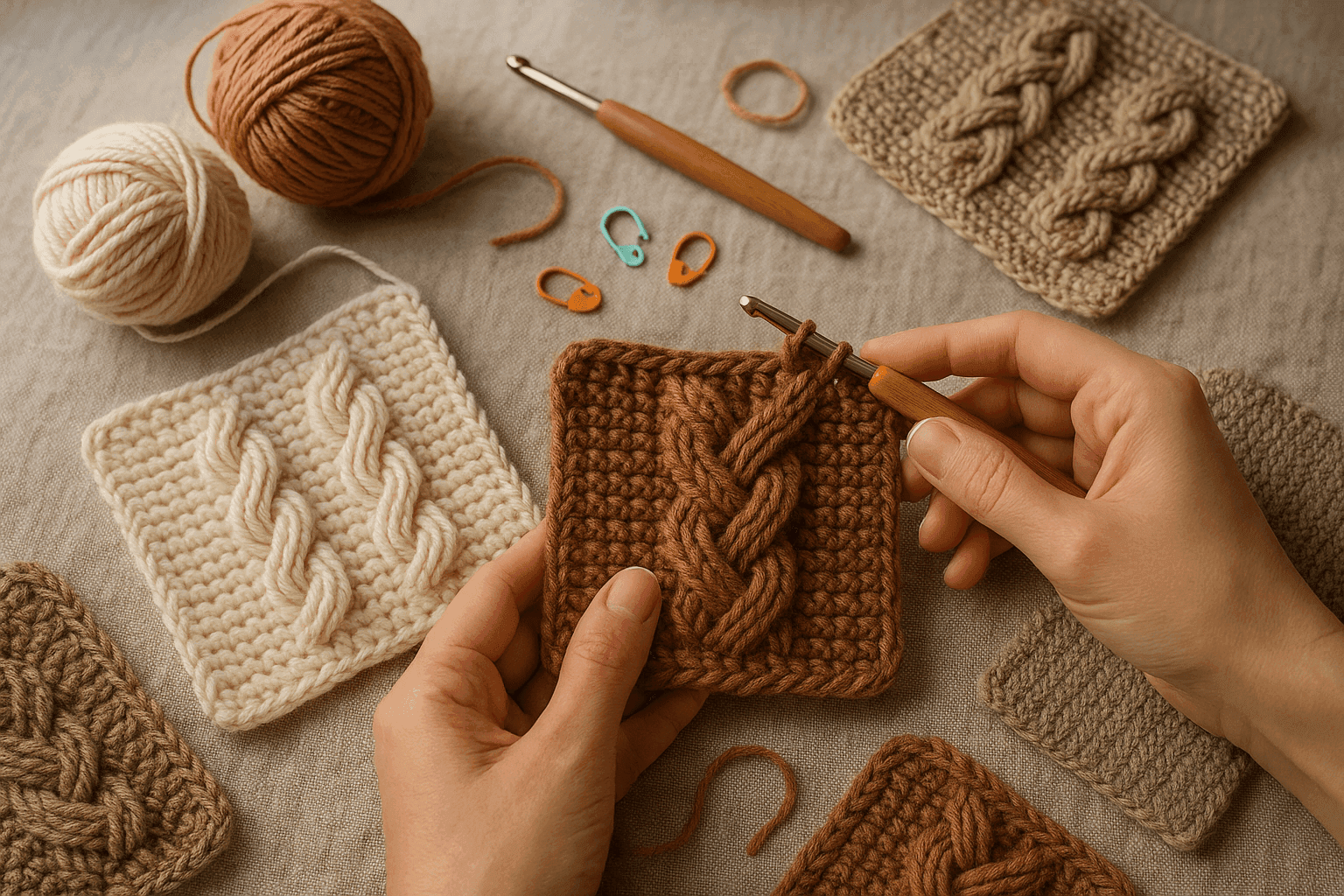
There’s a particular kind of disappointment that many of us have felt after spending hours on a “heavily textured” crochet panel: it looks dramatic in the pattern photo, but in our hands it turns stiff, thick, and strangely blunt. The cables are there, technically, yet instead of crisp rope-like definition we get a padded slab. The braid effect reads more like layered lumps than interlaced structure. That frustration often sends crocheters back to the same solutions—more front-post stitches, more crossings, more layers—when the real answer is often the opposite. If you want relief without bulk, the trick is not necessarily to stack more fabric. It is to control where the yarn path travels.
That shift in thinking opens up a fascinating design space. Rather than treating texture as mass, we can treat it as direction. Ply-split effects, faux-braided structures, split-loop anchoring, inset cords, and hybrid overlays all rely on this principle: move yarn paths so the eye reads lift, crossing, and depth, even when the fabric underneath remains comparatively light. In practical terms, that means fewer dense piles of post stitches and more intentional manipulation of where loops enter, emerge, cross, and recover.
This approach is especially useful when you want crochet to mimic braided fabric, woven cordage, knit cables, or raised applique without the weight penalty that usually comes with those effects. It is also one of the most satisfying technical rabbit holes in crochet, because tiny changes in yarn structure, hook size, stitch height, and anchoring points have enormous visual payoff.
In this guide, we’ll look deeply at how and why these techniques work. We’ll cover what makes a yarn suitable for ply-splitting, how fiber content changes cable behavior, and why clarity comes from twist energy and recovery as much as from stitch placement. Then we’ll go step by step through practical methods for creating dimensional panels: faux braids, inset cords, split-loop anchoring, and overlay hybrids. We’ll also talk about color choices, motif adaptation, and finishing methods that preserve sculptural definition after washing and blocking.
Why relief gets bulky in crochet
Traditional crochet cables often rely on front-post double crochet, front-post treble crochet, or layered surface work. These techniques absolutely have their place. They create strong architectural texture and can be very beautiful. But they add bulk for a simple reason: each relief element is built from additional yarn length that sits on top of an already complete ground fabric.
When too many of those raised stitches are concentrated in one area, you get:
- Excess thickness
- Reduced drape
- A panel that pulls inward or buckles outward
- Poor cable separation because neighboring raised stitches compress one another
- A heavy hand that can overwhelm garments and accessories
The eye reads a cable clearly when three things happen:
- The raised line stands above the ground.
- The edges of that line remain distinct.
- The crossing points retain tension and spring back after handling.
Bulk alone only solves the first problem. To solve the second and third, you need path control and yarn recovery.
That’s where manipulated yarn path techniques become so powerful. By redirecting loops, splitting plies strategically, staging crossings over lower-density ground stitches, and anchoring relief lines selectively, you can create a surface that looks deeply sculpted without packing the whole area with extra mass.
Understanding yarn structure before you split or redirect
Ply-splitting is not universally suitable for every yarn. In fact, whether a technique succeeds beautifully or turns into fuzz and frustration is often determined by the yarn long before the first stitch is made.
What “ply-splitting” means in crochet
In this context, ply-splitting means intentionally inserting the hook through part of the yarn structure of an existing stitch—not merely under the standard top two loops, but between plies or through a selected strand path—so a later stitch anchors in a more embedded, directional way. This can create a corded, stitched-through, or woven-in appearance.
It is related to, but not identical with, accidental splitting. Accidental splitting weakens stitch definition and makes fabric messy. Intentional ply-splitting is controlled and repeatable. You choose where the hook enters because you want the yarn path to lock, tilt, or recess in a specific direction.
Yarn characteristics that support intentional ply-splitting
The best candidates tend to have:
- Clear ply structure: You can visually identify separate plies.
- Firm twist: The yarn holds together when pierced.
- Moderate elasticity: Enough give to recover, but not so much that the split closes unpredictably.
- Low halo: Fuzz obscures the exact entry point.
- Smooth but not slippery surface: The hook can penetrate, but the stitch still grips afterward.
Tightly spun wool
This is usually the most forgiving option for learning.
Why it works:
- Visible ply definition makes consistent insertion easier.
- Wool’s natural elasticity helps the split area rebound around the anchoring stitch.
- Twist energy supports crisp cable edges.
- Blocking usually enhances stitch memory rather than flattening it permanently.
Recommended starting point:
- Yarn weight: DK or worsted
- Hook size: 4.0 mm for DK, 5.0 mm for worsted, adjusting down by 0.5 mm if you need sharper definition
A tightly spun wool or wool blend often creates the cleanest “rope” effect in faux braids because the strand paths remain visually separate.
Slick cotton
Cotton behaves very differently.
Advantages:
- Excellent stitch visibility
- Sharp, graphic relief when the structure is right
- Little halo, so crossings can look extremely precise
Challenges:
- Lower elasticity means split areas do not recover as readily
- Slick mercerized cotton can cause displaced loops to slide or flatten
- Heavier cotton gauges can become rigid if too many overlays are added
With cotton, cable clarity comes less from spring and more from engineering. You may need slightly shorter stitch heights, firmer anchoring intervals, and a looser ground fabric so the relief elements can sit on top without distorting the base.
Recommended starting point:
- Yarn weight: Sport to DK for home decor or bags; DK to worsted only if the panel is not overly dense
- Hook size: Match yarn band, then test one hook larger for base rows and one hook smaller for relief sections if your technique allows separate control
Halo-heavy alpaca or brushed fibers
These are the hardest fibers for ply-split work.
Why they resist crisp relief:
- Halo obscures entry points
- Split areas vanish into fuzz rather than reading as intentional structure
- Low memory in some alpaca-heavy blends can reduce cable spring-back
- Overlays tend to merge visually with the ground instead of standing apart cleanly
That does not mean you can’t use them. It means you should choose different dimensional strategies. Instead of true ply-splitting, favor broad directional texture, inset chains, or low-frequency crossings where silhouette matters more than exact stitch anatomy.
If you want visible faux braids in alpaca blends, use a structural partner:
- Hold alpaca with a fine wool for memory
- Use a smooth wool or cotton braid laid over a fuzzy ground
- Restrict braid sections to larger gauge, fewer crossings
Twist energy and cable clarity
Twist energy is one of the most overlooked factors in textured crochet. A yarn with lively twist tends to emphasize directional travel. It wants to coil, settle, and define edges. That can enhance cable appearance dramatically.
But too much twist can skew stitches if your tension is uneven. If your braid leans consistently one way, check whether the yarn twist and your dominant hand are amplifying each other.
In general:
- Balanced medium-firm twist = easiest cable definition
- Low-twist yarn = soft, plush, less crisp
- High-twist yarn = excellent definition, may torque if overworked
The structural logic behind faux-braided crochet
A real braid creates depth because strands travel independently and alternately pass over and under one another. Crochet fabric is not made of independent strands in the same way, so the illusion has to be constructed.
There are four main ways to do that:
- Directional relief lines: Raised columns cross on schedule over a stable ground.
- Inset cords: Separate narrow cords or chain-like elements are integrated into slots or channels.
- Split-loop anchoring: Raised elements are tethered into selected strand paths rather than broad stitch tops.
- Hybrid overlays: Surface and structural stitches combine so the top path reads as braid while the base remains flexible.
The strongest faux braids usually combine at least two of these methods.
Foundation swatch: a controlled base for dimensional experiments
Before building a full panel, make a swatch. This is essential, because relief techniques behave very differently from flat fabric.
Recommended swatch setup
- Yarn: Smooth 4-ply DK wool or wool-rich blend
- Hook: 4.0 mm
- Finished swatch target: About 6 x 6 in / 15 x 15 cm
- Foundation chain: Ch 28
Base pattern
Row 1: Sc in 2nd ch from hook and in each ch across. 27 sc. Ch 1, turn.
Row 2: Sc in each st across. 27 sc. Ch 1, turn.
Row 3: Work 1 sc in first 7 sts, 13 sts in center section for cable field, 7 sts at end. Use stitch markers around the center 13 sts. 27 sc total. Ch 1, turn.
Rows 4–8: Continue sc in all sts. 27 sc.
This plain ground lets you test insertion paths without dense post-stitch interference. The center 13 stitches become your relief field.
Why sc? Because a short, stable ground fabric gives clearer visual feedback when you begin moving yarn paths above it.
Technique 1: Split-loop anchoring for recessed relief lines
This is one of the simplest ways to create sculptural definition without adding heavy layers.
Instead of anchoring a raised line under both top loops of the ground stitch, you anchor through a selected strand path—often the back loop plus a partial body strand, or directly between visible plies in a sturdy yarn. The resulting raised element appears tucked in at the edge, like a cord emerging from the fabric rather than sitting bluntly on top.
When to use it
- To sharpen the outer edges of a faux cable
- To attach narrow relief lines that should look embedded
- To keep overlays from shifting after wear
Step-by-step practice sample
Use the center 13 stitches of your swatch.
Setup row: Work 27 sc across. Mark center 5 stitches.
Now create a narrow raised line over the center area using surface slip stitches or elongated anchored sl sts.
Step 1: Insert hook from front to back into the fabric at the base of marked stitch 1.
Step 2: Instead of entering under the full top loops of the next target stitch, enter through one visible ply or through the split between plies in the upper body of the stitch.
Step 3: Yarn over and pull through carefully. Keep the loop slightly taller than a normal slip stitch so the surface line does not pucker the base.
Step 4: Repeat across 5 center stitches.
Stitch count remains:
- Ground fabric: 27 stitches
- Added relief line: 5 anchored surface actions, no change to stitch count
What you should see:
- A corded line with edges that look “seated” into the fabric
- Less wobble than a standard surface slip stitch chain
- Better separation between relief line and ground
Common mistakes
Mistake: splitting random fibers rather than true plies
Fix: Work in good light and use a smooth yarn. If the yarn is fuzzy, switch technique rather than forcing ply-splitting.
Mistake: pulling relief stitches too tight
Fix: Raise the working loop to at least the height of the ground stitch before completing each sl st or anchoring stitch.
Mistake: visible distortion on the back
Fix: Keep your anchoring rhythm consistent. If the back is drawing in, you are taking too much yarn out of the surface path.
Technique 2: Faux braided columns using staged crossing paths
A braid reads clearly when strands appear to alternate dominance. In crochet, the easiest way to simulate that without huge post-stitch bulk is to create three narrow columns and cross only the active top paths, not entire thick stitch groups.
Basic three-strand braid panel
We’ll build this over a 15-stitch braid field inside a larger swatch.
Setup
- 3 background stitches
- 3 stitches strand A
- 3 stitches gap/background
- 3 stitches strand B
- 3 stitches gap/background
- 3 stitches strand C
- 3 background stitches
For a full sample, chain 25.
Row 1: Sc in 2nd ch from hook and across. 24 sc.
Rows 2–4: Sc across. 24 sc.
Mark stitches 4–6, 10–12, and 16–18 as braid columns.
Creating the columns
Option A is to form each strand as a line of extended surface slip stitches worked upward row by row. Option B is to build each strand with back-loop ground stitches and front-loop overlays. For most crocheters, Option B is easier to repeat.
Row 5: establish braid channels
Work as follows:
- Sc in first 3 sts
- In next 3 sts, work blo sc
- Sc in next 3 sts
- In next 3 sts, work blo sc
- Sc in next 3 sts
- In next 3 sts, work blo sc
- Sc in last 3 sts
24 sc total.
The unused front loops on the marked columns form future anchoring rails.
Row 6: plain stabilizing row
Sc in all 24 sts through both loops.
Row 7: first overlay pass
Work 24 sc across in the row as usual. Do not change stitch count.
Then, with right side facing, work surface slip stitches into the saved front loops of the first marked column for 3 stitches, then continue diagonally into the second marked column’s saved front loops from the prior marked row section. This creates the first “over” travel.
For cleaner relief, make 3 surface sl sts for strand A, skip the visual gap by carrying behind, then make 3 surface sl sts into strand B path.
Repeat with strand C separately if desired.
This sounds abstract until you do it once: the key is that the visible strand is not the whole column of stitches. It is just the top directional path.
Better repeat structure for real projects
A more stable braid repeat is:
- 2 setup rows
- 1 crossing row or overlay round
- 2 recovery rows
- 1 alternate crossing row
This spacing prevents the fabric from becoming rigid.
Sample repeat with counts
Assume 24 stitches per row remain constant.
Rows 1–4: Establish base.
Row 5: BLO channel row. 24 sc.
Rows 6–7: Stabilize. 24 sc each row.
Row 8: Overlay A over B.
Rows 9–10: Stabilize. 24 sc each row.
Row 11: Overlay C over center path.
Rows 12–13: Stabilize. 24 sc each row.
Repeat Rows 8–13.
Why this works
You are spacing the crossings in time, not stacking all the mass in one row. That staging allows the braid to read as interlaced while the ground fabric stays thinner and more flexible.
Technique 3: Inset cords for true raised structure with minimal fabric density
Inset cords are one of my favorite ways to get pronounced relief. Instead of building a cable entirely from the main fabric, you create or attach a narrow cord—an i-cord-like crochet tube, Romanian cord, foundation slip-stitch cord, or tight chain-and-slip braid—and seat it into channels in the fabric.
Because the relief comes from a compact cord rather than multiple post stitches, the surrounding panel can stay relatively open.
Cord options
- Slip-stitch cord: Dense, flat-leaning, very crisp
- Romanian cord: Rounded and decorative
- Single crochet tube over 3–4 stitches: Plush but heavier
- Chain cord with return slip stitches: Light and flexible
Good project uses
- Sweater fronts where you want dramatic braid motifs without adding weight everywhere
- Cushion panels
- Bag flaps
- Wall hangings where graphic relief matters
Sample inset cord panel
Use a 21-stitch panel.
Foundation chain: Ch 22.
Row 1: Sc in 2nd ch from hook and each ch across. 21 sc. Ch 1, turn.
Row 2: Sc 5, blo sc 3, sc 5, blo sc 3, sc 5. 21 sc. Ch 1, turn.
Rows 3–8: Sc across all stitches through both loops. 21 sc each row.
Now you have two vertical channels marked by the front loops left free in Row 2.
Make the cords
For each cord:
- Ch 18
- Sl st in 2nd ch from hook and in each ch across
- Fasten off, leaving a tail for sewing or join-as-you-go attachment
Each cord should approximately match the height of 6–7 rows, depending on your row gauge.
Inserting the cords
With right side facing:
- Weave or surface-anchor one cord up the first channel
- Weave the second cord up the second channel
- Cross them once at the center by laying cord 1 over cord 2
- Anchor at crossing with tiny split-loop tacks into the underlying fabric
Stitch counts remain unchanged in the base fabric: 21 stitches per row.
The result is dramatically raised, but the panel itself is not made from thick cable rows. The relief element is additive and controlled.
Design tip
If you want the inset cord to look like it grows from the fabric rather than being applied afterward, begin and end it by threading into split loops at the channel base and top instead of simply stitching over the surface.
Technique 4: Hybrid overlays that mimic braided fabric
Hybrid overlays combine regular crochet structure with selective surface work and strategic loop reservation. This is often the sweet spot for wearable pieces.
A practical formula:
- Ground fabric in sc, hdc, or linked hdc
- Reserved loops or side bars for future anchoring
- Surface or embedded strands crossing every few rows
- Recovery rows between all major directional changes
Why linked stitches help
Linked half double crochet or linked double crochet can create a smoother background with less horizontal interruption than standard dc. That makes the relief elements stand out more clearly.
For garments, I often prefer:
- Ground: linked hdc or plain hdc
- Relief strand: surface sl st, camel-stitch-like line, or attached cord
This creates dimensionality without the board-like feel of repeated front-post dc cables.
Sample hybrid panel
- Foundation: Ch 30
- Row 1: Hdc in 2nd ch from hook and across. 29 hdc.
- Row 2: Hdc 8, blo hdc 3, hdc 7, blo hdc 3, hdc 8. 29 hdc.
- Rows 3–4: Hdc across. 29 hdc each row.
- Row 5: Work as Row 2.
- Rows 6–7: Hdc across.
Now use the saved front loops from Rows 2 and 5 to create diagonal overlays that cross between the two channels. Because the channels are separated vertically as well as horizontally, the crossing reads more braided and less like a stitched line drawn on top.
Choosing stitch height for sharper or softer relief
Stitch height is critical. Taller stitches add span, but too much span can blur crossings.
General rules:
- sc ground: best for crisp, compact relief and strong anchoring
- hdc ground: balanced for wearables, slightly softer edges
- dc ground: more drape, but raised paths may sink unless yarn has strong recovery
- tall overlay stitches: useful only when they are supported; unsupported tall crossings often collapse sideways
If cable clarity is the goal, err shorter than you think.
In many braid panels, a common fix for mushy texture is simply this:
- Keep the ground in sc or hdc
- Reduce crossing frequency
- Shorten the visible raised path
- Let the eye complete the braid illusion
Color theory for relief: low contrast vs high contrast
Color changes whether a dimensional panel reads as sculpture or graphic linework.
Low-contrast relief
This means braid and ground are close in value and often similar in hue.
Best for:
- Sophisticated garments
- Texture-forward pieces
- Traditional cable looks
Examples:
- Oatmeal braid on warm beige ground
- Slate on charcoal
- Moss on olive
What happens visually:
- Shadow defines structure more than color
- The surface looks integrated and textile-rich
- Small directional changes become elegant rather than loud
Low contrast is ideal when your structural technique is refined and you want viewers to notice the craftsmanship gradually.
High-contrast relief
This uses strong hue or value difference between braid and ground.
Best for:
- Teaching samples
- Statement accessories
- Modern geometric braid effects
- Wall decor
Examples:
- Cream cord on black base
- Rust overlay on blush ground
- Navy relief on flax
What happens visually:
- Path direction becomes immediately legible
- Faux braids can read almost woven or embroidered
- Mistakes are also more visible
Practical design guideline
If your structure is subtle, increase value contrast. If your structure is bold and deeply sculpted, lower the color contrast unless you want a very graphic effect.
Tonal blending and marls
Marled or heathered yarns can be beautiful in relief work, but they reduce edge clarity. Use them when you want a softer braid impression. For precise ply-split and inset-cord work, solids or lightly heathered shades usually perform best.
Modifying flat motifs into dimensional panels
A lot of strong dimensional design starts with a flat chart or motif. You do not have to invent a cable panel from scratch. You can translate existing geometry into raised path systems.
Step 1: identify the motif skeleton
Take a flat motif—diamond, chevron, lattice, medallion—and reduce it to directional lines.
Ask:
- Which lines should appear above the surface?
- Which lines recede?
- Where do crossings occur?
- Which areas need open ground for contrast?
Step 2: assign structural roles
For each line, decide whether it will be:
- An overlay strand
- A recessed anchored line
- An inset cord
- A simple change in stitch direction or loop usage
Not every line needs full relief. If everything is raised, nothing stands out.
Step 3: build relief hierarchy
Use at least three visual levels:
- Ground: plain fabric
- Secondary texture: ribbing, BLO fields, or directional stitch changes
- Primary relief: braid, cable, or cord paths
This hierarchy is what makes panels look designed rather than cluttered.
Example: turning a flat diamond into a dimensional panel
Suppose your original motif is a 12-stitch-wide diamond.
Flat version might be:
- Wider center created by increases in dc
- Narrow top and bottom points
Dimensional version could become:
- Sc or hdc ground across 20 stitches
- Two diagonal overlay lines creating the outer diamond edges
- One inset cord on the vertical center axis
- Split-loop anchors at the diamond corners to sharpen points
Suggested row plan:
- Rows 1–4: plain ground
- Rows 5–8: introduce diagonal line A and B, each shifting 1 stitch inward per row
- Rows 9–12: center cord section
- Rows 13–16: mirror the top section
Stitch counts remain fixed in the ground fabric, which makes shaping easier later.
Pattern planning for garments and accessories
Dimensional techniques affect gauge differently from flat crochet.
Swatching rules
Make at least three swatches:
- Ground fabric only
- Ground plus relief but no crossings
- Full repeat with crossings and finishing
Measure all three before and after wet finishing.
You may find:
- Width pulls in by 5–15%
- Row height shortens slightly after overlays are added
- Blocking restores some width but softens edges unless done carefully
Ease considerations
For garments:
- Avoid high-relief panels over high-stretch zones like full bust, upper arm, or hip unless you account for reduced elasticity.
- Place dimensional panels centrally or symmetrically where they can act as visual columns.
- Balance heavy visual areas with plainer side sections.
Pattern modification strategy
If adapting an existing sweater or pillow panel:
- Substitute a relief panel of the same stitch count first
- Expect row gauge differences
- Add “buffer stitches” on both sides, usually 1–3 plain stitches, so the braid field can move without distorting seams
A reliable starting formula for a central braid panel:
- 2–4 plain stitches each side
- 9–21 stitch relief field depending on scale
- crossings every 4–8 rows
Troubleshooting common problems
Problem: the braid looks chunky, not defined
Causes:
- Yarn too soft or low twist
- Too many raised paths too close together
- Stitch height too tall
- No recovery rows between crossings
Fixes:
- Switch to a firmer yarn
- Reduce the number of active strands
- Use sc or hdc ground
- Space crossings farther apart
Problem: the panel buckles or tunnels
Causes:
- Surface paths are shorter than the fabric beneath them
- Anchoring is too tight
- Cords are too thick for their channels
Fixes:
- Lengthen overlay stitches slightly
- Block lightly before final anchoring to assess true shape
- Widen the channel or reduce cord diameter
Problem: intentional split stitches look damaged
Causes:
- Yarn lacks clear ply structure
- Hook tip is too sharp or too large
- Insertion point is inconsistent
Fixes:
- Choose a round, clearly plied yarn
- Try a slightly smaller hook with a smoother tip
- Practice on a light-colored swatch to see the ply path
Problem: relief disappears after washing
Causes:
- Fiber lacks memory
- Blocking was too aggressive
- Surface elements were not anchored enough
Fixes:
- Steam-hover rather than wet-block heavily for some fibers
- Reshape braid lines by hand while drying
- Add discreet split-loop tacks at key crossings and turning points
Problem: the fabric becomes stiff
Causes:
- Dense ground plus dense overlays
- Too many crossings in a short vertical space
- Cotton or linen worked too tightly
Fixes:
- Open the ground slightly with a larger hook
- Replace some structural lines with visual suggestion rather than full overlay
- Use cords selectively instead of all-over cable fields
Finishing techniques that preserve sculptural definition
Finishing can make or break this kind of work. Standard aggressive blocking is often not the answer.
Wet blocking
Best for wool and wool blends with memory.
Method:
- Soak gently
- Remove excess water by rolling in towels
- Lay flat and shape minimally
- Lift braid lines and crossings with fingertips before drying
- Pin only the edges of the panel, not across the relief itself unless absolutely necessary
The goal is not to flatten the fabric into submission. It is to let the ground settle while maintaining the raised pathways.
Steam blocking
Best for fibers that respond to heat but may flatten under saturation, and for touching up relief after seaming.
Method:
- Hover steam above the fabric rather than pressing
- Use fingers or a wooden tool to nudge braid lines into place
- Allow to cool completely before moving
Be especially cautious with acrylic and blends. Too much heat can permanently collapse texture.
Structured drying
For pronounced braid panels, I often recommend shaping the relief physically while drying:
- Roll a small towel under a major cable to support its curve
- Separate adjacent strands with pins placed in the valleys, not through the tops
- Check the piece midway through drying and reset crossings if needed
Finishing anchors
Once dry, inspect every crossing and edge transition.
If a line lifts or wanders, add a nearly invisible anchoring stitch using matching yarn:
- Catch only the inner body of the relief element
- Pass through a split loop or hidden strand in the ground
- Do not flatten the top ridge
This tiny tailoring step often turns a good panel into a polished one.
Best-use combinations by fiber and project
Wool sweater panel
- Ground: hdc or linked hdc
- Relief: split-loop anchored overlays or inset cords
- Contrast: low to medium
- Blocking: wet block lightly
Cotton cushion cover
- Ground: sc or hdc
- Relief: inset cords and bold staged crossings
- Contrast: medium to high
- Blocking: minimal, shape by hand
Alpaca blend scarf
- Ground: softer hdc rib or BLO texture
- Relief: broad surface braid suggestion, fewer split techniques
- Contrast: tonal
- Blocking: steam-hover only if needed
Structured bag flap
- Ground: firm sc
- Relief: inset cord plus split-loop anchors
- Contrast: high or graphic
- Blocking: little to none; line if needed for stability
Key takeaways for designing relief without bulk
The biggest conceptual shift is this: sculptural crochet does not have to come from stacking more stitches on top of more stitches. It can come from managing the route the yarn takes across and through the fabric.
When you want crisp cables or braided structures without heaviness, remember:
- Choose yarn for structure first. Firmly spun wool is easiest; slick cotton needs engineering; halo-heavy fibers soften clarity.
- Relief depends on recovery and edge definition, not just height.
- Shorter ground stitches often produce better sculptural results than tall ones.
- Stage crossings over multiple rows rather than concentrating all the action in one dense band.
- Use split-loop anchoring to seat raised lines into the fabric and prevent drift.
- Inset cords create dramatic depth with less all-over density.
- Color contrast changes whether texture reads as subtle sculpture or graphic braid.
- Finishing should support the relief, not flatten it.
If you are experimenting for the first time, begin with a plain sc or hdc swatch, a smooth DK wool, and one single technique—perhaps a pair of channels with an inset cord, or one narrow split-loop anchored line. Evaluate not only how it looks, but how it feels in the hand. Does it spring back? Does it drape? Do the edges of the raised path remain clean from a few feet away?
That is the standard to chase.
The most successful dimensional crochet is not simply textured. It is legible. The eye understands where the strand travels, where it dips, where it crosses, and where it emerges again. Once you start designing from that principle, cables and braids stop being heavy masses and become pathways—lightly engineered, deeply tactile, and far more versatile than stacked post stitches alone.