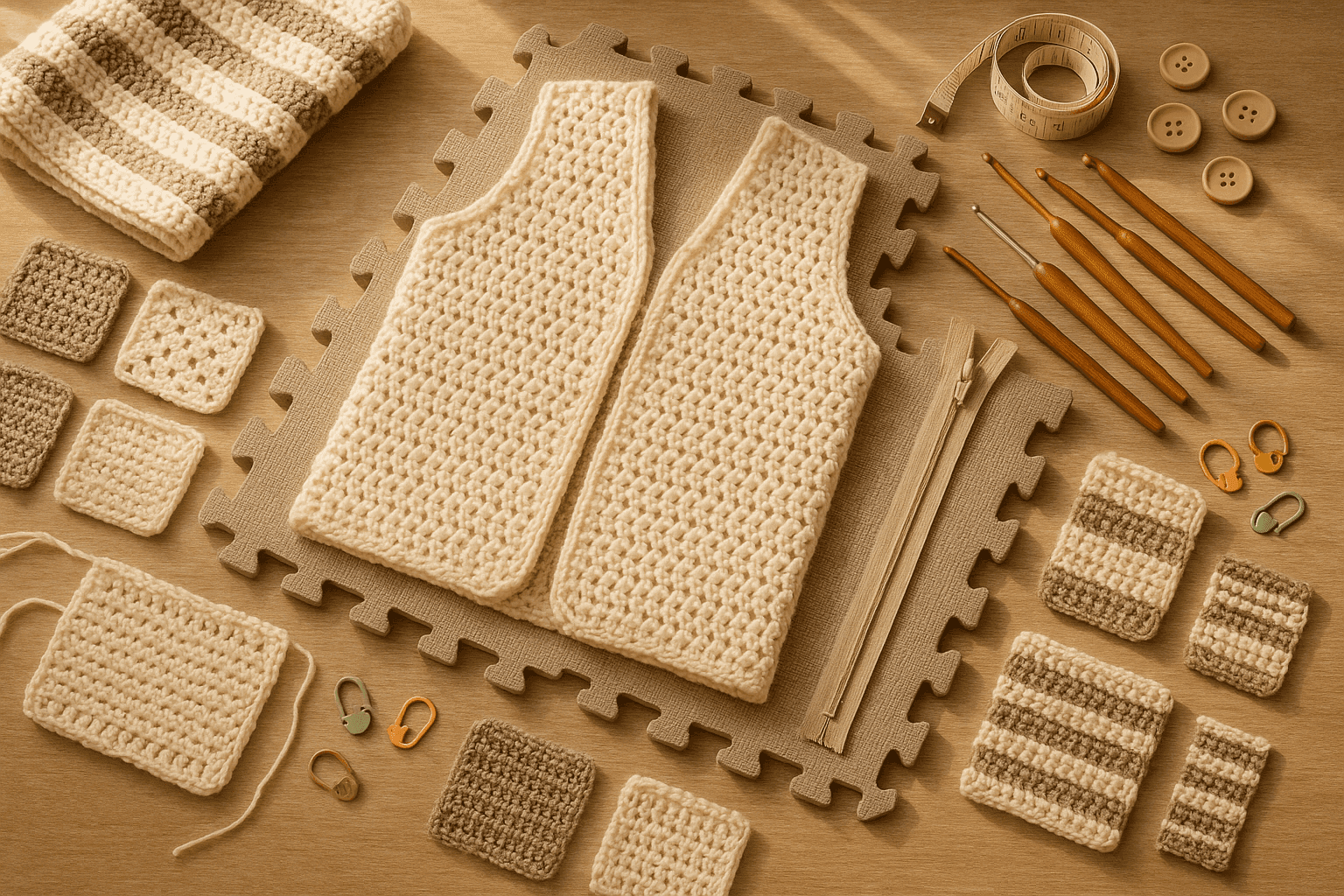
There is a particular kind of disappointment every crocheter eventually meets: the cardigan front that looked perfect on the table but ripples once a button band is added, the blanket border that flares at the corners no matter how carefully you stitch, the zipper that waves because the edge beneath it stretches and recovers unevenly, or the neckline pickup that looks tidy for one wear and then grows into a soft, collapsing curve. Most of us are taught to think of the edge as the place where we “finish things off.” In practice, the edge often determines whether the whole project behaves like a polished garment or a beautiful sample that never quite settles into useful wear.
That is why it helps to stop thinking about selvedges as a decorative afterthought and start treating them as fabric engineering. A crochet selvedge is not simply the outermost stitch. It is a structural zone: the last stitch of each row, the turning strategy, the edge column or chain, the density of the stitch architecture, and the way that zone receives tension during wear, seaming, laundering, blocking, and any later additions like bands, facings, zippers, or woven trim. When you design that zone intentionally, your openings stay crisp, your pickups stay even, and your finishing looks calm rather than fought for.
In sewing, interfacing and staystitching are accepted tools for controlling shape. In knitting, selvedges are planned specifically for seaming, picking up stitches, or supporting button bands. Crochet deserves the same level of structural thinking. Because crochet stitches are taller, more directional, and often less elastic in some directions than knitted fabric, raw edges can distort quickly if the stitch pattern and finishing method are not matched. A stable selvedge can prevent flare, resist draw-in, reduce curl, and create a clean anchor for additions. It can also lengthen the life of the project by spreading stress over a sturdier edge architecture.
This article takes a technique-deep approach to crocheted selvedges as design infrastructure. We will look at how edge stitch architecture influences behavior, how fibers affect raw edges, how to choose turning methods, what pickup ratios work, how to reinforce the last stitch, when to build modular edge bands, and how to block and finish so your edges stay useful through wear rather than just looking good for photographs.
Why selvedges matter more than we think
A selvedge does at least five jobs at once:
- It controls shape at the boundary of the fabric.
- It absorbs wear stress from pulling, buttoning, opening, handling, and laundering.
- It determines how cleanly you can add stitches later for button bands, neckbands, collars, borders, and facings.
- It affects visual neatness by reducing jagged row ends and inconsistent stitch heights.
- It influences drape and recovery at openings and edges.
If your body fabric is soft and fluid but your opening needs to support buttons, those two goals can conflict. The answer is not always to change the whole garment fabric. Often it is better to keep the body pleasant and flexible while engineering a denser, more stable edge zone.
Think of selvedges as having variables you can control:
- stitch type at the edge
- number of edge stitches reserved as a selvedge zone
- turning-chain method
- whether the turning chain counts as a stitch
- tension and hook size specifically at the edge
- reinforcement methods in the final and first stitch of rows
- whether the edge is worked plain, slipped, linked, or ribbed
- whether the edge is finished immediately or left for later pickup
Once you see these as design choices rather than habits, your finishing becomes much more predictable.
Understanding edge behavior: flare, draw-in, curl, and collapse
Before choosing a selvedge, it helps to understand the four most common edge problems.
Flare
Flare happens when the edge has more length than the fabric it is attached to or bordering. In crochet this often comes from:
- placing too many stitches along row ends during pickup or border rounds
- using tall turning chains that stand in for full stitches but also add extra space
- adding decorative edge stitches that are taller or looser than the body fabric
- using a highly elastic or springy border on a less elastic body
Typical example: a cardigan front worked in half double crochet rows gets a single crochet button band picked up at a 1:1 row-end ratio. Since row ends are not as wide as top loops, that often creates too many stitches and the band ripples.
Draw-in
Draw-in is the opposite problem. The edge is shorter than the fabric it needs to support. Common causes:
- too few pickup stitches along row ends
- slip stitch or very tight single crochet edging with no ratio adjustment
- small hook used for finishing without compensating stitch count
- over-tightened last stitch at each row end
Typical example: a blanket side with a border of one single crochet in every row-end on a dense stitch pattern. The border contracts and the side buckles inward.
Curl
Curl can be caused by stitch imbalance, especially where one side of the fabric has stronger directional pull. Crochet naturally builds asymmetry in some stitch patterns. Edge curl may increase when:
- a row-end chain forms a soft ladder beside a denser body stitch
- the edge column is too loose relative to the rest of the row
- the fabric has unbalanced front/back texture, as in some post-stitch patterns
- the fiber has memory that preserves the rolled shape
Collapse or wear-softening
Some edges look fine immediately after making but fail in use. This is common at necklines, button bands, and zipper openings. Causes include:
- fibers with poor recovery supporting stressed openings
- loose raw edges taking all the strain during dressing and undressing
- no reinforcement where hardware or buttons are attached
- pickups made from a jagged edge that concentrates force at isolated points
A good selvedge reduces all four problems by giving the edge a predictable geometry and enough density to distribute stress.
Fiber behavior at raw crochet edges
Not all yarns behave the same at an exposed crochet edge. Fiber choice changes what kind of selvedge will hold up best.
Wool and wool blends
Wool has resilience and memory, which can be very helpful for selvedges. A wool edge often bounces back after light stress and usually blocks well. It is forgiving for button bands and neckband pickups, especially in garments.
Best uses:
- cardigan fronts
- collars and necklines
- blanket borders needing gentle recovery
Watch for:
- over-blocking that stretches an edge longer than intended
- fuzzy wool obscuring exact pickup points
Recommendation: For most worsted-weight wool garments, use the same hook as the body or go down 0.25 to 0.5 mm for a structural selvedge zone or pickup band.
Cotton
Cotton gives beautiful stitch definition and a crisp edge initially, but it has less elasticity and can grow under weight. Raw cotton edges can become heavy or torque if the stitch pattern is dense.
Best uses:
- summer garments with facings or sewn support
- household items where crispness matters
- zipper applications when paired with stable selvedges
Watch for:
- stretching at long vertical openings
- sagging if heavy bands are added
Recommendation: In cotton, stability often improves with a denser edge stitch and sometimes a smaller hook by 0.5 mm. Reinforced last stitches are especially helpful.
Linen and plant-blend yarns
Linen and linen blends can produce elegant, tailored edges, but they soften with use and may bias during early wear. They benefit from deliberate blocking and sometimes from sewn reinforcement for garment openings.
Best uses:
- polished summer cardigans
- facings and neat bands
- decorative woven insertions with structure
Watch for:
- uneven early tension before fabric relaxes
- hard creases if blocked sharply and then stressed
Acrylic
Acrylic varies widely. Some acrylics are springy enough for stable edges; others are slippery and can loosen over time. Since acrylic does not always respond to blocking the way wool does, you need good edge architecture from the start.
Best uses:
- blankets and everyday garments
- sturdy children’s wear when worked densely enough
Watch for:
- loose row ends that cannot be fully corrected by blocking
- oversteamed edges losing texture or becoming too limp
Silk, bamboo, alpaca, and other drapey fibers
These fibers create gorgeous fluid fabric, but they can be poor candidates for unsupported openings. If you want drape in the body and stability at the edge, build a firmer selvedge or add a separate structural band.
Best uses:
- draped fronts with modular button bands
- elegant necklines with reinforced pickups
Watch for:
- collapsing cardigan fronts
- zipper rippling from differential stretch
- stretched buttonholes
Rule of thumb: The drapier the fiber, the more you should consider a purpose-built selvedge zone of 2–4 stitches at each vertical edge.
Edge stitch architecture: choosing the right selvedge zone
A raw crochet edge is easier to work with if it has a repeating, legible structure. Instead of letting the body stitch pattern run unmodified right to the edge, reserve a selvedge zone.
Option 1: Single crochet selvedge column
Use 1 to 2 stitches at each edge worked in single crochet regardless of the body pattern.
Why it works:
- compact and stable
- reduces jaggedness at row ends
- easy to seam into or pick up from
- resists stretching better than taller stitches
Good for:
- button bands
- zipper insertion
- facings
- blanket sides needing clean border setup
Typical setup:
- Body in dc, hdc, or pattern stitch
- First and last 1 sc of every row reserved as selvedge
- Turning chain does not count as a stitch
Option 2: Half double crochet selvedge column
A good middle ground when sc feels too firm relative to the body fabric.
Why it works:
- more height than sc, less instability than dc
- produces smoother row-end pickups than full dc edges
- balances flexibility and structure
Good for:
- sweaters in hdc-based fabrics
- lighter cardigans
- necklines that need softness without collapse
Option 3: Slip stitch or linked selvedge
A narrow edge worked in slip stitches or linked stitches can act like built-in stay tape.
Why it works:
- very low stretch
- neat visual line
- excellent support for zippers and woven finishes
Good for:
- zipper plackets
- heavily handled openings
- places where you want a folded facing or sewn application
Caution: Too many slip stitches or overly tight tension can cause severe draw-in. Swatch before using over long lengths.
Option 4: Chain-space selvedge for pickup clarity
Some makers intentionally create a small edge chain or chain-1 space to simplify later pickups.
Why it works:
- pickup points are visible
- useful for decorative additions
- can reduce guesswork in textured fabrics
Caution: This is often too stretchy for structural openings unless reinforced. Better for borders than for button bands unless paired with denser support.
Option 5: Two- or three-stitch modular edge band
Instead of relying on the raw body edge, work a deliberate vertical band as part of the piece.
Example:
- Last 3 stitches of every RS and WS row are worked in sc, slip stitch, or knit-look waistcoat stitch.
Why it works:
- creates a dedicated support rail
- separates visual body texture from functional edge
- excellent for front openings and zipper support
For garments that will receive buttons or a zipper, this is one of the most dependable strategies.
Turning strategy: where many edge problems begin
Turning chains are often the hidden source of unstable edges. If you have ever found one side of a panel longer, looser, or more holey than the other, your turning strategy is a prime suspect.
Whether the turning chain counts
For structural selvedges, a reliable approach is:
- Turning chain does not count as a stitch
- Work the first stitch of the row into the very first stitch
- Work the last stitch into the final actual stitch, not the turning chain
Benefits:
- straighter edge n- fewer accidental gaps
- more uniform stitch count
- easier pickup later
This is especially effective for sc and hdc fabrics.
Suggested turning chains by stitch type for cleaner edges
These are practical starting points, not rigid laws:
- sc rows: ch 1, does not count
- hdc rows: ch 1 or ch 2, does not count; many crocheters get cleaner edges with ch 1
- dc rows: ch 2, does not count, rather than ch 3 counting as a stitch
- treble rows: ch 3, does not count, and work a true final stitch at row end
Using a shorter non-counting turning chain often reduces flare and edge holes.
Stacked single crochet as a turning method
For dc-based fabrics, a stacked sc can replace a turning chain and create a more substantial edge post.
How:
- Turn.
- Work 1 sc in first stitch.
- Work a second sc stacked into the vertical bar of the previous sc.
- Continue row.
This can produce straighter edges than a chain and gives clearer structure for pickups. It is particularly useful when you want the edge to function almost like a built-in band.
Ending rows deliberately
The last stitch of the row matters as much as the turning chain. Many loose edges happen because the final stitch is rushed or inserted inconsistently. Always identify the final stitch before beginning the row if the pattern is textured or crowded. Mark it if necessary.
Reinforced last-stitch methods for durability
If a garment opening will be handled constantly, reinforce the edge as you build it rather than trying to rescue it later.
Method 1: Last-stitch tension lock
Work the last stitch of each row with the same hook, but consciously reduce excess slack in the final yarn-over and draw-through. The goal is not tightness, but consistency.
Use for:
- all projects
- especially garments with visible vertical fronts
Method 2: Edge hook reduction
Use a smaller hook only for the first and last selvedge stitches of each row.
Example:
- Body in 5.0 mm hook with worsted yarn
- Selvedge stitches worked with 4.5 mm hook
This is fiddly, but useful in slippery fibers or when swatching for tailored garments.
Method 3: Reinforcing chain or float
Carry the working yarn snugly up the edge for one or two rows, enclosing it periodically into edge stitches. This creates a subtly reinforced cord inside the selvedge.
Use for:
- zipper plackets
- button bands in plant fibers
- bag openings and blanket edges with high wear
Method 4: Double-edge stitch
Work the last stitch through the usual loops, then add a slip stitch or chainless anchoring maneuver into the side of that same edge zone before turning. This creates a denser edge node.
Use sparingly, because too much reinforcement can shorten the edge.
Method 5: Crochet over a support thread
For luxury fibers or heavily used openings, you can crochet the selvedge over a fine matching sewing thread or lightweight crochet cotton.
Use for:
- buttonhole zones
- neckline edges prone to stretching
- zipper support on soft yarns
This is essentially crochet’s answer to stay tape.
Pickup ratios: the math that keeps openings flat
One of the most useful skills in selvedge engineering is understanding pickup ratios. The side of crochet rows is not square in the same way the top of a stitch is. If you pick up one stitch in every row-end along a tall stitch fabric, you will often get too many stitches.
General pickup guidelines for row ends
Start with these ratios and swatch:
- Single crochet row ends: pick up about 3 stitches for every 4 rows
- Half double crochet row ends: pick up about 2 stitches for every 3 rows or 3 for every 4, depending on your row gauge
- Double crochet row ends: pick up about 2 stitches for every 3 rows
- Treble-heavy row ends: often 1 stitch for every 2 rows works better than 1:1
These are starting ratios, not commandments. Your actual row gauge matters more.
Practical example: button band on a dc cardigan front
Suppose your front edge is 90 rows of dc.
A 1:1 pickup would give 90 stitches, which is often too many.
Try a 2 for every 3 rows ratio:
- 90 rows ÷ 3 = 30 groups
- 30 groups × 2 stitches = 60 pickup stitches
So begin with 60 sc evenly spaced along the front.
If the band still ripples, reduce slightly to 58 stitches. If it draws in, increase to 62 stitches.
Practical example: neckband pickup around mixed edges
Suppose a neckline includes:
- cast-on or foundation edge across back: 36 stitches available directly
- left front slope: 24 row ends in hdc
- right front slope: 24 row ends in hdc
For the hdc slopes, use 2 pickups for every 3 row ends:
- 24 ÷ 3 = 8 groups
- 8 × 2 = 16 stitches on each side
Total neck pickup:
- 36 + 16 + 16 = 68 stitches
Then adjust by pattern repeat if needed. If your ribbing is worked in a multiple of 4, 68 already fits.
Practical example: blanket border on sc sides
If one side has 120 sc rows, do not automatically place 120 border stitches.
Try 3 stitches for every 4 rows:
- 120 ÷ 4 = 30 groups
- 30 × 3 = 90 stitches
Work 90 sc evenly along that side. This usually sits flatter than 120.
How to test pickup ratios quickly
Work the first setup row or round, then lay the piece flat without stretching.
- If the edge ruffles, remove about 5–10% of the stitches.
- If the edge cups inward, add about 5–10%.
- If only one area misbehaves, adjust regionally rather than globally.
That last point matters. A neckline curve may need a different pickup density than a straight shoulder edge.
Step-by-step: engineering a stable vertical selvedge for button bands and zippers
Here is a reliable framework for a garment front worked bottom-up or top-down in rows.
Materials and setup
- Yarn: DK, worsted, or aran weight garment yarn
- Hook for body: whatever achieves gauge, for example 4.0 mm to 5.5 mm
- Hook for selvedge/band if needed: 0.25–0.5 mm smaller
- Stitch markers
- Measuring tape
- Optional: matching sewing thread, zipper, grosgrain ribbon, buttons
Step 1: Reserve a selvedge zone
At each front edge, reserve 2 to 4 stitches.
Recommended starter formula:
- 1 slip stitch or sc nearest edge
- 1 hdc or sc just inside it
- remainder of row in body pattern
For a very soft body fabric, use 3 stitches in the selvedge zone:
- stitch 1: slip stitch
- stitch 2: sc
- stitch 3: hdc
This grades density from edge inward and reduces abrupt stiffening.
Step 2: Use a non-counting turn
At the start of every row:
- turn
- chain appropriate height but do not count it as a stitch
- work first actual stitch into the first stitch
For dc bodies, try ch 2, does not count.
Step 3: Mark your first and last true stitches
For the first several rows, place markers in the final stitch of each row before turning. This trains your eye and prevents accidental increases or decreases at the edge.
Step 4: Keep edge tension deliberate
Do not yank the last stitch tight, but do remove extra slack. Aim for the edge column to be firm enough to stand upright when lightly handled.
Step 5: Swatch the pickup before finishing the whole garment
Make a swatch at least 20 stitches wide and 24 rows high in your actual body pattern, including the selvedge zone.
Then test:
- pickup row for a button band
- one row with buttonholes if planned
- one zipper basted or clipped in place if using a zipper
This small step saves enormous frustration later.
Step 6: Pick up for the band using ratio, not guesswork
For a dc front edge, begin with 2 pickups per 3 rows.
Example:
- Front edge length: 72 rows
- Pickup count: 72 ÷ 3 × 2 = 48 stitches
Work 48 sc evenly along edge.
Step 7: Build the band to purpose
For button bands, a good basic structure is:
- setup row: 48 sc
- band rows: work 1×1 ribbing, slip stitch rib, waistcoat stitch, or plain sc depending on style
If working horizontal rows of ribbing attached to the front, the vertical selvedge still matters because it must support the join points.
For zipper plackets:
- work 2–4 rows of sc or linked sc after pickup
- keep stitch count unchanged
- steam or block lightly
- sew zipper to this stable placket, not directly into a loose raw edge
Step 8: Reinforce high-stress areas
At the top of the zipper, the base of the neckline, and around buttonholes, consider one of these:
- crochet over matching sewing thread
- whipstitch grosgrain ribbon or twill tape to wrong side of band
- add a narrow facing behind the band
This is especially helpful for cotton, bamboo, alpaca, and superwash wool.
Step-by-step: selvedges designed for neckband pickups
Necklines need both flexibility and recovery. Too stiff and they stand away from the body; too loose and they collapse.
Best selvedge choices for necklines
- sc edge column for most garments
- hdc edge column for softer styles
- avoid very loose chain-space edges if you plan to pick up ribbing
Working the neckline edge in the body
If shaping a front neckline, keep the last 1 or 2 stitches nearest the neckline in a stable stitch regardless of body pattern. This makes the curve much easier to pick up cleanly.
Pickup workflow
- Block body pieces before pickup if the pattern is complex.
- Measure neckline circumference after blocking.
- Count available top-edge stitches and row ends separately.
- Apply ratios to row-end sections.
- Mark quarters or shaping landmarks.
- Pick up with a smaller hook if you want a crisp neckband.
Example:
A sweater neckline measures 20 in / 51 cm after assembly.
Your ribbing gauge in sc blo worked flat is 5 stitches per inch.
Target neckband stitch count if worked directly around edge:
- 20 × 5 = 100 stitches
Now compare that to your actual pickup opportunities. If raw pickup count by geometry gives you 108, but your ribbing sits best at 100, reduce strategically over sloped sections.
The important idea: pickup count should satisfy both edge geometry and band gauge.
Modular edge bands: when to separate structure from body fabric
Sometimes the best selvedge is not a raw edge at all. A modular edge band can solve problems that are difficult to fix after the fact.
What is a modular edge band?
A separately worked band, placket, facing, or fold-over edge that is joined to the garment body by sewing or crocheting.
When modular bands are best
- very drapey body yarns
- openwork garments with unstable raw fronts
- long cardigan openings that need strong recovery
- zipper insertions where precision matters
- children’s garments or outerwear with hard wear
Common modular approaches
1. Vertical rib band worked separately
Work a ribbed strip to the exact finished length of the opening, then sew or slip stitch it on evenly.
Advantages:
- easy to control final length
- excellent recovery if worked in wool
- buttonholes can be integrated neatly
2. Flat woven-look band
Work a band in waistcoat stitch, linked sc, or dense sc.
Advantages:
- stable for buttons and zippers
- tailored appearance
- useful as hidden support under decorative outer band
3. Folded facing
Work or sew a narrow inner facing that folds to the inside.
Advantages:
- encloses raw edge
- doubles support at opening
- ideal for zipper applications and polished necklines
Stitch counts for modular bands
Suppose a cardigan front opening measures 18 in / 46 cm after blocking.
If your rib band gauge is 4 rows per inch when worked perpendicular to the front edge, you need:
- 18 × 4 = 72 rows in the band
The width of the band may be, for example, 8 stitches.
So your band piece might be:
- foundation: 8 stitches
- work in ribbing for 72 rows
- check exact measurement unstretched and lightly stretched
This often produces a more reliable button band than picking up directly from a fluid raw edge.
Supporting woven or sewn finishes
Crochet does not have to do every job alone. Some of the best long-wear finishing combines crochet with sewing notions.
Zipper insertion
For the cleanest result:
- Build or pick up a stable placket first.
- Block the placket so it lies perfectly straight.
- Baste zipper in place before permanent sewing.
- Sew through the placket or facing, not only the outermost loops.
- If the yarn is delicate, add a ribbon or lightweight facing behind the zipper tape.
A zipper sewn directly to a loose raw edge almost always highlights every inconsistency in tension.
Grosgrain or twill tape reinforcement
This is extremely effective behind button bands and shoulder-to-neckline transitions.
Use it when:
- the yarn has poor recovery
- buttonholes will take strain
- the opening is long and vertical
Attach it with small hand stitches after blocking and before buttons are sewn on.
Sewn facings
A simple woven facing can stabilize a crochet opening without visually changing the garment.
Best for:
- cotton or linen cardigans
- heirloom baby garments
- bags and household items
The crochet selvedge still matters because it provides the line to which the facing is attached.
Blocking and finishing protocols for crisp long-wear edges
An engineered selvedge still needs correct finishing.
Block before and after pickups when necessary
For garments, there are two moments that matter:
- pre-finishing block of the body pieces
- final block after bands, borders, or zipper plackets are attached
Pre-finishing block lets row ends relax to true gauge so your pickup ratios are based on reality, not fresh-off-the-hook distortion.
Match blocking style to fiber
- Wool: wet block or steam lightly, then shape and dry flat
- Cotton/linen: wet block firmly to dimensions, support the full length to avoid stretching
- Acrylic: very cautious steam or wash-and-dry method appropriate to yarn; do not overkill texture
- Drapey fibers: dry flat with openings fully supported
Use measurement checkpoints
Before adding a band, record:
- opening length
- width at top, middle, bottom
- whether the edge hangs straight under its own weight
After adding the band, remeasure. If the opening length changed significantly, identify whether the band or the body caused it.
Let edges rest
After blocking, allow the piece to rest completely dry for several hours before attaching buttons or zippers. This matters more than many of us think, especially with wool and plant fibers.
Troubleshooting common selvedge problems
Problem: One front edge is longer than the other
Causes:
- inconsistent turning chains
- accidental edge increases/decreases
- working last stitch into chain on one side and true stitch on the other
Fix:
- recount rows and stitches
- standardize turn method
- block and compare lengths before pickup
- if difference is minor, ease slightly with modular band rather than direct pickup
Problem: Button band ripples
Causes:
- too many pickup stitches
- band stitch pattern too elastic relative to edge
- raw edge too loose
Fix:
- reduce pickup count by 5–10%
- use smaller hook for setup row
- choose denser band stitch such as sc, linked sc, or firm ribbing
- consider adding a facing or ribbon support
Problem: Zipper waves after sewing
Causes:
- placket not stabilized before zipper insertion
- edge stretched during sewing
- mismatch between zipper tape length and crochet opening
Fix:
- remove zipper and block opening back to size
- add dedicated placket or facing
- baste zipper in place with garment laid flat and supported
Problem: Neckband stands up or flops out
Causes:
- too many pickup stitches around neckline
- too tall or stiff a band for the neckline curve
- edge sections not balanced in ratio
Fix:
- reduce pickup count, especially on slopes and curves
- switch to smaller hook or shorter band depth
- use hdc or sc band rather than dc for stability
Problem: Blanket border flares at sides but not top and bottom
Causes:
- using top-edge stitch count logic on row-end sides
- side row ends picked up 1:1
Fix:
- remove side stitches and rework using ratios such as 3 per 4 rows or 2 per 3 rows depending on stitch height
Problem: Selvedge curls inward before finishing
Causes:
- edge zone too tight relative to body
- slip stitch selvedge overused
- hook reduction too aggressive
Fix:
- widen selvedge zone gradually from edge inward
- switch from slip stitch to sc or hdc edge column
- reduce hook-size difference to 0.25 mm or use same hook with gentler tension
Variations to suit different project types
Tailored cardigan front
- body: dc or textured pattern
- selvedge: 3-stitch zone of slip stitch, sc, hdc
- pickup ratio: 2 per 3 rows
- reinforcement: grosgrain behind button band
Soft baby sweater neckline
- body: hdc or sc
- selvedge: 1–2 sc edge stitches
- pickup ratio: often close to 3 per 4 rows on side slopes
- finish: gentle wet block, avoid over-stiffening
Heirloom blanket border
- body: mixed stitch pattern
- selvedge: built-in 1 sc edge stitch every row from the start
- border setup: calculate each side separately by row-end ratio
- finish: block square before final border rounds
Zippered hoodie or jacket
- body: dense stitch fabric
- selvedge: 2–4 stitch placket zone in linked sc or sc
- added support: sewn ribbon or facing behind zipper tape
- hook: placket worked 0.5 mm smaller if needed
Openwork summer cardigan
- body: lace pattern
- raw edge: often too unstable alone
- solution: modular woven-look or rib band sewn on after blocking
- fiber note: especially important in cotton, bamboo, or linen blends
Practical takeaways for designing stable selvedges
If you remember only a handful of principles, let them be these:
1. Build the edge for its future job
If the edge will hold buttons, a zipper, pickups, or heavy border rounds, plan it while you crochet the main fabric. Decorative openness at the edge is rarely a structural advantage.
2. Reserve a selvedge zone
A dedicated 1–4 stitch edge zone often solves more problems than any heroic finishing technique later.
3. Use turning chains strategically
For cleaner, more stable edges, shorter turning chains that do not count as stitches are often the simplest improvement.
4. Pickup ratios matter more than intuition
Row ends usually need fewer stitches picked up than top loops. Start with:
- sc sides: 3 per 4 rows
- hdc sides: 2 per 3 or 3 per 4
- dc sides: 2 per 3
Then adjust by behavior.
5. Match selvedge density to fiber
Drapey fibers need stronger edge planning. Elastic fibers forgive more, but still benefit from structure.
6. Reinforce stress points early
Last-stitch control, denser edge stitches, support thread, ribbon, facings, and modular bands are all valid tools. They are not cheating; they are engineering.
7. Block with intention
A clean edge is not only stitched well but finished to true dimension and supported appropriately through drying and wear.
The most satisfying crochet finishing often becomes almost invisible. A good selvedge does not call attention to itself. Instead, it lets the button band sit flat, the zipper close smoothly, the neckline frame the face, the blanket border lie square, and the whole piece feel trustworthy in the hand. That trust is the real gift of selvedge engineering. It turns crochet from something merely made into something built.
And once you start designing edges this way, you may find that many finishing problems stop being problems at all. They become decisions made earlier, with confidence, one deliberate edge stitch at a time.