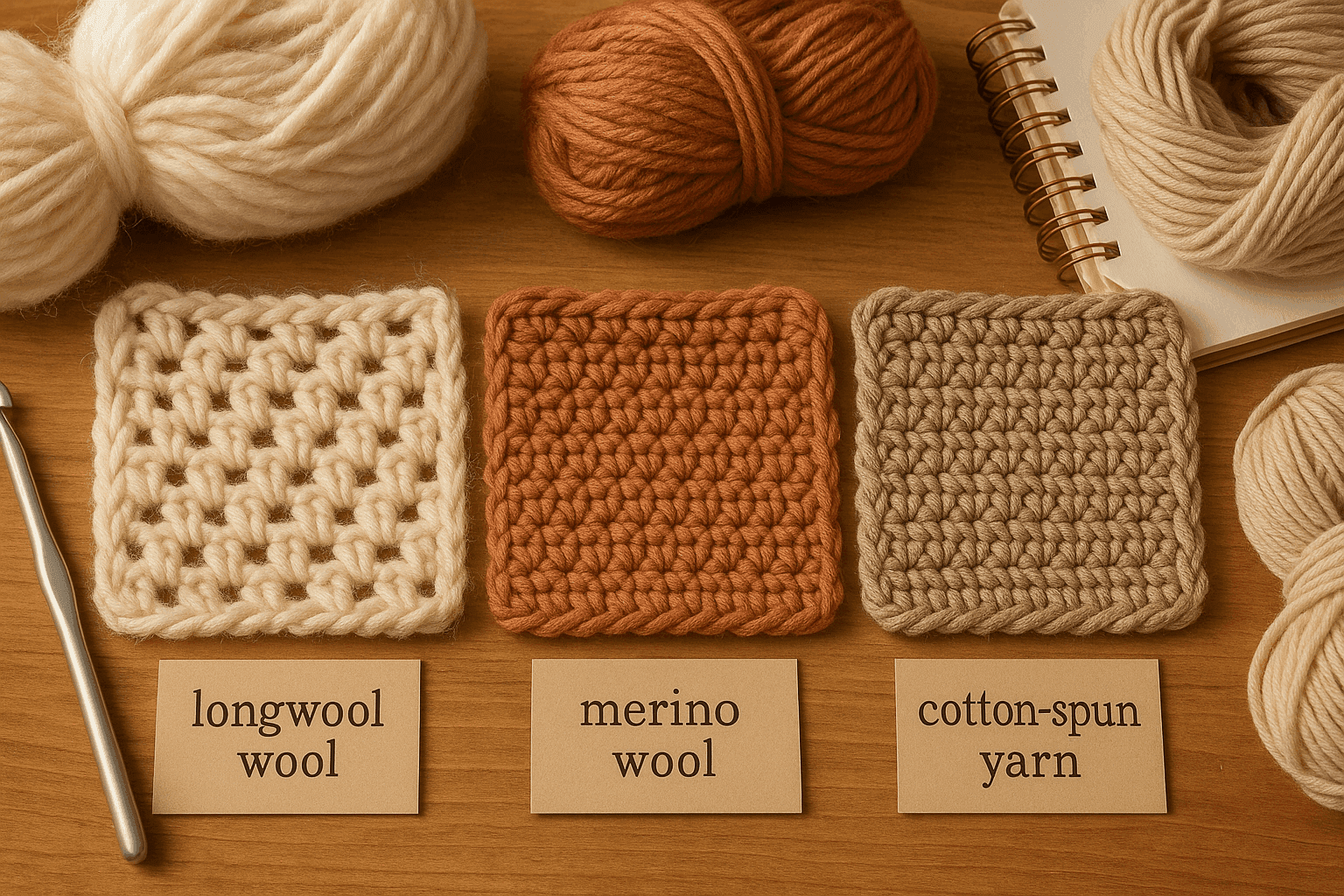
There is a particular kind of crochet disappointment that sneaks up on even experienced makers: you substitute a yarn that seems perfectly sensible on paper—same weight, same fiber family, similar yardage—and the finished fabric behaves nothing like the original. The stitch pattern that looked crisp in the sample turns soft and hazy. A cardigan elbow pills after a week of wear. A market bag stretches into a completely different shape after blocking. A shawl that seemed springy in the skein suddenly hangs with liquid drape after washing. At first it can feel mysterious, as if yarn has moods rather than mechanics.
But once you start looking past the ball-band label and into yarn structure, those surprises become easier to predict. Two yarns can both be called “DK wool” and still crochet into dramatically different fabrics because the fibers inside them are different lengths, different breeds, differently prepared, and spun with different methods. Longwool behaves differently from fine Merino. Woolen-spun and worsted-spun yarns do not merely feel different in the hand; they create different levels of stitch definition, abrasion resistance, elasticity, halo, pilling, and drape. Cotton-spun yarns add yet another set of behaviors because plant fibers have a very different kind of structure and response than wool.
For crochet, this matters a lot. Crochet fabric already tends to be denser and more structural than knitting because each stitch locks more firmly into itself. That means yarn architecture often shows itself vividly. A yarn that blooms and fills gaps can make a firm crochet fabric plush and forgiving. A smooth, compact yarn can carve every post and loop into sharp relief. A lofty wool may seem light for its thickness, while a mercerized cotton of the same nominal weight may pull the fabric downward with gravity. Understanding why helps you choose yarns intentionally instead of hoping a substitute works out.
In this guide, I want to look closely at three major factors: staple length, drafting style, and yarn preparation. We will compare longwool, Merino, and cotton-spun constructions in practical crochet terms, then turn that knowledge into a swatching and substitution method you can actually use. If you have ever wondered why one yarn gives cable-like stitch definition while another fuzzes over textured work, or why one sweater pills under the arms while another resists abrasion, this is the structural explanation.
Context: what these yarn terms actually mean
Before we talk about how yarn behaves in crochet, it helps to sort out a few overlapping terms that are often used loosely.
Staple length refers to the average length of individual fibers before they are spun into yarn. In wool, this can vary by breed and preparation. Longwool breeds generally have longer fibers, often lustrous and strong. Fine Merino tends to have shorter, finer, softer fibers. In cotton, staple length also matters: longer-staple cottons usually produce smoother, stronger yarns than shorter-staple cottons.
Drafting style describes how fibers are drawn out during spinning and what orientation they end up in. In broad practical terms for handmakers:
- Woolen-spun yarns are made so fibers are more jumbled, airy, and less parallel.
- Worsted-spun yarns are made so fibers are more aligned and compact.
- Cotton-spun usually refers to a spinning system designed for cotton or cotton-like fibers, often producing a firm, smooth, even yarn with relatively little elasticity.
Preparation refers to how fibers are processed before spinning. In wool, carded preparations preserve more air and randomness; combed preparations align fibers and remove more short ends. These preparation choices strongly influence whether a yarn becomes lofty and blooming or sleek and precise.
For crochet, these distinctions are not abstract textile trivia. They determine:
- how clearly stitch anatomy shows
- how much the yarn snags on itself or neighboring surfaces
- how quickly friction creates fuzz or pills
- how much the fabric springs back after stretching
- whether blocked fabric stays airy, structured, or fluid
- how the fabric changes after washing
A useful way to think about yarn is this: label weight tells you thickness; structure tells you behavior.
Technique explanation: why structure changes crochet fabric
Crochet forms fabric by pulling loops through loops, often with relatively high twist concentration at each stitch. Because of that, yarns are asked to do several things at once:
- slide smoothly over the hook
- hold enough integrity not to split excessively
- tolerate repeated friction during stitching
- reveal or soften the geometry of the stitches
- support the fabric’s final purpose, whether that is drape, durability, softness, or shape retention
Let’s break down the structural reasons different yarns answer those demands differently.
Long staple vs short staple
Longer fibers overlap each other over greater distances inside the yarn. That generally creates:
- better cohesion with fewer fiber ends poking out
- smoother yarn surface
- often greater resistance to abrasion
- lower tendency to pill, all else being equal
- clearer stitch edges
Shorter fibers create more exposed ends along the yarn surface. That often means:
- a softer hand, especially in fine fibers like Merino
- more halo or fuzz
- greater tendency for surface abrasion to lift fibers
- increased pilling if those loose fibers tangle into pills
- softer-looking stitch definition rather than carved definition
This is why a longwool yarn often looks glossy, strong, and “drawn with ink” in crochet, while a soft Merino can look plush and rounded even when the stitch pattern is identical.
Woolen-spun vs worsted-spun
This distinction deserves special attention because crocheters often feel the difference immediately but struggle to name it.
Woolen-spun
Woolen-spun yarns trap more air because fibers are less parallel and more randomly arranged. This usually creates yarn that is:
- lofty
- light for its diameter
- warm
- slightly fuzzy or haloed
- springy in a cushioned way
- softer in stitch definition
- prone to blooming and filling gaps after washing
In crochet, woolen-spun yarn can make fabric feel less heavy than expected, especially in garments. Since crochet can become dense quickly, that loft is often an advantage. The tradeoff is that highly textured stitches may blur a little, and abrasion can raise a fuzzy surface sooner than with a tightly worsted-spun yarn.
Worsted-spun
Worsted-spun yarns align fibers more parallel to the yarn axis and usually spin them into a smoother, denser structure. This often creates yarn that is:
- compact
- smooth
- highly defined
- durable against surface wear
- less haloed
- often more lustrous
- more likely to show every stitch exactly as made
In crochet, worsted-spun yarn makes cables, ribs, post stitches, lace outlines, and clean motifs stand out beautifully. It often resists pilling better than a comparable woolen-spun Merino because there are fewer short ends drifting to the surface. But it can also produce a heavier, more decisive fabric with less airy bloom.
Longwool vs Merino
Breed matters because fiber diameter, crimp, luster, and staple length vary.
Longwool
Longwool-type fibers are often:
- longer in staple
- stronger
- more lustrous
- smoother on the surface
- lower in fine crimp than Merino
- more resistant to pilling and abrasion
Crocheted fabric in longwool blends often shows:
- crisp stitch definition
- strong structural memory in textured stitches
- lower halo
- clearer openwork
- pleasant drape with less bounce than Merino, depending on twist
- excellent performance in outerwear, bags, and hard-wearing accessories
The caution is that some longwool yarns can feel less cloud-soft than Merino, particularly next to skin, though blends and modern finishing can soften that considerably.
Merino
Merino is prized for softness, elasticity, and fine crimp. It is often:
- finer in micron count
- softer against skin
- more elastic and springy
- shorter in staple than many longwools
- more prone to fuzzing and pilling, especially in soft-spun constructions
In crochet, Merino often gives:
- cushioned stitches
- excellent comfort and recovery
- warmth without harshness
- beautiful bloom after washing
- softer, rounder stitch outlines
- more vulnerability to abrasion at cuffs, underarms, and bag straps if the yarn is loosely spun or woolen-spun
For garments, Merino can be wonderful, especially where softness is the priority. For pieces that receive friction, yarn structure becomes crucial.
Cotton-spun yarns
Cotton behaves differently because it is a plant fiber, not a crimped animal fiber. Even when cotton yarn is beautifully spun, it generally has:
- less elasticity than wool
- less spring and recovery
- a cooler hand
- more direct stitch definition
- more weight for the same visual thickness
- less bloom after washing
Cotton-spun yarns are often smooth, firm, and even. In crochet, that usually means:
- very crisp stitch visibility
- excellent performance in lace and graphic textures
- reduced memory or rebound
- greater hand and fabric weight
- stronger drape after wear and wash because gravity acts on a less elastic structure
- little to no halo
Cotton can also abrade differently. It usually does not pill in the same way wool does, but it can become fuzzy, flattened, or abraded at the surface. Splitty cotton constructions may challenge stitch speed and precision. Mercerized cotton improves luster, smoothness, and stitch clarity but can also emphasize firmness.
Twist, ply, and finish matter too
Even within these categories, yarns vary according to twist level and ply structure.
- Higher twist often improves durability, stitch clarity, and snag resistance.
- Lower twist often increases softness and bloom but may reduce abrasion resistance.
- Multiple plies can improve roundness and definition in crochet.
- Singles or low-plied yarns may flatten, bias, or fuzz more quickly.
This is why a soft Merino 4-ply and a soft Merino singles can behave very differently even though both are Merino and both may be the same weight.
Step-by-step: how to evaluate a yarn for crochet by structure
Here is the practical process I recommend when choosing a yarn, substituting for a pattern, or trying to predict fabric behavior beyond the label.
Step 1: identify the project’s priorities
Decide what matters most in the finished object.
Ask yourself:
- Do I need crisp stitch definition or soft visual blending?
- Will this piece endure abrasion at underarms, seat, straps, or cuffs?
- Do I want bounce and elasticity or fluid drape?
- Will this be blocked aggressively?
- Does the fabric need to hold shape, relax, or collapse elegantly?
For example:
- A textured yoke sweater may benefit from worsted-spun wool or a long-staple wool blend.
- A soft cowl may shine in a woolen-spun Merino.
- A summer top may need cotton or a wool-cotton blend, but you must account for weight and post-wash drop.
Step 2: inspect the yarn in the skein
Before swatching, look closely.
Check for:
- halo or visible fiber haze
- smoothness vs fuzziness
- tightness of twist
- roundness vs flatness
- firmness vs loft
- luster vs matte finish
General clues:
- A smooth, lustrous, firm yarn often points toward longer fibers, more alignment, or cotton-spun/worsted-style structure.
- A matte, airy, fuzzy yarn often points toward woolen-spun preparation or shorter/finer fibers.
Step 3: test the strand with your hands
Do three quick tests.
The bend test
Wrap a strand around your finger.
- If it feels springy and rebounds, it likely has good elasticity.
- If it bends and stays relaxed, expect more drape and less recovery.
The rub test
Rub a 2 in / 5 cm section against itself 10 to 15 times.
- If fuzz rises quickly, expect softer stitch outlines and higher abrasion sensitivity.
- If the strand stays sleek, expect clearer definition and better surface wear.
The untwist glance
If possible, gently open the plies.
- Compact, parallel fibers often indicate a smoother, more defined yarn.
- Airy, less organized fiber mass suggests loft and bloom.
Step 4: swatch with more than one hook size
This is where crocheters gain real predictive power.
For a garment or accessory, make three swatches using the same yarn and stitch pattern with hooks spaced 0.5 mm apart.
For example, with a DK yarn you might try:
- 4.0 mm hook
- 4.5 mm hook
- 5.0 mm hook
For each swatch, work at least:
- foundation chain or foundation row wide enough for 20 stitches, plus turning allowance
- 6 in / 15 cm height minimum
- a measured center area of 4 in / 10 cm for stitch counting
A simple half double crochet swatch example:
- Ch 24.
- Row 1: hdc in 3rd ch from hook and across. 22 hdc.
- Rows 2–16: ch 2, turn, hdc across. 22 hdc per row.
If testing a textured pattern, use the actual repeat from the pattern. For instance, if the repeat is 12 + 3, swatch at least 27 stitches so the center area includes two full repeats.
Record for each swatch:
- stitches and rows per 4 in / 10 cm
- visual stitch definition
- hand feel before wash
- stretch widthwise and lengthwise
- yarn split tendency
- approximate fabric weight in the hand
Step 5: wash and dry exactly as the finished item will be treated
This is non-negotiable. Much of yarn behavior reveals itself only after finishing.
After washing, note:
- Did wool bloom and soften the stitch outlines?
- Did cotton lengthen or drop?
- Did the swatch widen, grow, or contract?
- Did drape increase dramatically?
- Did the fabric become denser or more fluid?
- Did the halo increase?
Measure gauge again after drying.
Example record sheet:
- Before wash: 18 hdc x 13 rows = 4 in
- After wash: 17 hdc x 12 rows = 4 in
- Change: fabric relaxed, gained drape, lost some row density
For cotton, changes can be especially significant. A top that fits perfectly in an unwashed swatch may lengthen by a noticeable amount after laundering.
Step 6: perform a mini abrasion test
This is especially useful for garments and bags.
Take the dried swatch and rub one corner against:
- itself
- denim
- the rough side of your palm
Rub for 20 to 30 strokes, then compare with an untouched section.
Look for:
- fuzzing
- pills
- flattening
- shine loss
- stitch distortion
Expected tendencies:
- soft Merino, especially low twist: likely to fuzz sooner
- longwool or smooth worsted-spun wool: likely to resist fuzz longer
- cotton-spun yarn: likely to show flattening or slight surface wear more than pilling
Step 7: compare by structure, not only by weight
When substituting, ask these questions in order:
- Is the fiber behavior similar?
- Is the yarn preparation similar?
- Is the spin style similar?
- Is the ply and twist level similar?
- Then, is the weight similar?
That order may sound backwards, but it prevents many disappointing substitutions.
A worsted-spun longwool DK may substitute more successfully for another smooth, durable DK wool than for a woolen-spun Merino DK, even if all labels say “100% wool.”
Practical behavior comparisons in crochet
Let’s compare how these yarn structures tend to perform in actual crochet categories.
Stitch definition
Best clarity:
- worsted-spun wool
- long-staple wool blends
- mercerized cotton
- firm cotton-spun yarns
Softer clarity:
- woolen-spun yarns
- low-twist Merino
- fuzzy or brushed yarns
If your project features front-post and back-post ribs, overlay crochet, cables, mosaic outlines, filet grids, or sharp lace eyelets, smoother and more aligned yarn structures almost always read more clearly.
Abrasion resistance
Usually stronger:
- longwool-based yarns
- tightly spun worsted yarns
- firm plied cottons for non-elastic uses
Usually more vulnerable:
- soft short-staple Merino
- low-twist singles
- halo-heavy woolen-spun yarns in high-friction zones
For backpack straps, bag bottoms, cardigan cuffs, and sofa-blanket edges, this becomes especially noticeable.
Pilling
Pilling happens when loose surface fibers tangle into small balls and remain anchored to the fabric.
Higher risk:
- shorter fine fibers
- softer spins
- low twist
- highly elastic, fuzzy yarn surfaces
Lower risk:
- longer fibers
- smoother yarn surfaces
- stronger twist
- firmer yarn architecture
This is why Merino can feel luxurious but still pill faster than a coarser, longer-staple wool in daily wear.
Elasticity and recovery
More spring:
- Merino
- crimped wools in general
- many woolen-spun yarns with airy resilience
Less spring:
- longwools with smoother fiber character
- cotton-spun yarns
- linen-forward plant blends
Crochet ribbing, hats, sleeve cuffs, and fitted yokes often benefit from some spring. Summer garments, wraps, and household textiles may benefit more from drape than rebound.
Drape before and after washing
Likely to bloom and soften:
- woolen-spun wool
- Merino blends
Likely to stay defined but relax somewhat:
- worsted-spun longwool or combed wool
Likely to drop and become more fluid with weight:
- cotton-spun yarns
- plant-fiber-heavy blends
The phrase “post-wash drape” matters because many crocheters judge a swatch too early. Wool may transform from firm to supple after finishing. Cotton may shift from slightly structured to notably longer and heavier in hang.
Troubleshooting common yarn-structure surprises
Problem: my textured stitches disappeared after washing
Likely causes:
- woolen-spun or haloed yarn bloomed
- hook size too large for the yarn’s loft
- soft Merino rounded the stitch edges
Fixes:
- go down 0.5 mm in hook size
- choose a smoother, more compact yarn
- reserve fuzzy or blooming yarns for simpler textures
Problem: my sweater pills at the underarms almost immediately
Likely causes:
- short-staple fine wool
- low twist yarn
- high-friction area combined with soft spin
Fixes:
- substitute a firmer plied Merino or longwool blend
- tighten gauge slightly for less yarn movement
- use softer yarns in low-friction garments like shawls rather than fitted pullovers
Problem: my cotton top grew after washing
Likely causes:
- cotton’s low elasticity and heavier fiber weight
- fabric worked too openly
- swatch not washed before measuring final dimensions
Fixes:
- wash and hang-dry swatches before garment math
- shorten body and sleeves preemptively based on swatch growth
- consider a cotton-wool or cotton-acrylic blend for more recovery
- use a smaller hook if fabric is too loose
Problem: the yarn keeps splitting while I crochet
Likely causes:
- cotton-spun yarn with soft multi-ply construction
- low twist wool
- hook tip too sharp for the yarn
Fixes:
- switch to a hook with a less pointy head
- slow down on yarn-over entry points
- test a firmer spun substitute if the pattern requires speed or precision
Problem: my crochet fabric feels stiff even though the yarn is soft
Likely causes:
- crochet gauge too tight
- compact worsted-spun yarn with too small a hook
- cotton or firm wool in a dense stitch pattern
Fixes:
- go up 0.5 mm to 1.0 mm in hook size
- choose a loftier woolen-spun option
- replace some dense stitches with chain spaces or taller stitches
Problem: my lace edges look messy instead of crisp
Likely causes:
- halo obscuring eyelets
- low-twist yarn flattening at stitch intersections
- overly elastic yarn stretching out motifs
Fixes:
- use mercerized cotton or smooth worsted-spun wool
- block aggressively if fiber permits
- choose a rounder plied yarn for defined loops
Variations: matching yarn structure to project type
Here is how I would think about common crochet categories.
Garments with texture
Best candidates:
- worsted-spun wool
- longwool blends
- Merino with firmer twist
Why:
- stitch patterns stay readable
- abrasion resistance improves in wear zones
- garment maintains shape better
Swatch tip:
- work at least 24 stitches x 18 rows in pattern
- hang the washed swatch with two clothespins for 24 hours to observe drop
Soft next-to-skin accessories
Best candidates:
- Merino
- woolen-spun blends
- soft wool-cashmere blends if durability demands are low
Why:
- softness and bloom matter more than hard-wearing edges
- drape and comfort usually outrank ultra-sharp stitch definition
Swatch tip:
- rub the swatch against your neck or inner wrist after washing, not just before
Bags and baskets
Best candidates:
- cotton-spun yarns
- longwool blends with firm twist
- sturdy plied fibers with high abrasion tolerance
Why:
- structure and wear resistance are key
- halo and pilling are usually drawbacks here
Swatch tip:
- make a small circular base swatch: start with 6 sc in a ring, then increase to 12, 18, 24 over 4 rounds
- check whether the fabric stands or collapses at your chosen hook size
Shawls and wraps
Best candidates:
- woolen-spun wool for airy warmth
- Merino for softness and bloom
- cotton or linen blends for cool-weather drape, if weight is acceptable
Why:
- low abrasion use allows softer yarns to shine
- drape can be a feature rather than a liability
Swatch tip:
- use the pattern repeat and block aggressively to final dimensions before evaluating openness
Summer tops
Best candidates:
- cotton-spun yarns
- cotton blends with wool, silk, or viscose for softness and drape control
Why:
- plant fibers suit warm-weather wear
- crisp stitches can look beautiful in lace and mesh
Caution:
- monitor growth carefully; crochet cotton can become heavy quickly
Swatch tip:
- make a larger swatch, at least 6 in x 6 in / 15 cm x 15 cm, because small cotton swatches can under-predict drape
How to substitute yarns by structure: a practical cheat sheet
When a pattern calls for one yarn and you want another, use this decision path.
If the pattern sample shows crisp cables, ribs, or geometric lace
Look for:
- smooth surface
- moderate to firm twist
- plied yarn
- low halo
- likely worsted-spun or combed preparation
Avoid if possible:
- fuzzy singles
- very woolen-spun haloed yarns
- brushed constructions
If the pattern sample looks airy, soft, and gently blurred
Look for:
- woolen-spun structure
- soft Merino or Rambouillet-like bounce
- lower visual density
- bloom after wash
Avoid if possible:
- mercerized cotton
- very compact longwool yarns unless you want a crisper reinterpretation
If the project must withstand wear
Look for:
- longer-staple fibers
- firmer twist
- multiple plies
- smooth surface
- abrasion-resistant blends
Avoid if possible:
- delicate singles
- low-twist extra-soft Merino in high-friction pieces
If the project relies on fluid drape
Look for:
- cotton-spun yarns
- silk or viscose blends
- softer twist if strength remains adequate
- larger hook-to-yarn ratio
Avoid if possible:
- very springy compact wool if you want liquid hang
A sample swatching workflow with stitch counts
If you want a reliable side-by-side comparison between a Merino DK, a longwool DK, and a cotton DK, here is an effective mini study.
For each yarn:
- Use hooks 4.0 mm, 4.5 mm, and 5.0 mm.
- Make one swatch in sc and one in dc.
Single crochet swatch
- Ch 26.
- Row 1: sc in 2nd ch from hook and across. 25 sc.
- Rows 2–18: ch 1, turn, sc across. 25 sc each row.
Double crochet swatch
- Ch 24.
- Row 1: dc in 4th ch from hook and across. 22 dc.
- Rows 2–14: ch 3, turn, dc across. 22 dc each row.
Now compare:
- Which yarn shows the cleanest V and post shape?
- Which fills the gaps after wash?
- Which grows most in length?
- Which pills after rubbing?
- Which feels heaviest at the same dimensions?
You will almost always see a pattern:
- Longwool DK: cleaner stitch architecture, less fuzz, strong performance under rubbing
- Merino DK: softer hand, more bloom, more cushion, greater fuzz potential
- Cotton DK: sharp definition, less bounce, more downward drape and growth weight
This sort of comparative swatching teaches more than any label ever could.
Key takeaways
The biggest shift a crocheter can make is moving from thinking only in yarn weight to thinking in yarn structure. “Worsted,” “DK,” and “fingering” tell you size categories; they do not tell you whether the yarn will bloom, pill, resist abrasion, snap back, or drape like water.
Here are the practical lessons to keep close:
- Longer staple fibers usually mean smoother surfaces, better stitch definition, and lower pilling.
- Shorter, finer fibers often mean softness, elasticity, halo, and a greater tendency to fuzz.
- Woolen-spun yarns give loft, warmth, bloom, and softer stitch outlines.
- Worsted-spun yarns give compactness, clarity, and often better wear resistance.
- Cotton-spun yarns give crisp stitches and drape through weight, but less recovery and more post-wash drop.
- Twist and ply can strengthen or soften all of the above effects.
- The wash test matters because post-finish behavior is often more important than in-skein feel.
- Substitute by structure first, weight second if you want the original design intent to survive the yarn swap.
If you are standing in front of a shelf choosing between a sleek longwool, a marshmallow-soft Merino, and a smooth cotton-spun skein, none of them is universally “better.” They are tools built for different fabric outcomes. The longwool is your ally when you want stitch architecture and resilience. The Merino is your comfort expert, especially when softness and bloom are welcome. The cotton-spun yarn excels when crispness, coolness, and gravity-led drape are the point.
And that, really, is the good news: yarn behavior is not random. Once you learn to read staple length, drafting style, and preparation, your swatches become more informative, your substitutions become smarter, and your finished crochet starts looking much more like what you intended all along.