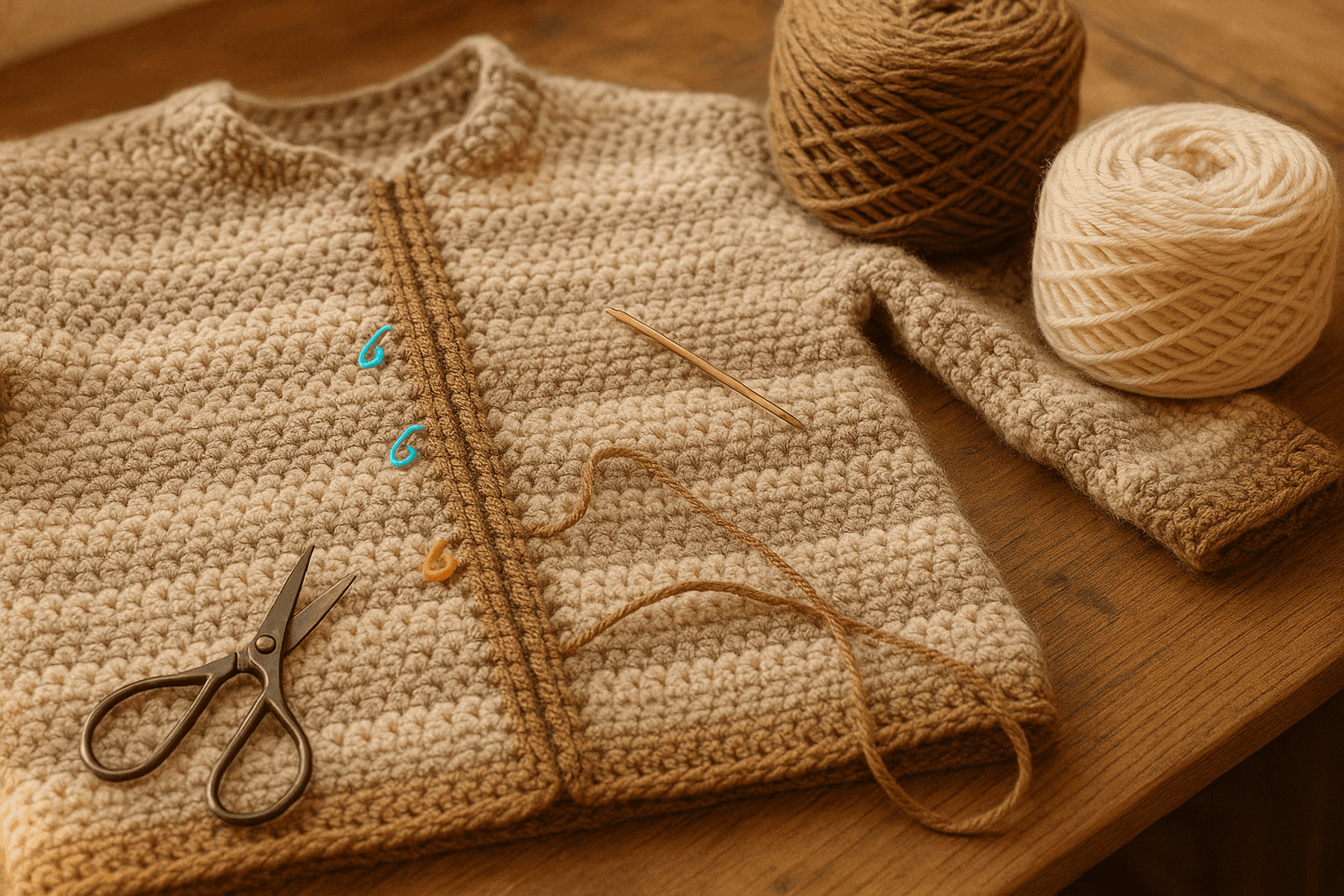
There is a very particular kind of bravery that shows up in crochet when you hold a finished tube of fabric in your hands, pick up a pair of scissors, and prepare to cut straight through work you may have spent days or weeks making. Even experienced crocheters pause at that moment. We are taught early on that crochet is secure because each stitch is completed before the next begins, so the idea of cutting it can feel slightly rebellious. But planned cutting in crochet—what many of us call steeking by borrowing the knitting term—is not reckless at all. When it is designed thoughtfully, reinforced properly, and finished with care, it becomes one of the most useful garment techniques you can add to your skill set.
If you have ever wished you could work a cardigan body in the round and open it later, create neat armholes in a seamless tube, add a zip opening to a pullover shape, or cut into colorwork fabric without rebuilding an entire garment from the ground up, crochet steeking gives you that flexibility. The key is understanding one important truth: crochet can be cut safely, but not all crochet fabrics behave the same way. Structure matters. Fiber matters. Reinforcement matters. And perhaps most of all, planning matters.
This guide is for crocheters who want the confidence to approach steeking methodically. We will look at when crochet fabric can be cut successfully, what kinds of stitch architecture hold up best, which yarn fibers support clean edges, how to build and reinforce steek columns, how to test your chosen stabilization method, exactly how to cut, and how to finish the resulting edges into polished cardigan fronts, armholes, and other intentional openings.
Understanding crochet steeking in practical terms
In knitting, steeking depends heavily on the way neighboring stitches support one another, especially when sticky wool helps cut strands grab each other. Crochet works differently. Each stitch is individually completed and anchored, which is good news in one sense: crochet does not unravel downward in the same laddering way knitting does. But crochet has its own vulnerability after cutting. Instead of running, cut crochet can shed short strand ends, lose edge stability, distort sideways, and gape if the cut passes through open or loosely structured stitch architecture.
So crochet steeking is less about preventing catastrophic unraveling and more about:
- preventing edge distortion
- preventing cut strand ends from pulling free
- preserving stitch shape near the opening
- creating a clean, stable edge that can support a facing, button band, zipper, or armhole trim
This is why reinforcement in crochet is often broader and more structural than simply sewing a line and snipping. You are not just securing loops; you are building a new edge behavior into an existing fabric.
When crochet fabric can be cut safely
The short answer is that dense, balanced, moderately stable crochet fabrics are the best candidates for steeking. The longer answer is that you want a fabric with enough internal cohesion that neighboring stitches support each other, plus enough density that the cut path does not slice through oversized gaps.
The best crochet stitch architectures for steeking are usually:
- Single crochet (sc) fabric, especially worked evenly and firmly
- Half double crochet (hdc) fabric, if gauge is not too loose
- Linked stitches, such as linked dc or linked tr, because they reduce openness
- Tunisian simple stitch and related Tunisian fabrics, which can be excellent candidates when reinforced properly
- Mosaic or colorwork fabrics worked densely
- Waistcoat stitch / center single crochet, if your tension is consistent
More challenging candidates include:
- standard double crochet (dc) at an airy gauge
- lacy mesh fabrics
- shell, fan, V-stitch, or filet structures
- highly textured fabrics with large post-stitch relief crossing the intended cut path
- very drapey fabrics worked with oversized hooks
That does not mean you can never cut these fabrics. It means they require more testing, more generous reinforcement, or a design adjustment so the cut falls in a denser column.
A simple rule for evaluating cut safety
Ask these three questions:
- If I cut here, am I cutting through dense stitch bodies or through open space bridged by long strands? Dense stitch bodies are safer.
- Will the surrounding fabric stay flat, or does this stitch pattern naturally spread apart under tension? Stable fabric is safer.
- Can I create reinforcement columns on both sides of the cut without ruining the fabric’s look? If yes, the project is a stronger candidate.
If the answer to all three is yes, you are likely working with a steek-friendly crochet fabric.
Fiber behavior: why yarn choice matters so much
Fiber influences friction, memory, bounce, drape, and how cut edges behave over time. If you want steeking to feel less stressful, start with a yarn that forgives small imperfections.
Wool and wool-rich yarns
Best overall choice for crochet steeking.
Non-superwash wool, woolen-spun yarn, and sheepy, slightly grippy wool blends are ideal because the fibers have natural friction. After cutting, tiny strand ends tend to stay put more willingly, especially when enclosed in a facing or reinforced with crochet or sewing.
Good options:
- non-superwash wool
- wool/alpaca blends with enough grip
- woolen-spun colorwork yarns
- rustic or heritage-breed wools
Considerations:
- wool can bloom after blocking, which often improves the edge
- very fuzzy wool can obscure stitch definition, so mark the cut path carefully
- some soft merino superwash yarns are much more slippery than rustic wool and need stronger reinforcement
Alpaca, llama, yak, and other soft animal fibers
These can work, but often have more drape and less memory than wool. That means edges may relax and stretch more after cutting.
Use them when:
- blended with wool
- worked at a firmer gauge
- reinforced generously
Be cautious with:
- very heavy drape
- brushed halo yarns that hide stitch columns
Cotton, linen, hemp, bamboo, and other plant fibers
These fibers are often smooth, heavy, and inelastic. They can absolutely be cut, but they are generally less forgiving because the fabric does not spring back and cut edges may feel more exposed.
Best practices:
- choose dense stitches like sc or linked hdc/dc
- work at a firm gauge
- use sewn reinforcement or a very secure crochet reinforcement
- plan facings or bands that fully cover the cut edge
Cotton in particular can make a handsome steeked cardigan if the fabric is compact, but it will not behave like sticky wool. Expect to rely more on engineering than on fiber forgiveness.
Acrylic and acrylic blends
Acrylic varies wildly. Some acrylic yarns are slightly grabby; others are slick and springy in an unhelpful way. Acrylic does not felt, and cut ends can work loose if the fabric is open or heavily handled.
Acrylic can be steeked if:
- the stitch pattern is dense
- reinforcement is robust
- the cut edge is enclosed under a facing, band, or zipper placket
I would avoid acrylic for a first steeking experiment unless the fabric is very compact and you are happy to sew reinforcement as insurance.
Choosing hook size and gauge for steekable fabric
Steeking success often starts before the first row or round. If you know a project will be cut later, resist the urge to chase drape at all costs. You want fabric with body.
General hook and yarn recommendations
For practice swatches and first garments:
- DK or light worsted yarn is excellent for learning
- use the hook size recommended on the ball band or 0.5 mm smaller if your fabric needs more stability
- aim for a fabric that feels flexible but not holey
Example starting points:
- DK wool with a 4.0 mm to 4.5 mm hook
- worsted wool with a 5.0 mm to 5.5 mm hook for sc/hdc, possibly 4.5 mm to 5.0 mm if you crochet loosely
- sport wool with a 3.5 mm to 4.0 mm hook
Swatch target
For steeking practice, make a swatch at least 24 sts wide x 24 rows/rounds tall in the intended stitch pattern. Build in a planned steek panel of 5 to 9 stitches in the center.
For a dense sc swatch in DK weight, a sample gauge might be:
- 18 to 22 sc per 10 cm / 4 in
- 20 to 24 rows per 10 cm / 4 in
These numbers vary by yarn and hook, but if your swatch has dramatic gaps between stitches, go down a hook size or choose a denser pattern.
Planning the steek area from the beginning
A steek should be visible in your pattern schematic long before scissors enter the room. The cleanest results come from designing a dedicated steek panel rather than deciding to cut through a random section of fabric later.
Width of the steek panel
A reliable crochet steek panel is usually:
- 5 stitches wide for compact fabrics and smaller openings
- 7 stitches wide for average garment openings
- 9 stitches wide for slippery fibers, textured fabrics, or when you want wider reinforcement/facings
A classic setup is:
- 2 stitches for left reinforcement zone
- 1 center stitch or cut channel
- 2 stitches for right reinforcement zone
Or, for a roomier setup:
- 3 stitches left reinforcement
- 1 center cut stitch/space
- 3 stitches right reinforcement
Marking the panel
Use removable stitch markers to identify:
- first steek stitch
- center cut line
- last steek stitch
- transition points where garment fabric resumes
If working in the round, place a highly visible marker at the center of the steek panel every round or at regular intervals, especially in colorwork or textured patterns.
Best locations for crochet steeks
Common planned openings include:
- center front of a cardigan body worked as a tube
- armhole openings in garments worked from shoulder to hem or vice versa
- neck plackets in pullovers
- side vents or split hems
- zip openings for bags or home décor projects
For cardigans, the center front steek is the most straightforward because you can support the cut edge later with button bands or facings.
Designing reinforcement columns into the fabric
The safest crochet steeks often include reinforcement as part of the original crocheted structure. Think of these columns as sacrificial architecture: they exist to absorb the disturbance of cutting while protecting the wearable edge.
Option 1: Plain dense steek panel
Work the steek panel in dense stitches, often sc or hdc, even if the surrounding garment uses another stitch. This creates a compact bridge zone that is easier to reinforce.
Example setup in a round for a cardigan body:
- Body pattern stitches
- 7 steek stitches in sc
- Body pattern stitches
This works especially well if the main body uses colorwork or hdc and the steek panel is kept plain and visible.
Option 2: Contrast-color steek panel
Using a contrast color in the steek stitches can make the cut path obvious. This is especially helpful in allover colorwork where locating the center line later would be difficult.
Use this if:
- the steek will be hidden under facings or bands
- the contrast does not shadow through the finished edge
Option 3: Built-in reinforcement ribs
You can intentionally work the outermost steek stitches tighter or in a more stable stitch than the center. For example:
- 2 sc, 3 hdc, 2 sc in a 7-stitch steek panel
- or 2 waistcoat sc, 3 sc, 2 waistcoat sc
The idea is that the edge-adjacent stitches become robust anchors for pickup and finishing.
Reinforcement methods: sewing and crochet-based stabilization
Before cutting, reinforce. There are two main families of reinforcement in crochet steeking: sewn reinforcement and crochet reinforcement. Both can work beautifully. Your fiber, stitch pattern, and comfort level will guide your choice.
Method 1: Sewing machine reinforcement
This is often the fastest and most secure choice, especially for smooth yarns or dense garments.
How to do it
- Block the garment lightly or steam settle the swatch so the fabric lies flat.
- Mark the center cut line.
- Sew two parallel lines of stitching, one on each side of the cut line.
- Each sewn line should catch the bodies of stitches in the reinforcement zone, not wander into the future wearable edge.
- Use a short stitch length and test on a swatch first.
Placement
For a 7-stitch steek panel, imagine stitches numbered 1 through 7.
- Sew one line between stitches 2 and 3 or through stitch 3’s inner leg area
- Sew the second line between stitches 5 and 6 or through stitch 5’s inner leg area
- Cut between stitches 4 and 5 or directly down the center stitch if that is your design plan
Exact placement depends on stitch shape. On crochet, you are often sewing through stitch bodies rather than tidy columns like knit V’s, so visual inspection matters more than formula.
Pros
- excellent for slippery yarns
- quick and strong
- creates a crisp edge for facings and zipper insertion
Cons
- can flatten textured crochet n- requires careful test sewing to avoid tunneling or distortion
- not every crocheter enjoys machine sewing into handmade fabric
Sewing tips
- use a fine universal or sharp needle appropriate for yarn weight
- reduce presser foot pressure if your machine allows
- place tissue paper under the swatch if the machine wants to chew the fabric
- do not stretch the crochet while sewing
Method 2: Hand-sewn backstitch or running backstitch
A strong hand-sewn line gives excellent control and is often better than a machine if the fabric is textured.
How to do it
- Thread a sharp hand needle with matching sewing thread or fine strong yarn
- Work two parallel lines of small backstitches on either side of the cut line
- Keep stitches close together, about 2 to 3 mm apart for finer yarns, slightly more for bulky yarns
- Avoid pulling tight enough to pucker the fabric
This method is slow, but wonderfully precise for colorwork or uneven textures.
Method 3: Crochet reinforcement with slip stitch or single crochet
If you prefer to stay entirely within crochet, you can stabilize the future edges by working reinforcement columns directly onto the fabric.
Surface slip stitch reinforcement
With right side facing:
- Insert hook along one side of the planned cut line.
- Surface slip stitch a straight vertical reinforcement path.
- Repeat on the other side.
- Keep the slip stitches firm but not strangling the fabric.
This creates a chain-like structural rail that helps hold neighboring stitch bodies in place.
Reinforcing crochet over the steek stitches
Another method is to work a line of single crochet or slip stitch through the fabric on each side of the cut path, almost like crocheted oversewing.
This is easiest on compact fabrics where stitch landmarks are visible.
Pros
- no sewing machine needed
- compatible with a fully crochet workflow
- can be decorative if visible
Cons
- less ideal for very slippery fibers
- can add bulk
- requires a steady hand to keep columns straight
My recommended testing sequence
If you are steeking crochet for the first time, swatch with intention.
Make three swatches in the exact yarn, hook, and stitch pattern:
- Swatch A: machine-sewn reinforcement
- Swatch B: hand-sewn reinforcement
- Swatch C: crochet reinforcement
For each swatch:
- Work at least 24 sts x 24 rows/rounds.
- Include a 7-stitch steek panel in the center.
- Reinforce both sides.
- Cut the center.
- Hang the swatch overnight with a light weight clipped to the lower edge.
- Pick up stitches along one cut edge and add a 6-row button band or facing.
- Evaluate distortion, shedding, and edge neatness.
That hour or two of testing can save an entire garment.
Step-by-step: steeking a crochet cardigan front
Let’s walk through a practical cardigan example using a dense hdc body with a sc steek panel.
Sample setup
- Yarn: DK non-superwash wool
- Hook: 4.5 mm for body, optional 4.0 mm for steek panel if you want extra firmness
- Gauge: 18 hdc x 14 rows/rounds = 10 cm / 4 in in body fabric
- Steek panel: 7 sc stitches
- Body circumference stitch count before steek: 180 hdc-equivalent stitches plus 7 sc steek stitches = 187 total stitches per round
The steek panel sits at center front. The garment is worked in the round to the underarm or full body length, depending on design.
Step 1: Work the body with a dedicated steek panel
At the center front location, maintain the 7-stitch sc panel every round. Keep these stitches consistent.
Example round structure:
- 90 body stitches
- 7 sc steek stitches
- 90 body stitches
Total: 187 stitches
Check your counts every few rounds. If the steek panel accidentally grows or shrinks, the cut path becomes less predictable.
Step 2: Stabilize before cutting
Once the body is complete and lightly blocked flat, place markers:
- between steek stitch 3 and 4
- between steek stitch 4 and 5
- or directly on stitch 4 if that is the designated center cut stitch
Then reinforce.
For a first cardigan, I recommend two sewn lines plus optional crochet reinforcement if your yarn is smooth.
A good beginner placement on a 7-stitch panel:
- Left reinforcement line through or just inside stitch 3
- Right reinforcement line through or just inside stitch 5
- Center stitch 4 becomes the cut channel or the stitch you split
Step 3: Cut slowly
Use sharp embroidery scissors or small applique scissors.
- Lay the fabric flat
- Begin at the hem edge
- Snip one strand at a time for the first 2 to 3 cm / 1 in
- Check that both reinforcement lines remain intact
- Continue cutting up the center path
If you feel the fabric shifting, stop and place the work on a flatter surface. Do not lift the garment while cutting.
Step 4: Inspect the cut edge
After cutting, look for:
- strand ends escaping beyond the reinforcement line
- sections that gape more than expected
- missed areas where the cut wandered
Minor fuzz and tiny strand ends are normal, especially in wool. What you do not want is a visible loosening of the future garment edge.
Step 5: Secure the cut edge under a facing or band
This is where the steek stops looking scary and starts looking elegant.
You now have two front edges. Before adding the visible button bands, decide whether to create:
- a turned facing
- a crocheted facing strip
- a grosgrain or woven ribbon facing
- a button band that fully covers the reinforcement zone
For crochet garments, I often prefer a crocheted facing plus button band because it distributes tension well.
Finishing option 1: Turned crochet facing
A facing hides the cut edge on the inside and creates structure.
How to do it
- On the right side, join yarn at the lower front edge.
- Pick up and work 1 stitch per row/round edge along the front, adjusting as needed to match row gauge.
- Work 4 to 6 rows of sc for a narrow facing or 6 to 10 rows for a deeper facing.
- Fold the strip to the inside over the cut edge.
- Whipstitch or mattress stitch the inner edge of the facing down neatly.
Pickup ratio
A common starting ratio for row-edge pickup is:
- 3 stitches for every 4 rows in shorter stitches like sc
- 2 stitches for every 3 rows in taller stitches like hdc/dc
But always check the fabric. If the front edge ripples, you picked up too many; if it pulls, too few.
Example
If your cardigan front opening spans 84 rows, and your hdc edge is moderately tall, begin by picking up about 56 stitches using a 2-for-3 approach, then adjust to what lies flat.
Finishing option 2: Button band worked onto the edge
If the reinforcement zone is narrow and tidy, you can skip a separate facing and make a wider button band that encloses the cut edge.
Basic button band setup
- Pick up stitches evenly along the front edge
- Work 6 to 12 rows in sc, slip stitch, ribbing, or linked stitches
- For a classic band, use a hook 0.5 mm smaller than the body hook to keep it crisp
Stitch count example
Suppose your front edge measures 48 cm / 19 in and your band gauge in sc is 22 sc over 10 cm / 4 in.
That suggests approximately:
- 48 cm x 2.2 sts per cm = about 106 pickup stitches
But because the edge is vertical row pickup, begin with your row-based estimate, then refine. If your row count suggests 102 stitches and the band lies flat, use that instead.
Buttonhole spacing
For 6 buttons on a band of 102 stitches:
- reserve 3 stitches at top and bottom edges
- available span: 96 stitches
- divide by 5 spaces = about 19 stitches between buttonholes
A possible setup:
- 3 edge sts, buttonhole, 19 sts, buttonhole, 19 sts, buttonhole, 19 sts, buttonhole, 19 sts, buttonhole, 19 sts, buttonhole, 3 edge sts
Test the buttonhole width against the actual button.
Finishing option 3: Armhole opening after cutting
Steeking armholes in crochet is more advanced because armholes must resist stretch while remaining comfortable. Reinforcement here matters even more.
Planning armhole steeks
For each armhole, include a vertical steek panel of 5 to 7 stitches where the opening will be cut.
Example upper-body tube:
- back stitches
- left armhole steek: 5 sc stitches
- front stitches
- right armhole steek: 5 sc stitches
After body completion:
- reinforce each side of each armhole steek
- cut the openings
- finish with an armhole facing or directly attach sleeves
Best finishing for armholes
I strongly prefer one of these:
- a crochet facing turned to the inside
- a narrow sewn binding
- immediate sleeve attachment followed by a stabilizing round of sc
Do not leave a raw cut crochet armhole edge unsupported.
Colorwork and texture considerations
Steeking becomes especially appealing when the fabric includes colorwork, because working motifs in the round often keeps tension more even. But color changes also create floats, carried strands, or layered stitch intersections that affect cutting.
For stranded-looking crochet colorwork or tapestry crochet
- keep the steek panel simple and separate from motif logic
- avoid carrying long floats across the cut path if possible
- use a plain, dense steek panel in a background color
- test whether color changes create bulk that interferes with sewn reinforcement
For mosaic crochet
Mosaic fabrics can be excellent for steeking if the base structure is dense. However:
- identify exactly which rows form the stable edge
- check whether elongated overlay stitches cross the intended cut line
- if they do, redesign so overlays stop before the steek panel
For highly textured fabric
Post stitches, cables, bobbles, and puff stitches should generally not sit directly on the cut line. Instead:
- place the steek panel in a flatter background section
- keep at least 2 plain stitches between texture and the reinforcement line
Troubleshooting common problems
Even careful steeking has moments that need rescue. Here are the most common issues and how to fix them.
Problem: The cut edge flares or waves
Cause: Too many pickup stitches in the band or inadequate reinforcement letting the edge spread.
Fix:
- remove the band
- reassess pickup ratio
- add a line of surface slip stitch reinforcement just inside the edge
- repick with fewer stitches
Problem: The edge pulls inward
Cause: Too few pickup stitches, too-tight reinforcement, or a facing sewn down under tension.
Fix:
- remove and repick more stitches
- steam lightly and let dry flat
- resew facing with the garment fully supported on a table
Problem: Strand ends appear beyond the reinforcement line
Cause: Cut path too close to wearable edge, slippery yarn, or insufficient reinforcement width.
Fix:
- dab a tiny amount of flexible fabric glue on deep-hidden inner cut ends only if absolutely necessary and appropriate for the yarn
- cover with a wider facing
- add a hand overcast stitch inside the facing area
Problem: The front edges have different lengths after cutting
Cause: Uneven cutting, asymmetrical blocking, or one side stretched during reinforcement.
Fix:
- reblock both fronts flat and matched
- use the same pickup count on both sides if the row count is the same
- if needed, ease a slight difference into the facing rather than the visible band
Problem: The machine sewing distorted the crochet fabric
Cause: Stitch length too short for the thickness, too much presser foot pressure, or fabric fed unevenly.
Fix:
- switch to hand sewing or use tissue stabilizer under the work
- test a longer stitch length on a swatch
- never pull the fabric from behind the machine
Problem: The button band collapses or flips outward
Cause: Band too soft, too narrow, or edge beneath it too bulky.
Fix:
- use a smaller hook for the band
- add a facing first, then a visible band
- choose ribbed sc blo or slip stitch ribbing for a firmer band
Design variations and creative uses
Once you understand the mechanics, crochet steeking opens up many design possibilities.
Convert a pullover tube into a cardigan
This is the classic use. Work the body in the round for cleaner tension, especially in colorwork, then cut center front and add bands.
Add a partial neck placket
Plan a short steek at the upper front only, perhaps 5 stitches wide and 12 to 20 rows tall, then cut and finish into a henley-style opening.
Insert a zipper
After reinforcing and cutting, stabilize each front edge with a facing. Then hand sew a zipper beneath the opening. A zipper can hide the steek beautifully and adds strong vertical structure.
Create side vents
Work the garment as a tube with planned side steek panels of 3 to 5 stitches, cut only the lower section, and finish with narrow facings for polished vent edges.
Cut after fulling or light felting
For wool projects, a gently fulled fabric can be very steek-friendly. Test carefully. A slight halo and fabric cohesion can make the cut edge feel much calmer.
A practical decision framework before you cut
If you are standing at the table wondering whether this specific project is ready, run through this checklist:
- Is the intended cut path in a dense, plain, clearly marked stitch area?
- Did you make a test swatch in the same yarn and stitch pattern?
- Is the yarn grabby enough, or have you compensated with stronger reinforcement?
- Do you have at least 5 steek stitches, and ideally 7 for a garment front?
- Have you chosen a finishing method that will cover or contain the cut edge?
- Is the fabric flat, blocked, and fully supported before cutting?
- Are your scissors sharp and small enough for controlled snips?
If yes, you are not gambling. You are executing a plan.
Takeaways to remember
Crochet steeking is not about forcing every fabric to behave like knit steeks. It is about understanding crochet on its own terms. Dense stitch structures, grippy fibers, and intentionally designed reinforcement zones make cutting crochet fabric both possible and practical. A steek-friendly project starts with the right yarn, hook, and stitch architecture; it becomes trustworthy through swatching and reinforcement; and it becomes beautiful through thoughtful finishing.
If you are new to the technique, begin with a swatch or a simple wool cardigan body worked in the round with a 7-stitch sc steek panel. Test sewn and crochet-based reinforcement. Cut only after the fabric is calm and well marked. Then finish the edge with a facing or button band that gives the opening a polished, wearable shape.
The emotional hurdle is real, but the technical path is clear. Once you have cut your first reinforced crochet steek and watched the edges hold exactly as planned, your relationship with garment construction changes. Tubes become cardigans. Closed shapes become openings. And suddenly, crochet fabric feels less like something fixed and more like something you can engineer with confidence.
That is the real gift of steeking without fear: not just the courage to cut, but the skill to design for the cut from the very beginning.