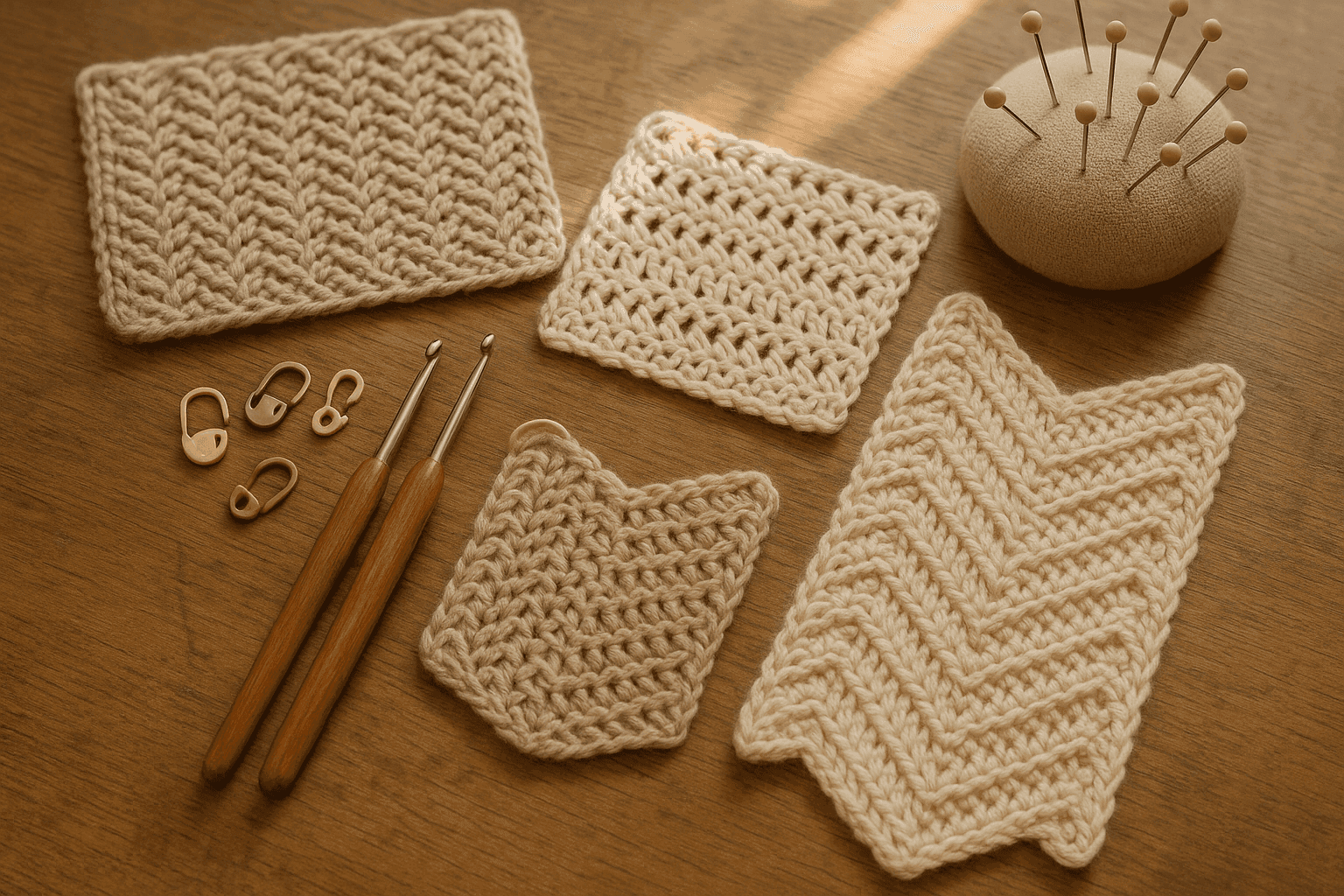
There is a particular kind of crochet frustration that only shows up after hours of satisfying stitching: you spread out a fabric that looked beautiful in your hands, and suddenly the diagonals are misbehaving. A herringbone panel has leaned harder to one side than the other. A V-stitch shawl has grown wings at the edges and a soft spiral through the center. A chevron blanket that was supposed to stack into crisp peaks and valleys now ripples, tilts, or pulls off-grain after a few repeats. Nothing is exactly “wrong” with the stitches themselves, yet the fabric has developed a strong opinion about direction.
That directional opinion is what many crocheters feel as torque, skew, drift, or cumulative slant. In diagonal crochet structures, torque is not just about yarn twist or uneven tension, though both matter. It comes from stitch paths: the way loops are built, stacked, crossed, increased, and anchored row after row. Once you start designing with diagonals—especially in herringbone structures, V-stitch fields, and chevrons—you are no longer only counting stitches. You are engineering force balance.
The good news is that diagonal stability is learnable. You can predict when fabric will skew, when it will flare, and when it will collapse inward. You can pair opposing slants to neutralize drift. You can choose fibers that support crisp geometry instead of washing it away. You can modify motifs for mirrored garment fronts, left and right shawl wings, or blanket panels that meet cleanly at a seam. Most importantly, you can make deliberate decisions so the energy in the fabric works for you rather than against you.
This guide is about that engineering mindset. We will look closely at how crochet torque develops in diagonal fabrics, then apply that understanding to three families of structures: herringbone, V-stitch, and chevron. Along the way, we will cover yarn behavior, hand dominance, increase placement, color planning, mirrored patterning, stitch counts, blocking, and finishing choices that preserve clean diagonals.
Understanding crochet torque in diagonal fabrics
Every crochet stitch has a path. The hook enters a loop or space, catches yarn, draws up a loop, and completes one or more partial wraps. That path creates a tiny directional unit. In straight, balanced stitch patterns, those units can visually average out. In diagonal patterns, however, the direction is emphasized and repeated, so even a subtle bias becomes cumulative.
A few forces commonly interact:
- Yarn twist: A tightly spun yarn may encourage stitches to sit with more spring and directional memory. An S-twist or Z-twist yarn can interact differently with your wrapping motion, depending on how you yarn over and pull through.
- Hand dominance and working style: Right-handed and left-handed crocheters often see mirrored visual slants. Even among right-handed crocheters, “knife hold” versus “pencil hold,” tight versus open tension, and the angle of yarn feeding can affect how a diagonal develops.
- Stitch asymmetry: Some stitches naturally lean. Herringbone double crochet, linked stitches, decreases, and shell-based increases all redistribute yarn unevenly across the width of the stitch.
- Increase and decrease placement: In chevrons and V fields especially, edge growth and motif expansion can either counterbalance or amplify drift.
- Row-turning structure: Turned rows alternate the visual face and often soften directional accumulation. Working in the round or always from the same side can intensify it.
- Fiber response to blocking and wear: Wool can often be coaxed back into line. Superwash wool may relax dramatically. Cotton can hold a crisp line but also reveal every imbalance.
A useful design principle is this: the stronger the visual emphasis on a diagonal, the more intentionally you must pair that diagonal with an opposing force somewhere in the fabric.
That opposing force can come from:
- mirrored stitch columns n- paired increases and paired decreases
- alternating row directions
- balanced motif repeats across a centerline
- seams that anchor bias edges
- blocking that equalizes but does not overstretch
Reading slant: what your stitches are telling you
Before changing a pattern, learn to diagnose the type of distortion you are seeing.
Skew
The whole fabric rotates off square. Side edges are no longer perpendicular to beginning and ending rows.
Common causes: cumulative stitch lean, one-sided increase energy, yarn twist, working from one side only.
Typical fix: introduce mirrored sections, alternate directional stitch variants, or block to square while adding edge stabilization.
Flare
The fabric widens more than planned, especially at the edges or at openwork points.
Common causes: too many edge increases, V-stitches stacked directly on V-stitches without compensating anchors, overly stretchy fiber, inconsistent chain spaces.
Typical fix: reduce chain-space width, replace some Vs with solid anchor stitches, tighten turning chains, or decrease increase frequency.
Collapse or cupping
The fabric pulls inward, cups, or tunnels through the centerline.
Common causes: too few increases in a chevron peak, too aggressive decreases in valleys, heavy yarn with insufficient open structure, blocked points pulled too sharply.
Typical fix: add support stitches at stress points, redistribute decreases, open up hook size, or adjust peak construction.
Ripple without planned shaping
The fabric develops wave even when the pattern was intended to lie flat.
Common causes: mismatch between repeat count and increase/decrease ratio, inconsistent chain tension, mixed stitch heights not properly compensated.
Typical fix: audit the repeat math and compare the stitch count entering and leaving each repeat.
The mechanics of opposing diagonals in herringbone crochet
Herringbone structures are one of the clearest places to study directional pairing because the stitch itself announces its slant. Whether you are using herringbone half double crochet (Hhdc), herringbone double crochet (Hdc), or a custom crossed arrangement, each stitch creates a visual line that sweeps across the fabric.
A simple herringbone fabric worked row after row may look balanced at first glance, but the stitch path often has a dominant directional drag. In practice, that can make a panel drift slightly even if your stitch counts are perfect.
Why herringbone skews
In many herringbone stitches, a loop is drawn through the first loop on the hook or through an intermediate stage before the stitch is completed. This elongates one side of the stitch path and compresses the other. Repeat that over 100 stitches for 60 rows, and you get an accumulated lean.
If you work all rows from the same side, the skew becomes more obvious. If you turn each row, the visual slant may alternate somewhat, but it does not always fully cancel because the architecture of the stitch remains asymmetric.
Designing stable herringbone panels
The most reliable method is to create true opposing diagonal pairing. Instead of allowing every slant to run in one visual direction, you build mirrored columns or mirrored sections.
Try these structures:
- Center-out mirror: Work a panel with a marked center column. On one side, stitches slant toward the center; on the other, they slant away or mirror back.
- Paired row sets: Work 2 rows of standard herringbone, then 2 rows of a reversed or differently anchored herringbone variant.
- Inset balancing bands: Separate herringbone sections with plain half double crochet or linked half double crochet bands to interrupt cumulative torque.
Swatch formula for testing herringbone balance
Make two swatches before committing to a garment or blanket panel.
Swatch A: single-direction emphasis
- Yarn: 100 g DK or light worsted, smooth plied yarn
- Hook: 5.0 mm/H-8
- Foundation: ch 32
- Row 1: work 30 Hhdc across, 1 turning chain
- Rows 2–24: 30 Hhdc across
Swatch B: mirrored structure
- Same yarn and hook
- Foundation: ch 33
- Row 1: work 31 Hhdc across, place marker in center stitch (st 16)
- Rows 2–24: work mirrored placement by visually maintaining slants away from the centerline, or divide the swatch into 15 sts + center st + 15 sts and reverse the directional arrangement after the center marker
Block both to the same target size and compare:
- Are side edges equally vertical?
- Does the centerline remain straight?
- Does one sample spiral after resting overnight?
Even when gauge matches, the mirrored swatch often hangs straighter.
Stitch counts for herringbone garment panels
If you are drafting a front panel where visual symmetry matters, use an odd stitch count so a center stitch or center column can act as an axis.
Examples:
- Narrow scarf panel: 41 sts
- Sweater front panel: 79 sts
- Cushion front: 61 sts
If you prefer a seam-based mirror, use an even stitch count and split the fabric into left/right halves:
- 40 sts total = 20 sts left, 20 sts right
- 78 sts total = 39 sts left, 39 sts right
For fitted garments, always make left and right fronts as mirror pieces rather than repeating the same shaping instructions exactly. If a herringbone front edge slants attractively on the left but fights the neckline on the right, that is a directional design issue, not a tension problem.
V-stitch fields: why open diagonals can grow wild
V-stitch looks airy and forgiving, but it is one of the easiest structures to destabilize because every V creates two outward arms and a center opening. That means each repeat has directional spread built in.
A classic V-stitch is often worked as:
- (dc, ch 1, dc) in the same stitch or space
The diagonal arms of that V naturally direct the eye outward. When stacked vertically, they can create elegant lattice. When offset or expanded too aggressively, they encourage flare and side drift.
Where torque shows up in V-stitch
- Edge growth: If the first and last V of each row are not anchored consistently, the fabric fans out.
- Center expansion: Shawls worked from a center spine can twist if increases favor one side or if one chain space remains looser than the other.
- Directional color effect: Striping across V-stitch exaggerates slant because color settles into the arms of each V.
- Space-only construction: Working exclusively into chain spaces can reduce structural correction that top loops sometimes provide.
Stabilizing V-stitch with directional pairing
Think of a V field as a network of miniature opposing diagonals. Stability improves when each left-leaning arm is countered by a right-leaning arm in a predictable grid.
To maintain that grid:
- Keep center chain spaces consistent. A ch-1 space with a 5.5 mm hook in worsted yarn may be enough; a ch-2 can become too loose unless the yarn is sticky or lofty.
- Use regular anchor rows. Every 4th or 6th row, work a row of solid stitches such as dc or extended sc into the V spaces to reset the fabric.
- Stabilize edges with non-growing selvedges. For example, begin and end each row with 1 dc rather than half a V unless the shaping explicitly needs expansion.
Sample balanced V-stitch panel
Materials
- Yarn: worsted weight (#4), 200–250 yds for a practice panel
- Hook: 5.5 mm/I-9
Foundation multiple
- Multiples of 3 + 2 for a common row-based V-stitch panel
Example panel
- Ch 29
Row 1: dc in 4th ch from hook, ch 1, dc in same ch, skip 2 ch, (dc, ch 1, dc) in next ch, skip 2 ch across to last 2 ch, dc in last ch. Stitch count: 9 V-sts + 2 edge dc.
Row 2: ch 3, turn, dc in first ch-1 sp, ch 1, dc in same sp, (dc, ch 1, dc) in next ch-1 sp across, dc in top of last dc. Stitch count remains 9 V-sts + 2 edge dc.
Rows 3–12: repeat Row 2.
Row 13 stabilization row: ch 2, turn, 2 hdc in first ch-1 sp, 2 hdc in next ch-1 sp across, hdc in top of last dc. Stitch count: 20 hdc.
Row 14: reestablish V-stitch evenly by working edge dc, then Vs across every other hdc as needed to restore 9 V-sts + 2 edge dc.
That stabilization row slightly interrupts drape, but it dramatically reduces diagonal drift in larger fabrics.
Designing mirrored V-stitch panels
For cardigans, kimono pieces, and shawl wings, mirrored panels matter. If you simply repeat the same V placement on both fronts, one side may visually throw its diagonal emphasis inward while the other throws outward.
To mirror successfully:
- Mark the garment centerline or front edge line.
- Reverse any partial-V edge treatment from left to right.
- If using V clusters plus accent post stitches, mirror the post stitch direction too.
- When adding shaping, place neckline decreases so they preserve the nearest full V whenever possible.
A practical rule: do not sacrifice symmetry to preserve exact row-by-row sameness. In diagonal fabrics, mirrored appearance is often more important than identical instructions.
Chevron fabrics: balancing peaks, valleys, and lateral pull
Chevron crochet is essentially directional engineering made visible. Every repeat creates opposing slopes rising to a peak and descending into a valley. Ideally, these slopes balance each other. In reality, the way you construct increases at peaks and decreases at valleys determines whether the chevron lies flat.
The core chevron equation
In each full repeat, the number of stitches added at the peak should equal the number removed at the valley, adjusted for the visual and structural width of the stitches used.
For a basic dc chevron repeat:
- 3 dc in one stitch at the peak adds 2 extra stitches over a standard single dc placement.
- dc3tog across 3 stitches at the valley removes 2 stitches.
That sounds balanced, and mathematically it is. But structurally, the increase area often spreads more than the decrease area compresses, especially in soft yarn or open tension. So a chevron can still flare.
Why mathematically balanced chevrons still distort
- Peak increases can be too open if the center stitch loosens.
- Valleys can cinch too tightly and shorten row depth locally.
- Stitch height changes around increases/decreases create differential row length.
- Color changes at the peak or valley can visually exaggerate motion.
- Border rows can flatten or overemphasize the waves.
Stable chevron design choices
-
Use moderate hook sizes If a yarn label suggests 5.5 mm, test 5.0 mm for a crisper chevron. Too loose and the peaks droop; too tight and valleys pucker.
-
Choose controlled peak increases Instead of 3 dc in one stitch, consider:
- dc, ch 1, dc in one stitch for lacier chevrons
- 3 hdc in one stitch for denser chevrons
- 2 dc, ch 1, 2 dc in one stitch for dramatic points that need room
-
Match the decrease style to the fabric personality
- dc3tog gives a stronger inward pull
- 3-dc cluster can soften the valley visually
- hdc3tog may better match a shorter stitch fabric
-
Anchor every few rows Insert a plain row in back loop only or standard top loops to reset alignment before the next wave stack.
Example chevron swatch with count audit
Materials
- Yarn: aran or worsted weight
- Hook: 5.0 mm/H-8
Foundation multiple
- 14 + 2 for this sample
Ch 30 for 2 repeats.
Row 1: dc in 4th ch from hook and next 4 ch, dc3tog over next 3 ch, dc in next 5 ch, 3 dc in next ch, dc in next 5 ch, dc3tog over next 3 ch, dc in next 5 ch, 2 dc in last ch. Total working count after setup aligns to 2 repeats plus edge turning structure.
A cleaner way to think about the repeat is:
- 5 dc down slope
- 1 valley decrease over 3 sts
- 5 dc up slope
- 1 peak increase into 1 st
For larger projects, mark:
- peak stitch or peak center space with one color marker
- valley center decrease with another color marker
If your peak markers start traveling sideways over several rows, you are not stacking increases consistently.
Chevron fabric for garments versus blankets
Blankets tolerate more horizontal spread and can be aggressively blocked. Garments need the chevron to remain readable without adding bulk where it crosses the body.
For garments:
- use finer yarns: sport, DK, or light worsted
- reduce repeat depth: 4 dc slopes instead of 7 or 9
- avoid bulky peak clusters near bust or shoulder shaping
- place seams on lower-stress lines, not at deep valleys if possible
For blankets:
- worsted, aran, and even bulky can work well
- deeper repeats create stronger visual rhythm
- a border may need partial filling of valleys to sit smoothly
Fiber selection and yarn twist for crisp diagonals
Not all yarns report diagonals the same way. If your goal is stable geometry, fiber choice is not decorative; it is structural.
Best fibers for defined diagonals
Wool or wool blends
- Pros: memory, elasticity, blocking responsiveness
- Best for: garments, heirloom blankets, chevrons that need recovery
- Caution: superwash may grow vertically and soften crispness
Cotton
- Pros: excellent stitch definition, sharp motif edges
- Best for: summer garments, cushions, table runners, structured shawls
- Caution: little elasticity, so imbalances are visible; heavy cotton may drag open V-stitch downward
Wool-cotton blends
- Pros: balance of memory and definition
- Best for: herringbone garments and refined chevron wraps
Acrylic
- Pros: affordable, resilient, easy care
- Best for: blankets and swatch experimentation
- Caution: some acrylics can appear puffy, reducing herringbone crispness; steam blocking must be done carefully
Twist considerations
A firm multi-ply yarn usually shows directional stitch architecture more clearly than a soft singles yarn. Singles or low-twist yarns can blur the herringbone line and relax V-stitch edges, which may be desirable if you want softness over graphic precision.
If you suspect twist interaction with your hand motion, test two yarns of similar weight:
- one tightly plied wool blend
- one softer, less-twisted yarn
Work the same 20-stitch by 20-row diagonal swatch. Often the “problem” is really the pairing of a specific stitch architecture with a specific yarn behavior.
Color planning for directional motifs
Color can either clarify diagonals or create visual noise that hides distortion until late in the project.
Strong choices for diagonal readability
- High contrast between motif and ground emphasizes slant and geometry.
- Tonal shifts show texture without over-highlighting every wobble.
- Long color changes can create false diagonal lines across V-stitch and chevrons.
Practical color rules
- For herringbone: use semi-solid or lightly tonal yarns to let the slant show. Speckles can obscure the directional effect.
- For V-stitch: avoid abrupt striping at irregular row counts unless you want zigzag optical movement.
- For chevrons: changing color every row sharpens peaks and valleys; changing every full repeat section softens them.
- For mirrored panels: begin color sequences from equivalent points if symmetry matters. A left front and right front worked from the same cake but different starting positions may mirror structurally yet mismatch visually.
A useful habit is to photograph your swatch in grayscale. If the diagonals disappear or become chaotic in black and white, your color plan may be competing with the structure.
Step-by-step design workflow for stable diagonal fabrics
Here is a practical process you can use whether you are designing from scratch or modifying an existing pattern.
Step 1: Identify the dominant diagonal force
Ask:
- Is the slant created by the stitch itself, like herringbone?
- By the spacing between stitches, like V-stitch?
- By shaping, like chevrons?
Write down where the visual pull is strongest: centerline, edges, peaks, valleys, or all-over.
Step 2: Choose your balancing strategy
Pick at least one:
- mirrored halves
- alternating row variants
- periodic stabilization rows
- seam anchoring
- edge reinforcement
For a shawl, that may be a center spine and mirrored wings. For a cardigan, it may be two mirrored fronts plus a firm shoulder seam.
Step 3: Swatch with purpose
Do not just measure gauge. Evaluate distortion.
Minimum useful swatch size:
- Herringbone: 24 rows x 30 sts
- V-stitch: 10–12 pattern rows over at least 8 V repeats
- Chevron: at least 4 full repeats wide and 12 rows tall
Pin your swatch to a flat surface without stretching. Measure top width, bottom width, and both side lengths. If left and right side lengths differ by more than 0.5 in / 1.25 cm on a medium swatch, investigate before proceeding.
Step 4: Audit stitch counts at stress points
Count separately at:
- edges
- center spine
- peak increases
- valley decreases
A repeat can be globally correct but locally unstable if one increase is being placed into a neighboring stitch instead of the intended center.
Step 5: Adjust hook size and chain-space width
Common starting points:
- sport yarn: 3.5–4.0 mm
- DK yarn: 4.0–4.5 mm
- worsted yarn: 5.0–5.5 mm
- aran yarn: 5.5–6.0 mm
For unstable diagonals, first try dropping hook size by 0.5 mm before rewriting the whole pattern. Then test reducing chain spaces:
- V-st ch-2 to ch-1
- peak ch-2 to ch-1
- turning ch-3 to a stacked dc alternative if edges flare
Step 6: Build mirrored shaping intentionally
For left and right panels:
- write separate instructions if necessary
- reverse decrease placement around front edges
- reverse post-stitch crossings and decorative slants
- keep the same total stitch counts but not necessarily the same exact sequence wording
Step 7: Finish and block for the intended use
A baby blanket can tolerate softer valleys and broader drape. A tailored vest panel cannot. Block to function, not just to beauty.
Troubleshooting common diagonal fabric problems
Problem: Herringbone panel leans left even though stitch count is correct
Likely causes: stitch asymmetry, yarn twist, uneven turning tension.
Fixes:
- add a center mirror or split panel construction
- use a slightly larger hook only for turning chain/first stitch if edge cinching is contributing
- test a linked or standard stitch border along side edges
- wet block and dry flat under measured tension
Problem: V-stitch shawl keeps expanding at the outer edges
Likely causes: half-V edge treatment adding hidden increases, loose final dc, chain spaces too large.
Fixes:
- replace edge V with a single dc on both sides
- reduce center chain space by 1 chain where applicable
- use a smaller hook at the edges only if your pattern style allows
- add a final round of sc or reverse sc to stabilize perimeter
Problem: Chevron blanket ripples between peaks and valleys
Likely causes: increase/decrease ratio visually imbalanced, hook too large, inconsistent valley decrease.
Fixes:
- tighten hook by 0.5 mm
- replace 3 dc peak with 2 dc, ch 1, 2 dc only if pattern supports it and re-swatch
- ensure dc3tog is worked over exactly the intended stitches each row
- block lightly, pinning peaks and valleys at equal intervals
Problem: Mirrored garment fronts do not look mirrored once worked
Likely causes: instructions copied rather than reversed, color sequence mismatch, directional texture not accounted for.
Fixes:
- chart the panel visually instead of relying only on written repeats
- reassign edge treatments from “beginning of row” to “front edge” logic
- start both panels from matched color positions if using gradient or self-striping yarn
Problem: Diagonals look crisp before washing but soften after laundering
Likely causes: fiber relaxing, overblocking, too-open gauge.
Fixes:
- swatch-wash before project launch
- choose a firmer yarn blend
- work at a slightly denser gauge
- use finishing seams or applied edgings to hold line
Finishing strategies that preserve crisp diagonals
Finishing is often where diagonal success is either secured or lost.
Blocking
For herringbone and structured chevron:
- wet block or steam lightly depending on fiber
- measure diagonals and side edges before pinning
- pin centerlines first, then peaks/valleys, then edges
- avoid dragging openwork into larger dimensions than the stitch architecture wants to hold
For V-stitch shawls:
- open the lace enough to define Vs
- do not overstretch one wing more than the other
- if there is a center spine, pin it perfectly straight before setting outer edges
Edgings
A good edging can counteract torque.
Useful choices:
- single crochet edging: adds gentle control with minimal visual interference
- reverse single crochet/crab stitch: firmer edge, excellent for blankets and garment fronts
- slip stitch edge: strong containment, but can tighten if worked too firmly
- applied i-cord substitute in crochet style: polished, excellent for shawl edges if flexibility is still needed
Seams
Do not underestimate seams as structural tools. Mattress seaming through side edges or shoulder joins can anchor directional fabric and prevent bias stretch in wear.
For garment pieces with strong diagonals:
- seam after blocking pieces to target dimensions
- support shoulder seams with a fine matching tape or a strand of yarn if the fabric is open
- avoid stretching front bands onto unstable edges without first stabilizing the edge row
Variations to explore once you understand the mechanics
Once you begin seeing diagonal balance clearly, you can use torque creatively rather than fearing it.
Herringbone with intentional directional fade
Work mirrored herringbone sections in two tonal gradients, darkest at the outer edges and lightest at the center. The mirrored slant remains stable while the color amplifies the inward movement.
V-stitch with alternating solid reset rows
Use 5 rows of V-stitch followed by 1 row of linked dc. This gives a refined stripe effect and keeps wide shawls from stretching too loosely.
Chevron with asymmetric color but symmetric structure
Keep all increase/decrease math perfectly mirrored, but color only one slope of each chevron in a contrast shade. This produces dramatic movement while maintaining physical balance.
Reversible diagonal fabrics
If you want both sides to read well, choose stitch patterns where the structural correction is built into repeat pairing rather than surface-only texture. Linked stitches, balanced V arrangements, and modest chevrons outperform highly relief-based directional motifs for reversibility.
Key takeaways for designing diagonal crochet that behaves
Diagonal crochet is beautiful because it carries motion, but motion in fabric has consequences. If you want herringbone, V-stitch, and chevron fabrics to stay stable, think like both a maker and an engineer.
Remember these principles:
- Every diagonal needs a counterforce somewhere in the fabric.
- Stitch-path mechanics matter as much as stitch counts.
- Mirrored appearance often requires mirrored instructions, not repeated instructions.
- Open structures like V-stitch need periodic stabilization.
- Chevron math must be checked visually as well as numerically.
- Yarn choice can either sharpen geometry or magnify distortion.
- Blocking should refine the fabric, not rescue a fundamentally unbalanced design.
If you are developing your own patterns, give yourself permission to swatch analytically. Mark peaks. Measure side edges. Compare mirrored and non-mirrored samples. Wash and block before making assumptions. That process is not fussy; it is what allows advanced crochet to feel reliable.
And if you are troubleshooting an existing piece that seems determined to slant, flare, or cup, do not jump straight to blaming your tension. Often the fabric is simply telling you that too many directional forces are running one way. Once you learn to pair those forces—left with right, increase with decrease, open with anchored, drape with memory—you can make diagonals that stay clear, deliberate, and beautifully crisp in use.
That is when these stitch families become especially exciting. Herringbone stops looking like a skew risk and starts behaving like a tailored texture. V-stitch becomes more than airy lace and turns into a controllable lattice. Chevron becomes not just a wave, but a repeatable architecture. And your finished garments, shawls, and blankets keep the geometry you intended from first swatch to long-term wear.