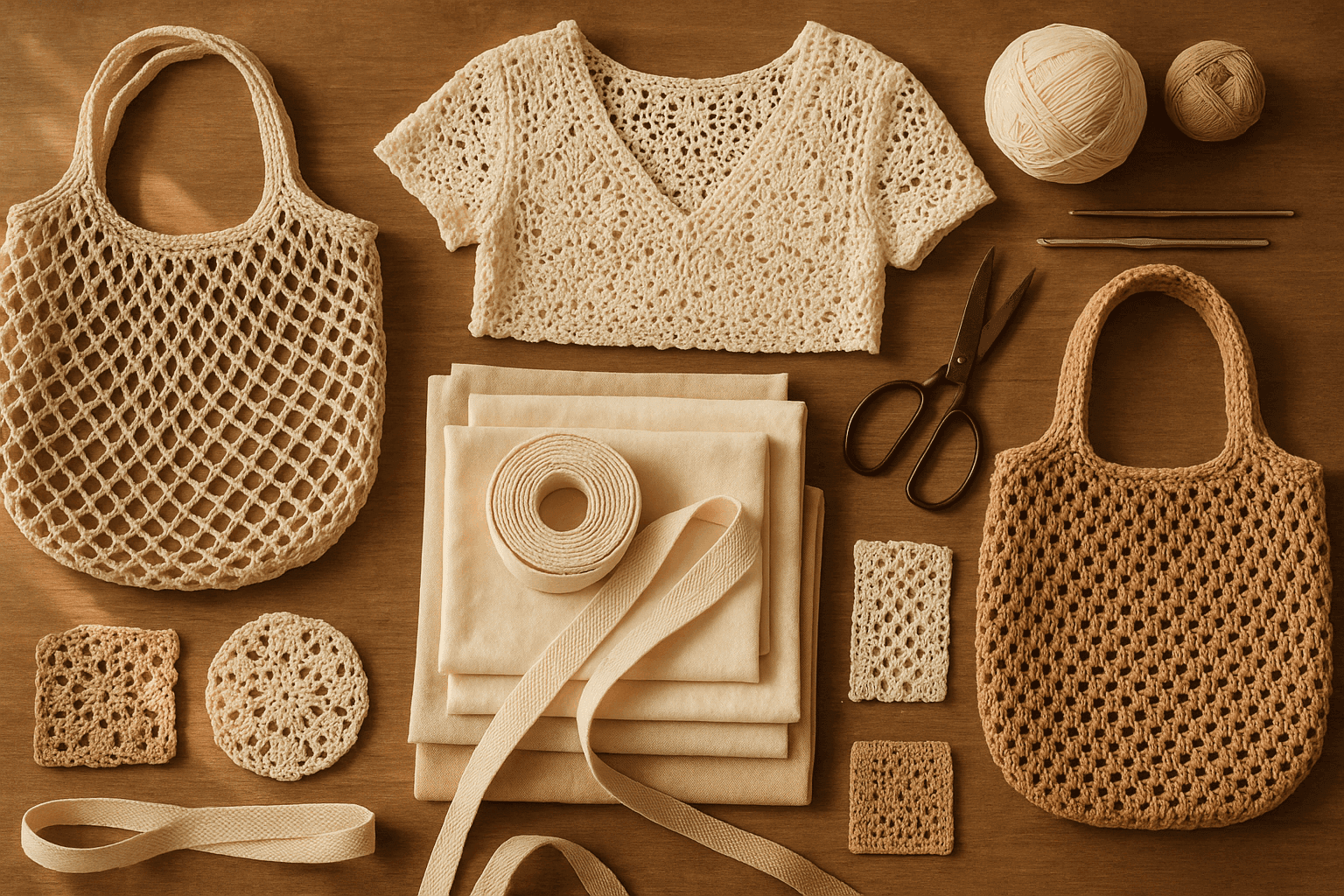
There’s a moment many of us reach after finishing a beautiful openwork piece when admiration gives way to engineering. The stitches are lovely, the drape is promising, and the fabric tells exactly the story we hoped for—until we pick the bag up by its handles, hold the garment against the light, or place that airy table runner on a surface where every tension point suddenly matters. The crochet itself is doing its job, but it’s also asking for a partner.
That partner is often some form of underlining, backing, lining, or reinforcement layer. Used well, it doesn’t fight the crochet. It supports it. It helps an openwork market bag keep its proportions, lets a lace top feel wearable instead of precarious, gives a cushion cover cleaner edges, and turns a decorative textile into a practical one. The goal is not to smother handmade fabric under rigid construction. The goal is to understand what the crochet wants to do, what the finished object needs to do, and how to bridge the gap without losing character.
This is one of those subjects that sits beautifully between yarn craft and sewing, but it does not require advanced tailoring to be useful. Some backing layers are fully sewn. Some are lightly tacked. Some are removable. Some are not fabric at all, but tapes, ribbons, mesh, canvas, or fusible supports hidden in strategic places. When you start thinking in terms of load paths, abrasion points, visibility, recovery, and directional stretch, your crochet finishes more cleanly and performs more reliably.
In this guide, I’ll walk through how to choose and apply backing layers for bags, garments, and home textiles, with a focus on stability, opacity, shape retention, and polished finishing. We’ll cover fiber compatibility, differential shrinkage, grain direction versus stitch direction, common attachment methods, selective reinforcement, and how to avoid deadening the fabric. I’ll also include practical stitch-count planning examples, hook and yarn recommendations, and troubleshooting notes from the perspective of someone who has absolutely fallen in love with a lace panel and then had to decide whether it was meant to be art, clothing, or architecture.
Why crochet often benefits from underlining or backing
Crochet fabric behaves differently from woven fabric. Even dense crochet has built-in mobility because each stitch is a loop interlocked with other loops. Openwork amplifies that mobility. This is part of crochet’s beauty, but also the source of familiar issues:
- Stretch under load: bag bodies lengthen, straps grow, necklines drop.
- Sagging and distortion: gravity pulls most strongly where stitches are tallest or where open spaces concentrate stress.
- Transparency: lace garments and home textiles may reveal more than intended.
- Abrasion vulnerability: high-friction zones like bag bottoms, corners, armholes, and cushion edges wear first.
- Shape creep over time: repeated use and laundering can change dimensions.
- Inconsistent edge behavior: button bands ripple, zipper edges wave, and openings flare.
A backing or underlining layer can solve one or several of these problems by:
- sharing load across a more stable substrate,
- limiting stretch in one or both directions,
- adding opacity without changing the visible stitch pattern,
- protecting the crochet from friction,
- giving edges something cleaner to attach to,
- improving recovery after wear,
- and helping the finished object hold a more intentional silhouette.
The key word is intentional. You do not need to line everything. But when a project has a job beyond looking lovely on a blocking mat, you want to decide where support belongs.
Definitions: lining, underlining, backing, interfacing, reinforcement
These terms overlap in casual use, but it helps to separate them.
Lining
A separate inner layer, usually used to hide seams, protect the inside, improve comfort, or add opacity. In a bag, the lining often forms the interior. In a garment, it may sit free or be attached at edges.
Underlining
A support layer attached directly behind the crochet so the two behave more like one fabric. Underlining is especially useful when you want to preserve the appearance of crochet while changing its performance.
Backing
A broad term for anything placed behind the crochet for support, opacity, or structure. In home textiles, backing may fully cover the wrong side. In bags, backing may refer to the supportive inner fabric.
Interfacing
A stabilizing material, woven, nonwoven, knit, fusible, or sew-in, added to fabric areas that need extra body. Interfacing is usually applied to the lining or support fabric rather than directly to crochet.
Reinforcement
Targeted structural support in high-stress areas such as straps, zipper openings, button bands, shoulder seams, and bag bottoms. Reinforcement may be fabric, tape, grosgrain ribbon, twill tape, stay tape, webbing, cord, or extra rows of crochet.
Start by diagnosing the behavior of your crochet fabric
Before you choose a backing layer, treat the crochet swatch like a material sample. Make a proper swatch at least 6 x 6 in / 15 x 15 cm, and for openwork or load-bearing projects, larger is better: 8 x 8 in / 20 x 20 cm gives more honest information.
For most projects in this category:
- Garments: DK to worsted weight yarn with hooks 3.5 to 5 mm for openwork, depending on pattern.
- Bags: cotton, cotton blends, raffia-like fibers, linen blends, or sturdy acrylic/cotton with hooks 3.5 to 5.5 mm, often smaller than typical for the yarn to control stretch.
- Home textiles: cotton, linen, blends, or sturdy synthetics with hooks 3.5 to 6 mm depending on intended hand.
When you swatch, record:
- stitch pattern,
- yarn fiber content,
- hook size,
- gauge before blocking,
- gauge after blocking,
- gauge after hanging or weighted testing.
For example:
- Swatch: filet mesh in mercerized cotton
- Hook: 4 mm
- Gauge before blocking: 18 dc and 9 rows = 4 in / 10 cm
- Gauge after blocking: 17 dc and 8.5 rows = 4 in / 10 cm
- Gauge after hanging 12 hours with small weight: length increased by 6%
That last number matters. If a bag panel grows 6% in the swatch, a 16 in body can become nearly 17 in under use—and more if loaded.
Quick diagnostic tests
1. Light test for opacity
Hold the swatch over a contrasting surface or in front of a window. Ask:
- Is the openness intentional and wearable as-is?
- Would a matching, contrasting, or skin-tone underlayer help?
- Do holes enlarge under tension?
2. Bias and directional stretch test
Mark a 4 in / 10 cm square in the center of the swatch with locking stitch markers. Gently pull horizontally, vertically, and diagonally. Measure how much it expands.
A sample result might be:
- Horizontal stretch: 12%
- Vertical stretch: 7%
- Diagonal distortion: 18%
This tells you the crochet is most unstable on the bias-like diagonal and may need a stable underlayer or edge control.
3. Recovery test
Stretch and release several times. Does it spring back, relax slowly, or remain enlarged? Cotton often has less elastic recovery than wool. Bamboo and rayon blends may drape beautifully but can lengthen noticeably.
4. Abrasion test
Rub the swatch lightly against denim, canvas, or your intended use surface. Fuzzy fibers can pill; delicate yarns can snag.
5. Wash/shrink test
Wash and dry exactly as you plan to treat the finished item. Then wash your candidate lining or backing the same way. This is where differential shrinkage reveals itself.
Fiber compatibility and differential shrinkage
One of the quickest ways to sabotage a well-made project is pairing fibers with very different wash behavior, shrinkage rates, or moisture responses.
Good compatibility questions to ask
- Will the crochet and backing be laundered the same way?
- Do they absorb moisture similarly?
- Will one become heavier when wet?
- Does one relax with steam while the other resists it?
- Will one shrink more than 2–3% relative to the other?
Common fiber pairings
Cotton crochet + cotton woven lining
A classic pairing for bags, summer garments, and home textiles. Cotton woven fabric can provide crisp support, good opacity, and relatively compatible care.
Watch for:
- quilting cotton that is too stiff for fluid garments,
- unprewashed cotton shrinking after the crochet has been set,
- mercerized cotton crochet having a smoother, firmer hand than soft washed cotton lining.
Linen or cotton-linen crochet + linen/cotton backing
Excellent for breathable garments and home textiles. Linen can wrinkle, but it supports openwork beautifully.
Watch for:
- greater relaxation and skew if either layer is not prewashed,
- stiffness if both layers are too dry-handed.
Wool crochet + silk, rayon, or lightweight cotton underlining
Useful in garments where warmth and drape matter. The underlayer can stabilize without making the fabric bulky.
Watch for:
- shrink/felt risk if wool is not superwash,
- steam sensitivity differences,
- lining drag if the inner layer catches against clothing.
Acrylic crochet + synthetic lining
Compatible in easy care, but be careful with heat. Acrylic can lose texture or “kill” under too much steam.
Watch for:
- static,
- lower breathability,
- slippery lining that changes hang.
Differential shrinkage guideline
After prewashing and drying both materials, compare dimensions. If one shrinks or grows more than the other by more than about 3%, do not fully join them edge-to-edge without allowing some ease or changing materials.
For a 20 in / 50 cm panel, a 3% difference is 0.6 in / 1.5 cm. That’s enough to cause bubbling, torque, or puckering.
Grain direction versus stitch direction
This is one of the most important and least discussed parts of successful backing.
Woven fabrics have:
- lengthwise grain: parallel to selvage, usually most stable,
- crosswise grain: more give than lengthwise,
- bias: diagonal, maximum stretch and drape.
Crochet fabrics have directional behavior too, though it varies by stitch pattern:
- Foundation chains and row direction create different give.
- Tall stitches often elongate vertically.
- Side-to-side stretch may be greater in some mesh patterns.
- Motif-based work can distort toward joining lines.
Matching directional behavior on purpose
You can orient the backing to either:
- Resist the crochet’s main stretch, or
- Allow some movement so the project stays lively.
Example: openwork tote bag panel
If the crochet stretches most vertically under load, align the woven backing so its lengthwise grain runs vertically too. That gives maximum resistance where the bag wants to grow.
Example: lace cardigan front
If the button band edge needs stability but the body should still drape, you might use a stable tape along the front opening while the underlayer is cut with some crosswise give or even as a separate partial panel.
Example: table runner
If the crochet tends to widen and scallop at the edges, a backing cut on straight grain and lightly mounted can help keep the runner rectangular without flattening the lace.
Rule of thumb
- For bags and load-bearing pieces, put the backing’s most stable direction where gravity pulls hardest.
- For garments, balance stability with comfort and drape.
- For home textiles, think about edge straightness, friction, and laundering.
Choosing the right kind of backing layer
Not every project wants a full sewn lining. Here are the main options.
1. Full fabric lining
Best for bags, pouches, market totes, pillow covers, baskets, and some skirts or openwork garment sections.
Pros:
- maximum opacity,
- clean interior,
- protects wrong side and carried items,
- distributes stress,
- easiest place to add pockets or closures.
Cons:
- can add bulk,
- may deaden drape if too stiff,
- requires more precise fitting.
2. Underlining directly behind crochet
Best for lace bodices, yokes, button bands, bag panels, and home décor where the crochet should remain visually dominant.
Pros:
- crochet and support act together,
- excellent for controlling stretch,
- preserves outer appearance.
Cons:
- every mismatch shows,
- careful attachment needed to avoid puckers.
3. Partial or selective backing
Best for reinforcing only where needed: straps, bag bottoms, shoulder areas, plackets, cushion edges, or transparent zones.
Pros:
- minimal change to hand,
- lighter and more breathable,
- very efficient structural upgrade.
Cons:
- requires planning,
- transitions must be smooth.
4. Mesh, net, or sheer support layers
Best when you want stabilization without obvious opacity. Power mesh, tulle, or stable net can support lace garments.
Pros:
- lightweight,
- preserves visual openness,
- excellent for hidden stability.
Cons:
- can snag,
- some nets feel synthetic or scratchy,
- harder to sew neatly if very fine.
5. Non-sewn supports
Think removable liners, felted inserts, plastic canvas, needlepoint canvas, foam stabilizer, zipper pouches inserted into crochet shells, or fabric sleeves attached only at key points.
Pros:
- accessible to non-sewers,
- useful in bags and baskets,
- easy to replace.
Cons:
- may shift,
- less integrated finish,
- often bulkier.
How underlayers change drape, recovery, and hand
This is the balancing act. Support should improve function without making the crochet feel laminated.
To preserve drape
Choose backing that is:
- lighter than you first think,
- close in weight to the crochet,
- soft enough to fold with the stitches,
- selectively applied rather than full coverage if possible.
To increase recovery
Use materials with moderate resilience:
- firm cotton lawn,
- lightweight woven cotton with a bit of body,
- stable knit lining for garments that need movement,
- hidden stay tapes at stress points.
To avoid deadening fabric
Avoid pairing airy crochet with:
- heavy duck canvas across the full garment body,
- thick fusible interfacing behind delicate lace,
- multiple rigid layers stacked without need.
A good test is the fold test. Fold the crochet-plus-backing together over your hand. Does it still bend naturally? If it forms a boardlike crease, the support is too heavy for that application.
Step-by-step planning method
Here is the process I recommend for nearly every project.
Step 1: Define the job of the finished piece
Write down the top 3 performance needs.
Examples:
Openwork shoulder bag
- Prevent vertical stretch under load
- Hide small carried items
- Resist corner abrasion
Lace summer top
- Provide opacity at bust
- Prevent front neckline from growing
- Preserve airy drape in lower body
Crochet table runner
- Improve stain resistance and washability
- Keep long edges straighter
- Protect lace from snagging on wood grain
When you know the job, the support strategy becomes clearer.
Step 2: Swatch both materials together
Cut a piece of candidate backing at least 1 in / 2.5 cm larger than the swatch all around. Combine them using your intended attachment method and test again.
Measure gauge changes if underlining is mounted firmly.
Example:
- Crochet alone: 16 sts x 8 rows = 4 in / 10 cm
- Crochet with underlining lightly mounted: same visible gauge, but stretch reduced from 10% to 4%
That is a meaningful improvement.
Step 3: Determine finished dimensions and ease
For items that will be backed, do not rely only on unlined crochet measurements.
For example, if a bag front is 40 stitches wide in a pattern with a gauge of 20 sts = 4 in, the panel width is 8 in. If the lined version pulls in slightly, final width may become 7.75 in. Account for this before completing two panels.
Step 4: Prewash everything
Prewash yarn if appropriate, or at least wash the finished swatch. Prewash backing fabric exactly as the finished item will be treated.
Step 5: Cut or prepare the support layer
Use the crochet as a template only after it has been blocked to intended dimensions.
General cutting guidance:
- Underlining: cut to finished size or slightly smaller, often 1/8 to 1/4 in / 3 to 6 mm inside edges if you want the crochet edge to remain dominant.
- Full bag lining: cut with seam allowance, usually 3/8 to 1/2 in / 1 to 1.25 cm.
- Garment lining panel: include garment-appropriate seam allowances and wearing ease.
- Selective reinforcement strips: cut to exact finished length after stabilizing, not before.
Step 6: Baste and check behavior
Temporary basting is not optional if precision matters.
Methods:
- hand basting with contrasting thread,
- quilting clips around edges,
- wash-away basting tape on support fabric only,
- safety pins for thicker bag layers.
Do not stretch the crochet to fit the backing or vice versa. Let both rest into place.
Step 7: Attach with the least force necessary
This is where many projects go wrong. Overattachment can cause ridges and stiffness.
Attachment methods
Hand whipstitch at edges
Good for: bag linings, removable-feel garment linings, cushion backs.
Work through the backing edge and into the backs of crochet stitches or an inner round of stitches so the thread is not visible on the front.
Use:
- sewing thread for light invisibility,
- matching yarn for chunkier work,
- fine crochet cotton for cotton lace.
Spacing:
- every 1/4 to 3/8 in / 6 to 10 mm for light pieces,
- closer, every 1/8 to 1/4 in / 3 to 6 mm, in stress zones.
Slipstitch or single crochet join through crochet and fabric edge casing
Good for: bag tops, basket rims, sturdy home textiles.
Fold the lining edge under, hold behind crochet, then crochet through the stitch edge and fabric fold.
This creates a decorative finish but can be firmer than hand sewing.
Ladder tacks or anchor points
Good for: preserving drape in garments.
Instead of attaching the whole surface, secure at:
- shoulder seams,
- side seams,
- armhole underpoints,
- neckline,
- waist seam or empire line.
This lets the underlayer float while controlling specific areas.
Mounting underlining as one fabric
Good for: lace panels that need true support.
Lay crochet over the support layer and hand stitch invisibly at motif intersections, row lines, or around pattern repeats.
For a filet panel of 10 blocks wide x 14 blocks tall, for example, tack at each corner of every second block rather than along every bar. That reduces drift without flattening the mesh.
Machine sewing to prepared fabric components
Good for: makers comfortable with sewing.
Usually you sew the lining pieces first, then insert and hand attach to crochet, rather than machine stitching directly onto loose crochet. Direct machine sewing onto open crochet can tunnel, snag, or feed unevenly.
Hidden structural tapes and internal supports
This is one of the smartest ways to stabilize crochet while keeping it supple.
Twill tape or stay tape
Use along:
- shoulder seams,
- button bands,
- neckline edges,
- zipper openings,
- bag top edges.
Width: 1/4 to 1/2 in / 6 to 12 mm depending on scale.
Apply by hand sewing to the wrong side, catching only the backs of stitches when possible. Do not pull the tape taut; it should match the stabilized edge measurement exactly.
Grosgrain ribbon
Excellent in bags and structured plackets because it is stable and abrasion-resistant.
Use for:
- hidden strap cores,
- button bands,
- tote upper edges.
Cotton webbing
Ideal for load-bearing straps.
If a crochet strap is 2 in / 5 cm wide, insert 1 to 1.5 in / 2.5 to 4 cm cotton webbing inside a fabric-backed or folded strap. Let the crochet act as the visible shell, not the sole load-bearing element.
Cord or fishing line in edges
Useful for scalloped home textiles or bag openings that flare. Fine cord can be encased in an edge round.
Plastic canvas or bag base inserts
Useful for bag bottoms where sagging is the issue. Cover the insert with fabric or create a removable sleeve.
Selective reinforcement: where it matters most
Straps
Crochet straps almost always stretch more than expected.
Best practice options:
- Crochet around webbing
- Back the strap with woven fabric
- Fold crochet over a stable core
- Use Romanian cord, i-cord style crochet cords, or thermal stitch strap plus hidden tape
Example:
A shoulder strap worked in sc:
- Foundation: 8 sc wide
- Yarn: worsted cotton
- Hook: 3.5 mm
- Gauge: 20 sc x 22 rows = 4 in
Worked plain, this may still lengthen significantly. Add a 1 in / 2.5 cm cotton twill tape centered on the wrong side, whipstitched every 1/4 in / 6 mm along both edges. Stretch drops dramatically.
Button bands and plackets
Openwork cardigans often need support here.
Use:
- woven stay tape,
- narrow grosgrain,
- a sewn-on facing strip,
- or a non-stretch crochet border worked at tighter gauge.
Button spacing matters too. If your button band is 24 rows tall and gauge is 6 rows per inch, the band is about 4 in tall; place 4 buttons roughly 1 in apart, but account for top and bottom margins, perhaps first button at 1/2 in from edge and distribute the rest evenly.
Reinforce behind buttonholes so they do not distort. A strip of lightweight cotton lawn or seam binding on the wrong side can help.
Bag tops and zipper openings
These need crispness and resistance to torque.
Use a fabric facing or stable tape under the edge. If adding a zipper, sew the zipper to the lining or a facing first, then attach the assembly to the crochet. This prevents the zipper from dragging directly on the stitches.
Bag bottoms and corners
Use:
- heavier lining fabric,
- interfaced lining,
- a false bottom insert,
- reinforced corner patches inside.
Shoulder seams and necklines
Especially in garments with openwork yokes or heavy sleeves, a hidden tape along the shoulder seam can prevent growth without changing appearance.
Project-specific strategies
Openwork bags
Bags combine gravity, abrasion, repeated handling, and shape expectations. They are where lining and reinforcement make the biggest difference.
Recommended materials
- Yarn: cotton, cotton-linen, hemp blends, sturdy raffia-style yarns, or dense acrylic/cotton blends
- Hook: usually 0.5 to 1 mm smaller than label suggestion for firmness
- Lining: cotton lawn for light bags, quilting cotton for medium support, canvas or twill selectively for structure
Construction plan
- Crochet and block panels.
- Test vertical stretch by hanging a weight equal to intended contents.
- Add underlining or full lining.
- Reinforce top edge with stay tape or grosgrain.
- Reinforce straps with webbing or tape.
- Add base insert if needed.
Stitch count example
Suppose your tote front is worked flat:
- Ch 46
- Row 1: dc in 4th ch from hook and across = 44 dc
- Mesh repeat establishes over 4-st multiple + 4
- Final panel after blocking: 14 in wide x 15 in tall
If hanging test increases height to 16 in, that is over 6.5% growth. A full lining cut on lengthwise grain plus a stabilized top edge will help limit that.
Garments
Garments need more nuance because comfort, breathability, and movement matter as much as support.
Best uses of underlayers in garments
- bust or torso modesty panels,
- lace yoke stabilization,
- neckline support,
- button band reinforcement,
- skirt underlining to control cling or transparency,
- strategic shoulder or side seam stability.
Lining choices
- cotton voile or lawn for breathable summer pieces,
- rayon challis for drape, if shrinkage tested carefully,
- silk habotai for luxury and lightness,
- stable tricot or knit lining where stretch is needed.
Selective rather than full support
Often the best garment result is not a full rigid underlayer but selective opacity and structure. For example, line the bodice but leave sleeves unlined. Stabilize the front opening but not the hem. Tack the underlayer at seam lines and motif points instead of quilting the entire area.
Home textiles
These vary widely, but the principles are similar.
Table runners and placemats
Need washability, flatter edges, and some protection from snags or spills.
A lightweight backing can preserve lace detail while making the item more practical. For placemats, consider a removable or wipeable insert layer if frequent use is expected.
Cushion covers
Need abrasion resistance and shape definition.
You might back only the front decorative crochet panel with fabric and then sew that panel into a full fabric cushion cover. This is often cleaner than making the crochet do all the structural work.
Curtains and café panels
Need controlled drape and protection from sun stress.
A sheer backing can support delicate motifs while preserving transmitted light.
Common mistakes and fixes
Mistake 1: Lining too stiff for the crochet
Symptom: fabric feels boardy, scallops collapse awkwardly, garment stands away from body.
Fix: switch to a lighter woven, use partial backing, or remove full-surface attachment and tack selectively.
Mistake 2: Puckering after attachment
Symptom: ripples, bubbles, torque.
Cause: mismatched dimensions, differential shrinkage, or stretching one layer during sewing.
Fix: unpick, re-block crochet, prewash lining, recut using blocked dimensions, baste at quarters and between.
Mistake 3: Crochet still stretches despite lining
Symptom: bag grows, strap lengthens, neckline drops.
Cause: lining is too soft, cut on stretchy direction, or attached only decoratively.
Fix: align stable grain to stress direction, add hidden tape, reinforce high-load edges, upgrade strap core.
Mistake 4: Visible stitches on the right side
Symptom: hand-sewn attachment dots show.
Fix: catch only back loops, inner bars, or wrong-side posts; use finer thread; place stitches in visual shadow lines of the pattern.
Mistake 5: Lining bags around carried items instead of bag shape
Symptom: lining sags separately inside bag.
Fix: support the lining at top edge and strategic lower points; consider boxed corners or a structured insert.
Mistake 6: Neglecting seam allowance bulk
Symptom: corners lumpy, top edge too thick.
Fix: grade seam allowances, clip corners, use lighter fabric in folded areas, avoid stacking interfacing plus canvas plus crochet unless truly needed.
Mistake 7: No reinforcement at closures
Symptom: zipper waves, magnetic snap tears stitches, buttonholes distort.
Fix: mount closures to reinforced fabric facings or backing patches, not unsupported openwork.
Variations and creative approaches
Contrast underlayers
A contrasting lining can turn lace into graphic design. Black behind natural crochet, nude behind bright lace, or tonal ombré under mesh can completely change the mood.
Floating lining
For garments, a free-hanging lining attached only at neck, shoulders, and armholes can preserve the outer drape beautifully.
Double-layer transparency control
Use a sheer underlayer for stability plus a removable slip for opacity. This is especially nice in garments where flexibility matters.
Reversible bag interior system
Create a separate sewn pouch or tote insert with its own handles or top zip. The crochet outer shell provides style; the insert handles the contents.
Patch reinforcement
Instead of full backing, place internal reinforcement only behind motifs that bear stress, like the top corners of a tote or the anchor points of D-rings.
Decorative facings
A printed fabric facing peeking through openwork can become part of the design rather than something hidden.
A practical mini workflow by project type
For a lace summer top
- Yarn: DK cotton or linen blend
- Hook: 3.75 to 4.5 mm
- Swatch and block
- Check opacity over intended undergarments
- Underline bodice only with cotton voile
- Add 1/4 in / 6 mm stay tape at shoulders and front neckline
- Hand tack at side seams, neckline, and motif intersections every 2 to 3 in / 5 to 7.5 cm in body
- Steam or block lightly after assembly
For an openwork tote
- Yarn: worsted cotton
- Hook: 3.5 to 4 mm
- Work denser than garment gauge
- Reinforce straps with webbing
- Use cotton lining on lengthwise grain vertically
- Add boxed lining base and optional insert
- Stitch lining to top edge every 1/4 in / 6 mm
- Add corner anchor tacks to prevent lining slump
For a table runner
- Yarn: mercerized cotton thread or sport cotton
- Hook: 2 to 3.5 mm depending on yarn
- Block to exact dimensions
- Back with lightweight cotton or linen cut on straight grain
- Edge attach discreetly behind border rounds
- Add sparse motif tacks across field if necessary
Finishing quality: the last 10 percent that makes everything look intentional
A backed crochet piece often looks polished not because of one dramatic structural choice, but because the small details were handled carefully.
Pay attention to:
- pressed or prepared fabric edges before insertion,
- matching color temperature between yarn and lining,
- thread weight appropriate to yarn scale,
- symmetrical placement of anchor points,
- blocked crochet before final attachment,
- closures mounted to stable substrates,
- testing hang before declaring finished.
If the project is a bag, hang it loaded overnight before final hemming or closure placement. If it’s a garment, try it on with the underlayer attached temporarily and move around. Sit, raise your arms, walk, and let gravity participate in the fitting.
Takeaways
Crochet underlining and backing layers are not a compromise with crochet’s nature. They are a way of collaborating with it. Openwork is beautiful because it moves, reveals, stretches, and breathes. Structure is useful because it directs that behavior toward a result that lasts.
If you remember only a few things, let them be these:
- Swatch for behavior, not just gauge. Measure stretch, recovery, opacity, and wash response.
- Match fiber care and shrinkage. Prewash and test every pairing.
- Respect direction. Grain direction and stitch direction determine whether support helps or fights the fabric.
- Use the lightest effective support. Stabilize enough, not as much as possible.
- Reinforce selectively. Straps, plackets, top edges, shoulders, closures, and bottoms deserve special treatment.
- Attach thoughtfully. Too much stitching can flatten the life out of crochet.
- Let the project’s job guide the method. Bags need load distribution. Garments need comfort and drape. Home textiles need durability and clean presentation.
The loveliest backed crochet pieces are the ones where no one immediately says, “Ah, there’s the lining.” Instead, they simply notice that the bag hangs well, the cardigan sits beautifully, the lace panel feels wearable, and the textile looks finished in the best sense of the word. That quiet competence is part of the craft too. And once you begin thinking this way, you’ll never look at openwork as fragile again. You’ll look at it as a fabric system—one you can tune for exactly the balance of softness, strength, opacity, and grace you want.