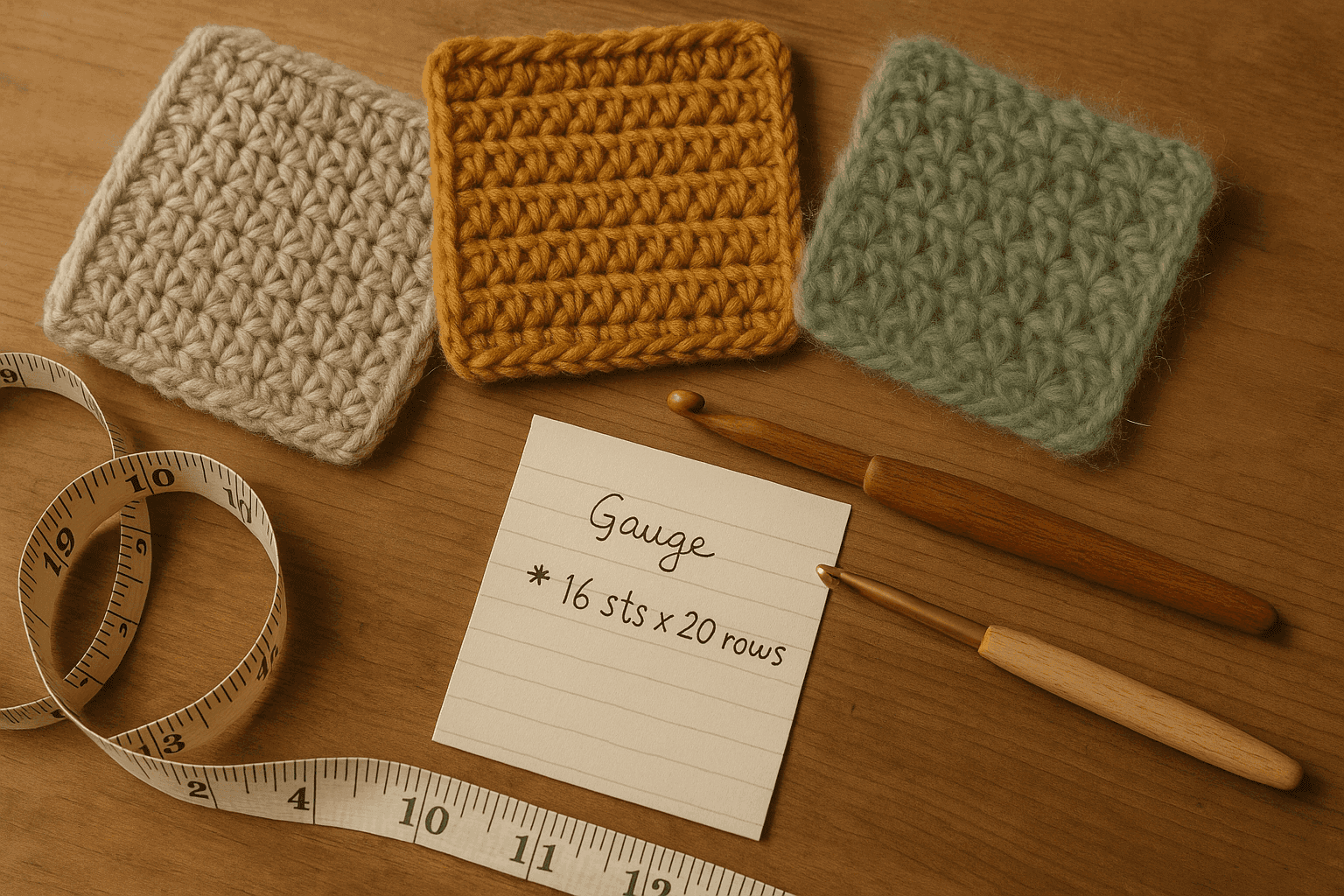
There is a particular kind of crochet surprise that almost every experienced maker meets sooner or later: the swatch looked crisp, airy, and neatly defined on the hook, and then after washing it became softer, fuller, and just a little more itself. The lace holes narrowed. The ridges rounded over. The fabric relaxed in one direction and pulled in another. Suddenly the cardigan that seemed slightly open now reads cozy, the cowl that looked sharply textured now feels cloudlike, or the sleeve circumference that matched the math while dry has quietly changed by an inch. That transformation is yarn bloom, and if you understand it well, it stops being a gamble and becomes a design tool.
Bloom is one of the most important but least fully discussed behaviors in crochet fabric. Knitters talk about blocking all the time, but crocheters are just as affected by what happens after a fabric gets wet, dries, and settles. In crochet, where stitches are denser, loops are more structural, and surface texture can be dramatically sculptural, yarn bloom can alter gauge, opacity, drape, and stitch definition in ways that are impossible to ignore. A yarn that looked smooth and architectural in the skein can become plush and gap-filling after washing. Another may barely change at all. A halo-rich yarn can soften every edge in your lace pattern; a tightly spun worsted-prep wool can preserve every line.
If you have ever wondered why one wool granny motif opens beautifully while another seems to fluff shut, why a woolen-spun sweater grows more cohesive after a bath, or why a brushed alpaca blend erases your cable-like post stitches, the answer usually lies in the physical structure of the yarn, not just the fiber label on the band. Fiber prep, staple length, crimp, drafting style, ply structure, spin direction, finishing treatments, and halo all influence bloom. So does your stitch architecture. So does your gauge. So does the way you wash and dry the finished piece.
This is the deep technique conversation: how to predict bloom before you commit, how to swatch for the fabric you will actually wear, how to choose stitches that benefit from expansion, how to compensate when a yarn wants to fill in openwork, and how to finish garments and accessories so the final fabric behaves as designed rather than simply as-hooked.
What crochet yarn bloom really is
In practical crochet terms, bloom is the post-wash expansion, relaxation, and surface change that happens when yarn fibers rehydrate, release tension from spinning and winding, shift into a more settled arrangement, and often lift a halo or fuller outer layer around the stitches. Bloom can mean several different changes happening at once:
- the yarn diameter appears slightly larger
- gaps between stitches become less visible
- the fabric softens and drapes differently
- gauge changes in width, height, or both
- textured stitches become more muted or more cohesive
- the surface becomes fuzzier, warmer, or more matte
- the hand changes from dry/crisp to elastic/plump
The key idea is that bloom is not just “getting softer.” It is a structural change in how the yarn occupies space inside the crochet fabric.
Because crochet stitches stack loops, bars, posts, and turning chains in a comparatively compact architecture, small changes in yarn diameter or halo can produce noticeable visual effects. A yarn that blooms by only a fraction of a millimeter can significantly reduce openness in filet, chain spaces, mesh, V-stitches, and shell lace. In denser stitch patterns, the same bloom can improve cohesion, reduce biasing in open post-work, and make a garment feel more polished and substantial.
Why wool blooms more than some other fibers
Wool is the classic bloom fiber because it has a naturally crimped, elastic structure with scales on the fiber surface. When spun into yarn, wool fibers are compressed, aligned or semi-aligned depending on prep, and held under some degree of tension. Wet finishing allows those fibers to relax and redistribute. The crimp can recover. The strand can puff outward. In some yarns, the loft increases dramatically.
But not all wool behaves the same way. A smooth, combed superwash merino spun tightly may stay comparatively sleek after washing. A woolen-spun Shetland-style yarn may transform from stringy-looking in the skein to beautifully cohesive in fabric. Add mohair or alpaca halo, and the yarn may obscure stitch outlines while also filling empty space.
This is why fiber content alone is never enough for predicting bloom. “100% wool” tells you less than you might think. You also need to know how that wool was prepared and spun.
The structural factors that predict bloom
Fiber prep: woolen vs worsted
This is one of the biggest bloom predictors.
Woolen-prep yarns are made from fibers that are more jumbled and airy rather than fully aligned. They trap more air, feel loftier, and often look a bit matte or fuzzy even before washing. In crochet, woolen yarns often:
- bloom noticeably after wet finishing
- fill in openwork more than expected
- create warmer, lighter fabrics for their apparent thickness
- soften the edge definition of complex textured stitches
- produce cohesive color fields in stranded or tonal work
Worsted-prep yarns are combed so the fibers lie more parallel. They are often smoother, denser, and more defined. In crochet, worsted-prep yarns often:
- retain clearer stitch definition after washing
- show less dramatic expansion into gaps
- display cables, post stitches, and rib textures more crisply
- drape differently because the strand is more compact
- shift gauge less dramatically, though still enough to matter
That does not mean woolen is better for lace or worsted is better for texture in all cases. It means the fabric outcome differs. A woolen lace cowl can become soft and atmospheric; a worsted-prep lace shawl can stay more graphic.
Staple length
Staple length refers to the length of the individual fibers in the yarn. Shorter-staple fibers tend to produce more ends protruding from the yarn surface, especially in loftier yarns. Those ends contribute to softness and visible bloom. Longer-staple fibers can spin more smoothly and may show less halo at the same twist level.
In crochet terms:
- shorter staple + lower twist often means more bloom, more fill-in, softer edges
- longer staple + firmer spin often means smoother surface, stronger line definition
This is why a rustic shortwool can suddenly become velvety after a wash, while a longwool blend may remain lustrous and distinct.
Crimp
Crimp is the natural waviness in wool fibers. More crimp usually means more elasticity and spring. That spring supports bloom because fibers can rebound and occupy more space after they are relaxed and dried.
For crochet, high-crimp fibers often:
- recover well from handling
- pull stitches into a plumper structure
- improve warmth and opacity after washing
- reduce the visual sharpness of negative space patterns if the design is very open
Low-crimp fibers, or fibers like silk and linen blended into wool, may reduce that spring and produce a more fluid, less puffy fabric.
Ply structure
A single, 2-ply, 3-ply, 4-ply, or cabled yarn all behave differently in crochet.
- Singles can bloom beautifully and create soft, painterly surfaces, but may blur stitch definition and pill more readily.
- 2-ply yarns can be lively and elastic, often with pleasant bloom, but sometimes lean or bias if loosely spun.
- 3-ply and 4-ply yarns often create rounder strands that hold stitch shape well; their bloom depends heavily on prep and twist.
- Cabled yarns tend to preserve definition and resist flattening, often showing less apparent bloom in the final surface.
In crochet, round plied yarns often make post stitches and popcorns read cleanly. Lofty lower-twist yarns often make plain stitch fields look richer and more uniform after washing.
Twist level
Twist is a major driver of how much a yarn can expand.
- Lower-twist yarns usually have more potential to bloom because the fibers are less tightly compressed.
- Higher-twist yarns tend to stay more compact, resilient, and defined.
The tradeoff is useful. If you want lace eyelets to remain sharply open, a smoother and perhaps firmer-twist yarn helps. If you want a lightweight yoke to become softly cohesive and warmer after blocking, a lower-twist woolen yarn may be ideal.
Halo fibers: mohair, alpaca, angora, brushed surfaces
Halo is often the most obvious visual bloom factor. Even if the core yarn barely changes diameter, a halo can bridge open spaces and soften edges.
- Mohair tends to create an airy veil that increases warmth and visual softness while reducing stitch crispness.
- Alpaca can add softness and drape, but if brushed or fuzzy it also mutes texture.
- Angora can dramatically soften outlines and fill the surface with a cloudlike bloom.
- Brushed yarns of any blend often obscure intricate stitch architecture.
In crochet, halo fibers especially affect:
- chain spaces n- filet or mesh motifs
- front-post/back-post contrast
- bobbles and popcorns
- colorwork edges
If the design depends on seeing exact stitch anatomy, halo needs to be treated as part of the pattern, not an afterthought.
Superwash vs non-superwash
Superwash treatment can reduce some of wool’s natural tendency to grab and full, but it does not eliminate bloom entirely. Many superwash yarns soften and relax significantly after washing, and some grow in length due to reduced fiber friction and increased drape.
Non-superwash wool often blooms more visibly in surface fullness and can lightly full, especially with agitation. It may also pull in slightly as fibers settle together.
That means:
- superwash garments often need close attention to vertical growth
- non-superwash lace may become less open but more cohesive
- fit calculations must consider not just stitch gauge, but blocked gauge
How bloom changes the crochet fabric you see and feel
1. Openwork fills in
This is the bloom effect crocheters notice first. Open patterns become less open. Not closed, usually, but softened.
A chain-1 space in a fingering wool lace may remain distinct after washing. A chain-1 space in a sport-weight woolen-spun yarn with halo may nearly disappear into a textured field. A chain-3 arch may still read as open, but its edges become rounded rather than sharp.
As a rough guide:
- small eyelets and chain-1 spaces are most vulnerable to fill-in
- chain-2 spaces may remain visible but shrink in apparent size
- chain-3 to chain-5 spaces usually survive bloom, though shape softens
- mesh worked at tight gauge can become much more opaque than expected
2. Gauge shifts
Bloom can change stitch gauge horizontally, vertically, or both.
Common post-wash outcomes include:
- stitches becoming wider as the yarn puffs and fills out
- rows becoming shorter as the loops settle and compact
- fabric growing longer under its own weight if the yarn gains drape after washing
- motifs changing shape from slightly angular to more rounded or square
There is no universal rule that bloom always shrinks or always grows the fabric. The interaction between stitch structure and yarn matters too much.
For example:
- a woolen-spun DK swatch in half double crochet may tighten horizontally as stitches nest together, while gaining loft and losing visible holes
- a superwash merino treble-lace swatch may grow vertically because the softened yarn drapes more heavily
- a brushed alpaca blend in double crochet may change very little in measured width but appear denser because the halo spans gaps
3. Opacity increases
Even when stitch counts do not change much, bloom often increases opacity. More of the background disappears between stitches. This is crucial for garments, especially fitted tops, yokes, and lightweight layering pieces.
A swatch that looked breezy over your hand might become modest enough after washing. Or, if you were aiming for dramatic openwork, it may become disappointingly tame.
4. Surface definition changes
Bloom alters how strongly each stitch type reads.
- Plain stitches like single crochet and half double crochet often look more luxurious after bloom because the field becomes smooth and cohesive.
- Ridges and ribs can become softer and rounder.
- Post stitches may lose some carved contrast if halo is high.
- Bobbles/popcorns can become plumper but less sharply outlined.
- Lace motifs often become more romantic and less architectural.
5. Drape changes
Wet finishing can either increase drape or create a springier, fuller hand depending on the fiber and spin.
- woolen-spun wool often feels loftier and more elastic after washing
- superwash merino can become silkier and heavier in drape
- alpaca-rich blends may relax significantly and hang longer
- high-twist yarns may retain a more sculpted fabric behavior
How to swatch specifically for bloom
If you only swatch dry, measure immediately, and start crocheting, you are swatching for the wrong fabric. You are making a pattern for the as-hooked state, not the finished state.
A bloom-conscious swatch should imitate the final life of the piece.
Swatch size
For garments and fitted accessories, make a swatch at least 6 x 6 in / 15 x 15 cm, and preferably 8 x 8 in / 20 x 20 cm if the stitch pattern is open or highly textured. Tiny swatches lie.
Why larger matters:
- edge distortion affects fewer stitches proportionally
- bloom in the center of the swatch is more realistic
- drape and weight interactions become visible
- you can measure stitch and row gauge after relaxing the fabric properly
Hook choices for testing
If the pattern suggests one hook, test at least three if bloom is likely:
- recommended hook
- one size smaller
- one size larger
For example, with a DK woolen-spun yarn, if the nominal hook is 4.0 mm/G-6, test 3.75 mm/F-5, 4.0 mm/G-6, and 4.5 mm/7.
Record each swatch with:
- yarn name and lot
- hook size
- stitch pattern
- dry stitch gauge over 4 in / 10 cm
- dry row gauge over 4 in / 10 cm
- washed and dried stitch gauge
- washed and dried row gauge
- notes on opacity, hand, halo, and stitch clarity
How to wash the swatch
Use the real finishing method.
For a wool sweater swatch:
- Soak 15–20 minutes in lukewarm water.
- Add wool wash if that is how you will launder the garment.
- Gently squeeze out water; do not wring.
- Roll in a towel and press firmly.
- Lay flat, shaping as you would the garment.
- Let dry completely before measuring.
If you plan to steam-block, pin aggressively, or machine-wash, test exactly that. Different finishing methods create different bloom outcomes.
What to measure
Measure in the center of the swatch. Count full stitches and rows over 4 in / 10 cm. If the pattern repeat is large, measure over 5 or 6 in and convert.
Also note:
- did chain spaces visibly shrink?
- did ridges flatten or sharpen?
- did the swatch pull in at the edges?
- did it gain length when hanging?
- can you still see the stitch architecture clearly?
- is the fabric appropriate for the intended use?
A simple bloom worksheet
For each swatch, compare:
- dry stitch gauge: 16 sts and 10 rows = 4 in
- washed gauge: 15 sts and 11 rows = 4 in
Interpretation:
- fewer stitches over 4 in means each stitch became wider
- more rows over 4 in means each row became shorter
- result: fabric widened and compacted vertically
Or:
- dry gauge: 14 sts and 9 rows = 4 in
- washed gauge: 14 sts and 8 rows = 4 in
Interpretation:
- stitch width stable
- rows elongated
- result: likely increased drape and vertical growth
Choosing stitch architecture that benefits from bloom
Bloom is easiest to manage when you choose stitches that welcome it.
Stitch patterns that often benefit from bloom
1. Simple stitch fields
Single crochet, extended single crochet, half double crochet, and linked stitches often become richer and more even after bloom. Wool bloom can hide tiny tension inconsistencies and create a polished cloth.
2. Moderate openwork
V-stitches, chain-2 spaces, arches, and filet-style motifs with generous openings can become softer and more wearable after washing, especially in shawls and cowls.
3. Gentle texture
Low-relief texture like griddle stitch, linen stitch, or subtle post-stitch ribs can become more cohesive and pleasant in hand once the yarn settles.
4. Color-led fabrics
Marls, heathers, hand-dyed semisolids, and rustic tonal yarns often look especially good when bloom softens the stitch-by-stitch contrast and lets the fabric read as a whole.
Stitch patterns that need caution with bloom
1. Tight mesh or tiny lace
Chain-1 meshes and very small eyelets can nearly vanish in lofty or haloed yarns.
2. Highly architectural lace
If the beauty of the fabric depends on sharp geometry, strongly blooming yarns may fight your intent.
3. Deep post-stitch textures
Halo and bloom can blur dramatic relief patterns, especially in darker colors.
4. Crisp crochet cables or faux cables
Use smoother, more defined yarns if line clarity matters.
Modifying patterns to account for bloom
Once you know a yarn will bloom, you can adjust the pattern before the project gets large.
Increase negative space intentionally
If lace is likely to fill in, enlarge the openings.
Possible modifications:
- replace some ch-1 spaces with ch-2
- replace some ch-2 spaces with ch-3 in motifs where geometry allows
- space shells or fans with an extra chain
- use taller stitches to maintain openness
Example: A mesh panel written as dc, ch 1, sk 1 may become too dense in a woolen-spun sport yarn. Try dc, ch 2, sk 2 on the swatch and compare after washing.
Change hook size strategically
A hook increase of just 0.5 mm can preserve openness in a blooming yarn. But larger is not always better. If the fabric becomes too loose before washing, bloom may turn it into a weak or unstable cloth.
General approach:
- if bloom closes lace, test one hook size up
- if bloom creates too much spread in a garment, test one hook size down
- always compare washed swatches, not dry feel
Adjust stitch counts for fit-sensitive garments
If washed gauge changes from 16 sts = 4 in to 15 sts = 4 in, that one-stitch difference matters.
A 40 in bust at 16 sts per 4 in:
- 4 sts per in × 40 in = 160 sts
At 15 sts per 4 in:
- 3.75 sts per in × 40 in = 150 sts
That is a difference of 10 stitches across the circumference. If you crochet to the dry gauge and the yarn blooms wider after washing, the garment can end up too large.
Similarly, if row gauge shifts, armhole depth, yoke depth, body length, and sleeve length can all change.
Use firmer support stitches around edges
A fabric may bloom beautifully in the body but lose edge clarity. Stabilize with:
- single crochet borders
- slip stitch edgings
- smaller-hook finishing rounds
- reinforced shoulder seams in garments
- neckline facings or hidden elastic/thread support where appropriate
Reserve halo yarns for simpler motifs
If the yarn has strong halo, let the fiber be the star. Use larger, cleaner shapes rather than fussy, intricate stitch motifs.
Step-by-step: planning a bloom-conscious crochet project
Step 1: Identify the yarn’s likely behavior
Before swatching, ask:
- Is it woolen or worsted prep?
- Is the yarn airy or compact in the skein?
- Is twist low, medium, or firm?
- Is there visible halo?
- Is there alpaca, mohair, angora, or brushed texture?
- Is it superwash or non-superwash?
Prediction examples:
- Lofty woolen non-superwash DK: likely to bloom, fill in gaps, and become more cohesive.
- Smooth tightly plied superwash merino worsted: likely to relax, perhaps grow vertically, but preserve stitch definition fairly well.
- Brushed alpaca silk lace held double: likely to obscure fine stitch detail and increase opacity.
Step 2: Match the stitch pattern to the yarn
Choose architecture that suits the bloom.
- For strong bloom, favor larger lace openings, simple shaping, and broad textures.
- For crisp texture, choose a smoother yarn or reduce halo.
- For garments requiring exact fit, avoid guessing and build from washed gauge only.
Step 3: Swatch at multiple hooks
Make at least two, ideally three, washed swatches. Include enough repeats to show the true fabric behavior.
Suggested minimum for a garment swatch:
- foundation long enough for 24–30 stitches or more depending on stitch pattern
- work until swatch height is 6–8 in
If using motifs, make at least 3 motifs and wash all three. Single motifs can distort differently from joined fabric.
Step 4: Wash, dry, and hang test if needed
For sweaters, tunics, and shawls, try a hang test. Clip the dry swatch vertically for several hours using light weights similar to fabric stress, or simply hang it from one edge if that mimics wear. Measure before and after.
This is especially useful for:
- superwash wool
- alpaca blends
- long garments
- open stitch fabrics
Step 5: Recalculate from finished gauge
Use the washed, rested swatch as the only real gauge.
If your target is a 38 in finished bust and your washed gauge is 3.5 sts per inch, then:
- 38 × 3.5 = 133 sts
Round to the nearest pattern repeat that preserves shaping symmetry.
For rows, if washed row gauge is 2.75 rows per inch, and your armhole depth needs to be 8 in:
- 8 × 2.75 = 22 rows
Step 6: Build ease with bloom in mind
A fabric that becomes denser and less open after washing often feels warmer and more substantial, so it may need slightly more wearing ease than the dry fabric suggests.
Conversely, a drapier superwash or alpaca blend may need less length ease because it can grow.
Step 7: Finish deliberately
When the project is complete, wash and shape with the intended final dimensions in mind. Measure while drying.
For garments:
- pin shoulder width if it tends to stretch
- check body circumference at chest, waist, and hem
- smooth lace panels evenly rather than over-stretching one section
- support collars and button bands so they dry straight
Troubleshooting bloom problems
Problem: The lace nearly disappeared after washing
Cause: openings were too small for the yarn’s loft or halo.
Fixes:
- re-swatch with a larger hook, typically 0.5–1.0 mm up
- substitute ch-2 for some ch-1 spaces
- choose a smoother or firmer-spun yarn
- reserve this yarn for simpler openwork
Problem: The garment grew longer than expected
Cause: washed row gauge changed, often in superwash or drapey blends.
Fixes:
- reduce body and sleeve length before washing
- use hanging swatches before starting
- add structural seams or shoulder stabilization
- choose a smaller hook for more supportive fabric
Problem: Texture looks blurred
Cause: halo or bloom softened relief.
Fixes:
- increase texture scale rather than using many tiny details
- use front-post stitches with deeper spacing
- switch to a plied, smoother yarn
- choose lighter colors if texture is disappearing in dark yarn
Problem: Fabric became too opaque
Cause: bloom filled the gaps and lifted surface fibers.
Fixes:
- enlarge chain spaces
- use taller stitches
- crochet more loosely with control, not slackness
- choose a lower-halo yarn for the same pattern
Problem: The swatch edges curled or pulled inward after washing
Cause: dense stitch architecture plus yarn contraction or post-wash settling.
Fixes:
- add a border to test stabilization
- use a taller stitch mix
- increase hook size slightly
- verify that the stitch pattern itself is balanced
Problem: Motifs changed shape after blocking
Cause: bloom altered the internal tension of the motif.
Fixes:
- block all motifs to a template
- adjust round spacing in the motif design
- test join method on washed motifs
- consider adding or reducing corner chains
Fiber-by-fiber expectations in crochet
These are tendencies, not laws, but they can help you predict outcomes.
Woolen-spun wool
Expect:
- strong bloom potential
- increased cohesion after washing
- softened stitch edges
- excellent warmth-to-weight ratio
- possible fill-in of small openwork
Best uses:
- sweaters
- cowls
- hats
- shawls with moderate or generous lace
- rustic or tonal texture fields
Worsted-prep wool
Expect:
- clearer stitch definition
- more stable linework
- moderate bloom depending on twist
- good performance in cables, ribs, and sculptural textures
Best uses:
- fitted garments
- textured accessories
- polished everyday crochet
- motifs where geometry matters
Merino superwash
Expect:
- softness increase after washing
- possible vertical growth
- moderate bloom but often less rustic puffing
- sleek stitch surface
Best uses:
- garments requiring softness against skin
- baby items
- polished accessories
Watch for:
- stretching in long lengths
- looser necklines or shoulders if unsupported
Mohair blends
Expect:
- significant halo effect
- reduced stitch crispness
- increased warmth and visual softness
- openwork appearing more atmospheric than defined
Best uses:
- wraps
- soft sweaters
- accessories where haze is a feature
Alpaca-rich yarns
Expect:
- drape increase
- some halo depending on finish
- less elastic rebound than wool
- possible growth with wear
Best uses:
- drapey shawls
- elegant garments
- soft cowls
Watch for:
- length growth
- reduced resilience in heavily textured patterns
Practical pattern adjustments by project type
Sweaters and cardigans
Prioritize washed gauge and shoulder stability. If the yarn blooms wider, recalculate circumference. If it grows longer, reduce pre-wash length. For openwork yokes, make sure the post-wash openness still suits the style.
Good approach:
- swatch body stitch and any lace panels separately
- test neckline edging on the swatch
- measure after 24 hours dry rest
Shawls and wraps
Bloom can be your friend here. It can turn slightly wiry crochet into graceful cloth. You can often tolerate more gauge shift, but still watch whether motifs fill in too much.
Good approach:
- use larger arches if the yarn is lofty
- block assertively if definition matters
- expect halo to soften point edges
Hats
Bloom often improves comfort and warmth, but gauge changes can affect fit significantly because hats rely on negative ease.
Good approach:
- swatch in the round if possible
- wash the swatch exactly as the hat will be washed
- if the yarn blooms and relaxes, aim for firmer pre-wash tension
Cowls and scarves
These are excellent bloom-friendly projects. A yarn that softens and fills in can become especially luxurious.
Good approach:
- decide whether you want visible openwork or just lightness
- use larger chain spaces for lacier outcomes
- embrace simple stitch repeats in halo yarns
Blankets
Bloom can make blankets feel more unified and warmer. But motif blankets need motif testing because squares can change size after washing.
Good approach:
- wash several motifs together
- measure each motif after drying
- account for cumulative size changes across many repeats
Common mistakes crocheters make when dealing with bloom
- Trusting the skein appearance too much. A stringy-looking wool can become magnificent after washing.
- Measuring immediately after crocheting. Fresh fabric is still under tension from your hands.
- Ignoring row gauge. Vertical growth can ruin otherwise correct fit.
- Using tiny lace openings with fuzzy yarn. The pattern and yarn are working against each other.
- Blocking the swatch gently but the garment aggressively. The swatch must match reality.
- Skipping support on superwash garments. Softness is lovely; sagging is not.
- Choosing highly textured stitches for halo yarns. Complexity disappears into the fuzz.
A quick decision framework before you start
Ask these five questions:
- Will this yarn likely puff, halo, or relax after washing?
- Do I want the finished fabric to be crisp, airy, soft, opaque, drapey, or sculptural?
- Are my stitch openings large enough to survive bloom?
- Does the washed gauge support the intended fit?
- Will the final finishing method reinforce or undo the fabric behavior I want?
If you can answer those honestly from swatching, you are already ahead of most pattern mishaps.
The biggest takeaway: design for the washed fabric
The most reliable mental shift is this: crochet is not finished when the last end is woven in. The real fabric is the washed fabric. That is the fabric that will be worn, folded, stretched over shoulders, pulled onto hands, and seen in daylight. Bloom is not a problem to correct after the fact. It is a stage of construction that belongs in your planning.
When you learn to read yarn structure, you stop being surprised by post-wash transformation. You begin to expect the woolen-spun skein to fill in your mesh just a little. You know that the brushed halo blend will blur your tiny ribs. You understand that the smooth plied wool will keep your stitches visible, and that the superwash cardigan needs support so the shoulder seams stay where they belong.
That knowledge makes you a stronger crocheter and a more intentional designer. It lets you choose larger chain spaces before disappointment, add ease before stretching, downshift texture before it vanishes, and embrace bloom where it adds luxury, warmth, and beauty.
In other words, once you start crocheting for bloom instead of in spite of it, your finished pieces begin to feel less accidental and more deeply crafted. And that is one of the most satisfying developments in a maker’s life: when the project after washing looks not surprising, but exactly as you meant it to become.