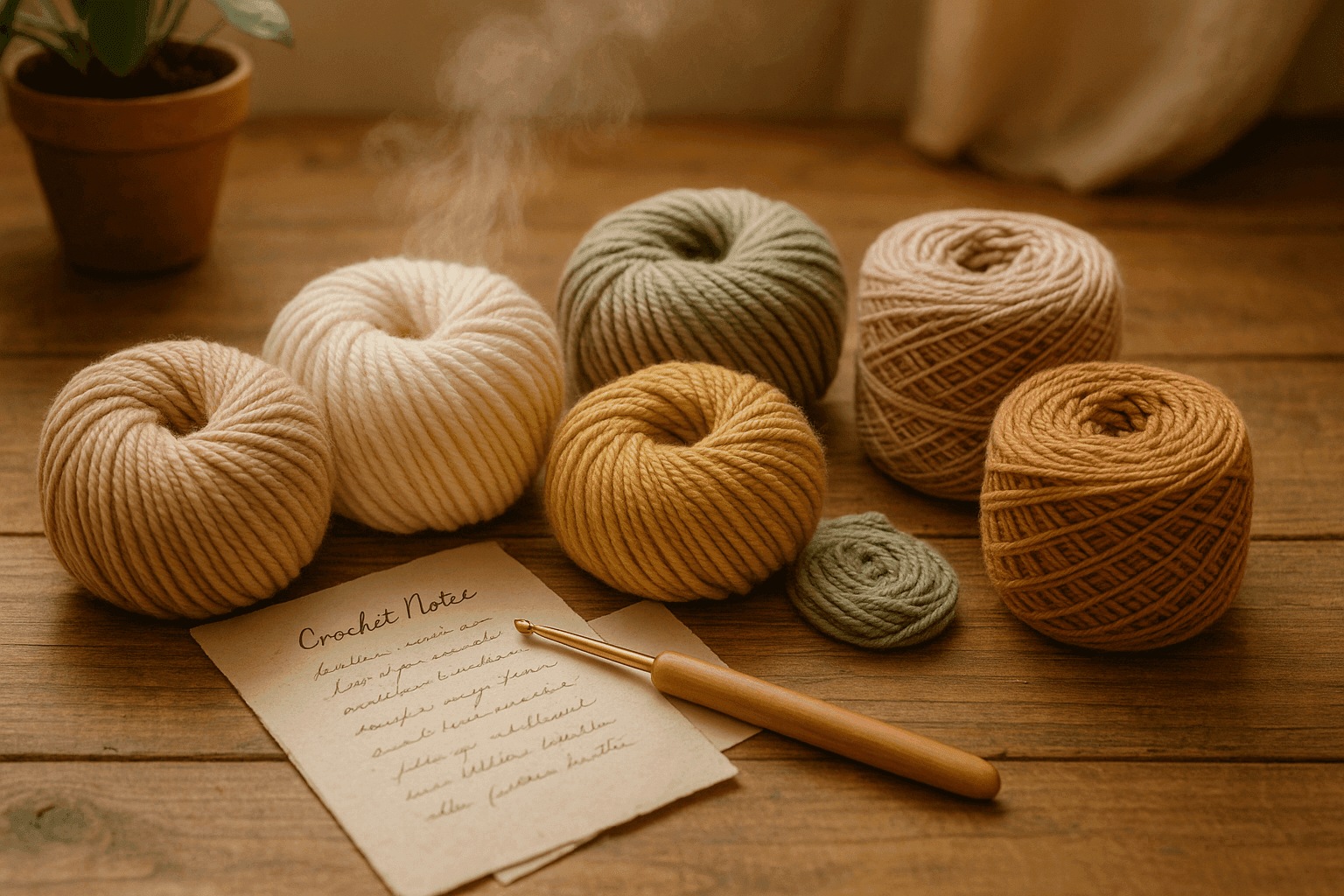
You know the moment: you have the perfect pattern, a hook you trust, and yarn that looked beautiful in the shop or in the online listing. You chain a few rows, settle into your rhythm, and then something starts to feel off. The yarn wants to corkscrew around itself. Your stitches look tighter than they did in the swatch. The fabric leans slightly to one side, or the strand splits more than expected, or the center-pull starts coughing up a heap of tangled yarn halfway through the first repeat. None of this is dramatic enough to count as a full disaster, yet all of it changes the way crochet feels in your hands.
That “off” feeling is often yarn energy.
Crocheters talk a lot about fiber content, drape, halo, elasticity, and ply structure, but less often about the hidden tension stored in a skein before we ever make the first stitch. Yarn remembers how it was spun, plied, dyed, wound, shipped, shelved, and handled. It carries residual twist. It responds differently depending on whether you pull from the center or the outside. It may tighten or relax when rewound into a cake. It may soften after a rest period or after a little steam. And because crochet adds twist through repeated hook motion, the way yarn enters your hand can absolutely change gauge, stitch definition, bias, tangling, and hand fatigue.
If you have ever wondered why the same yarn behaves beautifully in knitting but fights you in crochet, or why one skein from the same batch feels livelier than the next, this is the missing layer of understanding. Skein management is not fussy extra work. It is a technical skill that helps you engineer smoother fabric before the first stitch.
In this guide, we will look closely at what yarn energy is, how to spot it, how pull direction changes feed consistency, when rewinding helps and when it does not, how resting and steam relaxing can improve behavior, and how your own crochet motion interacts with yarn twist. I will also give you a practical workflow for testing and managing yarn structure, plus troubleshooting for common problems like kinking, yarn barf, bias, and splitty stitches.
What crocheters mean by yarn energy
Yarn energy is the stored tendency of yarn to twist, untwist, kink, recoil, torque, or shift its structure when tension is released. It comes from several sources working together:
- Single and ply twist from spinning and plying
- Residual torque left in the yarn after manufacture
- Factory winding tension in skeins, balls, donuts, hanks, or cones
- Moisture and finishing treatments from dyeing and setting
- Compression and storage during shipping and shelving
- The direction and speed of feed while you crochet
- The extra twist introduced by your hook motion and yarn handling
A yarn can be technically well made and still feel energetic. In fact, some lively yarns produce excellent stitch definition because they have strong structure. The goal is not to eliminate all energy. The goal is to understand whether the yarn’s stored twist is helping or fighting your specific crochet project.
When yarn energy is balanced, the strand feeds smoothly, plies stay coherent, the hook catches predictably, and the fabric lies flat. When the energy is mismatched to the project, you may see:
- Yarn kinking ahead of the hook
- Plies loosening or over-tightening as you work
- Stitch columns slanting or fabric biasing
- More frequent tangles from center-pull collapse
- Inconsistent gauge between skeins or between sessions
- Increased hand and wrist fatigue from fighting the strand
- More splitting, snagging, or ropey-feeling stitches
Why crochet is especially sensitive to yarn twist behavior
Crochet is not neutral. Every stitch asks the yarn to bend sharply, wrap around the hook, and pass through loops under tension. Compared with many knitted fabrics, crochet structures are denser and involve more repeated manipulation in shorter lengths of yarn. That means crochet amplifies problems in feed consistency.
Your hook motion may also add or subtract twist from the working yarn depending on:
- Whether you crochet right-handed or left-handed
- Whether you knife-hold or pencil-hold the hook
- How the yarn wraps through your tension hand
- Whether you rotate the hook aggressively during yarn-over and pull-through
- Whether you frequently let the work or hook dangle and spin
This is why one crocheter can declare a yarn dreamy while another finds it maddening. The yarn is only half the story. The interaction between yarn structure and your motion is the other half.
Twist basics: S-twist, Z-twist, and residual torque
Most commercial yarn is made by spinning fibers into singles and then plying those singles together. Each stage introduces twist. If the visible slant of the yarn resembles the middle stroke of the letter S, it is S-twist. If it resembles the middle stroke of Z, it is Z-twist.
You do not need a spinner’s technical vocabulary to use this information practically, but it helps to know one key point: the direction in which your crochet motion encourages the yarn to rotate can either tighten the ply or loosen it.
When your motion loosens the ply:
- The strand may flatten out
- Individual plies may separate
- The hook may split the yarn more often
- Fabric can look fuzzier or less crisp
When your motion tightens the ply:
- The strand may feel wiry or ropey
- The yarn may kink up before the hook
- Gauge may tighten slightly
- Hand fatigue can increase because the yarn resists bending
Residual torque is what you see when yarn, left hanging freely, wants to twist back on itself. A moderate amount is normal. A strong tendency to coil is a sign that the yarn is carrying active twist energy that may affect your crochet.
How to diagnose yarn energy before you start
A few simple tests can tell you a lot. I strongly recommend doing these before you swatch, especially for garments, large blankets, lace, Tunisian crochet, and any pattern where stitch definition matters.
1. The hanging strand test
Pull out 18 to 24 inches of yarn. Hold one end and let the rest hang freely.
Watch for:
- Does the yarn hang straight?
- Does it begin twisting around itself?
- Does it form loops or kinks near the lower end?
- Do the plies open up or tighten visibly?
Interpretation:
- A straight, relaxed strand usually means manageable energy.
- A strand that quickly twists into little corkscrews has strong residual torque.
- A strand that untwists and opens may be vulnerable to splitting under your crochet motion.
2. The hook-and-dangle test
Make 10 to 15 chain stitches with your planned hook, then stop and let the hook dangle from the working loop for a moment.
Watch for:
- Does the hook spin?
- Does the work itself rotate?
- Does the working yarn wind tighter above the hook?
Interpretation:
- If the work repeatedly twists in one direction, your motion is introducing additional twist. That may be fine, but if you are already seeing kinks, it confirms that twist buildup is part of the problem.
3. The two-minute swatch test
Work a tiny swatch, about 20 stitches wide and 10 rows tall, in the stitch pattern you plan to use.
For example:
- Single crochet swatch: ch 21, work 20 sc per row for 10 rows
- Half double crochet swatch: ch 22, work 20 hdc per row for 10 rows
- Double crochet swatch: ch 23, work 20 dc per row for 10 rows
Use the hook size recommended on the yarn label as a starting point, then compare with your pattern. Common pairings:
- Fingering weight: 2.25 to 3.5 mm
- Sport weight: 3.0 to 4.0 mm
- DK weight: 3.5 to 4.5 mm
- Worsted weight: 4.5 to 6.0 mm
- Bulky weight: 6.0 to 9.0 mm
Look for:
- Are stitches crisp or ropey?
- Is the swatch leaning?
- Is one row height inconsistent with another?
- Are your hands getting tired unusually fast?
- Is the yarn feeding with little jerks?
4. The untwist test
Pinch the yarn close to the hook and allow a short section between your hand and the skein to relax. If it immediately twists into a kink, you have active twist buildup during working, even if the skein itself seemed calm.
5. The ply-split test
Insert your hook into a loose chain or swatch stitch several times.
- If the hook catches between plies often, your motion may be loosening the yarn too much.
- If the yarn feels hard and wiry, your motion may be tightening the twist too much.
Pull direction: center-pull versus outer-pull
This is where skein management starts making a real difference.
Center-pull
Center-pull is convenient for many crocheters because the yarn source stays put and does not roll around. Tension can feel steady at first. But center-pull also changes the structure of the package as you work.
Potential benefits:
- The skein usually remains stationary
- Less chasing a rolling ball across the room
- Easy to work from a project bag
- Often smoother for the first section of the skein if the core is cleanly wound
Potential drawbacks:
- “Yarn barf” when the center core collapses and brings out a clump
- Feed tension changes as the internal structure empties
- The strand may rub against inner wraps and pick up intermittent drag
- The shell of the skein can collapse inward and tangle
- Twist may build if the yarn snakes out in little turns rather than releasing smoothly
A clean center-pull can be excellent. A messy one can add enough inconsistency to alter your rhythm and slightly alter your gauge, especially in tight stitch patterns.
Outer-pull
Outer-pull lets yarn unwind from the outside of the package.
Potential benefits:
- Often a more direct release path with fewer internal collapses
- Easier to see knots, weak spots, or twist inconsistencies
- Less risk of dramatic center-collapse tangles
- Can reduce internal drag in some factory-wound skeins
Potential drawbacks:
- The ball or skein may roll, bounce, or spin away
- If the package spins freely, it can add or subtract twist depending on direction
- Tension may vary if the yarn catches under a wrap
- Not always practical in a crowded bag or travel project
Which is better?
Neither is universally better. The useful question is: Which pull direction gives this yarn the smoothest, least torque-heavy feed for this crocheter in this project?
As a rule of thumb:
- Choose center-pull if the skein is wound cleanly, the yarn is stable, and you want a stationary source.
- Choose outer-pull if center-pull is collapsing, if the yarn is twisting up as it exits the core, or if you want to monitor the strand more actively.
- If both feel inconsistent, rewind into a cake or ball and test again.
Factory winding and why it matters
The shape you buy is not neutral. Yarn comes in hanks, twisted skeins, pull-skeins, balls, donuts, cones, and cakes. Factory winding compresses yarn under tension. Sometimes that tension is modest. Sometimes it is enough to leave the strand lively, flattened, or slightly over-organized.
A few common scenarios:
- Hanks usually preserve the yarn more gently but must be wound before use.
- Tightly wound pull-skeins can store compression and internal drag.
- Donut balls may release smoothly from the outside but can snag if wraps slip.
- Cones are often excellent for consistent feed because the yarn is meant to draw off evenly, especially for high-yardage projects.
- Retail cakes can be convenient but may still carry tension from winding, especially if wound quickly.
If your yarn feels springier or kinkier straight from the package than it does after being rewound and rested, you are seeing the effect of package tension as much as twist structure.
Rewinding into cakes, balls, or cones
Rewinding is one of the most effective interventions for difficult yarn, but it is not magic. The way you rewind matters.
When rewinding helps
Rewinding is most useful when:
- The original center-pull collapses repeatedly
- The yarn exits with jerky resistance
- You see kinks forming every few stitches
- The skein is misshapen or partially tangled
- You want to inspect for knots, joins, thick-thin areas, or damage
- You need a more stable feed for gauge-critical work
When rewinding may not help much
- The yarn itself is fundamentally overtwisted
- The ply structure is poorly balanced
- Your crochet motion is adding most of the twist problem
- The yarn is novelty-textured and naturally inconsistent
Best practice for rewinding
If you have a swift and winder, use them gently. Fast winding creates its own tension.
- Open and inspect the yarn source. If working from a hank, make sure the loop is untwisted and all ties are identified.
- Wind at moderate speed. Avoid pulling hard. Let the yarn travel smoothly.
- Do not over-tighten the cake. A dense, hard cake can reintroduce compression.
- Label the outside. Keep ball band details with the new package.
- Let the cake rest. Even a few hours can help. Overnight is better if the yarn was tightly wound.
For hand-winding into a ball:
- Wind around two fingers first, then rotate frequently
- Keep the ball airy rather than dense
- Change direction often enough to avoid creating a hard core
Does rewinding change gauge?
It can, indirectly.
If rewinding reduces drag and active kinking, your tension may relax and your stitches may become slightly taller or wider. If the original package was fighting you, a rewound cake may give you a looser gauge with better stitch consistency. This is exactly why swatching should be done from the yarn state you plan to use for the real project.
If you swatch from the original pull-skein and then crochet the project from a relaxed cake, gauge can shift. The difference may be small, but for garments even a quarter stitch per inch matters.
Steam relaxing and resting yarn
Sometimes the yarn needs time more than intervention. Sometimes it benefits from a little moisture and warmth.
Rest periods
A rest period lets yarn redistribute tension after winding.
Helpful after:
- Rewinding a hank into a cake
- Undoing a tangled center-pull core
- Frogging a large amount of yarn
- Unraveling a previous project
A practical rule:
- Minimum: 2 to 4 hours
- Better: overnight
- Best for stubborn reclaimed yarn: 24 hours or more after rewinding
Steam relaxing
Steam can soften memory from winding and reduce surface liveliness, especially in wool, wool blends, some acrylics, and plant-fiber blends. It is not suitable for every yarn in the same way, so always test first.
To steam relax a cake or hank lightly:
- Place the yarn where it can be exposed to steam without getting wet.
- Hold a steamer or steam iron several inches away.
- Let steam pass over the yarn briefly.
- Do not press the iron onto the yarn package.
- Let the yarn cool and dry fully before use.
For sensitive fibers, less is more. You are not blocking fabric here. You are encouraging the yarn to relax from package stress.
Cautions:
- Acrylic can be permanently altered by too much heat.
- Superwash wool can behave differently from non-superwash wool.
- Cotton may relax somewhat but may not lose torque if the issue is structural twist rather than compression.
- Silk and linen should be tested carefully.
When yarn barf changes feed consistency
Yarn barf is not just annoying; it changes how the yarn feeds.
When a center-pull coughs up a clump, several things happen at once:
- The strand may feed from a temporary tangle point rather than a clean inner core
- Tension alternates between slack and drag
- The working yarn may twist around itself as the clump shifts
- You may unconsciously tighten your grip or alter your tension to compensate
That can affect gauge in the moment. Usually the difference is subtle, but in repetitive crochet the body notices everything. A few rounds worked while fighting a collapsing core may come out tighter, shorter, or less even.
What to do when yarn barf appears
- Stop immediately if the clump is large.
- Gently separate the outer shell from the center tangle.
- If the core looks unstable, rewind the remainder into a cake or ball.
- If you continue center-pull, place the skein in a yarn bowl or bag so the shell stays supported.
- After fixing the feed, work a few inches and compare tension with the previous section.
If this happens in a gauge-sensitive garment piece, mark the row where feed conditions changed. If you later notice a visible difference, you will know why.
Hook motion, handedness, and yarn twist interaction
This is one of the least discussed but most useful diagnostics.
Right-handed and left-handed crocheters often report opposite experiences with the same yarn. That is not imaginary. The direction of wrapping during yarn-over and the tiny rotations in pulling through loops can either tighten or loosen the plies.
Signs your motion is loosening the yarn
- The hook repeatedly splits the strand
- The yarn looks flatter just before entering the stitch
- Ply separation increases in taller stitches like dc and tr
- Stitch definition looks soft rather than crisp
Possible fixes:
- Rotate the hook less during yarn-over
- Shorten the distance between tension hand and hook slightly
- Try feeding from the opposite end of the rewound cake
- Test outer-pull if you were using center-pull
- Go down 0.25 to 0.5 mm in hook size if the fabric also seems too loose
Signs your motion is tightening the yarn
- The working yarn kinks in little loops ahead of the hook
- The strand feels wiry or telephone-cord-like
- Your hands tire quickly
- Gauge gets tighter as the session goes on
Possible fixes:
- Pause periodically and let the hook or work dangle to release twist
- Try center-pull versus outer-pull, whichever reduces added rotation
- Rewind into a cake and let it rest
- Increase hook size by 0.25 to 0.5 mm if the fabric is too dense
- Reduce how much you roll the hook in your hand during pull-throughs
Stitch choice and fabric behavior
Different crochet stitches react differently to energetic yarn.
Single crochet
Single crochet is compact and exposes tension issues quickly. If the yarn is overtwisting, sc fabric may become dense, stiff, and slightly skewed.
Test swatch: ch 21, work 20 sc for 12 rows.
Watch for:
- Horizontal tightness
- Ropey top loops
- Bias at the side edges
Half double crochet
Hdc can be a useful diagnostic stitch because the yarn-over adds another chance for twist interaction.
Test swatch: ch 22, work 20 hdc for 12 rows.
Watch for:
- Uneven third loop appearance
- Inconsistent row height
- Splitting during yarn-over
Double crochet and taller stitches
Taller stitches showcase stitch definition but also expose loose plies.
Test swatch: ch 23, work 20 dc for 10 rows.
Watch for:
- Split yarn during insertion or pull-through
- Variable post thickness
- Leaning stitch columns if feed is inconsistent
Lace and openwork
Lace magnifies kink memory because the yarn has room to show its natural behavior. A twisty yarn may not relax into clean eyelets until blocked or steamed.
Textured stitches
Post stitches, bobbles, popcorns, and cables require repeated wrapping and turning. If the yarn is already energetic, textured sections can become noticeably tighter than surrounding plain stitches.
Bias, gauge drift, and stitch definition
Yarn energy does not just affect the strand; it affects the finished fabric.
Bias
Bias in crochet can come from stitch architecture alone, but yarn torque can increase it. If your fabric persistently leans, ask whether:
- The yarn is overtwisted
- The working strand is twisting tighter as you crochet
- The pull direction is adding rotation
- Your stitch pattern naturally slants and the yarn is exaggerating it
Gauge drift
Gauge drift happens when your stitches change size over time, not just because of mood or posture, but because the yarn feed changes.
Common causes:
- Beginning with a compact factory skein and finishing from a relaxed remainder
- Switching from center-pull to outer-pull mid-project
- Rewinding partway through
- Working through a yarn barf section with extra drag
- Crocheting longer without releasing twist buildup
Stitch definition
Balanced yarn often gives clean, stable definition. But if the yarn gets over-tightened in use, that definition can turn harsh and corded. If the plies loosen too much, the surface gets fuzzy and indistinct. Good skein management aims for the middle ground: coherent plies, smooth feed, no fight.
A practical pre-project workflow
Here is the process I recommend when you want your yarn to behave well from the start.
For hanks
- Inspect label for fiber, weight, and care.
- Wind the hank into a cake at moderate tension.
- Let it rest overnight if possible.
- Do the hanging strand test.
- Test both feed directions if your cake allows it.
- Swatch in your planned stitch pattern.
- Steam relax only if needed and if fiber is appropriate.
- Re-swatch if steaming changes the feel significantly.
For factory pull-skeins
- Try the hanging strand test directly from the skein.
- Test a small swatch from center-pull if the core is clean.
- If you encounter drag, kinks, or early yarn barf, stop.
- Rewind into a soft cake or ball.
- Let rest several hours.
- Swatch again using the rewound package.
- Choose the feed direction that gives the smoothest tension.
For reclaimed or frogged yarn
- Rewind into a hank if heavily kinked.
- Wash or steam lightly according to fiber.
- Dry fully and rewind gently.
- Rest before swatching.
- Expect gauge to differ from the original project state.
Troubleshooting common problems
Problem: The yarn keeps kinking ahead of the hook
Likely causes:
- Overtwisted yarn
- Your motion is tightening the ply
- Center-pull exit is rotating the strand
- The cake or ball is too tight
Fixes:
- Let hook and work dangle periodically to release twist
- Rewind more loosely
- Switch pull direction
- Increase hook size by 0.5 mm as a test
- Work in shorter sessions and compare if fatigue is contributing
Problem: The hook splits the yarn constantly
Likely causes:
- Your motion is loosening the plies
- The yarn has a soft or low-twist structure
- Hook tip is too sharp for the yarn construction
Fixes:
- Try a hook with a different head shape
- Reduce hook rotation during yarn-over
- Feed from a package direction that keeps the plies coherent
- Go down 0.25 mm in hook size if stitches are overly loose
Problem: Gauge is changing between skeins
Likely causes:
- Different winding tension between skeins
- One skein is center-pull, another rewound
- Some skeins rested after winding and others did not
- Batch variation in twist or finishing
Fixes:
- Prepare all skeins the same way before starting
- Rewind all skeins into similarly soft cakes
- Let all rewound skeins rest
- Alternate skeins every 2 rows or every round in garments if necessary
Problem: The fabric is biasing more than expected
Likely causes:
- Yarn torque plus stitch architecture
- Consistent twist buildup during long sessions
- Uneven feed tension from collapsing center-pull
Fixes:
- Swatch from a differently prepared yarn source
- Block the swatch and reassess
- Change stitch pattern if bias remains severe
- Use a less energetic yarn for strongly structured garments
Problem: My hands are getting tired unusually fast
Likely causes:
- Fighting drag from the yarn package
- Over-tightened ply making the yarn wiry
- Crochet tension compensating for inconsistent feed
Fixes:
- Rewind and rest the yarn
- Place the yarn source so it feeds directly without sharp angles
- Use a yarn bowl only if it reduces drag, not if it adds it
- Test a hook 0.5 mm larger and compare hand comfort over 20 minutes
Variations by fiber type
Different fibers hold and release energy differently.
Wool and wool blends
- Often respond well to resting and light steam
- Elasticity can mask tension problems temporarily
- High-crimp fibers may spring back attractively after relaxation
Cotton
- Less elastic, so drag and torque feel more immediate in the hands
- Can show bias clearly
- Rewinding often helps more than resting alone
Linen and flax blends
- May feel wiry at first and soften with handling
- Package tension can be very noticeable
- Resting after rewinding is often worthwhile
Acrylic
- Can carry package memory and static-related tangling
- Steam must be used cautiously
- Rewinding into a softer cake can greatly improve feed
Silk, bamboo, and slippery blends
- Feed may look smooth but still change tension subtly due to slipperiness
- Center-pull collapse can be especially annoying because the yarn slides into knots easily
- A controlled outer-pull or cone setup can be ideal
Engineering smoother fabric before the first stitch
If you want consistent, polished crochet, think like an engineer before you think like a stitcher. Prepare the yarn source to suit the project.
For garments, consistency matters most. Rewind all skeins similarly, let them rest, swatch from the prepared package, and avoid changing feed method midway.
For blankets, tangling and hand comfort often matter more than microscopic gauge shifts. A well-supported center-pull or a large loose cake usually works beautifully.
For amigurumi, tighter gauge means any added torque can become exaggerated. Stable feed and regular twist release are especially helpful.
For lace shawls, prioritize ply coherence and clean stitch definition. If the yarn opens under your motion, test hook shape and feed direction carefully.
For textured home decor, a slightly energetic yarn can actually be an advantage if it enhances definition without causing kinks.
Recommended starting points by yarn weight
These are not rigid rules, but helpful starting recommendations when testing yarn behavior.
- Fingering weight yarn: 2.25 to 3.5 mm hooks, swatch at least 24 stitches x 16 rows in pattern
- Sport weight yarn: 3.0 to 4.0 mm hooks, swatch at least 22 stitches x 14 rows
- DK weight yarn: 3.5 to 4.5 mm hooks, swatch at least 20 stitches x 12 rows
- Worsted weight yarn: 4.5 to 6.0 mm hooks, swatch at least 16 to 20 stitches x 10 to 12 rows
- Bulky weight yarn: 6.0 to 9.0 mm hooks, swatch at least 12 to 16 stitches x 8 to 10 rows
If evaluating yarn energy specifically, make your swatch at least 4 inches square after light smoothing, and note:
- Pull direction used
- Whether yarn was rewound
- Whether it rested
- Hook size
- Any steam treatment
- Session length before measuring
Those notes are incredibly valuable when you compare outcomes.
Small habits that make a big difference
A few subtle habits can dramatically improve yarn behavior:
- Let the hook dangle every so often to release twist buildup
- Keep the yarn path from package to hand as straight as possible
- Avoid death-gripping the yarn when the feed gets sticky; fix the source instead
- Wind cakes softly, not rock-hard
- Prepare all skeins for a project the same way
- Re-swatch if you change the yarn source structure
- Mark where in the project you switched skeins or feed methods
These are quiet, professional habits. They do not look exciting, but they create better crochet.
The big takeaway
Yarn is not passive. It arrives with memory, structure, and stored energy. The way it was wound, the direction you pull it, the way your hook moves, and whether you rewind, rest, or steam it can all change what happens in your hands and in the final fabric.
If a yarn kinks, biases, splits, tangles, or tires your hands, that does not automatically mean it is bad yarn or that you are doing something wrong. It may simply mean the yarn package and your crochet motion are interacting in an unhelpful way. Change the structure before you change your confidence.
The most reliable path is simple: diagnose first, prepare deliberately, swatch from the yarn state you plan to use, and pay attention to feed consistency as seriously as you pay attention to hook size. When you manage skein structure before the first stitch, you give yourself a better chance at even gauge, cleaner definition, smoother rhythm, and fabric that behaves the way you hoped it would.
And honestly, that is one of the most satisfying parts of becoming an experienced crocheter. You stop feeling at the mercy of a difficult skein. You learn to read what the yarn is telling you, make a few smart adjustments, and turn a frustrating start into a beautifully controlled piece of crochet.