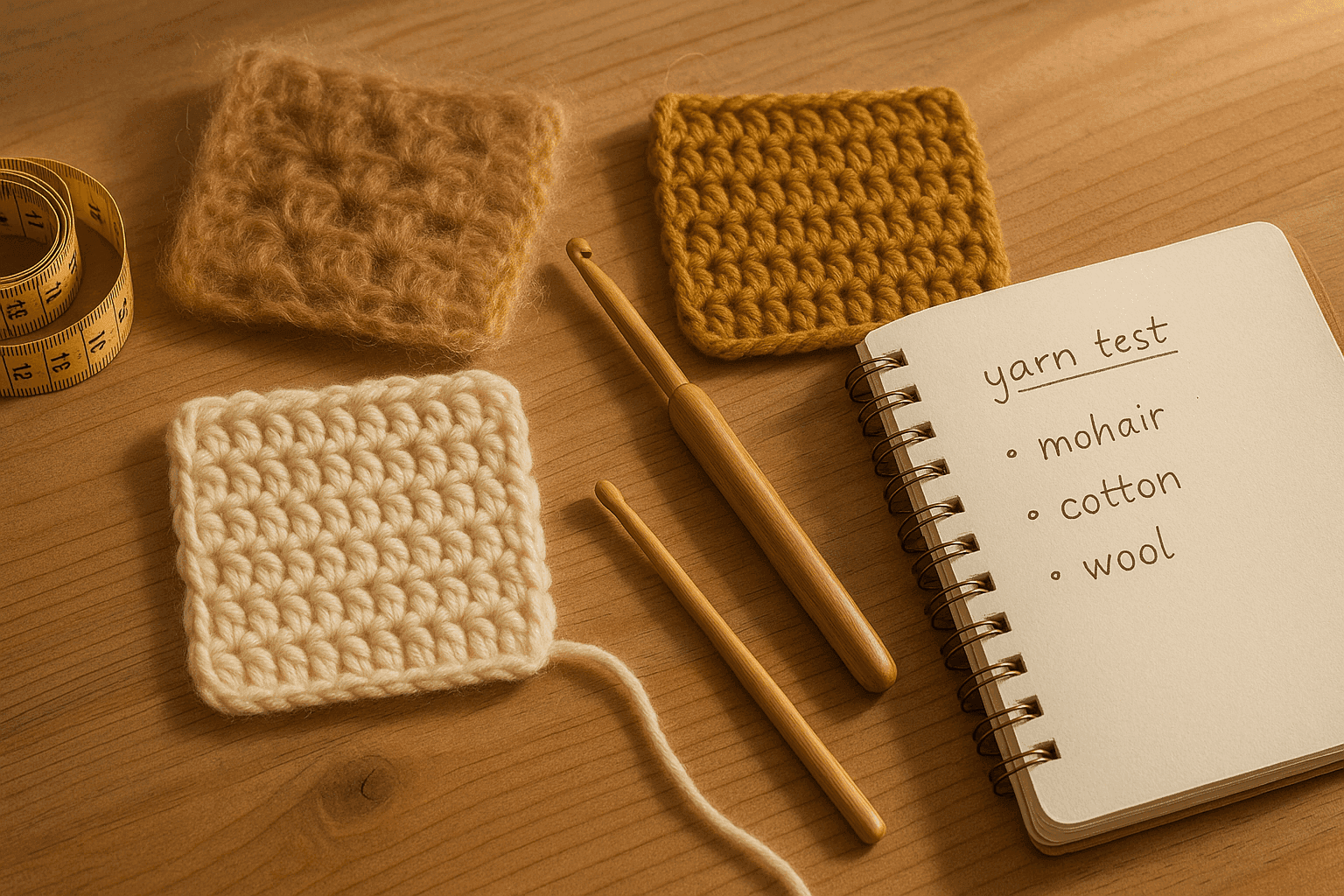
There is a very specific kind of crochet frustration that happens when the yarn in your hand seems lovely in the skein, soft in the cake, and even gorgeous in the first few rows—right up until your hook starts catching every loose fiber, the stitch tops disappear into a halo, and the beautiful shell pattern you imagined turns into a charming but slightly mysterious blur. On the other end of the spectrum, some yarns behave with almost architectural clarity: every loop stands at attention, every post stitch pops, every seam sits neat and exact. Most of us learn to describe that difference with words like fuzzy, smooth, splitty, crisp, or haloed. But when you want to design thoughtfully—or simply choose the right yarn for lace, texture, seams, and wear—it helps to get more systematic.
That is where a practical “hairiness index” becomes useful. Not as a laboratory measurement, but as a maker’s working tool: a way to assess how many fiber ends sit proud of the yarn surface, how likely the yarn is to catch under the hook, how clearly stitches read once worked, how much abrasion blooms the halo over time, and how cleanly the yarn behaves in joins and seams. In crochet, yarn hairiness matters perhaps even more than many knitters expect, because the hook interacts directly with the yarn surface on every insertion, pull-through, and finishing pass. A yarn can have beautiful drape and color yet still be miserable for deeply textured stitches or precise lace if its surface obscures structure.
In this article, I’ll walk through a practical framework for evaluating yarn hairiness and applying that information to your crochet choices. We’ll look at what creates fuzz in the first place, how fiber content, spin, ply structure, and finishing change crochet behavior, and how to run swatch tests that tell you far more than touching the ball band ever could. Then we’ll translate those observations into design decisions for lace openness, textured fabric, seam performance, and long-term wear.
Why hairiness deserves its own evaluation in crochet
When we talk about yarn characteristics, weight, twist, and fiber content get most of the attention. Hairiness often gets folded vaguely into “softness” or “halo,” but for crochet it deserves separate evaluation because it affects five major things at once:
- Hook catching propensity — how often the hook snags stray fibers instead of entering the intended loop cleanly.
- Surface clarity — how readable the stitch architecture remains after the fabric is worked.
- Abrasion bloom — how much fuzz rises with handling, frogging, washing, and wear.
- Seam neatness — how clean joins, mattress seams, whipstitch seams, slip-stitched edges, and woven ends appear.
- Lace openness and negative space — whether openwork remains visually crisp or turns soft-edged and clouded.
A fuzzy yarn is not a bad yarn. Often it is the exact right yarn when you want softness, atmospheric color blending, warmth without density, or a brushed, romantic finish. But fuzzy yarn behaves differently from a smooth mercerized cotton, a tightly spun wool, or a round multi-ply acrylic. The point is not to rank one as superior—it is to match surface behavior to fabric architecture.
What creates yarn hairiness
At the simplest level, yarn hairiness comes from fiber ends and loops projecting from the yarn body. Some of that is inherent to the fiber itself, some of it comes from spinning and plying, and some develops later through abrasion and finishing.
1. Fiber length and fiber type
Shorter fibers generally create more opportunities for ends to protrude from the yarn surface. That is why woolen-spun yarns from shorter staple fibers often carry more halo than tightly spun long-staple cottons or silks. Fiber character matters too:
- Mohair and brushed alpaca naturally create prominent halos.
- Wool can range from smooth to woolly depending on breed, prep, and spin.
- Cotton is often clearer in stitch definition, especially mercerized cotton, though some matte cottons can bloom slightly.
- Silk tends toward smoothness and sheen, increasing stitch visibility.
- Acrylic varies widely: some budget acrylics pill and fuzz quickly, while others remain quite crisp.
- Singles and roving-style yarns may look smooth initially but can abrade into haze fast.
2. Spin direction and spin amount
Higher twist generally binds fibers more tightly into the yarn body, reducing protruding ends and improving resistance to splitting. Lower twist often feels softer and loftier but can allow more fuzz and more hook-catching.
For crochet, this matters twice: once in basic surface behavior and again in how the hook motion interacts with the twist. If the yarn untwists slightly as you work, hairs and fiber loops can stand out more, increasing catching.
3. Ply structure
A well-balanced plied yarn usually gives clearer stitch definition than a softly spun single. Common behavior patterns:
- Firm 3- or 4-ply round yarns: often excellent surface clarity, good for cables, post stitches, and seams.
- Chainette constructions: can be light and lofty with moderate clarity; behavior depends on fiber and brushing.
- Singles: soft and expressive, but may flatten, fuzz, or obscure textured stitches.
- Loosely cabled yarns: can catch at the hook if plies separate.
4. Yarn finishing
Finishing processes can dramatically alter the surface:
- Brushing increases halo and softness.
- Mercerization smooths and adds sheen to cotton.
- Superwash treatments may change bounce and surface slickness.
- Steam setting or fulling can tighten or soften the visual edge of stitches.
5. Wear and abrasion
Some yarns look clean in the skein but bloom under friction. Crochet itself creates surface contact at every pull-through. Then there is additional rubbing during blocking, seaming, wearing, and laundering. A useful hairiness assessment has to consider not just fresh-off-the-ball appearance, but how the yarn changes after use.
A practical Crochet Yarn Hairiness Index
Let’s build a maker-friendly index you can use at home. Rate each category from 1 to 5, where 1 = very low and 5 = very high. You can keep this in a notebook for future projects.
A. Surface Fuzz Level (SFL)
How many visible fibers protrude from the strand before crocheting?
- 1: Nearly glassy smooth; very few visible hairs.
- 2: Slight fuzz only on close inspection.
- 3: Noticeable soft halo, but yarn outline is still clear.
- 4: Strong halo; strand edges look softened.
- 5: Dense fuzz cloud; yarn outline is partially obscured.
B. Hook Catch Index (HCI)
How often does the hook catch stray fibers or partial plies instead of the intended loop?
- 1: Almost never catches.
- 2: Occasional snag when working quickly.
- 3: Moderate attention required.
- 4: Frequent catching interrupts rhythm.
- 5: Constant snagging; difficult to work cleanly.
C. Stitch Visibility Score (SVS)
How clearly can you identify stitch tops, posts, spaces, and shaping after crocheting?
- 1: Very obscured; counting is difficult.
- 2: Reduced definition; texture partially lost.
- 3: Readable with attention.
- 4: Good clarity.
- 5: Excellent stitch-by-stitch definition.
Note that this one runs in the opposite visual direction from fuzz. Higher is better for clarity.
D. Abrasion Bloom Rate (ABR)
How much additional halo develops after rubbing, frogging, or washing?
- 1: Little to no change.
- 2: Slight softening.
- 3: Moderate blooming.
- 4: Significant halo growth.
- 5: Dramatic fuzz increase or pilling tendency.
E. Seam Cleanliness Score (SCS)
How neat do joins, sewn seams, woven ends, and edge finishes look in the yarn?
- 1: Bulky, cloudy, or difficult to place accurately.
- 2: Acceptable but visually soft.
- 3: Functional with care.
- 4: Clean and tidy.
- 5: Crisp, nearly tailored finish.
F. Lace Edge Clarity (LEC)
How sharply do open spaces and lace motifs read in the finished fabric?
- 1: Eyelets and chain spaces blur strongly.
- 2: Soft-edged openings.
- 3: Moderately open, still readable.
- 4: Clear lace structure.
- 5: Sharp, architectural lace.
A yarn’s profile might look like this:
- Brushed alpaca/silk lace held alone: SFL 5 / HCI 4 / SVS 1 / ABR 4 / SCS 1 / LEC 2
- Mercerized cotton DK: SFL 1 / HCI 1 / SVS 5 / ABR 1 / SCS 5 / LEC 5
- Soft woolen-spun non-superwash wool: SFL 3 / HCI 2 / SVS 3 / ABR 3 / SCS 3 / LEC 3
- Smooth plied acrylic: SFL 2 / HCI 2 / SVS 4 / ABR 2 or 4 depending on quality / SCS 4 / LEC 4
How to swatch for hairiness in a way that actually tells you something
Touching the yarn is not enough. You need to observe it in worked fabric, because crochet compresses, wraps, and exposes yarn differently than a simple strand test.
I recommend making three small swatches, each about 4 x 4 in (10 x 10 cm) minimum after a light block. Use the hook size suggested on the ball band first, then adjust if needed.
For most yarns:
- Lace/Fingering weight: start with 2.5–4.0 mm hook
- Sport/DK: start with 3.5–5.0 mm hook
- Worsted/Aran: start with 5.0–6.5 mm hook
- Bulky: start with 6.5–9.0 mm hook
If the yarn is very fuzzy, I often go 0.5 mm larger than I would for a crisp yarn in the same weight when testing lace or drape, because the halo visually fills space.
Swatch 1: Surface and stitch clarity swatch
Work a square in rows with three bands:
- Rows 1–8: single crochet
- Rows 9–16: half double crochet
- Rows 17–24: double crochet
Foundation suggestion for worsted weight: ch 24.
Typical counts for a row-based swatch in worsted with a 5.0 mm hook:
- Row 1: 23 sc
- Rows 2–8: ch 1, turn, 23 sc
- Row 9: ch 2, turn, 23 hdc
- Rows 10–16: ch 2, turn, 23 hdc
- Row 17: ch 3, turn, 23 dc
- Rows 18–24: ch 3, turn, 23 dc
What to observe:
- Can you clearly see the top loops?
- Does the yarn catch more in sc, where insertions are tighter?
- Does taller stitch fabric let halo soften into a more attractive surface?
- Does the stitch pattern flatten or blur?
Many fuzzy yarns feel more cooperative in dc and taller stitches than in dense sc fabric, because the hook makes fewer tight penetrations and the fabric gives the halo room to sit gracefully.
Swatch 2: Lace openness and catching swatch
Chain a multiple that suits a simple mesh pattern. For example:
- ch 22
- Row 1: dc in 4th ch from hook, ch 1, sk 1, dc in next ch across. You should end with 10 dc and 9 ch-1 spaces.
- Row 2: ch 3, turn, dc in next dc, ch 1, dc in next dc across.
- Repeat for 12 rows.
What to observe:
- Do chain spaces remain open and distinct?
- Does the halo visually shrink the negative space?
- Are return-row insertions hard to place because the loops are obscured?
- Does the lace read better from a short viewing distance or only up close?
This swatch quickly reveals whether a yarn is suited to crisp filet-like structures, soft romantic lace, or neither.
Swatch 3: Texture and seam swatch
Use front-post stitches or a simple rib section plus a seam test.
Foundation for DK/worsted: ch 26.
- Rows 1–4: 25 dc
- Row 5: ch 3, turn, FPdc around next st, BPdc around next st across to create vertical rib texture
- Rows 6–10: repeat rib pattern
- Fasten off.
- Make a second identical swatch.
- Seam them together over 3 in / 7.5 cm using whipstitch or mattress-style seaming.
What to observe:
- Do the raised stitches stand out or disappear under fuzz?
- Does the seam line stay crisp?
- Can you identify edge stitches easily while seaming?
- Do woven ends vanish nicely, or create fuzzy lumps?
Bonus abrasion test
Take each swatch and rub one corner firmly between your fingers for 20 seconds, then compare that corner to the untouched corner. If appropriate for the fiber, wet block or wash the swatch and compare again when dry.
This gives you a practical ABR score. Some yarns transform radically after just one wash.
Reading your swatch results in design terms
Now let’s move from observation to decisions.
For lace
If your yarn scores:
- High fuzz (SFL 4–5)
- Low clarity (SVS 1–2)
- Low lace edge clarity (LEC 1–2)
then avoid highly technical lace motifs that depend on precise geometry. Pineapples, filet images, sharply articulated fans, or narrow eyelet ladders may lose definition.
Instead, use:
- Larger chain spaces
- Simpler open meshes
- Repeating arches
- Airy shawl fabrics where softness is a feature
- Bigger hook sizes for more breathing room
For example, a brushed lace yarn may perform beautifully in ch-3 or ch-5 arches with occasional dc anchors, but poorly in a dense lace chart with clustered decreases every other row.
If your yarn scores:
- Low fuzz (SFL 1–2)
- High clarity (SVS 4–5)
- High lace edge clarity (LEC 4–5)
then it can support:
- Filet crochet
- Pineapple motifs
- Shells with clear spacing
- Irish crochet-inspired relief work
- Delicate thread-style lace
Mercerized cotton and smooth plied wools are especially satisfying here.
For texture
Texture needs shadows and edges. If surface halo is too strong, it fills the valleys between raised stitches and mutes the pattern.
Best yarns for strong texture usually have:
- SFL 1–3
- SVS 4–5
- Round, plied construction
- Moderate to high twist
Excellent matches include:
- Front- and back-post ribbing
- Popcorns and bobbles
- Basketweave
- Cable-like crossings
- Deeply sculpted stitch patterns
A moderately fuzzy wool can still work for texture if the motifs are large-scale. Tiny waffle textures or delicate post-stitch cables are more likely to blur.
If you love a fuzzy yarn and still want texture, think bigger relief, fewer tiny details. A broad ridge reads better than a fine cord.
For seams and finishing
This is one area where hairiness surprises many crocheters. Fuzzy yarn can seem forgiving because joins disappear visually—but it can also make seams bulky, hide edge anatomy, and create drag while sewing.
For garments with many shaped pieces, precise shoulders, set-in sleeves, or tailored bands, yarns with:
- Lower HCI (1–2)
- Higher SCS (4–5)
- Higher SVS (4–5)
will make finishing much easier.
Hairier yarns can still seam well if you:
- Work looser edge stitches
- Use mattress-style seaming through structural bars rather than fuzzy outer hairs
- Steam or lightly block pieces before assembly
- Avoid over-handling edges
- Use a blunt tapestry needle that parts the halo less aggressively
For invisible joins, fuzz can help. For crisp, straight seams, smoothness wins.
For durability and abrasion zones
Underarms, cuffs, bag straps, elbows, and seat areas experience friction. A yarn with high ABR may bloom attractively in a shawl but pill or mat in a fitted cardigan.
When testing a garment yarn, pay close attention to:
- Does the halo become denser after rubbing?
- Does the fabric snag easily?
- Does frogging damage the surface?
- Does the yarn lose stitch memory as fuzz increases?
A yarn with beautiful initial surface clarity may degrade if the fibers are weakly anchored.
Matching yarn surface to fabric architecture
This is the heart of good design: not just choosing a pretty yarn, but pairing its behavior with a stitch structure that benefits from it.
Best uses for high-hairiness yarns
Think of fuzzy yarn as an atmospheric medium.
Good matches:
- Halo-rich shawls
- Soft cowls and wraps
- Simple silhouettes
- Open but uncomplicated lace
- Tall stitches and chain-based fabric
- Held-together marling with a smoother companion yarn
Less ideal matches:
- Dense amigurumi requiring exact stitch counting
- Intricate relief texture
- Crisp filet imagery
- Hard-wearing market bags
- Precise tailored seams
Best uses for medium-hairiness yarns
This is often the sweet spot for cozy crochet.
Good matches:
- Everyday garments
- Hats and mittens
- Moderate texture
- Granny-based fabrics
- Relaxed lace
- Blankets with visible but softened patterning
Design tip: medium fuzz can soften the blockiness that very crisp yarn sometimes gives crochet, especially in garments.
Best uses for low-hairiness yarns
Think structural clarity.
Good matches:
- Lace motifs with sharp negative space
- Cables and post-stitch textures
- Home décor needing definition
- Bags and baskets if the fiber itself is sturdy
- Precise piecing and seaming
- Edgings where every picot should show
Potential trade-off: very smooth yarn can reveal every tension inconsistency. What fuzz obscures, smoothness displays.
Combining fuzzy and smooth yarns strategically
One of my favorite design approaches is pairing surface types intentionally rather than treating them as accidental opposites.
Holding strands together
Combine a fuzzy strand with a smooth structural strand to get softness without total loss of clarity. For example:
- brushed lace + smooth fingering merino
- mohair + silk blend held with a plied wool
- halo lace + cotton blend for stability
The smoother yarn acts like scaffolding. You often improve HCI and SVS slightly while keeping visual softness.
Using contrast by section
Try:
- Smooth yarn for cuffs, button bands, collars, and seams
- Fuzzy yarn for body panels or yokes
- Crisp motifs appliquéd onto a haloed ground
- Smooth joining rounds around fuzzy granny motifs
This works especially well in garments where finishing areas benefit from stitch visibility.
Striping and color effects
Hairier yarns blur stripe edges and create painterly blending. Smoother yarns preserve distinct color changes. If your pattern relies on high-contrast stranded-looking effects created by stitch placement, fuzzy yarn may mute the graphic result.
Common mistakes when evaluating yarn hairiness
Mistake 1: Judging only from the skein
A yarn can seem manageable in hand and become a snaggy mess in crochet. Always swatch.
Fix: Work at least one textured and one open swatch before committing.
Mistake 2: Assuming soft means easy
Soft brushed yarns often require more deliberate technique, not less.
Fix: Slow down, improve lighting, and use hooks with tips that suit the yarn.
Mistake 3: Using tiny, dense stitches in highly fuzzy yarn
This is where counting errors and hook catches multiply.
Fix: Choose taller stitches, larger hooks, or simpler pattern repeats.
Mistake 4: Ignoring post-wash bloom
Some yarns transform after blocking.
Fix: Wash the swatch the way you plan to wash the finished item.
Mistake 5: Forcing crisp texture out of a halo yarn
If the yarn wants softness, let it excel there.
Fix: Use larger-scale shaping and silhouette interest instead of tiny relief motifs.
Technique adjustments for hairy yarns
Sometimes the yarn is exactly the one you want aesthetically, and adapting technique is the better answer.
Choose the right hook shape
Inline hooks can help some crocheters place stitches more deliberately in fuzzy yarn. Tapered hooks may glide better for others. The key is testing whether the hook tip catches surface fibers.
If snagging is frequent, try:
- A slightly blunter tip
- A hook 0.5 mm larger
- Slowing insertion angle so you enter loops cleanly
Control tension thoughtfully
Death-gripping a fuzzy yarn often worsens catching because the loops tighten and the halo compresses around insertion points.
Try a relaxed hand and let the hook do the work.
Use stitch markers generously
In low-visibility yarns, mark:
- first and last stitch of rows
- repeat boundaries
- shaping points
- every 10 or 20 stitches in long rounds
This matters especially for dark fuzzy yarn, where stitch anatomy can vanish completely.
Minimize frogging when possible
Hairy yarns can felt lightly into themselves or tangle on reworking.
Fix:
- Place lifelines in complex rows
- Check counts frequently
- Swatch enough to avoid repeated pattern experimentation in the project itself
Seam with structure, not fluff
Insert your needle under bars or full loops consistently. Do not chase the halo.
If necessary, lightly smooth the seam area with your fingers before stitching so you can identify the true yarn path.
Troubleshooting by symptom
“My hook keeps snagging, and I’m splitting the yarn.”
Likely causes:
- low twist or loose ply
- too small a hook
- too sharp a hook tip
- inserting through fuzzy surface rather than clearly visible loops
Try:
- going up 0.5 mm in hook size
- changing hook style
- reducing speed
- working a taller, less dense stitch pattern
“I can’t see where to put the next stitch.”
Likely causes:
- high halo combined with small stitches
- dark color plus fuzz
- inadequate lighting
Try:
- stronger directional light
- stitch markers at regular intervals
- pattern choices with chain spaces and taller stitches
- smoother yarn for the same project if exact placement is essential
“My lace looks closed up.”
Likely causes:
- halo filling the eyelets
- hook too small
- pattern scale too fine for the yarn surface
Try:
- increasing hook size by 0.5–1.0 mm
- substituting larger chain spaces
- using fewer but bolder lace elements
“My textured stitch pattern disappeared.”
Likely causes:
- fuzz masking shallow relief
- yarn flattening under the stitch structure
Try:
- choosing deeper post-stitch relief
- increasing motif scale
- switching to a rounder, smoother plied yarn
“The seams look messy.”
Likely causes:
- edge stitches too tight to identify
- halo obscuring insertion points
- too much handling during finishing
Try:
- blocking before assembly
- using mattress-style seaming where possible
- leaving longer tails for more controlled sewing
- using a smooth contrast yarn for internal structural seams if appropriate
Suggested test matrix for your yarn notebook
If you like methodical making, keep a page for each yarn with:
- Fiber content
- Yarn weight
- Recommended hook size
- Tested hook sizes
- Gauge in sc and dc over 4 in / 10 cm
- SFL / HCI / SVS / ABR / SCS / LEC scores
- Notes on frogging behavior
- Notes after blocking
- Best use categories
Example entry:
Yarn: 100% wool, DK, 50 g / 112 m
Hooks tested: 4.0 mm, 4.5 mm, 5.0 mm
Gauge at 4.5 mm: 18 sc x 22 rows = 4 in; 14 dc x 9 rows = 4 in
Scores: SFL 3 / HCI 2 / SVS 4 / ABR 3 / SCS 3 / LEC 3
Best for: hats, cardigans, textured yokes, simple lace
Avoid for: filet, micro-texture, high-abrasion bags
Over time, this becomes much more valuable than generic impressions like “nice and soft.”
Design strategies by project type
Shawls
You can be more forgiving here. Shawls are excellent homes for halo yarns because they do not endure as much friction, and visual softness often enhances the piece.
Use:
- large open motifs
- chain arches
- dc/tr cluster arrangements with room around them
- hooks at the upper end of the recommended range
Garments
Balance beauty with wear.
For cardigans and pullovers:
- choose medium hairiness for cozy everyday pieces
- reserve high-halo yarns for lower-friction silhouettes
- avoid dense underarm texture in bloom-prone yarns
- keep seams simple and planned
Accessories
For hats and cowls, fuzzy yarn often shines. For mittens, bags, and socks-like crochet slippers, abrasion matters much more.
Home décor
Texture-heavy pillows and baskets usually benefit from clearer yarns. Throws can go either way depending on whether you want sculptural pattern or plush atmosphere.
The big takeaway: yarn surface is a design tool
Once you start paying attention to hairiness as a measurable quality rather than a vague impression, yarn choice becomes much more intentional. You stop asking only, “Do I like this yarn?” and start asking, “What does this yarn want to become?”
A halo-rich yarn wants space, softness, and simple forms that let its atmosphere show. A smooth, crisp yarn wants definition, geometry, and visible structure. A moderate-fuzz yarn often bridges the two, softening crochet’s edges while still preserving enough stitch identity for texture and shaping.
If you remember nothing else, remember this:
- For lace clarity: choose lower hairiness or enlarge the scale.
- For textured definition: choose rounder, smoother, plied yarns.
- For easy seaming and finishing: prioritize stitch visibility and lower hook-catching.
- For softness and romance: let halo yarns work in open, simple architectures.
- For durability: test abrasion bloom before committing.
And always, always swatch for the fabric you actually plan to make—not just gauge, but behavior. A 4-inch square can tell you whether a yarn will sing in your hands or make you negotiate every row.
That kind of knowledge is one of the pleasures of experienced crochet. The more closely you look, the more yarn stops being generic material and becomes a collaborator with very specific strengths. When you can read fuzz, catch, bloom, and clarity before the full project begins, you set yourself up not just for fewer frustrations, but for better design decisions and more satisfying finished work.