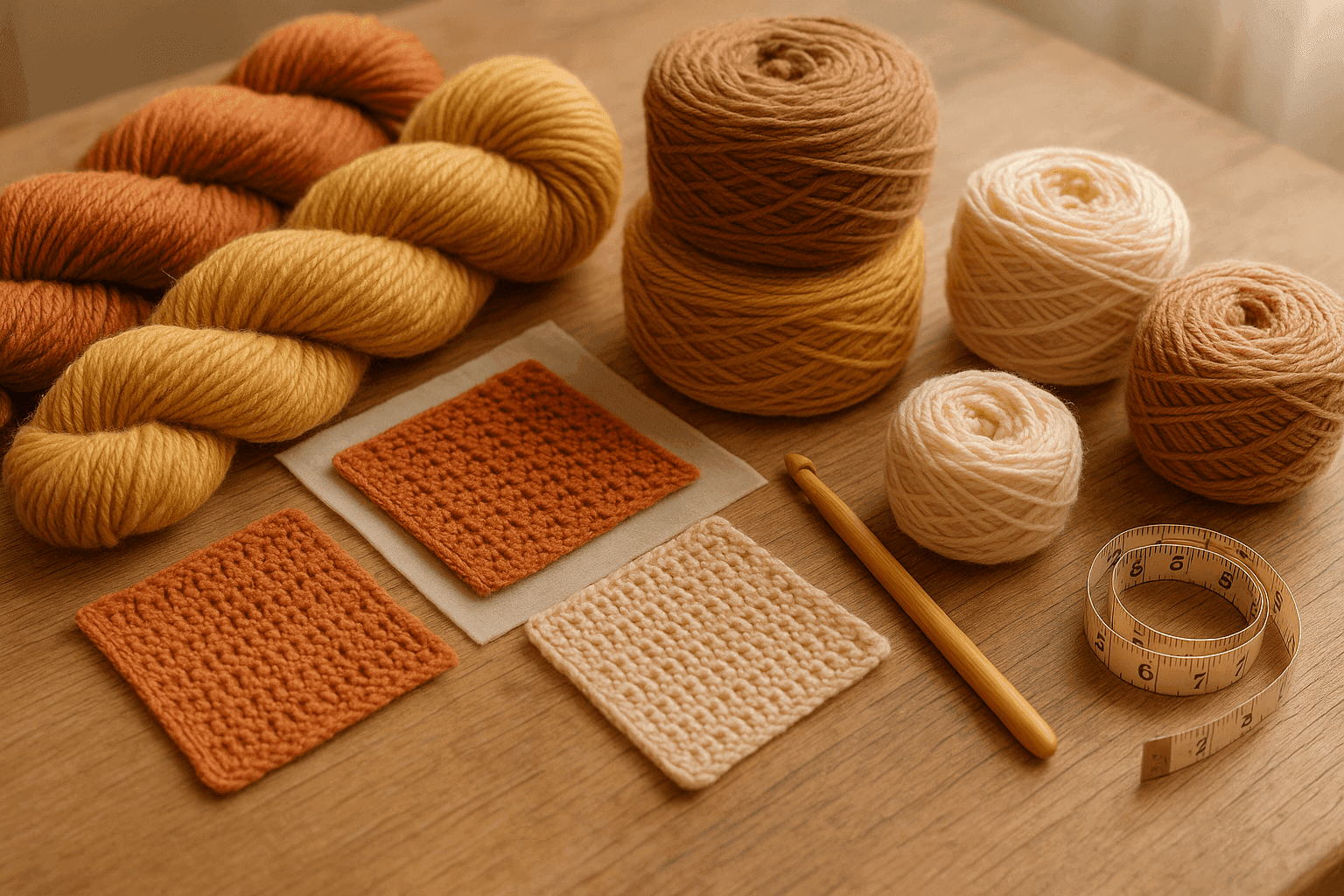
There is a very specific kind of crochet frustration that sneaks up on experienced makers as often as beginners: you do everything “right,” you use the recommended hook, you make a swatch, your stitch pattern looks fine, and then halfway through a garment the fabric starts behaving differently. The rows feel denser. The motifs grow a little less springy. The colorwork puckers in one section but not another. Or worse, your post-blocking gauge shifts more than expected and the fit is suddenly a negotiation instead of a plan.
A lot of us are taught to treat gauge as something that begins with the first chain. But gauge often starts much earlier, before the hook touches the yarn at all. The way yarn has been finished at the mill, twisted, hanked, wound into cakes, compressed in storage, shipped under tension, rewound by hand, or washed before use can all change how it presents itself to your hands. That “yarn memory” is not mystical. It is the practical, physical result of stored tension, fiber elasticity, twist energy, humidity history, finishing treatments, and stress relaxation.
If you design garments, substitute yarns often, work detailed stitch textures, or just want more predictable results, learning to read and condition yarn before crocheting can be as important as choosing the right hook size. In crochet especially, where each stitch is individually formed and can either lock structure tightly or exaggerate irregularity, yarn preconditioning becomes a real design tool.
This is a deep dive into how stored tension affects yarn behavior, what changes when yarn lives in a hank versus a cake versus a center-pull ball, why wool, cotton, and synthetics relax differently, when washing yarn before stitching helps, and how to create preconditioned swatches that tell you something useful instead of something temporary.
Why yarn memory matters in crochet
When crocheters say a yarn has “memory,” they usually mean one of two things:
- Elastic recovery in the finished fabric — how well the crocheted piece bounces back after stretching.
- Stored shape or tension in the yarn itself — how the strand wants to curl, kink, untwist, cling, flatten, or puff based on what happened to it before use.
This article focuses on the second meaning, though the first is related.
A yarn strand is not neutral when it reaches you. It has a history:
- It was spun with a certain amount of twist.
- It may have been steamed, washed, fulled, dyed, heat-set, or coated at the mill.
- It was put into a format: hank, skein, ball, cone, cake, or center-pull package.
- It sat under its own weight or under packaging pressure.
- It may have been rewound tightly on a swift and ball winder.
- It absorbed or lost moisture in storage.
- It may have been compressed in bins, shelves, or project bags for months.
All of those things influence four qualities that directly affect crochet gauge and fabric behavior:
- Twist liveliness: how much the yarn wants to rotate, kink, or bias.
- Diameter: whether the yarn is puffed open, flattened, compacted, or temporarily stretched thin.
- Elasticity: how much it stretches under crochet tension and how much it springs back.
- Surface behavior: drag, smoothness, bloom, splitting tendency, and stitch definition.
In practical terms, that can alter:
- stitches per 4 in / 10 cm
- rows per 4 in / 10 cm
- drape
- fabric density
- edge stability
- colorwork smoothness
- motif blocking response
- final garment measurements
A half-stitch per inch difference does not sound dramatic until you multiply it across a chest circumference or the depth of a yoke.
Context: mill finishing, packaging, and the hidden starting line
The reason two balls of the “same” yarn can behave a little differently is that yarn is both manufactured and alive in a fiber sense. It is structured matter, but it is still responsive matter.
Mill finishing changes the starting state
Before yarn gets wound into retail form, mills often apply finishing processes that can calm or preserve twist, soften handle, remove spinning oils, stabilize color, or improve machine processing. These steps vary widely by fiber and brand.
Common effects include:
- Steaming or heat-setting can relax some spinning stress and stabilize plies.
- Dyeing can make wool bloom, cotton soften, or some superwash yarns feel temporarily slick or compact.
- Finishing coatings can reduce drag but may wash out later, changing gauge after the first laundering.
- Fulling or slight blooming can round out a woolen-spun yarn.
That means your pre-project swatch may reflect the mill’s temporary finish as much as the yarn’s long-term behavior.
Packaging format is not just convenience
Hanks, cakes, center-pull skeins, cones, and hand-wound balls each store the yarn differently. The same fiber blend may present as lively and open from one format, and compacted or crimped from another.
Storage compression accumulates quietly
A yarn stash stored in stacked bins, vacuum bags, tightly packed cubbies, or sun-warmed shelves may not be damaged, but it may behave differently when first used. Compression can flatten the strand. Long storage under tension can leave persistent kinks. Dry indoor air can reduce immediate suppleness in some fibers. None of this means the yarn is “bad.” It means you may need to let it recover before asking it for accurate gauge.
The main mechanics: stored tension and stress relaxation
To use yarn conditioning deliberately, it helps to understand one key idea: stress relaxation.
Stress relaxation is what happens when a material held under strain gradually reduces internal tension over time. In yarn terms, if the strand has been stretched, bent, tightly wound, compressed, or heat-set into a package, it may not instantly return to its most relaxed state once unwound. It may need time, moisture, washing, or light tension-free rest to settle.
Crocheters notice this as:
- ramen-like kinks when yarn comes off a frogged project or a tight cake
- a strand that feels skinnier while crocheting from a tight center-pull ball
- rows that loosen later even though they seemed firm while worked
- wool that blooms and fills after washing
- cotton that softens and drops after wetting
- acrylic that changes more from heat than from water alone
Twist liveliness and balance
Yarn is spun with twist, then often plied with opposing twist. Ideally, the finished yarn is balanced enough to resist excessive torque. But packaging and handling can temporarily disturb that balance.
Signs of active stored twist or imbalance include:
- the strand loops back on itself when dangling freely
- the yarn twists your project as you work
- splitty plies open unusually often
- textured stitches lean or bias more than expected
Crochet can either amplify or tame this, depending on stitch structure. Taller stitches with more open loops may reveal torque more readily. Dense single crochet fabrics may compact and mask some of it while increasing stiffness.
Diameter changes are often temporary but important
If a yarn has been stretched in winding or compressed in storage, its working diameter may be temporarily altered.
- A stretched yarn may feel thinner and give you more stitches per inch.
- A compressed yarn may look flat in the ball but puff open after washing, reducing stitches per inch.
- A humidified or washed wool may bloom visibly.
- A mercerized cotton may change less in diameter than an unmercerized cotton but may still soften and drape differently.
Because crochet gauge is highly sensitive to yarn diameter, even a subtle change matters.
Hank vs cake vs center-pull: why format affects behavior
Let’s talk about the formats you’re most likely to encounter.
Hanks
A hank stores yarn in a large looped circumference with relatively gentle bends compared to a compact cake or tightly wound ball. It is often the least compressive retail format, especially for hand-dyed and premium wool yarns.
Typical behavior of hanked yarn
- less tightly bent than in small cakes
- often retains more of its natural loft
- may arrive with residual twist liveliness, especially in hand-dyed yarns
- can benefit from washing if dye residue, spinning oils, or over-twist are present
When hanked yarn may need pre-washing
Consider washing a hank before winding if:
- the yarn feels crisp, sticky, oily, or unusually energized
- hand-dye runoff is likely and you want calmer colorwork handling
- the strand is visibly kinked or overtwisted
- you are making a fitted garment and want the most stable pre-crochet state possible
Basic hank wash method
- Keep the hank tied securely in at least 4 places.
- Fill a basin with lukewarm water.
- Add a small amount of wool wash or gentle detergent appropriate to the fiber.
- Submerge without agitation. Soak 15–30 minutes.
- Rinse only if needed.
- Press gently in towels. Do not wring.
- Hang or lay to dry depending on fiber, with minimal or no added weight unless you are intentionally trying to remove kinks from reclaimed yarn.
For fresh yarn intended for gauge testing, avoid hanging a heavy wet hank with substantial weight. That can overstretch the strand and create a different problem.
Cakes
A cake is convenient and often attractive, but it can store yarn under notable winding tension, especially if wound tightly on a ball winder.
Typical behavior of caked yarn
- compact, easy feed
- can flatten or slightly elongate the strand
- may create a “thin while working, plump later” effect
- outer layers and inner layers may behave a bit differently if wound tightly
If you have ever crocheted from a tightly wound cake and found that your later washed swatch grew or softened unexpectedly, this may be why.
Best practice for cakes
- Wind with light, even tension rather than maximum firmness.
- Let freshly wound cakes rest 12–48 hours before swatching if possible.
- For wool and lofty yarns, longer rest can be helpful.
- If the cake is drum-tight, consider rewinding more loosely.
Center-pull skeins and balls
Commercial center-pull skeins are efficient, but the yarn can emerge with extra bends and compression from the package structure. Hand-wound center-pull balls can be even tighter if made with too much enthusiasm.
Typical behavior of center-pull yarn
- variable tension as the package collapses
- crimped strand shape from winding layers
- occasional twist buildup while pulling from the center
- temporary diameter reduction in tightly packed sections
This is one reason gauge from the first small swatch worked from a fresh center-pull skein can be slightly misleading.
Quick fix
Pull out a few yards, let them relax loosely beside you, and crochet from that relaxed length rather than directly from a tugging package. For sensitive projects like garments or colorwork yokes, this can noticeably calm your stitches.
How different fibers relax: wool, cotton, and synthetics
Not all yarns respond to conditioning in the same way. Fiber type matters enormously.
Wool
Wool is the most dramatically responsive to stress relaxation, moisture, and wet finishing in many crochet contexts.
What wool tends to do
- springs back after deformation better than cotton
- blooms after washing, especially woolen-spun yarns
- relaxes stored winding tension with humidity and rest
- may even out stitch irregularity after wet-setting
- can change both stitch gauge and row gauge meaningfully
Design implications for crochet
A wool swatch worked directly from a tight cake may read smaller and denser before washing than the fabric will behave in actual wear. If you are making:
- yokes
- fitted sweaters
- stranded colorwork crochet
- textured pullovers
- hats requiring precise negative ease
then a washed and fully dried swatch is essential, and a preconditioned swatch is often even better.
Typical gauge shift example in wool
A pre-wash swatch in half double crochet might measure:
- 15 sts x 11 rows = 4 in / 10 cm on a 5 mm hook
After wash and dry, the same swatch might become:
- 14 sts x 10 rows = 4 in / 10 cm
That is a full inch of difference over 56 stitches across a garment body.
Cotton
Cotton behaves differently. It has less elastic recovery than wool and often shows stress and tension more directly while working.
What cotton tends to do
- stretches under weight but springs back less
- softens with washing
- can relax and drape more after wet finishing
- may become less wiry if it was tightly wound
- often shows row growth from fabric settling rather than bloom
Design implications for crochet
Cotton gauge may not “bounce around” the way wool does, but preconditioning still matters because cotton can shift from crisp and compact to softer and more fluid after washing. This affects:
- summer garments
- bags if structure matters
- filet and lace openness
- stitch definition in textured patterns
Mercerized cotton often changes less dramatically in surface fuzz and bloom, but can still drop in drape after wetting.
Typical gauge shift example in cotton
A single crochet swatch might begin at:
- 18 sts x 20 rows = 4 in / 10 cm on a 4 mm hook
After washing and laying flat, it may remain near:
- 18 sts x 19 rows = 4 in / 10 cm
or become:
- 17.5 sts x 19 rows = 4 in / 10 cm
Small shift, but in cotton, drape changes can matter as much as stitch count.
Synthetics
Acrylic, nylon, polyester, and blends vary widely. Water alone may do little to alter stored tension compared with wool, but heat can be significant.
What synthetics tend to do
- may retain package kinks stubbornly
- can show limited change from soaking alone
- may soften in handling over time
- may respond strongly to steam or heat setting, sometimes permanently
Design implications for crochet
With synthetics, the issue is often less bloom and more mechanical memory from winding plus the long-term effect of finishing heat. For garments, swatching should mimic your actual finishing process exactly.
If the finished piece will be machine washed and dried, your swatch must be treated the same way. If you plan to steam-block lightly, test that on the swatch first. Some acrylics can become wonderfully fluid; others can be damaged or over-relaxed.
Caution
Do not aggressively heat-set synthetic yarn before stitching unless you already know how that specific yarn responds. Oversteaming can flatten texture and destroy resilience.
When to wash yarn before stitching
Pre-washing yarn is not mandatory for every project, and sometimes it is unnecessary. But it can be a smart move in the right situations.
Good reasons to wash yarn first
- The yarn is hand-dyed and has excess dye or feels energized from dye processing.
- The strand is visibly kinky, compressed, or overtwisted.
- You are reclaiming frogged yarn with strong ramen crimp.
- The project needs highly accurate garment gauge.
- The yarn feels coated, sticky, dusty, or heavily handled.
- Multiple skeins from different lots feel inconsistent and you want to normalize them before use.
Situations where pre-washing may not help much
- Stable commercial acrylic with no obvious distortion
- Mercerized cotton behaving consistently already
- Cone yarn intended to relax primarily after the finished fabric is washed
- Novelty yarns where washing the loose yarn may tangle or damage structure
Situations where pre-washing can be risky
- Loosely spun singles prone to tangling in hank form
- Very dark hand-dyed yarns likely to felt if agitated carelessly
- Fibers with labels that specifically warn against soaking before use
If in doubt, test one skein or part of one skein first.
How to build a preconditioned swatch that actually predicts reality
This is where the technique becomes truly useful. A preconditioned swatch is not just a swatch you wash after crocheting. It is a swatch made from yarn that has already been allowed to reach a more realistic working state.
Step 1: Choose the actual yarn package you will use
If your project yarn is in hanks, swatch from a hank that has been wound in the same way you plan to use. If you intend to wash hanks before winding, do that before swatching. If the project will be crocheted from a cake, do not swatch from a loose untensioned pile and assume it means the same thing.
The goal is to match reality.
Step 2: Condition the yarn deliberately
Pick one route based on fiber and project sensitivity.
Option A: Rest only
Best for:
- commercial wool blends
- decent-quality commercial skeins
- yarns that feel slightly tense but not distorted
Method:
- Wind loosely if needed.
- Let yarn rest 12–48 hours.
- Keep it uncompressed.
Option B: Wash hank, then dry and wind
Best for:
- hand-dyed wool
- reclaimed yarn
- visibly energized or kinky yarn
- fit-critical garments
Method:
- Wash hank gently.
- Dry fully.
- Wind with light tension.
- Rest before swatching.
Option C: Relax pulled length while working
Best for:
- center-pull skeins with mild package tension
- quick projects where full pre-washing is excessive
Method:
- Pull out 1–3 yards at a time.
- Let the length lie relaxed before feeding it to the hook.
Step 3: Make a large enough swatch
For accurate crochet gauge, go larger than the measured area.
Recommended minimums:
- 4 in / 10 cm gauge target: make at least a 6 in / 15 cm swatch
- For garments: make 7–8 in / 18–20 cm if possible
- Include at least 2 in / 5 cm extra beyond the measurement area on all sides if the stitch curls or distorts
Example starting counts for a medium-weight yarn swatch:
- Single crochet: chain 30–34
- Half double crochet: chain 26–30
- Double crochet: chain 24–28
These are examples only; adjust for expected gauge.
Hook sizes to test
For most garment yarns, test at least 3 hook sizes:
- recommended hook size on label
- one size smaller
- one size larger
For instance, if the label suggests 5 mm, test:
- 4.5 mm
- 5 mm
- 5.5 mm
If the yarn feels especially compact from winding, that larger hook may reveal what the relaxed fabric really wants to do.
Step 4: Work the swatch as the real fabric will be worked
That means:
- same stitch pattern
- same colorwork method
- same working orientation where relevant
- same yarn feed style
- same package setup
If you will alternate skeins in the garment, alternate in the swatch. If your stranded section puckers only when worked from center-pull cakes, then test that exact setup.
Step 5: Let the swatch rest before measuring
This is a step many crocheters skip.
After crocheting, let the swatch rest flat and undisturbed for at least:
- 2–4 hours for most yarns
- overnight for wool, cotton garments, or larger swatches
This allows some immediate stress from stitch formation to dissipate.
Step 6: Measure unwashed, then wet-set
Record both states.
Measure over the center 4 in / 10 cm:
- stitch count
- row count
- width and height
- how the fabric feels in hand
Then wet-finish exactly as the final project will be treated.
Wet-set method
- Soak or wash according to yarn care.
- Remove excess water gently.
- Lay flat to shape without stretching unless the pattern instructs stretching.
- Let dry completely.
- Measure again.
For wear-critical garments, an even better test is to hang the dried swatch briefly or pin it vertically after drying to see whether it drops under its own weight.
Step 7: Record the delta
The key number is not only the final gauge. It is the difference between conditioned-before, fresh-off-hook, and wet-finished states.
Keep notes like:
- Fresh from rested cake: 16 sts x 11 rows = 4 in
- After overnight rest: 15.5 sts x 10.5 rows = 4 in
- After wet set: 15 sts x 10 rows = 4 in
That tells you the yarn relaxes significantly, and your project plan should use the final gauge, not the first one.
A practical step-by-step workflow for fit-critical crochet garments
If I were starting a sweater where fit matters, this is the workflow I would use.
Materials
- project yarn
- 3 hook sizes, for example 4.5 mm, 5 mm, and 5.5 mm
- locking markers
- tape measure or gauge ruler
- notebook or phone notes
- basin and wool wash if needed
Process
-
Inspect the yarn.
- Is it in hank, cake, or center-pull skein?
- Does it feel energized, tight, flat, or dry?
-
Decide whether to precondition.
- For wool hanks: often wash if hand-dyed or lively.
- For tight cakes: rewind loosely and rest.
- For cotton: rest or wash if it feels stiff.
-
Prepare at least one skein exactly as project skeins will be prepared.
- Same winding method.
- Same storage time if possible.
-
Crochet 3 swatches.
- Make each at least 6 in / 15 cm square.
- Label hook size with a locking marker.
-
Rest swatches overnight.
-
Measure unwashed gauge.
- Count stitches and rows over 4 in / 10 cm.
-
Wet-finish swatches.
- Use the exact finishing you will use later.
-
Dry fully and remeasure.
-
Drape test.
- Hold each swatch at one edge.
- Check whether the fabric folds softly, stands rigidly, or grows too much.
-
Recovery test.
- Gently stretch widthwise and lengthwise, then release.
- Notice spring-back.
-
Choose hook size based on final fabric, not first measurement.
-
Keep a reference swatch.
- Save it until the project is complete.
This sounds like extra work, but compared with reworking a sweater yoke or hem, it is a bargain.
Common mistakes and how to fix them
Mistake 1: Swatching from freshly wound, drum-tight cakes
Problem
Your swatch comes out small, tidy, and firm. The finished garment grows after washing.
Fix
Rewind more loosely or let cakes rest 24–48 hours before swatching. For wool, consider washing the hank first.
Mistake 2: Measuring immediately after crocheting
Problem
You capture the fabric at peak formation tension, not settled tension.
Fix
Let the swatch rest flat for several hours or overnight before the first measurement.
Mistake 3: Washing the finished swatch but not matching actual finishing
Problem
You soak the swatch gently by hand, but later machine wash the garment. The gauge data is not comparable.
Fix
Treat the swatch exactly like the final piece will be treated.
Mistake 4: Ignoring row gauge in relaxing fibers
Problem
Width seems fine, but garment depth changes after washing.
Fix
Always record both stitch gauge and row gauge. Cotton and wool can change row gauge noticeably.
Mistake 5: Overweighting wet hanks to remove kinks
Problem
The yarn dries overstretched and thinner, leading to false swatch results.
Fix
Use only gentle hanging or flat drying for fresh yarn. Reserve weighted hanging for reclaimed frogged yarn, and even then use restraint.
Mistake 6: Assuming all skeins in a project are equally relaxed
Problem
The first skein was prepped and rested, but later skeins are wound and used immediately, changing gauge mid-project.
Fix
Prepare all skeins consistently. If possible, wind several at once and let them all rest.
Mistake 7: Confusing splitty structure with under-twist from handling
Problem
You blame your hook technique, but the plies are opening because the yarn is actively untwisting from package torque.
Fix
Change yarn feed direction, let the yarn dangle periodically to release twist, or work from a more relaxed package.
How yarn conditioning can improve colorwork and surface quality
This topic is not only about gauge. Preconditioned yarn often produces calmer, cleaner crochet fabric.
Smoother colorwork
Colorwork puckers when tension is uneven, and yarn that is springy in one skein and compacted in another can exaggerate that. Pre-washing hand-dyed hanks or resting rewound cakes can make the strand feed more evenly, helping floats or carried strands stay consistent.
For crochet colorwork swatches, test at least:
- one section with main color dominant in handling
- one section alternating every row or round
- one section after wet-finishing
If one color blooms more, you may need to adjust hook size or float tension.
Better stitch definition
Textured crochet relies on yarn opening and sitting consistently in each stitch. A compacted yarn may make front-post and back-post work look sharp but rigid while fresh, then soften into the intended relief after washing. You want to know that before committing.
More even fabric in garments
A yarn that is conditioned before use is often less likely to create sudden transitions between:
- early rows and later rows
- one skein and the next
- body fabric and sleeves
- plain sections and colorwork sections
Variations: conditioning strategies for different project types
For fitted sweaters and cardigans
Use the most controlled method.
- Wash lively hanks first if needed.
- Wind loosely.
- Rest yarn 24 hours.
- Make large swatches.
- Measure after rest and after wet-finishing.
- Prioritize final row gauge and drape, not just stitch gauge.
For shawls and wraps
You can be a little looser unless dimensions are critical.
- Rest tightly wound yarn.
- Wet-set swatch for lace opening.
- For wool, expect bloom and edge softening.
For bags and structured accessories
Sometimes you want the denser, less-relaxed state.
- If structure is the goal, pre-washing may reduce crispness too much.
- Swatch both conditioned and unconditioned states.
- Choose the one that gives the support you want.
For amigurumi
Gauge is usually tight by intention, but yarn memory still matters.
- A tightly wound cotton or acrylic can work smaller at first.
- If consistency between pieces matters, prepare all yarn the same way.
- Test on the hook sizes you actually use, often 2.25 mm to 3.5 mm depending on yarn weight.
For reclaimed frogged yarn
This is the classic case for deliberate relaxation.
- Skein the yarn with at least 4 ties.
- Soak appropriately for the fiber.
- Dry with very light tension only if needed to reduce crimp.
- Rewind loosely.
- Swatch after rest.
Do not skip the swatch. Reclaimed yarn often looks relaxed before it behaves relaxed.
A note on yarn weight recommendations and expectations
Because yarn memory can temporarily alter diameter, the printed yarn weight category on the label is only a starting point.
General hook ranges often look like this:
- Fingering weight: 2.25–3.5 mm
- Sport weight: 3.25–4 mm
- DK weight: 3.5–4.5 mm
- Worsted weight: 4.5–5.5 mm
- Aran weight: 5–6 mm
- Bulky weight: 6–8 mm
But if a wool DK is freshly washed and blooms, it may behave closer to a plump DK. If a cotton worsted is tightly caked and worked under tension, it may behave temporarily slimmer. This is exactly why testing multiple hook sizes matters.
What to write in your yarn notebook
If you want this knowledge to become truly useful, keep notes beyond standard gauge.
Record:
- brand, fiber content, and yarn weight
- package format: hank, cake, center-pull, cone
- whether you rewound it
- whether you washed the yarn first
- how long it rested
- hook sizes tested
- fresh gauge
- rested gauge
- wet-finished gauge
- drape notes
- bloom notes
- colorwork behavior
- whether later project skeins matched the swatch skein
After a few projects, patterns emerge. You may learn that your favorite non-superwash wool always relaxes by 0.5 stitch per 4 inches, or that one mercerized cotton barely shifts in stitch gauge but gains noticeable length.
That is design knowledge.
The big takeaway: gauge begins before the first row
Crochet teaches us to pay attention with our hands, and yarn memory is one more thing worth noticing. The strand coming off the skein is not a passive ingredient. It has energy, compression history, moisture history, and a current state of tension. Those factors affect diameter, elasticity, twist behavior, and ultimately the crochet fabric you build from it.
If you ignore that, gauge can feel unpredictable. If you account for it, yarn becomes more cooperative.
So when a project really matters, especially garments, do not ask only:
- What hook should I use?
- What is the label gauge?
- Did I make a swatch?
Also ask:
- What state is this yarn in right now?
- Has it relaxed from storage and winding?
- Should I wash the hank first?
- Am I swatching the yarn I actually plan to crochet with, or a temporary version of it?
That shift in thinking can give you more accurate gauge, calmer colorwork, smoother fabric, and better fit with less guesswork.
And perhaps best of all, it turns one of crochet’s most annoying surprises into something you can observe, test, and use deliberately. That is the kind of control that feels less like perfectionism and more like craft wisdom: not forcing the yarn, but meeting it in the state it is truly in before you ever start the first row.