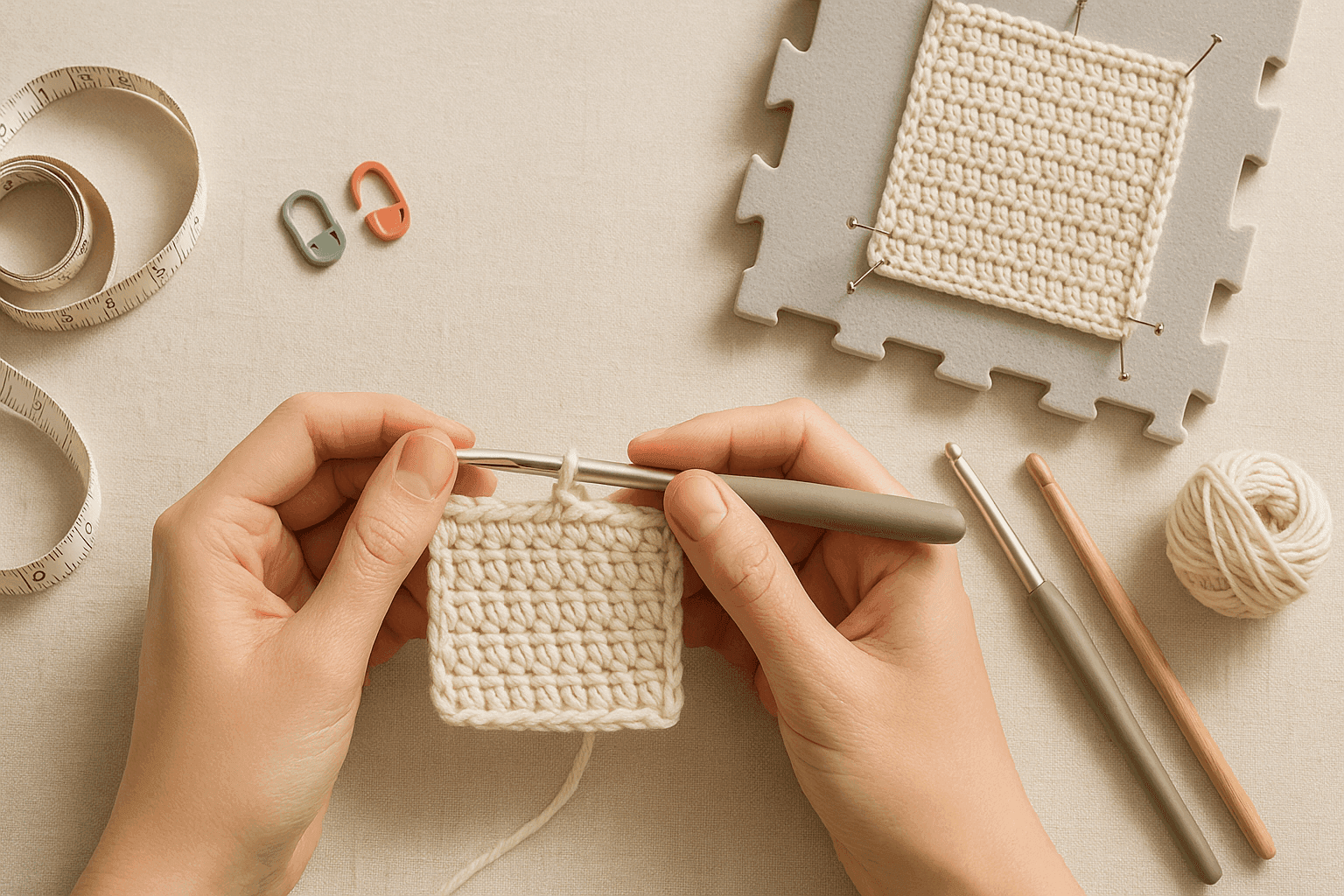
Why tension matters (and why it can feel so mysterious)
Tension is the invisible “handwriting” in crochet: the way you hold yarn, angle your hook, and form loops determines stitch size, fabric density, drape, and even how a piece wears over time. Two crocheters can follow the same pattern with the same yarn and hook, yet end up with projects that differ by several inches. That difference is usually tension.
In practical terms, tension influences:
- Gauge (stitches and rows per inch/cm)
- Drape and stiffness (how fluid vs. board‑like a fabric feels)
- Shape and fit (especially in garments, hats, and amigurumi)
- Colorwork clarity (stranded work, mosaic, tapestry)
- Edge quality (waviness, cupping, flare)
- Consistency across motifs and panels
The good news: tension is not a fixed trait you either “have” or “don’t.” It’s a set of habits and variables you can observe, adjust, and standardize—without losing your personal style.
What “tension” actually is: the mechanics behind the loops
In crochet, each stitch is built from loops: the loop on your hook, yarn overs, and pulled‑through loops. Tension is the combination of:
- Loop size on the hook: how tall the working loop is before completing a stitch.
- Yarn feed resistance: how easily yarn slides from your hand or tensioning method.
- Pulling force: how hard you tug after completing a stitch or row.
- Hook-to-yarn relationship: hook diameter, head shape, and finish interacting with yarn thickness and texture.
- Stitch anatomy: where you insert the hook (top loops, back loop only, post stitches) and how you draw up loops.
A useful way to think about it: most stitch size is set when you draw up the loop (especially for single crochet and the first pull-up in taller stitches). If you consistently draw up loops to the same height and avoid “yanking” them tight, your stitches become more uniform.
The “golden rule” of loop size
Aim to let the loop on your hook match the shaft diameter of the hook, not the narrow neck near the head. Many uneven tension issues come from working on the tapered part of the hook instead of the full shaft.
Common tension problems and what they look like
Even experienced crocheters run into tension quirks, especially when changing yarns, hooks, or techniques.
1) Tight tension
Signs:
- Stiff fabric, little drape
- Hook struggles to enter stitches
- Hands fatigue quickly
- Edges curl or corners pull inward
Common causes:
- Working on the hook’s taper instead of the shaft
- Pulling yarn too hard when tightening the working loop
- Gripping hook tightly (often from fear of “loose” stitches)
Fixes:
- Size up your hook (often 0.5–1.0 mm makes a noticeable difference)
- Consciously lift the working loop to the shaft before each yarn over
- Relax your grip; try holding hook further back on the handle
2) Loose tension
Signs:
- Gaps between stitches (unwanted holes)
- Fabric looks sloppy or uneven
- Amigurumi stuffing shows through
- Edges flare or ripple
Common causes:
- Over‑tall pull-up loops
- Yarn not controlled (no consistent feed resistance)
- Switching between projects/techniques without recalibration
Fixes:
- Size down hook or tighten yarn feed slightly
- Practice keeping pull-up loop height consistent
- For amigurumi: choose a hook 1–2 sizes smaller than the yarn label suggests, and use a firm stitch like single crochet in continuous rounds
3) Uneven tension within the same project
Signs:
- First rows differ from later rows
- One side of a rectangle is tighter
- Motifs don’t match size
Common causes:
- Starting chain too tight
- Tension changes when tired, stressed, or crocheting in a different posture
- Different stitch types (e.g., rows of sc vs. dc) worked with inconsistent loop height
Fixes:
- Use a larger hook for the foundation chain, or use a foundation stitch (e.g., foundation single crochet / foundation double crochet)
- Take “tension breaks,” stretch hands, reset posture
- Block and measure swatches at multiple stages
Yarn properties that affect tension (and why your “usual hook” may fail)
Yarn is not a uniform material. Fiber content, spin, ply, and surface finish all change how yarn flows through your hands and over the hook.
Fiber content
- Wool: springy and elastic, often forgiving—stitches bounce back; can mask minor inconsistencies.
- Cotton: low elasticity; shows every tension wobble; can feel “splitty” and may encourage tighter stitching.
- Acrylic: varies widely; often smooth and consistent; can be slippery or squeaky depending on finish.
- Silk, bamboo, rayon/viscose: slippery with high drape; stitches may loosen as fabric hangs.
Ply and twist
- High twist yarns can feel wiry and resist sliding, pushing you toward looser loops.
- Low twist or single‑ply can flatten and fuzz, sometimes leading to tighter gripping and less stitch definition.
Texture and halo
- Mohair/halo yarns create friction; ripping back can be difficult; tension must be consistent from the start.
- Chenille/velvet yarns compress; stitches can “sink,” and gauge can shift after handling.
Practical takeaway: Expect to recalibrate tension when switching yarns. Make a quick swatch (even 10–15 minutes) to save hours of reworking.
Hook choice: not just size, but shape and material
Two hooks labeled the same size can behave differently.
Hook head shape
- Inline (Bates-style): often helps consistent loop sizing; some find it reduces splitting.
- Tapered (Clover-style): can be faster and smoother for many; may encourage working on the taper if you’re not mindful.
Hook material
- Aluminum: smooth, fast, can increase looseness for slippery yarns.
- Wood/bamboo: more grip; can help control slippery fibers but may slow you down.
- Plastic/resin: varies; can create drag with some acrylics.
If you’re chasing consistent tension, try experimenting with the same size hook in two materials and see how your loop height changes.
The foundation chain: the most common source of tension trouble
A too‑tight starting chain is behind many “my edge is shrinking” problems.
Solutions that actually work
- Use a larger hook for the chain, then switch to pattern hook for row 1.
- Chain loosely with intention: pause and check that each chain loop can slide comfortably on the hook shaft.
- Use foundation stitches:
- Foundation Single Crochet (FSC)
- Foundation Double Crochet (FDC)
Foundation stitches build the chain and first row together, creating an edge with more elasticity and often more consistent gauge—especially in garments and blankets.
Gauge: how tension becomes measurable
Gauge is the bridge between your personal tension and the designer’s intended dimensions.
How to swatch like it matters
- Make a swatch larger than 4 in / 10 cm—aim for 5–6 in so you can measure the center.
- Use the exact stitch pattern called for (including lace repeats, post stitches, etc.).
- Block the swatch the same way you’ll block the finished item.
Measuring gauge accurately
- Count stitches across 4 in / 10 cm in the middle.
- Count rows too (row gauge affects length, sleeve depth, yoke shaping).
If your gauge is off
- Too many stitches per inch (tight): go up a hook size.
- Too few stitches per inch (loose): go down a hook size.
If changing hook size ruins fabric quality (e.g., makes lace too tight or too open), consider changing yarn or choosing a different size in the pattern.
Practical techniques to improve tension consistency
These strategies help at every skill level.
1) Standardize your yarn feed method
Common holds:
- Yarn over index finger with one wrap
- Yarn woven through fingers
- Yarn held with a tension ring
Pick one method and stick with it for a project. Consistency beats complexity.
Tip: If you’re a tight crocheter, reduce wraps or loosen finger spacing. If you’re loose, add one wrap or guide yarn through one more finger.
2) Calibrate the working loop
Before every stitch, glance at the loop on your hook:
- If it’s tiny and hugging the throat, lift it up to the shaft.
- If it’s overly tall, gently snug it to shaft diameter—don’t choke it tight.
3) Use the “pause and place” rhythm
Many uneven stitches happen when you rush the insert/yarn over/pull through steps. A steadier rhythm:
- Insert hook
- Yarn over
- Pull up loop to shaft height (pause)
- Complete stitch
That micro‑pause is often enough to standardize loop height.
4) Count turning chains as design, not afterthought
Turning chains affect edge tension. If you yank the turning chain tight, your edge will pull in.
- For sc rows, consider ch 1, do not count as a stitch (common approach) and place first sc into the first stitch.
- For dc rows, patterns vary (ch 2 or ch 3, may count). If edges gap, consider a chainless starting dc (stacked sc method) for cleaner tension.
5) Use stitch markers for edge stitches
Place markers in the first and last stitch of each row (or every few rows). This prevents accidentally skipping stitches—a problem often mistaken for tension issues.
Tension in the round: amigurumi, hats, and circular yokes
Crocheting in the round introduces spirals, joins, and continuous tension shifts.
Amigurumi tension essentials
- Use a smaller hook than recommended to avoid gaps.
- Prefer tight, even single crochet with consistent pull-up loops.
- Learn the invisible decrease (invdec) to maintain smooth tension and surface.
Troubleshooting stuffing show-through:
- Smaller hook
- Tighter yarn feed
- Change stuffing color (white stuffing under dark yarn shows more)
- Add an inner lining (for large plush)
Hats: elasticity and negative ease
Hats often rely on negative ease (finished hat smaller than head circumference). If your tension changes, fit changes.
- Ribbing (back loop only sc/hdc) is very tension-sensitive.
- If the hat brim flares, you may be crocheting too loosely or adding too many increases.
- If it rides up, your tension may be too tight or ribbing too short.
Circular yokes and doilies: managing ripple vs. cup
Flat circles follow a mathematical relationship between stitch height and increase rate. If your circle cups, you need more increases; if it ripples, fewer.
However, tension can mimic math problems:
- Tight tension can cause cupping even with correct increases.
- Loose tension can cause rippling.
Before rewriting the pattern, test a swatch circle with a hook size change.
Colorwork tension: mosaic, tapestry, and stripes
Color changes add friction and can tighten your fabric.
Tapestry crochet (carrying yarn)
Common issue: carried yarn pulls tight, causing the piece to narrow.
Fixes:
- Lay carried yarn along the top of the previous row without tension.
- Periodically stretch the fabric widthwise as you work to check for puckering.
- Consider going up a hook size.
Stripes and jogs
Even if tension is perfect, color changes in continuous rounds create a jog. Methods like jogless joins improve visual continuity but can also affect stitch height slightly—keep your tension gentle and consistent at join rounds.
Blocking: the final tension adjustment tool
Blocking doesn’t “fix” everything, but it can refine stitch appearance and help fabric relax into its intended dimensions.
- Wet blocking (soak and pin) works well for wool and many natural fibers.
- Steam blocking can help acrylic (careful: too much heat can “kill” acrylic and change drape permanently).
- Spray blocking is gentler, useful for delicate items.
Blocking can even out minor tension differences, open lace, and straighten edges—but it won’t correct major gauge mismatch.
Pattern examples to practice tension (with what to watch for)
Below are mini “practice patterns” you can use as tension labs. They’re simple on purpose.
1) Tension sampler square (great for all levels)
Goal: learn how sc, hdc, and dc change height and density with your personal tension.
Materials: any worsted/aran yarn; hook size suggested by yarn label.
Pattern (make a square swatch):
- Ch 26.
- Row 1: Sc in 2nd ch from hook and across (25 sc). Ch 1, turn.
- Rows 2–8: Sc across (25 sc). Ch 1, turn.
- Rows 9–15: Hdc across (25 hdc). Ch 2, turn.
- Rows 16–22: Dc across (25 dc). Ch 2 or 3 per your preference, turn.
What to observe:
- Does the swatch widen or narrow as you change stitch type?
- Are your dc rows significantly looser than sc rows? Many crocheters unconsciously increase loop height in taller stitches.
Adjustment drill: redo only the dc section, focusing on drawing up loops to the same shaft height each time.
2) Foundation edge practice (for tight chainers)
Goal: compare a standard chain start to foundation stitches.
Make two strips:
- Strip A: chain + row 1 in sc.
- Strip B: foundation single crochet to same stitch count.
What to observe:
- Which edge stretches more?
- Which lies flatter?
If Strip A bows, your chain tension is likely tighter than your stitch tension.
3) Simple beanie gauge test (for practical fit)
Goal: convert gauge to a real object.
- Swatch in the stitch pattern you’ll use (e.g., hdc in rounds or sc in BLO rib).
- Calculate stitches per inch/cm.
- Multiply by head circumference minus negative ease (typically 1–2 in / 2.5–5 cm).
What to observe:
- If your hat is too tight even when math is right, your fabric may lack elasticity due to tight tension or fiber choice (cotton hats often feel tighter).
Troubleshooting guide (quick diagnosis)
Problem: Edges are wavy in a rectangle
Likely causes: too many stitches, inconsistent turning chain, or uneven tension at row ends.
Try:
- Count stitches every row.
- Use markers in first/last stitch.
- Use chainless starting stitches for dc.
Problem: Blanket corners curl or won’t lie flat
Likely causes: tight tension at corners, too few corner stitches, or tight foundation chain.
Try:
- Add the corner stitch count specified (often 3 dc, ch 2, 3 dc in the corner space).
- Work corners a touch looser.
- Block aggressively with pins.
Problem: Motifs don’t match size
Likely causes: tension drift between sessions, different hook brand/material, or subtle yarn changes.
Try:
- Use the same hook and keep it with the project.
- Measure each motif after blocking.
- If needed, adjust hook size for later motifs to match finished dimensions.
Problem: Hands hurt, forearms ache
Likely causes: tight tension, death grip, repetitive strain.
Try:
- Move to ergonomic hook handle.
- Crochet in shorter sessions.
- Loosen yarn feed; consciously relax shoulders.
- Consider checking guidance from occupational therapy resources on handcraft ergonomics.
Building a personal “tension toolkit”
Crocheters who get consistently professional results often do a few boring-sounding things really well.
Keep notes
Write down:
- Yarn brand, fiber content, and lot
- Hook brand and size
- Your measured gauge after blocking
- Any modifications (hook size up for chain, etc.)
Use a “calibration swatch”
Some crocheters maintain a small reference swatch in a go-to yarn (like a standard worsted acrylic). If your tension feels off, crochet a few rows and compare to your usual fabric density.
Accept that tension changes with context
Tension can change with:
- Time of day
- Stress level
- Temperature (cold hands often tighten)
- Posture and seating
If you notice drift, pause and reset rather than pushing through.
Expert-aligned principles (without getting dogmatic)
While crochet doesn’t have a single governing body for technique, a few widely taught principles show up across reputable design and education sources (e.g., Craft Yarn Council guidance on gauge and standards, and common best practices taught in pattern writing):
- Gauge swatching and measuring the center is crucial.
- Consistent loop height is the foundation of even stitches.
- Hook size is a tool, not a moral judgment—changing it is normal.
- Fiber behavior (elasticity, drape, memory) affects finished measurements.
Treat your tension as adjustable engineering rather than a personal flaw.
A practical step-by-step plan to improve tension in two weeks
If you want an actionable path, here’s a simple schedule.
Days 1–3: Observe
- Crochet 10 minutes of sc rows.
- Watch your loop height and how often you re-grip the yarn.
- Note where stitches get tighter (often row ends or decreases).
Days 4–7: Standardize
- Choose one yarn hold method.
- Practice the “pause and place” rhythm.
- Try one hook size up and one size down; label swatches.
Days 8–10: Apply to a small project
Make something small but real (mug cozy, headband, granny square pouch). Focus on consistency, not speed.
Days 11–14: Calibrate for a pattern
- Swatch for a garment or fitted hat.
- Block and measure.
- Adjust hook size and re-swatch if needed.
After two weeks, many crocheters find their tension is not only more even, but also more predictable—meaning patterns become less frustrating.
Final thoughts: consistent tension is a skill you can build
Perfect tension isn’t about crocheting tightly or loosely—it’s about crocheting intentionally and repeatably. Once you learn how yarn properties, hook choice, loop height, and hand posture interact, you can diagnose issues quickly and make smart adjustments.
If you take only one idea from this: set your stitch size with the pull-up loop, and let the loop rest on the hook shaft. That single habit resolves a surprising number of uneven tension problems—and makes every project look more polished.